


World's Top 10 Petrochemical Companies
World's Top 10 Petrochemical Companies
The global petrochemical industry has entered one of its most consequential structural transition periods in decades. As reported by the NAVADHI Global Petrochemical Market Strategic Research Report 2026–2031 (Publication ID: NAV0326006, March 27, 2026), the global petrochemical market was valued at USD 582 billion in 2025 and is projected to grow at a CAGR of 5.53% to reach USD 803.3 billion by 2031. This growth trajectory, however, is being dramatically reshaped by the 2026 Iran War and the resulting disruption to the Strait of Hormuz — through which a significant portion of global petrochemical trade flows — causing polymer prices to surge approximately 40% in some markets and packaging costs to rise over 20% due to polyethylene and polypropylene inflation.
The ten companies profiled in this report collectively represent the apex of global petrochemical production, spanning the full chemical value chain from upstream naphtha cracking and ethylene production through to specialty polymers, performance materials, and agricultural chemicals. Sinopec, the world's largest integrated petrochemical company by total revenue (USD 422.7 billion in 2024), towers above all peers, while BASF, Dow, LyondellBasell, SABIC, and ExxonMobil Chemical form a cohesive tier of Western producers with revenues in the USD 22–70 billion range. Reliance Industries of India occupies a unique position as the only non-OECD company in this second tier, with its Oil-to-Chemicals (O2C) segment generating approximately USD 23.5 billion in revenue as part of a USD 119.8 billion group.
Ethylene and propylene together account for approximately 46% of the global petrochemical market in 2025, cementing their position as the foundational olefins underpinning downstream plastics, resins, and chemical intermediates. Methanol is the fastest-growing named segment at a CAGR of 6.2%, reflecting rising demand for methanol-to-olefins routes in China and methanol's emerging dual role as a marine fuel and hydrogen carrier. The structural shift from commodity to specialty petrochemicals is the defining strategic trend: as the NAVADHI report identifies, specialty and high-performance polymer premiumisation is one of nine key growth drivers, with the 'Others' specialty chemicals category growing fastest at 6.4% CAGR.
Asia-Pacific dominates the global petrochemical landscape and maintains its leadership through the forecast period, with China as both the world's largest consumer and fastest-growing producer of commodity petrochemicals. The Iran War supply shock — creating a structural shift from oversupply-driven margin pressure to supply-constrained inflationary conditions — has reshuffled the competitive advantage landscape, benefiting producers with low-cost North American shale gas feedstocks (Dow, ExxonMobil Chemical, LyondellBasell) and Middle East crude-to-chemicals integration (SABIC) while further stressing European energy-cost disadvantaged producers (BASF, INEOS).
Top 10 at a Glance
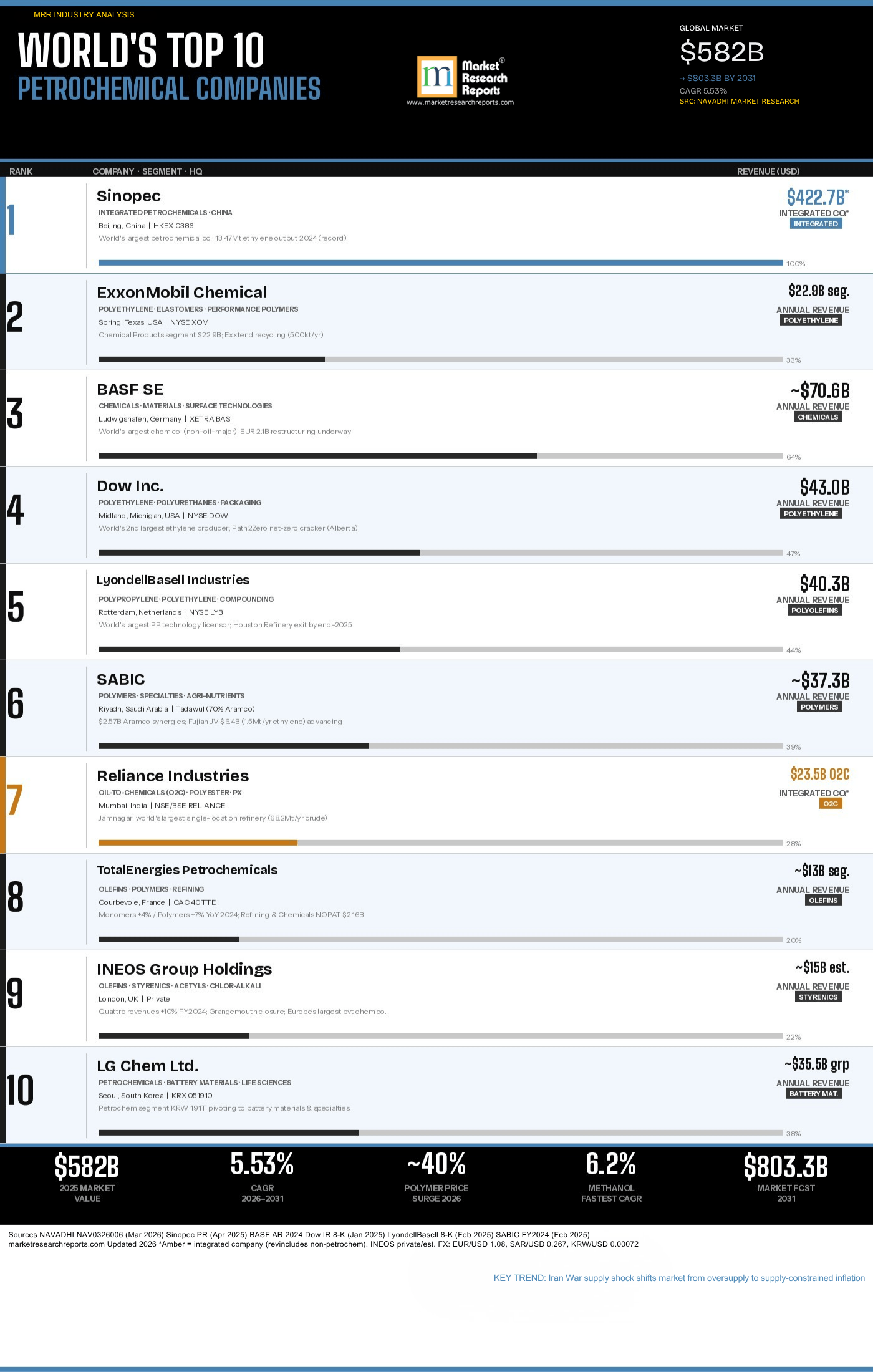
Rank | Company | HQ | Key Segment | Est. Revenue (USD) |
|---|---|---|---|---|
| 1 | Sinopec (China Petroleum & Chemical) | Beijing, China | Integrated Petrochemicals | ~$422.7B (2024, IFRS) |
| 2 | ExxonMobil Chemical (ExxonMobil Corp.) | Spring, Texas, USA | Chemical Products | ~$22.9B segment / $339B group |
| 3 | BASF SE | Ludwigshafen, Germany | Integrated Chemicals & Materials | ~$70.6B (EUR 65.3B, 2024) |
| 4 | Dow Inc. | Midland, Michigan, USA | Polyethylene, Specialty Plastics | ~$43.0B (2024, SEC) |
| 5 | LyondellBasell Industries N.V. | Rotterdam, Netherlands | Polyolefins, Refining, Compounding | ~$40.3B (2024, SEC) |
| 6 | SABIC (Saudi Basic Industries Corp.) | Riyadh, Saudi Arabia | Polymers, Chemicals, Agri-Nutrients | ~$37.3B (SAR 140B, 2024) |
| 7 | Reliance Industries Limited | Mumbai, India | Oil-to-Chemicals (O2C) | ~$119.8B group / $23.5B O2C |
| 8 | TotalEnergies Petrochemicals | Courbevoie, France | Olefins, Polymers, Refining | ~$13B segment / $225B group |
| 9 | INEOS Group Holdings | London, UK | Olefins, Styrenic Polymers | ~$15B est. (pvt, 2024) |
| 10 | LG Chem Ltd. | Seoul, South Korea | Petrochemicals, Battery Materials | ~$35.5B (KRW 48.9T, 2024) |
* Revenue figures represent group total unless noted as segment-specific. Sinopec and Reliance revenues include significant non-petrochemical segments (refining, retail, telecom). ExxonMobil Chemical segment revenue ($22.9B) is a subset of ExxonMobil group ($339B). INEOS is private; revenue estimated from production volumes and third-party sources. All USD figures; non-USD revenues converted at approximate 2024 average FX rates. Source: NAVADHI NAV0326006; company SEC/annual report filings.
Global Market Statistics
- Global petrochemical market value (2025): USD 582 billion (source: NAVADHI NAV0326006)
- Projected market size by 2031: USD 803.3 billion
- Market CAGR (2026–2031): 5.53%
- Largest segment by type: Ethylene (27.8% market share, 5.5% CAGR)
- Fastest-growing segment by type: Methanol (6.2% CAGR; MTO capacity + marine fuel demand)
- Fastest-growing application: Aerospace (7.1% CAGR, 2% market share in 2025)
- Second-fastest application: Pharmaceuticals & Healthcare (6.8% CAGR)
- Automotive & EVs petrochemical CAGR: 6.3% (battery separators, lightweighting composites)
- Dominant region: Asia-Pacific; fastest-growing regions: Latin America and Middle East & Africa
- Iran War impact: Polymer prices up ~40%; packaging costs up 20%+ (PE/PP); Hormuz Strait disruption 2026
- Packaging: largest application segment at 35% of market (2025), growing at 5.2% CAGR
- Structural mix-shift to specialties: 'Others' segment CAGR 6.4%, share rising from 18.6% to 19.5% by 2031
Company Profiles
1. Sinopec (China Petroleum & Chemical Corporation)
China Petroleum & Chemical Corporation, universally known as Sinopec, is the world's largest petrochemical company by revenue and China's largest oil refiner and chemical producer. Established in 2000 through the restructuring of the former Sinopec Group, the company is listed on the Hong Kong, Shanghai, and New York stock exchanges, with the Chinese government retaining majority control through Sinopec Group. Sinopec operates an extraordinarily integrated value chain spanning upstream oil and gas exploration, crude oil refining, petrochemical manufacturing, and retail fuel distribution through approximately 30,000 service stations across China. Its petrochemical operations produce virtually the full portfolio of commodity chemicals: ethylene, propylene, PX (paraxylene), PTA, polyethylene, polypropylene, synthetic rubber, acrylonitrile, and hundreds of downstream derivatives.
Sinopec disclosed operating revenue of RMB 3.07 trillion (USD 422.7 billion) for 2024, with profit attributable to shareholders of RMB 48.94 billion (USD 6.74 billion), in accordance with IFRS. In terms of chemical production scale, Sinopec produced 13.47 million tonnes of ethylene in 2024 — a record high — while total chemical product sales volume reached 83.45 million tonnes, with export volume growing 13.1% year-on-year. PX production also hit a record high in 2024. The company's 2024 results confirm its unchallenged position as the world's largest petrochemical company by volume and revenue. Sinopec's scale confers unrivalled feedstock optimization advantages across its 29 refineries and integrated chemical complexes.
- HQ: Beijing, China (listed: HKEX 0386, SSE, NYSE ADR)
- 2024 Revenue: USD 422.7B (RMB 3.07T, IFRS, verified via PRNewswire April 1, 2025)
- Key Products: Ethylene (13.47Mt), PX, PE, PP, PTA, synthetic rubber, acrylonitrile, fertilizers
- Segments: Exploration & Production, Refining, Marketing & Distribution, Chemicals, Corporate
- 2026 Update: Record ethylene output 13.47Mt; chemical exports +13.1%; PX production at record high
2. ExxonMobil Chemical (ExxonMobil Corporation)
ExxonMobil Chemical is the chemical products division of ExxonMobil Corporation (NYSE: XOM), one of the world's largest publicly traded oil and gas companies. Headquartered in Spring, Texas, ExxonMobil Chemical operates through the broader 'Product Solutions' division and focuses on performance polymers, commodity chemicals, and advanced materials. Its product portfolio spans polyethylene, polypropylene, specialty elastomers (Vistamaxx, Santoprene), synthetic lubricant base stocks (PAO, synthetic fluids), benzene, paraxylene, and a comprehensive range of packaging, automotive, and medical-grade performance polymers. ExxonMobil Chemical differentiates through its proprietary metallocene catalyst technology and its global network of world-scale integrated crackers co-located with refineries to maximize feedstock optimization.
ExxonMobil reported full-year 2024 total revenues and other income of USD 349.6 billion (sales and other operating revenue of USD 339.2 billion), with Chemical Products segment earnings of USD 2.6 billion — an increase of USD 940 million versus 2023 reflecting improved margins. The Chemical Products segment generated approximately USD 22.9 billion in revenue in 2024. ExxonMobil is executing a major USD 20 billion advanced recycling and circular economy strategy, including its Baytown, Texas chemical recycling facility (Exxtend technology), which will process over 500,000 tonnes per year of plastic waste into petrochemical feedstocks. The company is also advancing its Gulf Coast plastics complex, adding significant ethylene and polyethylene capacity.
- HQ: Spring, Texas, USA (listed: NYSE XOM)
- 2024 Revenue: USD 22.9B (Chemical Products segment); USD 339.2B group (SEC Form 8-K, Jan 2025)
- Key Products: Polyethylene, polypropylene, Vistamaxx/Santoprene elastomers, PX, benzene, PAO lubricants
- Segments: Upstream, Energy Products, Chemical Products, Specialty Products
- 2026 Update: Exxtend chemical recycling (Baytown, 500kt/yr); Gulf Coast growth project advancing
3. BASF SE
BASF SE, headquartered in Ludwigshafen, Germany, is the world's largest chemical company by a broad measure of chemical production diversity, and the largest non-integrated (non-oil-major) chemical company globally. Founded in 1865, BASF operates on the Verbund principle — a highly integrated production network where byproducts of one process become feedstocks for another — at its Ludwigshafen site, the world's largest integrated chemical complex. BASF's product portfolio is extraordinarily broad: basic chemicals, performance materials, functional materials, surface technologies (coatings, catalysts), nutrition & care ingredients, and agricultural solutions (crop protection and seeds under the BASF Agricultural Solutions brand). This diversity distinguishes BASF from more focused polyolefin producers like Dow and LyondellBasell.
BASF generated sales of EUR 65.3 billion (approximately USD 70.6 billion at 2024 average EUR/USD rates) for the full year 2024, a decline of approximately 5.3% from EUR 68.9 billion in 2023, reflecting continued pressure from high European energy costs and weak demand in automotive and construction end markets. EBITDA before special items was EUR 7.9 billion for 2024. BASF has been executing a major restructuring since 2023, including the announcement in February 2024 of plans to permanently reduce its cost base by EUR 2.1 billion by end-2026, involving significant workforce reductions at its Ludwigshafen headquarters. The company is advancing its 'China-for-China' strategy, having committed USD 10 billion to build a new fully integrated Verbund site in Zhanjiang, Guangdong Province.
- HQ: Ludwigshafen, Germany (listed: Frankfurt XETRA BAS)
- 2024 Revenue: ~USD 70.6B (EUR 65.3B; verified, BASF press release Jan/Feb 2025)
- Key Products: Isocyanates (MDI, TDI), polyamides, acrylic acid, performance polymers, coatings, catalysts
- Segments: Chemicals, Materials, Industrial Solutions, Surface Technologies, Nutrition & Care, Agricultural Solutions
- 2026 Update: EUR 2.1B cost reduction by 2026; USD 10B Zhanjiang Verbund site (China) under construction
4. Dow Inc.
Dow Inc., headquartered in Midland, Michigan, was created in 2019 when DowDuPont separated into three independent companies (Dow, DuPont, and Corteva). As a standalone chemical company focused on plastics, packaging, and specialty chemicals, Dow is the world's second-largest ethylene producer and the leading producer of polyethylene — the world's highest-volume plastic used in packaging, pipes, films, and consumer goods. Dow's three principal segments are Packaging & Specialty Plastics (the largest, accounting for approximately 50% of revenues), Industrial Intermediates & Infrastructure (polyurethane systems, epoxies, industrial coatings), and Performance Materials & Coatings (silicones, coatings intermediates). The ethylene value chain represents approximately 60% of Dow's total sales base, consistent with the NAVADHI report's characterisation.
Dow reported full-year 2024 net sales of USD 43.0 billion, a decline of approximately 4% from USD 44.6 billion in 2023, reflecting lower polyethylene prices across most regions. GAAP net income was USD 1.2 billion, up from USD 660 million in 2023, while operating EBIT was USD 2.6 billion. Despite the revenue decline, Dow advanced its Path2Zero program — a landmark initiative to build the world's first net-zero carbon emissions ethylene cracker complex in Fort Saskatchewan, Alberta (in partnership with the Canadian government, receiving USD 600 million in federal support). The company also implemented aggressive price hikes in response to the Iran War polymer inflation of 2026, positioning it to benefit from the supply-constrained environment.
- HQ: Midland, Michigan, USA (listed: NYSE DOW)
- 2024 Revenue: USD 43.0B (verified, SEC Form 8-K / Dow IR, January 2025)
- Key Products: Polyethylene (LDPE, HDPE, LLDPE), polyurethanes, silicones, ethylene oxide, coatings resins
- Segments: Packaging & Specialty Plastics, Industrial Intermediates & Infrastructure, Performance Materials & Coatings
- 2026 Update: Path2Zero net-zero cracker (Alberta); aggressive PE price hikes on Iran War PE inflation
5. LyondellBasell Industries N.V.
LyondellBasell Industries N.V., incorporated in the Netherlands and headquartered in Rotterdam (with operational headquarters in Houston, Texas), is the world's largest licensor of polyolefin technology and a leading producer of polypropylene, polyethylene, and advanced polymer solutions. Formed through the 2007 merger of Lyondell Chemical and Basell Polyolefins, LyondellBasell operates one of the most technologically advanced polyolefin businesses in the world, with its Spheripol (polypropylene), Lupotech (HDPE), and Hostalen (HDPE) process technologies licensed to over 110 plants globally. In addition to polyolefins, LyondellBasell operates a substantial refining business (Houston Refinery, one of North America's largest), and a compounding business (Advanced Polymer Solutions) focused on high-performance plastic compounds for automotive, building, and consumer applications.
LyondellBasell reported full-year 2024 revenues of USD 40.3 billion, a modest decline of approximately 2% from USD 41.1 billion in 2023, with EBITDA declining due to margin compression in the Olefins & Polyolefins Americas and Europe segments. The company progressed its strategic transition, announcing the permanent closure of its Houston refinery by the end of 2025 — a strategic exit from the lower-margin refining business to focus capital on higher-value chemicals and circular economy investments. LyondellBasell is a leader in chemical recycling, advancing its MoReTec molecular recycling technology, and has committed to incorporating 2 million tonnes per year of recycled and renewable-based plastics into its product portfolio by 2030.
- HQ: Rotterdam, Netherlands / Houston, Texas (listed: NYSE LYB)
- 2024 Revenue: USD 40.3B (verified, SEC Form 8-K, LyondellBasell IR, February 2025)
- Key Products: Polypropylene, polyethylene, Catalloy resins, PO/TBA, methanol, butanediol
- Segments: O&P Americas, O&P Europe/Asia/International, Intermediates & Derivatives, Advanced Polymer Solutions, Refining
- 2026 Update: Houston Refinery closure by end-2025; MoReTec chemical recycling advancing; 2Mt/yr recycled plastic target by 2030
6. SABIC (Saudi Basic Industries Corporation)
Saudi Basic Industries Corporation (SABIC), headquartered in Riyadh and 70% owned by Saudi Aramco since 2020, is the largest non-Chinese petrochemical company in the Middle East and one of the world's most strategically positioned chemical producers. Founded in 1976 by royal decree, SABIC was established to monetize Saudi Arabia's abundant hydrocarbon feedstocks — ethane and propane extracted as byproducts of oil and gas production — which provide an inherent feedstock cost advantage versus naphtha-based European and Asian producers. SABIC operates manufacturing facilities across the Kingdom of Saudi Arabia, Europe (Netherlands, Germany, Spain, UK), the Americas, and Asia, producing a full portfolio of petrochemicals, polymers, fertilizers, and metals.
SABIC reported full-year 2024 revenues of SAR 139.98 billion (approximately USD 37.3 billion at 2024 average SAR/USD rate of 3.75), a decline of 1% year-on-year despite a 1% increase in average selling prices, as sales volumes dropped 2% to 45.1 million metric tonnes. Profit rebounded to SAR 1.54 billion (USD 410 million), a significant turnaround from the SAR 2.77 billion loss in 2023. Operating income jumped 54% to SAR 5.74 billion, driven by a 16% rise in gross profit. SABIC has achieved USD 2.57 billion in cumulative synergy value realization from its Aramco integration to date. Key growth projects include the USD 6.4 billion Fujian Petrochemical Complex in China (in JV with Sinopec and Fujian Petrochemical), which will produce 1.5 million tonnes of ethylene per year upon completion.
- HQ: Riyadh, Saudi Arabia (listed: Tadawul SABIC; 70% owned by Saudi Aramco)
- 2024 Revenue: ~USD 37.3B (SAR 139.98B at 3.75 SAR/USD; verified, SABIC full-year 2024 results Feb 2025)
- Key Products: Polyethylene, polypropylene, MEG, PET, methanol, specialty resins (ULTEM, Noryl), agri-nutrients
- Segments: Petrochemicals, Specialties, Agri-Nutrients, Metals
- 2026 Update: USD 6.4B Fujian (China) cracker JV; USD 2.57B cumulative Aramco synergies; 135 new products in 2024
7. Reliance Industries Limited
Reliance Industries Limited (RIL), headquartered in Mumbai and founded by Dhirubhai Ambani in 1966, is India's largest company by revenue and market capitalisation, and the country's pre-eminent integrated petrochemical and refining company. RIL's Oil-to-Chemicals (O2C) segment — which encompasses refining, petrochemicals, and fuel retailing — is built around its Jamnagar refinery complex in Gujarat, the world's largest single-location refining complex with combined crude processing capacity of approximately 68.2 million tonnes per year. The petrochemical value chain at Jamnagar produces a comprehensive portfolio: ethylene, propylene, PX, MEG, PTA, polyester, polypropylene, polyethylene, acrylics, and specialty chemicals. Downstream, RIL operates one of the world's largest integrated polyester and specialty chemicals businesses.
RIL reported total income of INR 9,98,114 crore (approximately USD 119.8 billion) for FY2025 (April 2024–March 2025), with O2C segment revenue of approximately INR 1,64,613 crore (approximately USD 19.7 billion in Q4 FY25 alone, full year approximately USD 23.5 billion). The O2C segment experienced margin compression in FY2025 due to weak chemical deltas and fuel crack spreads in a globally oversupplied environment — consistent with the NAVADHI report's identification of structural China-driven overcapacity as a key pain area. However, RIL's integration with its retail (Reliance Retail, the largest retailer in India) and digital services (Jio, the largest telecom network in India) makes it uniquely positioned to monetize its chemical outputs in India's rapidly growing consumer market.
- HQ: Mumbai, Maharashtra, India (listed: NSE/BSE RELIANCE)
- FY2025 Revenue: ~USD 119.8B group (INR 9,98,114 Cr); O2C segment ~USD 23.5B
- Key Products: Polyester (PET, PTA, MEG), polypropylene, polyethylene, PX, acrylics, specialty chemicals
- Segments: Oil to Chemicals (O2C), Oil & Gas Exploration, Retail, Digital Services (Jio)
- 2026 Update: World's largest single-location refinery (Jamnagar, 68.2Mt/yr); O2C margins under pressure from chemical deltas
8. TotalEnergies Petrochemicals (TotalEnergies SE)
TotalEnergies SE, headquartered in Courbevoie, France, is one of the world's largest integrated energy and chemicals companies, with petrochemical operations managed through its Refining & Chemicals business segment. TotalEnergies Petrochemicals produces olefins (ethylene, propylene), polymers (polyethylene, polypropylene), specialty chemicals, and elastomers through a network of crackers and downstream plants in Europe (Belgium, France, Germany, Netherlands), the Middle East (Saudi Arabia through JVs with Saudi Aramco), and Asia. Its steam crackers in Belgium (Antwerp, Feluy) and France (Carling, Gonfreville) are among the largest in Europe, while its Middle East joint ventures — including PetroRabigh with Saudi Aramco — give it access to low-cost Middle Eastern feedstocks.
TotalEnergies' Refining & Chemicals segment generated adjusted net operating income of USD 2.16 billion for 2024, with the segment's full year revenues in the range of USD 13 billion for the pure petrochemicals subsegment. The broader group reported full-year 2024 revenues of approximately USD 224–228 billion. In 2024, TotalEnergies produced approximately 9.5 million kilotonnes of monomers (olefins) and 8.6 million kilotonnes of polymers — both volume increases of 4–7% versus 2023, reflecting cracker optimization and new capacity ramp-up. TotalEnergies has been investing in circular economy initiatives, including the Borealis partnership and advanced chemical recycling projects across Europe, aligning with EU circular plastics mandates.
- HQ: Courbevoie, France (listed: Paris CAC 40 TTE; NYSE TTE ADR)
- 2024 Revenue: ~USD 13B (petrochemicals segment est.); USD ~225B group; Refining & Chemicals adj. NOPAT USD 2.16B
- Key Products: Ethylene, propylene, polyethylene, polypropylene, elastomers, specialty chemicals
- Segments: Exploration & Production, Integrated LNG, Integrated Power, Refining & Chemicals, Marketing & Services
- 2026 Update: Olefins production +4-7% YoY in 2024; advancing EU chemical recycling mandates; PetroRabigh JV (Saudi Arabia)
9. INEOS Group Holdings
INEOS Group Holdings, headquartered in London and founded in 1998 by Sir Jim Ratcliffe, is Europe's largest privately-owned chemical company and one of the world's top-15 chemical producers. Built through an aggressive acquisition strategy over 25 years — purchasing undervalued chemical assets from BP, ICI, Norsk Hydro, Degussa, and others — INEOS now operates over 36 manufacturing sites across Europe and North America, with a core product portfolio centred on olefins (ethylene, propylene), polyolefins, styrenic polymers (polystyrene, acrylonitrile-butadiene-styrene/ABS), acetyls, specialty chemicals, and chlorine/PVC. INEOS is the world's third-largest producer of ethylene in Europe and the operator of the Grangemouth refinery and chemical complex in Scotland.
INEOS Group is private and does not publish consolidated annual accounts. Based on its reported bond indenture filings and industry cross-references, INEOS Group's estimated total revenue for 2024 is approximately USD 14–16 billion, with its largest sub-group, INEOS Quattro (olefins & polyolefins), reporting revenues up 10% for full year 2024 driven by increased volumes. INEOS has been impacted by the European energy cost crisis — its Grangemouth refinery announced closure in 2024, with petrochemical operations at the site transitioning to an import terminal. Simultaneously, INEOS is investing in North American shale gas feedstock advantages through its US operations, seeking to leverage lower-cost ethane cracking relative to its European naphtha-based peers.
- HQ: London, United Kingdom (private; bond-issuing entity: INEOS Group Holdings S.A.)
- 2024 Revenue: ~USD 14–16B est. (private; INEOS Quattro bond filings; revenues +10% FY2024 YoY)
- Key Products: Ethylene, propylene, polyethylene, polypropylene, polystyrene, ABS, acetyls, chlorine/PVC
- Segments: Quattro (olefins), Styrolution (styrenics), Acetyls, Enterprises (specialty chemicals), Automotive
- 2026 Update: Grangemouth refinery closure 2024; Quattro revenues +10% YoY; pivoting to US ethane cracking advantage
10. LG Chem Ltd.
LG Chem Ltd., headquartered in Seoul, South Korea, is the largest chemical company in South Korea and a major global player spanning petrochemicals, advanced battery materials, life sciences, and specialty chemicals. Listed on the Korea Stock Exchange, LG Chem has undergone a profound strategic transformation since 2020: its battery materials subsidiary, LG Energy Solution (LGES), was partially listed in 2022 in the world's largest IPO of that year, and LG Chem retains approximately 82% of LGES. The petrochemicals segment — producing NCC (naphtha cracking centre) derived ethylene, propylene, butadiene, PE, PP, and acrylonitrile-butadiene-styrene (ABS) — competes alongside the battery materials and specialty chemicals segments within a rapidly diversifying corporate portfolio. LG Chem's ABS polymer business is among the top 3 globally.
LG Chem reported consolidated revenue of KRW 48.9161 trillion (approximately USD 35.5 billion at 2024 average KRW/USD of 1,380) for 2024, a decline of 11.46% year-on-year, with operating profit of KRW 916.8 billion (down 63.75%). Excluding LG Energy Solution, LG Chem's standalone revenue was approximately KRW 27.1 trillion (approximately USD 19.6 billion), of which the Petrochemicals segment contributed KRW 19.1 trillion (approximately USD 13.8 billion). The petrochemicals segment faced significant margin pressure from the China-driven commodity oversupply cycle, consistent with the NAVADHI report's structural overcapacity pain point. LG Chem is executing a strategic portfolio shift toward eco-friendly solutions, battery materials (cathode materials, separators), and life sciences to reduce dependence on commodity petrochemical cycles.
- HQ: Seoul, South Korea (listed: Korea Stock Exchange 051910)
- 2024 Revenue: ~USD 35.5B consolidated (KRW 48.9T); Petrochemicals segment ~USD 13.8B (KRW 19.1T)
- Key Products: Polyethylene, polypropylene, ABS, acrylonitrile, cathode materials (NCA, NCMA), battery separators
- Segments: Petrochemicals, LG Energy Solution (batteries), Advanced Materials, Life Sciences, Farm Hannong
- 2026 Update: Petrochems under China oversupply pressure; pivoting to battery materials and specialty chemicals for growth
Key Changes & Competitive Landscape Developments
- Iran War 2026 supply shock: Hormuz Strait disruption caused polymer prices to surge ~40% in some markets; the industry has shifted from oversupply-driven margin pressure to supply-constrained inflationary conditions — a fundamental structural change benefiting cost-competitive producers.
- Dow's Path2Zero cracker announcement: USD 2B+ net-zero carbon emissions cracker in Alberta (Canada) with USD 600M federal support — the world's first net-zero ethylene cracker — positions Dow at the frontier of decarbonised petrochemicals.
- BASF's EUR 2.1B cost restructuring: The deepest restructuring in BASF's history, involving permanent headcount reductions at Ludwigshafen and strategic withdrawal from commodity segments where the European energy cost disadvantage is structural.
- SABIC-Aramco synergy milestone: USD 2.57B in cumulative synergy value realised to date from the 2020 Aramco acquisition of 70% SABIC; Fujian JV (USD 6.4B, 1.5Mt/yr ethylene) advances Middle East crude-to-chemicals integration.
- LyondellBasell Houston Refinery closure: Exit from refining by end-2025 signals industry-wide trend of commodity rationalisation and capital reallocation to higher-value chemical recycling and specialty polymer businesses.
- Sinopec ethylene record (13.47Mt in 2024): China's domestic ethylene capacity growth is the primary driver of global commodity polymer oversupply — the structural pain point identified across NAVADHI's competitive analysis.
- LG Chem battery materials pivot: KRW 19.1T petrochemicals vs. KRW 25.6T LG Energy Solution in 2024 revenues — battery materials have surpassed petrochemicals as LG Chem's primary growth engine, signalling the EV-driven demand transformation.
Key Industry Trends
1. Geopolitical Bifurcation and Supply Chain Fracture
The Iran War of 2026 represents more than a price shock — it is accelerating a structural bifurcation of the global petrochemical supply chain into Western (US/Europe) and Eastern (China/Middle East) blocs. The disruption to the Strait of Hormuz — through which Saudi, Iranian, and UAE petrochemical exports transit — has forced importers to urgently diversify supply sources. US-China tariff escalation, already a significant inhibitor identified in the NAVADHI report, compounds this fragmentation. Companies with diversified geographic production (BASF's Verbund model, Dow's Americas-first strategy, SABIC's global manufacturing network) are structurally advantaged versus those reliant on single-region production, as the era of frictionless global petrochemical trade appears to be ending.
2. China-Driven Structural Overcapacity as the Defining Market Headwind
China's massive investment in domestic petrochemical capacity — Sinopec's record 13.47 million tonnes of ethylene output in 2024 is the most visible indicator — has created a structural global oversupply of commodity polyolefins that has compressed margins for all non-Chinese producers for 2–3 consecutive years. The NAVADHI report identifies this as the single most significant growth inhibitor for the 2026–2031 period. China's domestic PE, PP, and PTA capacity additions have outstripped domestic demand growth, and Chinese exports are flooding global markets at prices that Western producers cannot match given higher energy costs. The strategic response from Western majors — BASF's restructuring, LyondellBasell's refinery exit, LG Chem's battery materials pivot — reflects rational capital reallocation away from commodities toward defensible specialty positions.
3. Chemical Recycling and Circular Feedstocks at Scale
Chemical recycling — the molecular depolymerisation of plastic waste back to petrochemical feedstocks — is transitioning from pilot scale to commercial reality in 2024–2026, driven by EU plastic circularity mandates requiring recycled content in packaging and single-use plastic bans. ExxonMobil's Exxtend technology (Baytown, 500kt/yr capacity), LyondellBasell's MoReTec molecular recycling program, and BASF's ChemCycling initiative represent commitments by the three largest non-Chinese petrochemical producers to establish recycled feedstock supply chains. The NAVADHI report identifies circular economy and chemical recycling scale-up as one of nine key growth drivers for the market through 2031. Companies that establish early-mover advantages in certified recycled-content products will capture significant premium pricing.
4. Specialty Polymer Premiumisation Outpacing Commodity Olefins
The structural mix-shift from commodity to specialty petrochemicals is one of the most consequential strategic themes for the 2026–2031 period. The NAVADHI report's data confirms this: specialty chemicals and advanced intermediates (the 'Others' segment) are growing at the fastest CAGR (6.4%), while commodity butadiene grows slowest (4.4%). ExxonMobil's Vistamaxx performance polymers, BASF's Ultramid polyamides, Dow's Affinity polyolefin plastomers, and LG Chem's battery cathode materials represent the premium tier that commands price points multiple times above commodity polyethylene or polypropylene. Companies investing in proprietary catalyst technologies, metallocene polymers, and functional materials are creating defensible moats against Chinese commodity competition.
5. EV and Clean Energy Materials as a New Structural Demand Wave
The automotive transition to electric vehicles is simultaneously a threat and an opportunity for petrochemical producers. The threat is reduced synthetic rubber demand for tyres (butadiene CAGR 4.4%, the slowest) as EV penetration reduces traditional tyre volumes. The opportunity is enormous: battery separators, thermal management polymers for EV battery packs, lightweight carbon-fibre reinforced polymers (CFRP) for vehicle weight reduction, and specialty adhesives and sealants for EV assembly all require advanced petrochemical-derived materials. LG Chem's cathode materials and separator businesses, BASF's battery electrolyte and cathode precursor chemicals, and Dow's advanced film and adhesive technologies for EV assembly are the clearest manifestations of this demand wave. The NAVADHI report projects Automotive & EVs petrochemical application CAGR of 6.3% — the third-highest application segment growth rate.
Sources
- NAVADHI Market Research: Global Petrochemical Market Strategic Research Report 2026–2031 (Publication ID: NAV0326006, March 27, 2026) — primary source for market sizing, CAGR forecasts, segment analysis, growth drivers/inhibitors, and competitive framework
- Sinopec 2024 Operating Results (PRNewswire, April 1, 2025): RMB 3.07T revenue (USD 422.7B), ethylene output 13.47Mt, chemical exports +13.1%
- BASF Group: Full Year 2024 Preliminary Figures (BASF press release, January 24, 2025) and 2024 Financial Report (March 21, 2025): EUR 65.3B revenue
- Dow Inc.: Q4 & Full Year 2024 Results (Dow IR / SEC Form 8-K, January 30, 2025): USD 43.0B net sales
- LyondellBasell Industries: Q4 & Full Year 2024 Results (SEC Form 8-K, February 2025): USD 40.3B revenues
- SABIC: Full Year 2024 Financial Results (SABIC press release, February 26, 2025; ArabNews; AGBI): SAR 139.98B (~USD 37.3B) revenue; net profit SAR 1.54B
- ExxonMobil Corporation: Q4 & Full Year 2024 Results (SEC Form 8-K, January 31, 2025): total revenues USD 349.6B; Chemical Products segment ~USD 22.9B; Statista ExxonMobil segment data
- Reliance Industries Limited: FY2025 Annual Results (BSE/NSE disclosures; PolymerUpdate; Indmoney): total income INR 9,98,114 Cr; O2C segment INR 1,64,613 Cr (Q4 FY25)
- TotalEnergies SE: Q4 & Full Year 2024 Results (SEC Form 6-K, February 2025): Refining & Chemicals adj. NOPAT USD 2.16B; petrochemical production data
- INEOS Group: INEOS Quattro Q4 2024 Trading Statement (ineos.com); Statista segment revenue data (2023 base); revenue +10% YoY 2024
- LG Chem: 2024 Financial Results (lgcorp.com, February 3, 2025): KRW 48.9161T consolidated; KRW 19.1T petrochemicals segment