


Unlocking the Future of Bio-Based Polymers: The Rise of 3-Methyl-d-Valerolactone (3MdVL)
Unlocking the Future of Bio-Based Polymers: The Rise of 3-Methyl-d-Valerolactone (3MdVL)

In an era where sustainability and green chemistry redefine industrial priorities, 3-Methyl-d-Valerolactone (3MdVL) is emerging as a game-changing platform chemical. As a chiral γ-lactone, 3MdVL is setting the stage for a new generation of bio-based polyesters and polyurethanes. Derived from biomass-based levulinic acid, this compound offers not only environmental benefits but also high-performance properties suitable for demanding applications across automotive, packaging, healthcare, and construction industries.
Market Outlook
The global 3MdVL market is on a phenomenal growth trajectory. Valued at just $0.54 million in 2024, it is projected to soar to $47.65 million by 2031, representing a staggering CAGR of 94.50% over 2025–2031. In volume terms, global sales are expected to grow from 198.9 kg in 2024 to 48,273.7 kg in 2031, with an even more impressive CAGR of 121.53%.
Regionally, Asia-Pacific is expected to lead with the fastest CAGR of 117.07%, reaching $18.83 million by 2031. Europe follows with $16.13 million (CAGR 81.58%), and North America with $11.76 million (CAGR 90.00%).
Applications in Industry
Polyurethane Sector 3MdVL is used as a bio-based monomer or chain extender in polyurethane formulations. Its incorporation enhances elasticity, thermal stability, and hydrolytic resistance in products like:
-
Flexible and rigid foams (e.g., automotive seats, footwear soles)
-
Adhesives and protective coatings
-
Elastomers and sealants for industrial and construction use
Comparative Analysis of Bio-based Polymers
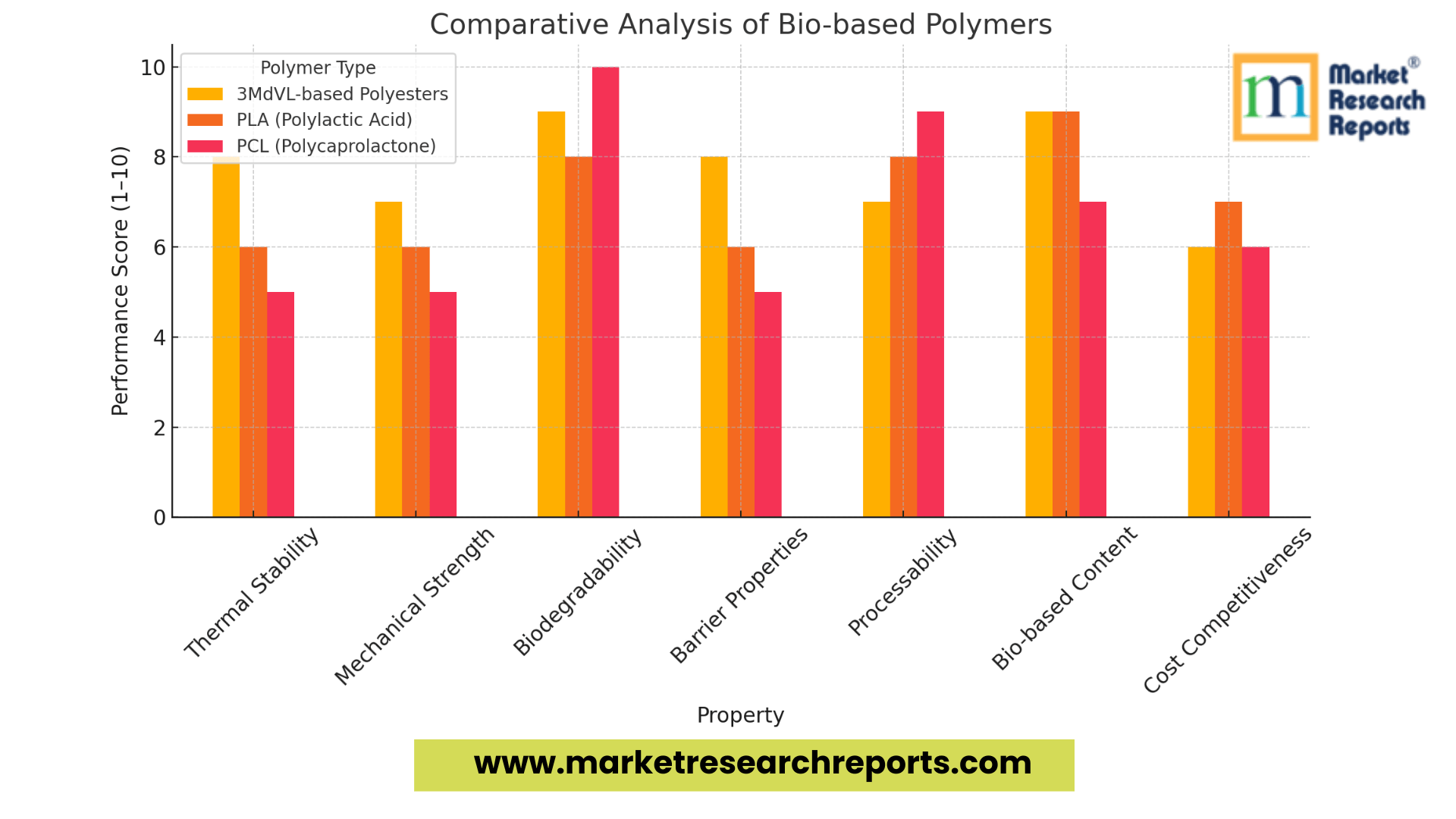
Here's a comparative analysis chart showing how 3MdVL-based polyesters stack up against PLA (Polylactic Acid) and PCL (Polycaprolactone) across key performance parameters:
-
3MdVL-based polyesters score higher in thermal stability, mechanical strength, and barrier properties, making them well-suited for high-performance packaging, automotive, and medical applications.
-
They also offer high biodegradability and bio-based content, aligning with sustainability goals.
-
Cost competitiveness remains a developing area but is improving with scale.
Market Opportunity Snapshot
| Industry | Key Drivers | 3MdVL Value Proposition |
|---|---|---|
| Automotive | Lightweight, durable, and green components | Foams and elastomers for interiors |
| Packaging | Regulatory push for compostables | Tough, thermally stable bioplastics |
| Footwear/Textiles | Eco-friendly materials | Elastomeric soles, fiber blends |
| Healthcare | Need for safe biodegradables | Biocompatible polyesters |
| Construction | Green building certifications | Durable PU insulation and sealants |
With increasing pressure to reduce petroleum dependency, major players like BASF, Covestro, and Huntsman are investing in 3MdVL-integrated polyurethane systems.
Polyester Sector In the polyester segment, 3MdVL enables the synthesis of high-performance, biodegradable polyesters via ring-opening polymerization (ROP). These materials excel in:
-
Packaging: Compostable films and rigid containers
-
Textiles: Eco-friendly synthetic fibers
-
Engineering plastics: Automotive and electronic housings
-
Biomedical applications: Drug delivery, implants, and sutures
Key Manufacturers and Suppliers
-
Mevaldi (Netherlands)
-
Specializes in pilot-scale production of 3MdVL
-
Focus: Renewable polyols for polyurethanes and sustainable plastics
-
-
LEAPChem Co., Ltd. (China)
-
Offers a wide range of specialty chemicals including 3MdVL derivatives
-
Applications in pharmaceuticals, agrochemicals, and materials science
-
-
Dayang Chem (Hangzhou) Co., Ltd. (China)
-
Supplies 98% pure 3-Methyl-delta-valerolactone for research and industrial use
-
-
Certech (Belgium)
-
Involved in R&D for scalable bio-based chemical production
-
Focuses on 3MdVL in the NEXT-STEP project for sustainable polymer development
-
-
Bio Base Europe Pilot Plant (Belgium)
-
A demonstration facility for upscaling green chemistry solutions
-
Develops safe-by-design 3MdVL-based products from lignocellulosic feedstocks
-
Sustainability and Future Outlook The sustainability value of 3MdVL lies in its origin—synthesized from non-edible lignocellulosic biomass—and its end-of-life biodegradability. It fits seamlessly into circular economy strategies and enables greener supply chains. Industries adopting 3MdVL-based solutions benefit from reduced greenhouse gas emissions, enhanced product performance, and compliance with emerging bio-content regulations.
Conclusion
3MdVL is more than just a novel molecule; it is a gateway to a sustainable industrial future. With exponential market growth, diverse applications, and increasing adoption by top-tier manufacturers, it is poised to redefine the landscape of bioplastics and high-performance materials. For businesses and innovators looking to stay ahead of the curve, 3MdVL is a molecule worth investing in.