


Economic Impact of COVID-19 on Israel and its Policy Response
Economic Impact of COVID-19 on Israel and its Policy Response
Israel’s economy was adversely affected by COVID-19 pandemic in 2020. The growth of real gross domestic product (GDP) of Israel shrank and unemployment levels increased due to COVID-19 in 2020. As of 20th May 2021, Israel had 8,39,162 confirmed COVID-19 cases out of which 6,395 people have lost their lives.
In this blog post we will be focusing on economic impact of COVID-19 pandemic on Israel. We will also be looking at the fiscal, monetary, employment and social policy measures taken by Israel government under following sections –
-
Impact of COVID-19 on Israel Economy in 2020
-
COVID-19 Containment Measures of Israel
-
COVID-19 Related Fiscal Policy Measures by Israel
-
COVID-19 Related Monetary Policy Measures by Israel
-
COVID-19 Related Employment Policy Measures by Israel
-
COVID-19 Related Social Policy Measures by Israel
We have covered various macroeconomic factors and PESTLE (political, economic, social, technological, legal, and environmental), SWOT (Strengths, Weaknesses, Opportunities and Threats) and risk analysis for Israel in separate market research reports.
1. Impact of COVID-19 on Israel Economy in 2020
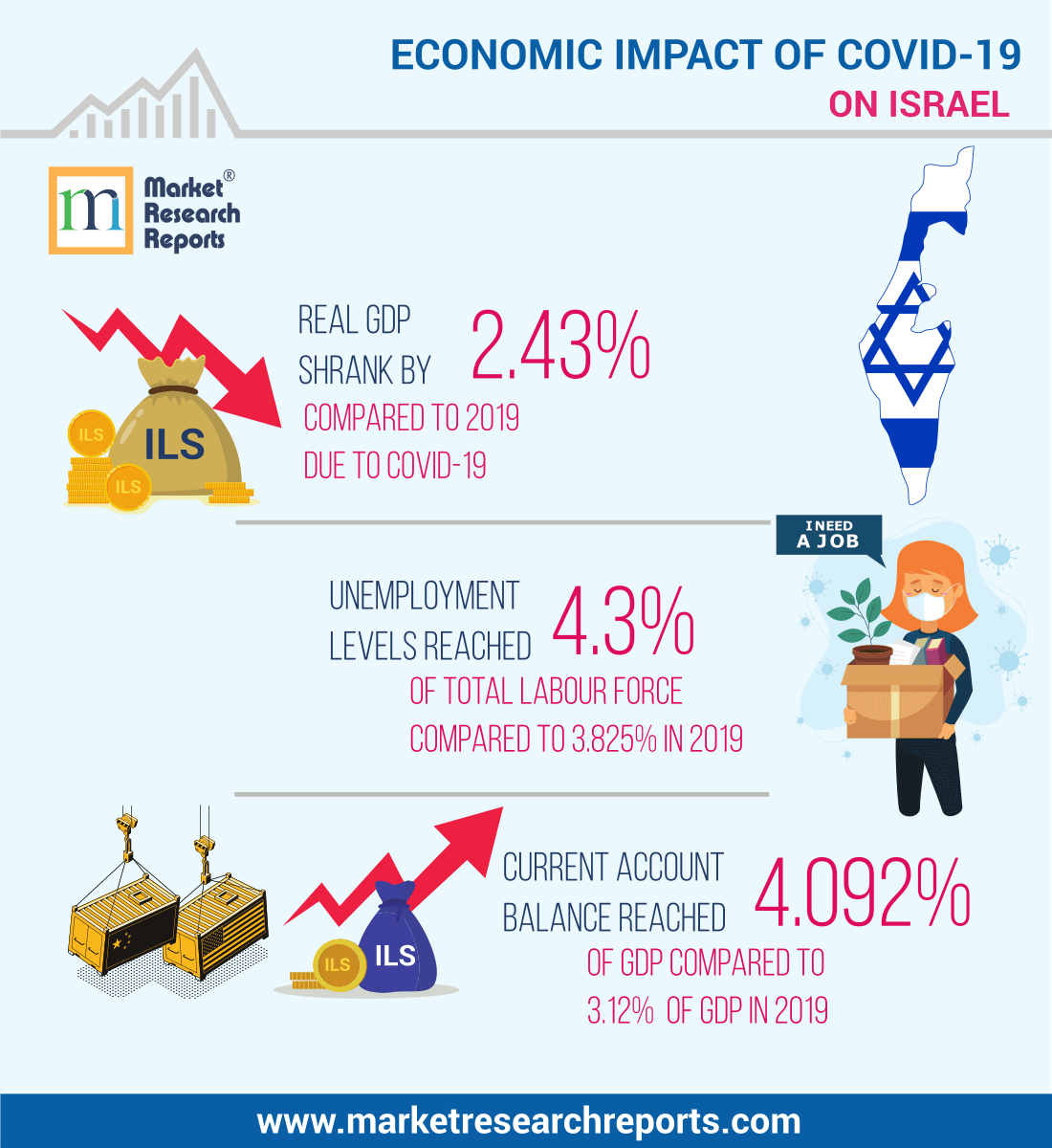
Israel’s real gross domestic product (GDP) was ILS 1342.97 billion in 2019 and due to COVID-19 outbreak it contracted by 2.43% to be around ILS 1311.05 billion in 2020. It is expected to increase by 4.75% in 2021 and reach ILS 1376.48 billion.
Israel’s unemployment rate was 3.825% of total labor force in 2019. Due to slowdown in global economic activity due to COVID-19 pandemic the unemployment increased by 11.05% and reached 4.3% in 2020. Unemployment is further estimated to increase in 2021 by 14% and reach 5% of total labor force in Israel.
Israel’s current account balance in 2020 was 4.902% of GDP compared to 3.12% of GDP in 2019. This means Israel remained net lender to rest of the world in 2020.
As of 06th May 2021, the Israel government has taken following fiscal, monetary, employment and social related policy measures to contain coronavirus (COVID-19) pandemic.
2. Coronavirus (COVID-19) Containment Measures of Israel
Quarantine/Confinement
On 1st November 2020, school grades 1-4, beauty salons, houses of worship and bed & breakfasts have been reopened.
The exit from the second lockdown began on 18th October 2020. Movement restrictions have been lifted, preschools & daycares, businesses that don't receive customers, beaches and national parks are allowed to re-open except for cities with high infection rates ("red cities").
Travel bans/restrictions
On 31st August 2020, the list of countries from which returning Israelis no longer have to quarantine was extended to 30 (from 20 on 16th August 2020). Foreigners are still largely barred from entering the country.
Closure of schools/universities
On 1st November 2020, school grades 1-4 have also been reopened.
Preschools and daycares are allowed to reopen from 18th October 2020. All other schools except some special eduction programmes are closed since 18th September 2020.
Cancellation of public events / Closure of public places
Since 18th September 2020, gatherings were limited to 10 indoors and 20 outdoors
Obligatory shut down of economic activities
Since 1st November 2020, beauty salons and bed & breakfasts were also allowed to open.
Since 18th October 2020, businesses that don't receive customers are allowed to open and restaurants are allowed to offer take-away and deliveries, except for cities with high infection rates ("red cities")
3. Coronavirus (COVID-19) Related Fiscal Policy Measures by Israel
Overall fiscal measures
On 2nd June 2020, the parliament approved the expansion of the aid package from NIS 80 billion (approved 8 April) to ILS 100 billion. Around ILS 65 billion are spending and revenue measures, while ILS 35 billion loan guarantees and payment deferrals.
On 16th June 2020, the parliament approved grants to firms that rehire laid-off workers (around ILS 5.5 billion)
On 29th July 2020, parliament approved another aid package (Economic Safety Net) in particular to extend unemployment benefits and grants and loan guarantees to SMEs. Around NIS 50 billion are budgetary measures and NIS 30 billion are off-balance liquidity measures. Parliament also approved one-time payments to adults and families with children, excluding high-income earners (around ILS 6.7 billion)
On 30th September 2020, parliament approved an extension of the Economic Safety Net (29th July 2020), which includes lower eligibility thresholds for firms to receive grants and an employee retention scheme. Budgetary costs are estimated at around ILS 10.5 billion in 2020/21.
Health system measures
On 30th March 2020, ILS 10 billion was allocated to increase health sector capacity, including for the procurement of protective gear, medicine and respirators, to increase the number of hospital beds for corona virus patients and the number of tests for the virus. An additional ILS 1 billion is allocated for civil needs (police, food security, vaccine research).
Income support measures for individuals and households excluding tax and contribution changes
On 07th April 2020, one time ILS 500 grant for each child up to fourth child per family, elderly people and people with disabilities
Temporary increase of the in-work benefit (earned-income tax credit) of 62% for April to December 2020.
On 29th July 2020, eligibility to unemployment benefits was extended and broadened including for furlough workers : benefits will be paid in full until June 2021 or until unemployment falls below 10%. If unemployment falls between 7.5%-10%, benefits are reduced to 90% and if unemployment falls below 7.5% benefits will be paid for another month. Eligibility after 6 instead of 12 months of employment in the last 18 months.
On 29th July 2020, extension of payments of up to ILS 4000 per month for people aged 67 and above until June 2021.
On 29th July 2020, one-time payment for every resident (over the age of 18 and with income below ILS 651,000) of ILS 750, an additional grant of ILS 500 for each child up to the fourth child, and a grant of ILS 300 for each additional child.
Tax and contribution policy changes
On 29th July 2020, extension of property tax reimbursement: property taxes will be reimbursed until June 2021 for SMEs (turnover up to ILS 100 million) that have experienced a decrease of turnover of at least 60%.
On 29th July 2020, tax exemption on the capital withdrawal up to NIS 7500 from advanced study funds for 6 months, for individuals that suffered income losses.
On 29th July 2020, the purchase tax rates on buying a second or further home has been cut.
Public sector subsidies to businesses
On 24th April 2020, grant for small businesses (up to NIS 20 million turnover) up to NIS 400 000 to cover fixed expenses.
On 24th April 2020, grant to self-employed: A grant of 70% of the average monthly taxable income up to NIS 10 500 in April and May for the self-employed that experience a 25% decrease in activity.
On 16th June 2020, parliament approved a grant of ILS 7500 for businesses for each employee with a minimum monthly salary of NIS 3300 that they rehire from 1st June 2020, payed in four monthly installments.
On 29th July 2020, social assistance grant to self-employed and controlling shareholders with an annual taxable income of up to NIS 651,000, whose sales turnover fell by more than 40%. These self-employed people will receive a 70% grant of taxable income up to NIS 15,000 every two months, until the end of June 2021.
On 29th July 2020, business assistance grants for business and self-employed with turnover up to ILS 400 million that have experienced turnover decrease of at least 40%, payable every two months until June 2021 (29 July): For small firms (turnover < ILS 300,000) grants between ILS 3000-6000. Firms with turnover 300000-100 million and at least 40% turnover decline receive grant for reimbursement of fixed expenses up to ILS 500,000. Firms with turnover 100-200 million and at least 60% turnover decline receive grant for reimbursement of fixed expenses up to ILS 500,000. Firms with turnover 200-400 million and at least 80% turnover decline receive grant for reimbursement of fixed expenses up to ILS 500,000.
On 29th July 2020, grant for small new businesses established between Jan-Feb 2020 up to NIS 4000, payable every two months until June 2021.
On 30th September 2020, the eligibility threshold for business grants was lowered from previously 40% to 25% decline in turnover during September and October 2020.
On 30th September 2020, employee retention grant: Firms with maximum turnover of ILS 400 million and a turnover decline of at least 25% in can receive a one-time grant of ILS 5000 per eligible employee.
Deferral of taxes and social security contributions and bringing forward expenditures within current fiscal year
Tax and payment deferrals (ILS 9 billion). Payment of VAT, municipal taxes, social security contributions, utility payments, government fees have been deferred for SMEs until the end of April.
Loan guarantees by the state benefiting private borrowers
On 29th July 2020, loan guarantees for SMEs. Expansion of the loan fund for SMEs from ILS 22 billion to ILS 50 billion.
Loan guarantee fund for large firms: ILS 6 billion loan fund businesses for firms with annual revenue turnover over ILS 200 million.
4. Coronavirus (COVID-19) Related Monetary Policy Measures by Israel
Monetary policy
Since 15th March 2020, the Bank of Israel is offering banks repo transactions with government bonds (and corporate bonds as of 06th April 2020) as collateral of an undisclosed amount.
On 18th March 2020, the Bank of Israel is also offering domestic banks one-week US dollar swap transactions of a total volume of up to ILS 15 billion (18 March).
On 23rd March 2020, the central bank announced the start of purchases of government bonds of various types and maturities in the secondary market totaling ILS 50 billion (3.5% of GDP).
On 06th April 2020, the central bank lowered the policy rate from 0.25% to 0.1%.
On 06th July 2020, the central bank announced that it will renew its programme to provide the banking system with fixed-rate loans at 0.1% interest rate, for a term of 3 years, with the goal of increasing the supply of bank credit to small businesses. There are limitation on the total amount of the loans, and it will be in operation until further notice.
On 06th July 2020, the central bank announced to buy corporate bonds in the secondary market of up to ILS 15 billion.
On 22nd October 2020, the central bank announced the expansion of its government bond buying programme by ILS 35 billion to ILS 85 billion and a new credit facility for small businesses via banks at a scope of ILS 10 billion until the end of June 2021, at a fixed interest rate of -0.1% for a term of 4 years.
Prudential regulation
On 15th March 2020, the Bank of Israel introduced a number of regulatory leniencies for the banking sectors such as higher loan-to-value ratios of all-purpose household credits backed by a residence, allowing banks to increase credit facilities (overdrafts) to customers, and increasing limits in the banks' loan portfolios for credits to the construction and real estate industry.
On 29th March 2020, Regulatory capital requirements for banks were lowered by 1 percentage points.
On 01st November 2020, the leverage ratio requirement was lowered by 0.5 percentage points.
5. Coronavirus (COVID-19) Related Employment Policy Measures by Israel
Reducing workers’ exposure to Covid-19 in the workplace
Only vital employees in the public sector will work. The rest will have to take paid sick leaves (with some deductions).
Between 1st April 2020 and 19th April 2020, only 15% of the private sector employees were allowed to go physically to work.
Since 19th April 2020, workplace restrictions eased with around 30% of employees in the private sector being physically allowed to go to work. Workplaces meeting certain standards (e.g. on hygiene and distancing) can admit a larger number of employees.
Financial support to firms affected by a drop in demand
The fund for state guaranteed loans to support mainly SMEs with cash-flow problems was increased from ILS 4 billion to ILS 8 billion.
On 30th March 2020, local tax reductions for firms (2.7 billion): 25% discount on municipal property tax for industries significantly affected by the crisis (effectively cancelation of property tax between March to May).
On 24th April 2020, Grant for small businesses (up to ILS 20 million turnover) up to ILS 400 000 to cover fixed expenses.
Tax and payment deferrals (ILS 9 billion): Payment of VAT, municipal taxes, social security contributions, utility payments, government fees have been deferred for SMEs until the end of April. Loan guarantees for SMEs. Government has set up a loan find of ILS 8 billion for SMEs. The government guarantees 85% of each loan but guarantees are limited to 15% of overall losses on all loans. Loans have a maturity of up to 5 years, with lower collateral requirements (5%). The first year is interest rate free. The time required for banks to provide credit approval is reduced to 7 working days. Loan guarantee fund for large firms: The government has set up a ILS 6 billion loan fund businesses for firms with annual revenue turnover over ILS 200 million. Firms can apply for a loan of up to 8% of their annual turnover up to ILS 100 million. The state guarantees 75% of each loan but guarantees are limited to 12% of overall losses on all loans.
6. Coronavirus (COVID-19) Related Social Policy Measures by Israel
Income support to quarantined workers who cannot work from home
Only vital employees in the public sector worked during the lockdown. The rest was allowed to take paid sick leaves (with some deductions).
Helping dealing with unforeseen care needs
One-off payment for parents worth NIS 500 per child, up to the fourth child.
Income support to persons losing their jobs or self-employment income
On 30th March 2020 and extended on 08th & 24th April 2020, all employees on unpaid leave for at least 30 days will be able to claim unemployment benefits immediately. Unemployment benefits can be claimed after employment for the least 6 months, from 12 months previously A one-time payment of ILS 6000 (about EUR 1500) for the self-employed. A grant of 70% of the average monthly taxable income up to ILS 10,500 in April and May for the self-employed that experience a 25% decrease in activity.
Helping economically insecure workers stay in their homes
Temporary suspension of evictions from public housing and rent reductions for tenants severely affected by Covid-19. Mortgage breaks of up to 4 months are available without accruing additional costs. Leniency in the industry restriction – for the Construction and Real Estate industry, such that the banks will be able to increase credit to the industry so that total credit will increase from 20 percent to 22 percent of total public indebtedness. The bank will be permitted to provide an all-purpose loan that is not for the purchase of rights to land, backed by a residential property, up to an LTV rate of 70 percent instead of the current 50 percent restriction.
Source – With inputs from Organisation for Economic Co-operation and Development (OECD), International Monetary Fund, World Bank, International Labour Organization (ILO) and Government of Israel.