


Economic Impact of COVID-19 on Singapore and its Policy Response
Economic Impact of COVID-19 on Singapore and its Policy Response
Singapore’s economy is expected to be adversely affected by COVID-19 pandemic in 2020. The growth of real gross domestic product (GDP) of Singapore is expected to shrink, unemployment level to increase and current account balance to decline due to COVID-19 this year. As of 13th Aug 2020, Singapore had 5,66,109 confirmed COVID-19 cases out of which 4,26,125 people have recovered from the disease while 10,751 have lost their lives.
This blog post covers economic impact of COVID-19 pandemic along with fiscal, monetary and containment policy measures taken by Singapore government under following sections –
-
Impact of COVID-19 on Singapore Economy in 2020
-
COVID-19 Containment Measures of Singapore
-
COVID-19 Related Fiscal Policy Measures by Singapore
-
COVID-19 Related Monetary Policy Measures by Singapore


1. Impact of COVID-19 on Singapore Economy in 2020
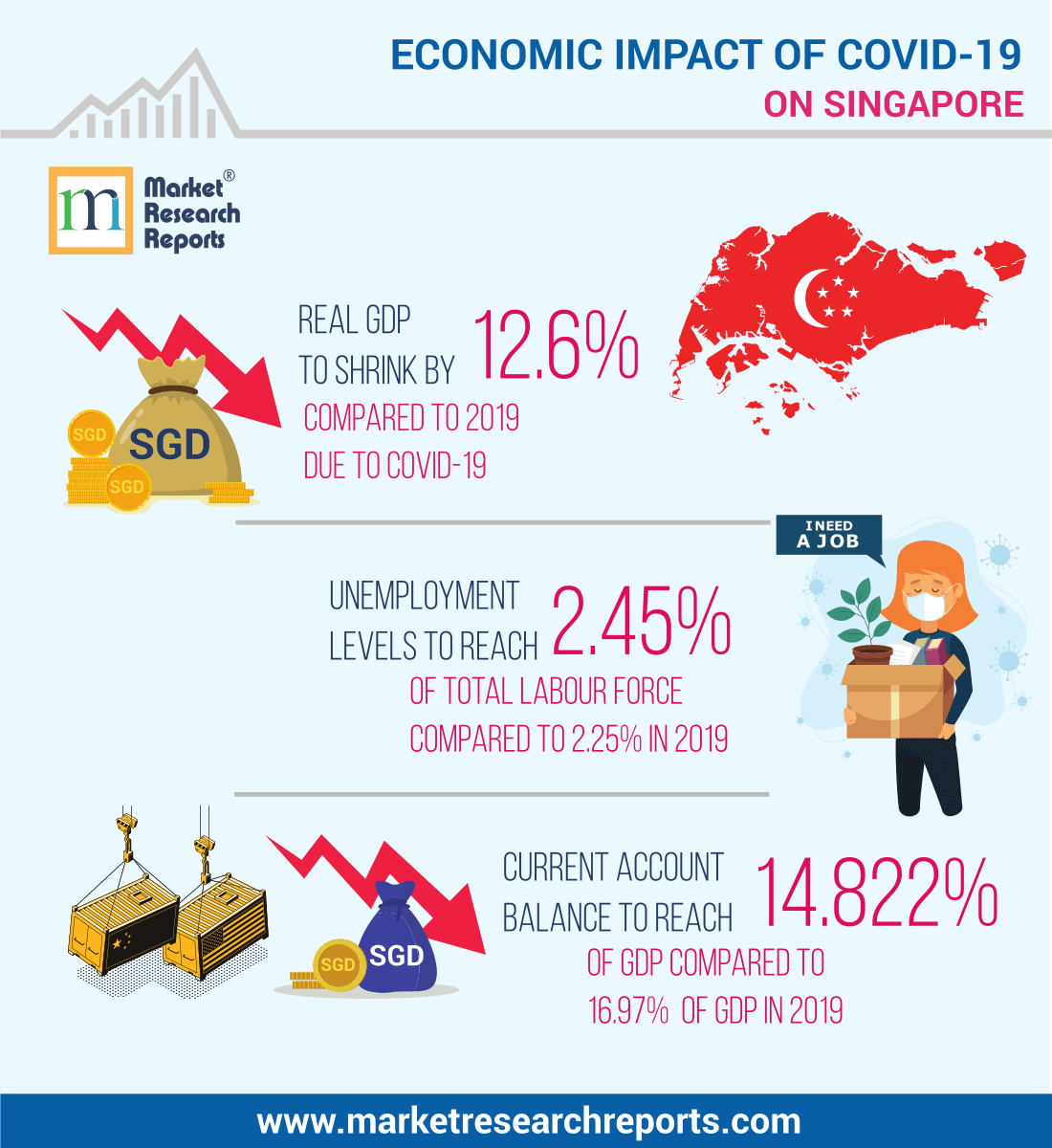
Singapore’s real gross domestic product (GDP) was SGD 446.63 billion in 2019 and due to COVID-19 outbreak it is estimated to decrease by 12.6% to be around SGD 390.35 billion in 2020.
Singapore’s unemployment rate was 2.25% of total labor force in 2019. Due to slowdown in global economic activity due to COVID-19 pandemic the unemployment is expected to increase by 8.16% and reach 2.45% in 2020. Unemployment is further estimated to decrease in 2021 by 2.08% and reach 2.4% of total labor force in Singapore.
Singapore’s current account balance in 2020 is expected to be at 14.822% of GDP compared to 16.97% of GDP in 2019. This means Singapore will remain net lender to rest of the world in 2020 despite decline in its current account balance.
As of 30th July 2020, the Singapore government has taken following fiscal, monetary and containment related policy measures to contain coronavirus (COVID-19) pandemic.
2. Coronavirus (COVID-19) Containment Measures of Singapore
Singapore’s first confirmed COVID-19 case was reported on 23rd January 2020. Safe distancing measures were considerably intensified in April 2020 to break the trend of increasing local transmission. In view of a significant decrease in community transmissions, the Government has announced a three-phased approach to resume activities starting 02nd June 2020. Community infection rates have remained generally stable and Phase Two commenced on 19th June 2020.
3. Coronavirus (COVID-19) Related Fiscal Policy Measures by Singapore
Overall fiscal measures
Singapore government has announced 5 packages of measures on 18th February 2020, 26th March 2020, 06th April 2020, 21st April 2020 and 26th May 2020 amounting to SGD 92.9 billion (19.7 percent of GDP).
Funds to contain the outbreak are about SGD 800 million (mainly to the Ministry of Health). The Care and Support Package provides support to households, including a cash payout to all Singaporeans (higher for families with children under 20), and additional payments for lower-income individuals and the unemployed. The Stabilization and Support Package provides support to businesses, including wage subsidies, support to cover rental costs, an enhancement of financing schemes, and additional support for industries directly affected and the self-employed. The authorities have increased their contingencies funds for unforeseen expenditure needs and also set aside loan capital of SGD20 billion to help businesses and individuals facing cash flow challenges with loan obligations and insurance premium payments. Other economic resilience measures include support to R&D investment, a national stockpile of health supplies, and a program on food resilience.
4. Coronavirus (COVID-19) Related Monetary Policy Measures by Singapore
Monetary policy
On 14th February 2020, the Monetary Authority of Singapore (MAS) welcomed the announcements from banks and insurers in Singapore to support their customers facing financial difficulties due to the impact of the COVID-19 outbreak, while adhering to prudent risk assessments.
On 19th March 2020, the MAS announced the establishment of a USD 60 billion swap facility with the US Federal Reserve. The MAS is drawing on this facility to provide USD liquidity to Singapore banks through weekly auctions held every Monday since late March 2020.
On 30th March 2020, the MAS adopted a zero percent annual rate of appreciation of the policy band and reduced the mid-point to the prevailing level of the S$NEER, with no change to the width of the band.
On 31st March 2020, the MAS and the financial industry announced a detailed package of measures to help individuals and SMEs facing temporary cashflow difficulties. The package has three components:
- help individuals meet their loan and insurance commitments
- support SMEs with continued access to bank credit and insurance cover, and
- ensure interbank funding markets remain liquid and well-functioning.
A second package announced on 30th April 2020 extends the scope of relief for individuals to a broader set of loan commitments.
On 07th April 2020 the MAS announced that it will adjust selected regulatory requirements and supervisory programs to enable financial institutions to better deal with issues related to the pandemic.
On 08th April 2020, the MAS announced a SGD 125 million support package to sustain and strengthen financial services and FinTech capabilities. The package, funded by the Financial Sector Development Fund, has three main pillars:
- supporting workforce training and manpower costs
- strengthening digitalization and operational resilience and
- enhancing FinTech firms’ access to digital tools.
On July 29, the MAS called on locally-incorporated banks headquartered in Singapore to cap their total dividends per share to 60 percent of the FY2019 level and offer shareholders the option to receive dividends in scrip (as shares) instead of cash.
On 30th July 2020, MAS announced that the swap facility has been extended to end-March 2021.
Source – With inputs from Organisation for Economic Co-operation and Development (OECD), International Monetary Fund, World Bank, International Labour Organization (ILO) and Government of Singapore