


Economic Impact of COVID-19 on Germany and its Policy Response
Economic Impact of COVID-19 on Germany and its Policy Response

Germany’s economy is expected to be adversely affected by COVID-19 pandemic in 2020. The growth of real gross domestic product (GDP) of Germany is expected to shrink, unemployment level to increase and current account balance to decline due to COVID-19 this year. As of 11th Aug 2020, Germany had 2,18,500 confirmed COVID-19 cases out of which 1,98,900 people have recovered from the disease while 9,265 have lost their lives.
This blog post covers economic impact of COVID-19 pandemic along with fiscal, monetary, employment and social policy measures taken by Germany government under following sections –
-
Impact of COVID-19 on Germany Economy in 2020
-
COVID-19 Containment Measures of Germany
-
COVID-19 Related Fiscal Policy Measures by Germany
-
COVID-19 Related Monetary Policy Measures by Germany
-
COVID-19 Related Employment Policy Measures by Germany
-
COVID-19 Related Social Policy Measures by Germany


1. Impact of COVID-19 on Germany Economy in 2020
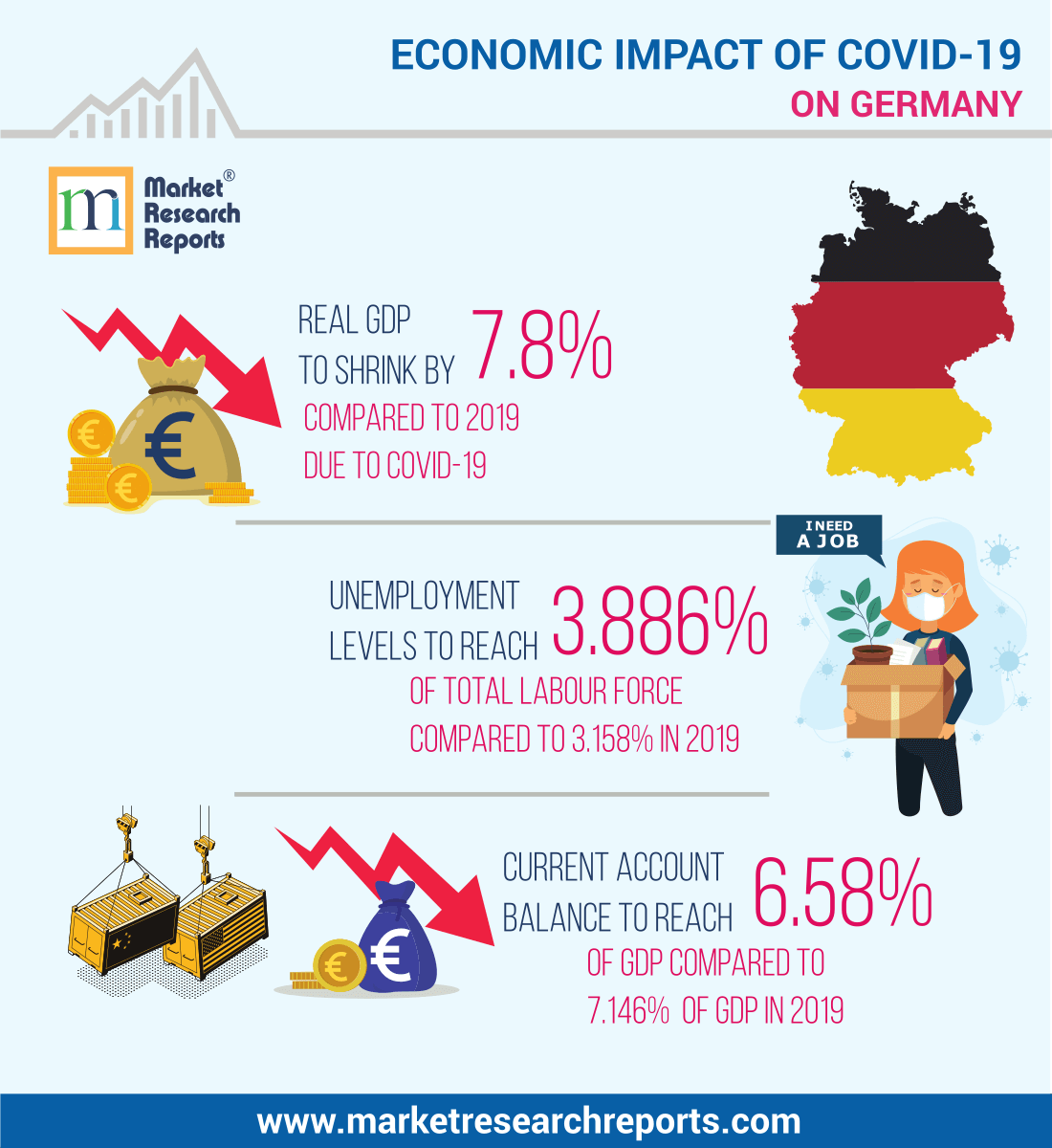
Germany’s real gross domestic product (GDP) was Euro 2988.81 billion in 2019 and due to COVID-19 outbreak it is estimated to decrease by 7.8% to be around Euro 2755.68 billion in 2020.
Germany’s unemployment rate was 3.158% of total labor force in 2019. Due to slowdown in global economic activity due to COVID-19 pandemic the unemployment is expected to increase by 18.73% and reach 3.886% in 2020. Unemployment is further estimated to decrease in 2021 by 12.57% and reach 3.452% of total labor force in Germany.
Germany’s current account balance in 2020 is expected to be at 6.58% of GDP compared to 7.146% of GDP in 2019. This means Germany will remain net lender to rest of the world in 2020.
As of 03rd July 2020, the Germany government has taken following fiscal, monetary, employment and social related policy measures to contain coronavirus (COVID-19) pandemic.
2. Coronavirus (COVID-19) Containment Measures of Germany
Quarantine/Confinement
- On 16th June 2020, Germany government launched a Corona-Warn app that allows users to trace potential contact with COVID-infected individuals. Its use is voluntary.
- On 17th June 2020, Containment measures re-imposed in two municipalities in the state of North-Rhine Westphalia after a resurgence in new COVID-19 cases (“emergency brake"). Restrictions were eased on 06th July 2020.
- A general contact restriction of keeping distance and wearing masks in stores and public transport should continue until further notice.
- The general contact ban for meetings in public decided on 22nd March 2020 has been extended but eased further such that up to 10 individuals can meet in public from 30th May 2020 onwards in some states.
- From the week of 27th April 2020 onwards, individuals have been required to wear a mask in stores and public transport in all states.
Travel bans/restrictions
- Temporary border controls for individuals arriving from the Schengen area as well as restrictions on seasonal workers have been lifted on 15 June.
- A travel warning for 27 countries in the Schengen area has been lifted on 15 June.
- A general obligatory quarantine for all incoming individuals put in place on April 10 has been lifted in mid-May.
- For other countries, the travel warning has been extended until the end of August. Self-isolation is only necessary if individuals are entering from a country outside the Schengen area or from a country with the number of new infections over the previous seven days exceeding 50 per 100.000 population.
Closure of schools/universities
From the beginning of May 2020, classes have resumed gradually for certain grades.
Cancellation of public events / Closure of public places
- Restrictions on most activities in compliance with hygiene measures have been lifted again by individual states. Restrictions remain on nightclubs or conventions.
- The states have agreed on a cap of new cases at the municipal level, above which stricter lockdown measures have to be reintroduced. This cap is 50 new cases per 100.000 inhabitants over the previous seven days.
- The cancellation of large events has been extended until the end of October.
- The contact ban for meetings in public decided on March 22 has been extended until June 29 but eased further such that up to 10 individuals can meet in public from 30 May onwards in some states.
Obligatory shut down of economic activities
- Restrictions on most activities in compliance with hygiene measures have been lifted again by individual states. Restrictions remain on nightclubs or conventions.
- The states have agreed that the re-opening will be subject to an “emergency brake", where the occurrence of more than 50 new infections per 100.000 inhabitants over 7 days at the municipal level will require state governments to re-impose containment measures.
3. Coronavirus (COVID-19) Related Fiscal Policy Measures by Germany
Overall fiscal measures
- On 23rd March 2020, the clause for exceptional circumstances in the debt break was triggered on 25th March 2020. This allows debt financing of a supplementary budget of Euro 156 billion (4.5% of GDP) to cover response measures and an estimated reduction in revenues of Euro 33.5 billion (1% of GDP).
- On 3rd June 2020, an additional recovery package has been agreed on of roughly Euro 130 billion (3.8% of GDP) for the years 2020 and 2021, which will render a second supplementary budget for 2020 necessary. The included measures provide short-term consumption incentives and increase resources to address longer-term investment needs into digitalization and greening the economy.
Health system measures
-
On 13th March 2020, the budget committee provided additional Euro 800 million for protective equipment, equipment for intensive care and research on vaccines. Previously, around Euro 350 million were already agreed on for protective equipment and the WHO. Other initiatives were -
- Additional central procurement of special equipment on federal level, in addition to procurement of hospitals and private practices like participation in EU joint procurement.
- Derogation for the provision and use of biocidal products (Biocide Ordinance) allows pharmacists to produce and place on the market hand disinfectants.
- Sick leave by telephone for up to 14 days for patients with minor illnesses.
- On 23rd March 2020, agreement of federal level and Länder to expand hospital capacities for COVID by e.g. postponing elective treatments. Additional funding for hospitals will be provided to balance losses due to rescheduled surgeries and to increase ICU capacity. Federal government will provide Euro 2.8 billion in 2020, additional funding will come from health insurance.
- As part of the 03rd June 2020 recovery package, further support to health authorities in the technical and digital upgrading of equipment and strengthening their possibilities for personnel recruitment is planned. The Federal Government is setting up a "Hospitals of the Future Programme", which promotes necessary investments by hospitals.
Income support measures for individuals and households excluding tax and contribution changes
- Starting 01st April 2020, access to social benefits (basic income support for job-seekers and social assistance) were eased for six months, with assets and apartment size not taken into consideration. Parents, who temporarily lose income, were able to benefit from child allowance (Kinderzuschlag).
- On 23rd April 2020, for individuals receiving unemployment benefits, the length of entitlement was increased by three months if the entitlement would otherwise end between May and December 2020.
- As part of the 03rd June 2020 recovery package, families will receive a one-off payment of Euro 300 per child in 2020.
Tax and contribution policy changes
- On 23rd April 2020, Germany government announced that the reduced VAT rate of 7% will apply for restaurants for 12 months starting on 01st July 2020.
- On 03rd June 2020, the VAT rate were lowered temporarily until the end of the year from 19% to 16% and from 7% to 5% (reduced VAT rate).
Public sector subsidies to businesses
- On 13th March 2020, short-time working scheme (Kurzarbeit): The government temporarily eased access to the “short-time” work scheme as was the case during the financial crisis. Firms can request support for their workers under this scheme if 10% of their workforce is affected by cuts in working hours as opposed to one third under the usual regulation. In addition to compensating 60% of the difference in monthly net earnings due to reduced hours, the labour agency will now also cover 100% of social-security contributions for the lost work hours. This is an increase compared to the financial crisis, where only 50% of social-security contributions were subsidised and employers had to cover the other half.
- On 23rd March 2020, Direct support to self-employed and small businesses with fewer than 10 employees of up to Euro 15,000 per firm (total of Euro 50 billion foreseen).
- On 23rd April 2020, the government decided to increase the replacement rate of lost net earnings to 70% for childless workers and to 77% for workers with children from the fourth month of short-time work onwards if they have reduced their working time by at least 50%. In the seventh month, payments are increased further to 80% and 87% respectively.
- As part of the 03rd June 2020 recovery package, direct support to self-employed and small businesses with fewer than 10 employees have been extended for the period June-August 2020. The government will reimburse between 50%-70% of their fixed operating costs up to Euro 15,000. Payments of more than Euro 15,000 are possible in exceptional cases.
Deferral of taxes and social security contributions and bringing forward expenditures within current fiscal year
- On 13th March 2020, tax deferrals are possible and tax prepayments can be adapted to expected lower income in 2020. Enforcement measures and penalty surcharges will be paused in 2020 if the enterprise is hit hard.
- On 13th March 2020, the labor agency will cover 100% of social-security contributions for lost hours of short-time workers. This is an increase compared to the financial crisis, where only 50% of social-security contributions were subsidized and employers had to cover the other half.
- On 23rd April 2020, loss carry-back for the 2020 tax year which will allow taxpayers to carry back their 2020 tax losses against advance tax payments from the previous year.
-
As part of the 03rd June 2020 recovery package,
- the due date for import sale tax will be shifted to the 26th of each following month to increase liquidity for firms.
- The loss carry-back for the years 2020 and 2021 will be extended to Euro 10 million.
- Degressive depreciation will be possible for the years 2020 and 2021.
Public sector loans or capital injections to businesses
- On 13th March 2020, providing liquidity to affected firms through programs of the KfW with unlimited credit. Firm size limitations for liquidity support will be adjusted upwards. Risk taken by the government will increase.
- On 23rd March 2020, Euro 2 billion for co-investment in start-ups through the KfW bringing forward a first tranche of an already planned future fund of Euro 10 billion.
- On 23rd March 2020. an Economic Stabilization Fund for larger companies with 250 employees or more. The fund will provide EUR 100 billion for recapitalization, EUR 400 billion of guarantees for corporate liabilities, and a credit authorization for EUR 100 billion to the KfW for refinancing purposes.
- In line with a EU decision from 27th March 2020, export guarantees will temporarily be extended to cover EU countries and some OECD countries.
- As announced on 06th April 2020, firms will be able to apply for immediate loans through the KfW with 100% government guarantee worth up to 25% of 2019 revenue, capped at Euro 500,000 and EUR 800,000 for firms with 10 to 50 employees and those with more than 50 employees, respectively. Screening will be eased and based on past profitability only, conditions comprise an interest rate of 3% and a maturity of ten years. Loans can be converted to regular KfW loans over time following usual risk screening measures by banks.
Loan guarantees by the state benefiting private borrowers
- On 13th March 2020, the volume of guarantees provided by guarantee banks will be doubled to Euro 2.5 billion.
- On 23rd March 2020, an Economic Stabilisation Fund for larger companies with 250 employees or more. The fund will provide EUR 400 billion of guarantees for corporate liabilities.
- In line with EU decision from 27th March 2020, export guarantees will temporarily be extended to cover EU countries and some OECD countries.
- On 06th April 2020, firms will be able to apply for immediate loans through the KfW with 100% government guarantee worth up to 25% of 2019 revenue, capped at Euro 500,000 and Euro 800,000 for firms with 10 to 50 employees and those with more than 50 employees, respectively.
4. Coronavirus (COVID-19) Related Monetary Policy Measures by Germany
Monetary policy
- On 25th March 2020, a three-month payment moratorium on consumer loans established before March 15th is granted until 30th June 2020 if the debtor is financially affected by the COVID-19 crisis.
- On 01st April 2020, the national designated authority BaFin reduced the countercyclical capital buffer for banks from 0.25 % to 0 %.
Support to individuals and households
- On 25th March 2020, for private or commercial tenants facing income losses, the landlords' right to terminate tenancies due to rent arrears is restricted between 01st April 2020 and 30th June 2020.
Support to firms
- On 25th March 2020, for private or commercial tenants facing income losses, the landlords' right to terminate tenancies due to rent arrears is restricted between 01st April 2020 and 30th June 2020.
- On 25th March 2020, the obligation to file for insolvency will be suspended until 30th September 2020, unless the insolvency is not due to the effects of the COVID 19 pandemic or there is no prospect of eliminating an inability to pay that has occurred.
5. Coronavirus (COVID-19) Related Employment Policy Measures by Germany
Helping firms to adjust working time and preserve jobs
Previously, companies could apply for Kurzarbeit when 30% of their employees were affected by a drop in orders due to economic developments. This has now been lowered to 10% of employees. There has been a partial or complete waiver of the need to build up a negative balance in working hours. Reduced hours compensation benefit will also be available to temporary/agency workers. Social security contributions are completely reimbursed by the Federal Labour Office.
On 22nd April 2020, the government announced to increase replacement rates for lost earnings in the short-time work scheme. Payments will increase from 60% to 70% for childless workers and from 67% to 77% for workers with children from the fourth month of short-time work onwards if they have reduced their working time by at least 50%. In the seventh month, payments are increased further to 80% and 87% respectively.
Financial support to firms affected by a drop in demand
Germany has protected businesses with liquidity measures, authorizing the state-owned bank KfW to lend out Euro 610 billion to companies to cushion the effects of the coronavirus. To support the recovery of restaurants, the reduced VAT rate of 5% will be applied to this sector for 12 months starting on 1 July. The economic stimulus package from 12 June includes a comprehensive support program for small and medium-sized companies that are particularly badly affected by the COVID-19 pandemic.
6. Coronavirus (COVID-19) Related Social Policy Measures by Germany
Reducing workers’ exposure to Covid-19 in the workplace
Germany has encouraged teleworking of employees when possible.
Income support to sick workers and their families
Application of the Protection against Infection Act (IfSG), in place prior to the crisis but only applying in such crisis circumstances due to a virus. For the first six weeks of sick leave, the amount provided as sick leave corresponds to the net salary, after which the amount equals to sick leave benefits. Also applies to self-employed workers. As of 09/03, temporary easing of requirements for the provision of a doctor’s certificate: people with symptoms of COVID-19 may call their doctor to get a telephone-based or online medical assessment instead of a visit and go into sick leave afterwards for a maximum of 7 days.
Income support to quarantined workers who cannot work from home
The Infection Protection Act ensures that quarantined employees who cannot work from home will continue to receive a salary and employers will be reimbursed by the government (the health ministry). The self-employed also have the right to an income replacement from the health ministry if there is a concrete and certified suspicion of infection.
Helping to deal with unforeseen care needs
Working parents with children under age 12 who have not been able to work due to school or child care closures have been entitled to six weeks of paid leave, paid at 67% of earnings up to the ceiling of EUR 2016 per month. The leave is paid by the employer who then claims compensation from the relevant state authority. In addition, the government has simplified the application process for the child supplement, a means-tested in-work benefit. During the confinement phase, some schools and childcare facilities remained open, with a skeleton staff, to look after children of essential service workers.
Income support to persons losing their jobs or self-employment income
Self-employed persons and freelancers will receive compensation for loss of earnings based on the profits established in the tax declaration of the previous calendar year. The ruling coalition agreed to extend the maximum unemployment benefit duration by three months for all claimants whose entitlements end between 1 Mai and 31 December.
Helping economically insecure workers stay in their homes
As of April 1st, missed rent payments due to COVID-related reasons cannot lead to evictions and rent payments for these tenants will be postponed (in force 1st of April to 30th of June). Rents need to be paid in full afterwards (by 30th of June 2022) to ensure no losses for landlords. Those served with termination notices on their tenancy, but who have yet to leave their rental property, will be entitled to remain in occupation of the dwelling until the expiration of the emergency period. Consumers that cannot finance running consumption costs for their housing units (such as electricity, gas, telecommunication and water) can postpone them without being charged late payment fees or forced to judicial debt collection. Payments of interest and capital for loans due between 1st April and 30th June can be suspended up to three months from the due date. Also, the banks themselves have decided to grant their customers a mortgage break.
Source – With inputs from Organisation for Economic Co-operation and Development (OECD), International Monetary Fund, World Bank, International Labour Organization (ILO) and Government of Germany