


Economic Impact of COVID-19 on Egypt and its Policy Response
Economic Impact of COVID-19 on Egypt and its Policy Response
Egypt’s economy is expected to be adversely affected by COVID-19 pandemic in 2020. The growth of real gross domestic product (GDP) of Egypt is expected to slow down, unemployment level to increase and current account balance to remain negative due to COVID-19 this year. As of 24th July 2020, Egypt had 90,413 confirmed COVID-19 cases out of which 31,066 people have recovered from the disease while 4,480 have lost their lives.
In this blog post we will be focusing on economic impact of COVID-19 pandemic and the fiscal, monetary and social policy measures taken by Egypt government under following sections –
-
Impact of COVID-19 on Egypt Economy in 2020
-
COVID-19 Containment Measures of Egypt
-
COVID-19 Related Fiscal Policy Measures by Egypt
-
COVID-19 Related Monetary Policy Measures by Egypt
-
COVID-19 Related Social Policy Measures by Egypt


1. Impact of COVID-19 on Egypt Economy in 2020
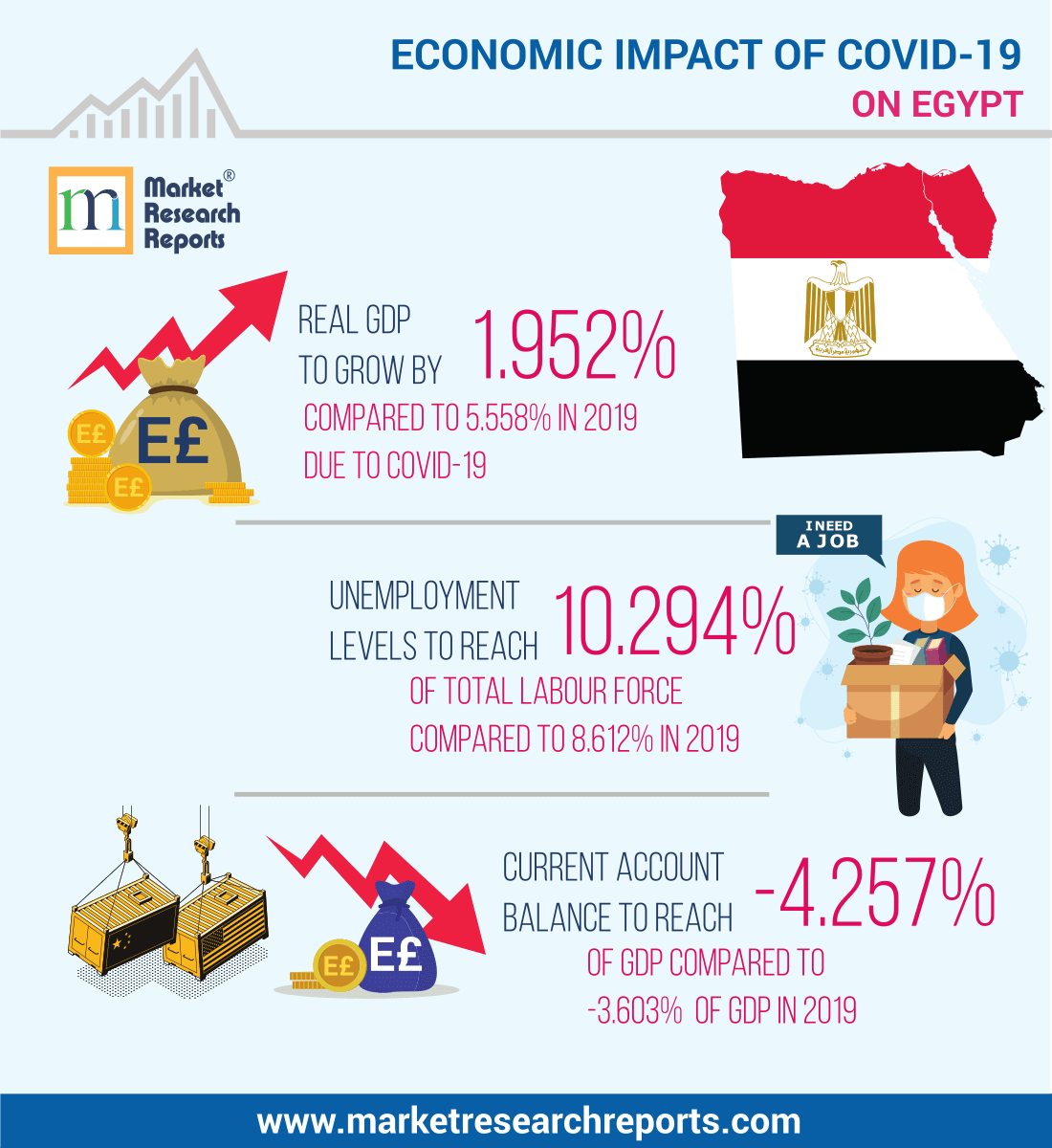
Egypt’s real gross domestic product (GDP) was EGP 2221.457 billion in 2019 and due to COVID-19 outbreak it is estimated to increase by 1.952% to be around EGP 2264.820 billion in 2020.
Egypt’s unemployment rate was 8.612% of total labor force in 2019. Due to slowdown in global economic activity due to COVID-19 pandemic the unemployment is expected to increase by 16.34% and reach 10.294% in 2020.
Egypt’s current account balance has remained constantly negative since 2014. In 2020, its current account balance is expected to be at -4.257% of GDP compared to -3.603% of GDP in 2019. This means Egypt will remain net borrower from rest of the world in 2020.
As of 27th June 2020, the Egypt government has taken following fiscal, monetary and social policy measures to contain coronavirus (COVID-19) pandemic.
2. Coronavirus (COVID-19) Containment Measures of Egypt
Quarantine/Confinement
- On 17th March 2020, Egypt placed over 300 families under quarantine in a Delta village to stem the spread of the new coronavirus.
- On 25th March 2020, a night-time curfew between 8pm and 6am local time has been introduced. The government has also reduced by half the number of public sector employees coming to work.
- On 28th April 2020, a Presidential decree published in the Official Gazette declared the state of emergency across the country for three months starting April 28.
- On 10th May 2020, due to the steady number of positive cases in Egypt, the Ministry of Health announced that it will continue to implement its curfew during Ramadan.
- On 14th May 2020, The Ministry of Health published a three-stage plan outlining the required procedures for the gradual reopening of the economy.
- On 27th June 2020, the night-time curfew in place since 25th March 2020 is fully lifted as of 27th June 2020 announced Hany Younes, the Prime Minister's Media Advisor.
Travel bans/restrictions
- All borders are closed, remaining open for cargo only. Domestic and international flights are also suspended and airports are closed.
- On 23rd June 2020, Prime Minister Mostafa Madbouli announced that starting on 27th June 2020 public transportation will operate between 4 a.m. and midnight.
- On 01st July 2020, reopening of select tourist destinations to international charter flights. EgyptAir will resume flights to more than 29 international destinations.
Closure of schools/universities
- On 15th March 2020, All schools, universities, and colleges have been closed.
- On 24th March 2020, The closure of schools was extended (two extra weeks).
- The Ministry of Education and Technical Education (MOETE) announced steps to implement distance learning and assessment during school suspension. MOETE extended the access to the Egyptian Knowledge Bank (EKB) to students, providing content by grade level and subject (kindergarten through secondary education). Content is available in both Arabic and English to all students, parents and teachers.
- On 19th March 2020, Egypt announced it had contracted with the online learning provider Edmodo to deliver remote instruction to the country's entire K-12 student body.
Cancellation of public events / Closure of public places
- On 24th March 2020, Egypt government closed churches, mosques and their attachments. It also cancelled cultural events and touristic trips and banned religious prayers in public gatherings as well as other large public gatherings.
- On 04th May 2020, Hotels are allowed to operate at 25% capacity until June 2020 and at 50% capacity thereafter.
-
On 23rd June 2020, Prime Minister Mostafa Madbouli announced that starting on 27th June 2020,
- worship places will be open for daily prayers but main prayers like Friday prayers and masses will be banned
- toilets and ceremonial halls at worship places will be closed.
Obligatory shut down of economic activities
-
On 23rd June 2020, Prime Minister Mostafa Madbouli announced a bundle of measures aimed at co-existing with COVID-19 that went into effect on June 27 2020,
- restaurants and cafes will resume work with 25 percent capacity
- shisha will still be banned
- stores will close at 9 p.m. while restaurants and cafes will close at 10 p.m. and
- cinemas, theatres, and entertainment venues will operate with 25 percent capacity.
- On 16th June 2020, The Minister of Tourism and Antiquities, Khaled El-Anani, confirmed the reopening of some of eight of Egypt's most significant archaeological sites in July. These are the Pyramids of Giza and their surrounding areas, the Egyptian Museum in Tahrir, the Citadel of Salah El-Din, the temples in Karnak and Luxor, Hurghada Museum, Abu Simbel temples and the Temple of Philae in Aswan.
- The government has closed all malls, gyms, sporting clubs, in-dining restaurants and cafes. Supermarkets, bakeries and pharmacies remain open.
3. Coronavirus (COVID-19) Related Fiscal Policy Measures by Egypt
Overall fiscal measures
- On 22nd March 2020, President Al-Sisi announced the allocation of 100 billion EGP (USD 6.4 billion equivalent to 2% of GDP) to fund a comprehensive plan to combat the coronavirus. Half of the budget is allocated to the tourism sector while the rest will support poor families and the stock market through a stock purchase programme by the Egyptian Central Bank (USD 1.3 billion).
- Egypt government also introduced a six-month extension for credit repayments targeting all individuals and businesses, and the cancellation of the ATM withdrawal fees.
- The cost of transactions in the EGX will be reduced from 0.15% to 0.125% and from 0.15% to 0.05% for non-residents and Egyptian residents, respectively. All spot transactions on EGX will be exempt from stamp duty.
- The Ministry of Finance lifted the Administrative detention for taxpayers in return for payment of 10% of the tax due and to settle the outstanding tax due through the Dispute Resolution Committee. The Egyptian Tax Authority has also lifted the means of payment to allow cash or cheque payment of taxes due for fiscal year 2019/2020.
Health system measures
- The authorities have taken a host of precautionary measures to improve testing as well as to limit the community spread of the virus, including setting up testing centres, temporarily closing places of worship, temporarily halting all air travel, and encouraging civil servants to work from home in non-essential sectors. The central bank and the government are actively implementing measures to contain economic implications of the epidemic.
- On 24th March 2020, The government recently has announced 1 billion EGP (USD 63.5 million) in extra funding for its health services and applied various measures to increase the country's capacity to absorb the sudden increase of critical patients that the outbreak might bring.
- On 25th March 2020, WHO delegation concludes COVID-19 technical mission to Egypt, as a result of which alternative mechanisms for testing patients were identified through the establishment of 27 laboratories across the country and additional 4 university laboratories.
Income support measures for individuals and households excluding tax and contribution changes
- On 22nd March 2020, Egypt government announces that pensioners will get five overdue bonuses (amounting to 80% of the basic salary), as well as a 14% annual bonus as of the fiscal year 2020/2021.
- The Ministry of Workforce has allocated EGP 50 million (USD 2.9 million) for irregular workers, including women, who lost their job due to the coronavirus. Around 300,000 beneficiaries will receive EGP 500 (around USD 32) in cash.
- The government increased payments to women community leaders in rural areas from EGP 350 to EGP 900 per month to ensure gender equity.
- Expansion of the Takaful and Karama social protection programmes to an additional 60,000 households, where women already represent 88% of the programmes' beneficiaries.
- Annual salary increase of 7-12 % for government employees starting from June 30, 2020. Total cost of EGP 31 billion (USD 1.8 billion).
Tax and contribution policy changes
- The price of natural gas and electricity has been reduced for industrial use. Natural gas for industrial use will be priced at USD 4.50 for mmbtu (one million British thermal units), down from USD 5.50, while electricity for heavy industry will be priced at 0.10 EGP (USD 0.0064) per kilowatt hour, down from 1.10 EGP. The price of electricity for other industries will be kept stable for three to five years. The government also postponed repayment of loans for SMEs.
- Capital gains tax has been postponed until further notice.
- The Ministry of Finance lifted the Administrative detention for taxpayers in return for payment of 10% of the tax due and to settle the outstanding tax due through the Dispute Resolution Committee. The ETA has also lifted the means of payment to allow cash or cheque payment of taxes due for FY 2019/2020.
- The stamp duty on transactions in the EGX are reduced from 0.15 percent to 0.125% and from 0.15% to 0.05% for non-residents and Egyptian residents, respectively. All spot transactions on EGX are exempt from stamp duty.
- Personal income tax: introducing a progressive system instead of the current credit system, where income is subject to progressive income tax rates between 2.5% to 25% with additional rules applied to individuals who earn a higher income.
- The Export Subsidy Fund will pay out the entire EGP 1 billion in arrears in March and April 2020, plus 10% in cash payments to exporters in June 2020.
- The withholding tax on dividends paid by listed companies in EGX will be reduced from 10% to 5%.
Deferral of taxes and social security contributions and bringing forward expenditures within current fiscal year
- Extended extension of the suspension from the taxation of Capital Gains on securities listed on the EGX for Egyptian residents until 01st January 2022 which was originally due to expire in 17th May 2020. The exemption from the taxation of Capital Gains on securities listed on the EGX for non-residents will be permanent.
- The moratorium on the tax law on agricultural land has been extended for 2 years.
- Three months extension for the payment of property taxes for companies in the industrial and tourism sector. The property taxes shall be payable in monthly instalments over the following six months.
- Extension of the individuals' annual tax return filing deadline to 16th April 2020 instead of 31st March 2020. Exemption of the tax returns online filing subscription fee for the use of the Egyptian Tax Authority online filing portal.
- The Agricultural Land Tax Act is suspended for two years.
4. Coronavirus (COVID-19) Related Monetary Policy Measures by Egypt
Monetary policy
- On 26th March 2020, The Egypt`s Central Bank cut interest rates to historic lows, reducing the overnight deposit rate by 300 basis points to 9.25% and the lending rate to 10.25%. The preferential interest rate on loans to SMEs, industry, tourism and housing for low-income and middle-class families, has been reduced from 10% to 8%.
- On 29th March 2020, The Central Bank announced a series of new limits on cash withdrawals and deposits to avoid overcrowding, in particular during payroll and pension disbursement. A daily limit of 10,000 Egyptian pounds (around 630 USD) for individuals and 50,000 (around 3180 USD) for businesses is applied until further notice, while fees on electronic transactions have been lifted for six months to encourage people to rely on electronic payment methods and bank transfers instead of using cash.
- On The limit for electronic payments via mobile phones has been raised to EGP 30,000/day and EGP 100,000/month for individuals, and to EGP 40,000/day and EGP 200,000/per week for corporations.
- On A new debt relief initiative for individuals at risk of default has also been announced. It will waive marginal interest on debt under EGP 1 million if customers make a 50% payment.
- On The Egyptian Central Bank has also launched an EGP 20 billion stock-purchase program.
Measures to promote burden sharing within the private sector
- The Central Bank introduced credit lines for tourism enterprises to facilitate paying of salaries and financial dues for suppliers. Such credit lines can be paid over a maximum of two years with a six-month grace period.
- The Financial Regulatory Agency (FRA) announced a set of measures to aid micro-finance activity, including introducing free financial services for regular clients, postponing 50% of payments with no penalty, and reducing the administrative fees for current finances.
- The FRA extended deadline for the EGX listed companies to submit their financial statements for 4Q 2019 to 15 June 2020 (original deadline 30 April). The FRA requested mortgage lenders, factoring and leasing companies to grant six-month grace period upon request by clients.
- The National Bank of Egypt and Bank Misr announced a one-year deposit program with a 15% interest rate.
- Meetings of Board of Directors: On 18 March 2020, the General Authority for Investment and Free Zones (GAFI) issued Decree No. 160 to temporarily allow virtual attendance of general assembly meetings for companies governed by the provisions of Law No. 159 of 1981 and Law No. 72 of 2017.
- Free Zones: On 16 April 2020, GAFI issued Decree No. 187 to allow industrial companies operating in Free Zones to produce facemasks and protective supplies using existing production lines for a period of six months.
- On 9 April 2020, GAFI issued Decree No. 175 to increase export allowance to the local market of industrial companies located in Free Zones from 20% to 50% for a period of six months. Companies can also sell up to 20% or more of their raw materials and accessories to the local market with special approval from the Head of the Free Zone and the Head of Free Zones Sector. The deadline for submission of financial statements has also been extended for three months.
- Investment Zones: On 22 April 2020, GAFI issued Decree No. 192 to facilitate approval of new projects inside the Zones and allow companies engaged in manufacturing of medical supplies, pharmaceuticals, and food commodity to change or add business activity immediately upon a notification for a period of six months. New projects are also granted a temporary six-month licence to operate without having to comply with the normal procedures if the production lines have been already installed.
- April 21: The House of Representatives amended two articles of the real estate and property tax Law (196/2008) to relieve businesses of the real estate tax provided that these lands are used in industrial and production activities. Upon a report submitted by the Finance Ministry, the Cabinet will decide whether industries using their affiliated lands in industrial, strategic and service activities are eligible for real estate tax exemptions.
Other structural policy measures
- On 18th March 2020, Brokerage firms are allowed by the EGX to receive orders via e-mail or mobile text messages.
- On 29th March 2020, The Egypt for Information Dissemination Company (EGID), a subsidiary of EGX, developed an electronic voting system called (E-Magles) enabling board members of a listed company to vote remotely.
- On 30th March 2020, The EGX developed electronic trading support systems allowing remote access to several platforms, including customer coding, electronic membership system, financial solvency, and OMNI accounts.
5. Coronavirus (COVID-19) Related Social Policy Measures by Egypt
The Egyptian government has undertaken important efforts to integrate the specific needs of women in its COVID-19 response plan. The National Council for Women (NCW) will be part, along with other state institutions, of the committee in charge of designing additional tailored measures to mitigate the impact of the crisis on informal sector workers. Its recent policy brief outlines the pillars of Egypt's response to women's situation during the outbreak, including immediate and medium-term policy suggestions to mainstream the needs of women in health, social protection and economic measures. It also recently launched a policy tracker to monitor the policy measures taken by the government to respond to women's needs in the context of the COVID-19 outbreak.
Source – With inputs from Organisation for Economic Co-operation and Development (OECD), International Monetary Fund, World Bank, International Labour Organization (ILO) and Government of Egypt