


Economic Impact of COVID-19 on India and its Policy Response
Economic Impact of COVID-19 on India and its Policy Response
Indian economy is expected to be adversely affected by COVID-19 pandemic in 2020. The real gross domestic product (GDP) growth of India is expected to slow down, unemployment level to increase and current account balance to continue its negative growth due to COVID-19 this year. As of 11th June 2020, India had 2,98,283 confirmed COVID-19 cases out of which 1,47,195 people have recovered from the disease while 8501 have lost their lives.
In India, the inability of informal and self-employed workers to earn a living and gain access to health care has led to migration from urban to rural areas, which have caused the virus to spread further.
In this blog post we will be focusing on economic impact of COVID-19 pandemic on India. We will also be taking a look at the containment, fiscal, monetary and social policy measures taken by India under following sections –
-
Impact of COVID-19 on India Economy in 2020
-
COVID-19 Containment Measures
-
COVID-19 Related Fiscal Policy Measures
-
COVID-19 Related Monetary Policy Measures
-
COVID-19 Related Social Policy Measures


1. Impact of COVID-19 on India Economy in 2020
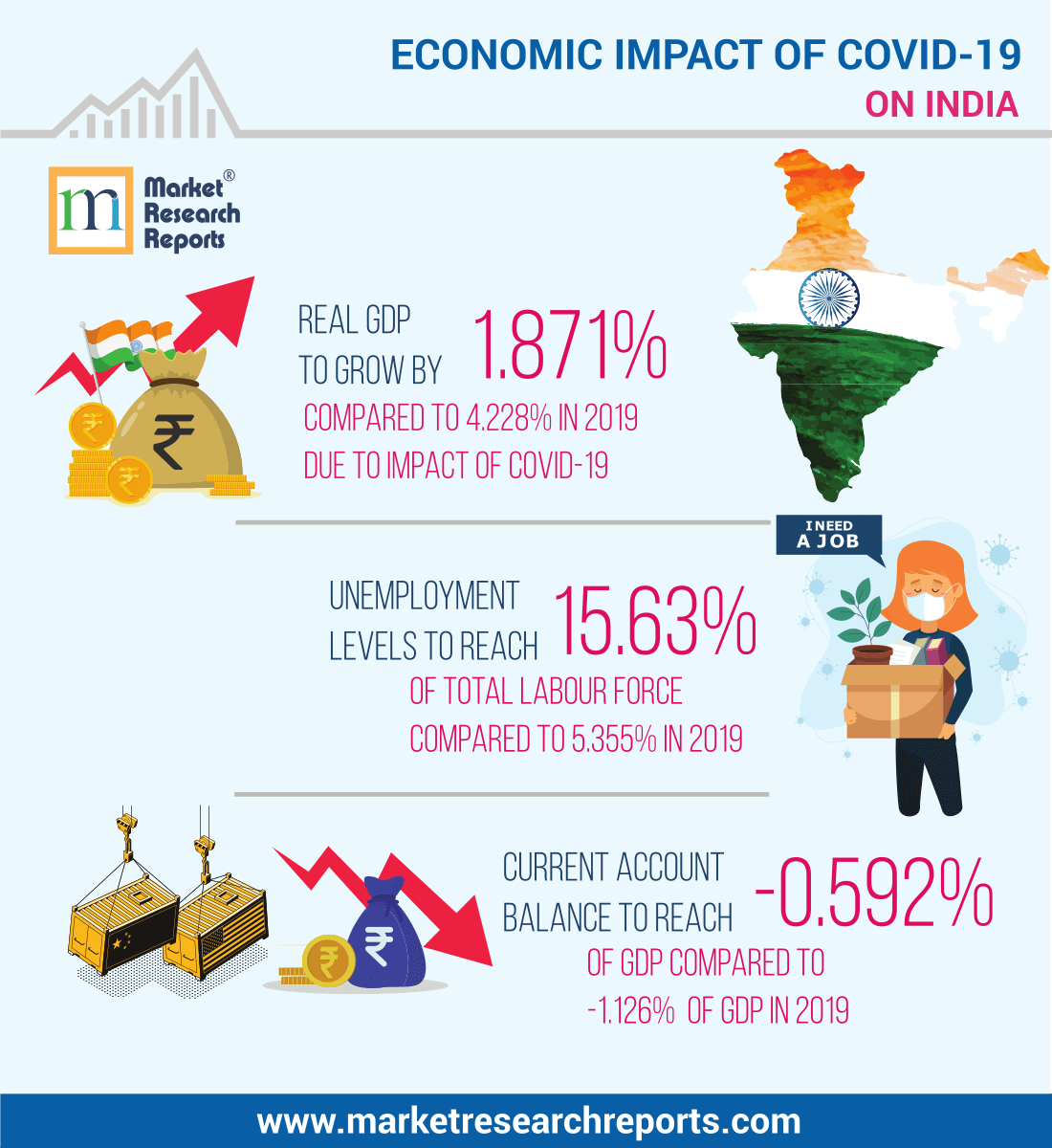
India’s real gross domestic product (GDP) was INR 1,47,059.21 billion in 2019 and due to COVID-19 outbreak it is estimated to grow by 1.871% to be around INR 1,49,810.69 billion in 2020.
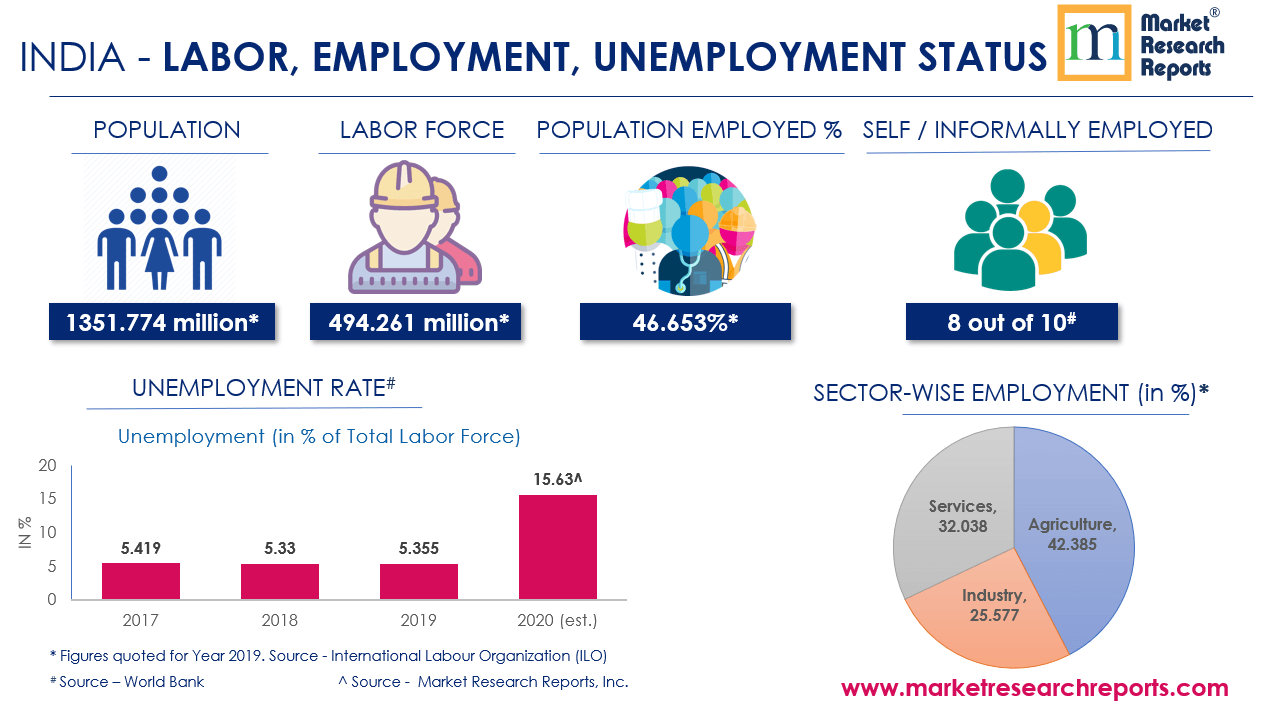
As per International Labour Organization (ILO), India’s labor force has been increasing at a CAGR of 1.03% since 2017 and was estimated at 494.261 million in 2019. On the other hand, India’s % of employed population had be decreasing at a CAGR of 0.56% since 2017 and was estimated at 46.653% in 2019.
The employment in Indian agriculture segment which consists of activities like agriculture, hunting, forestry and fishing has been declining at a CAGR of 1.91% since 2017 and was estimated to generate 42.385% of total employment in 2019.
The employment in Indian industrial segment which consists of activities like mining and quarrying, manufacturing, construction and public utilities (electricity, gas, and water) has been increasing at a CAGR of 1.76% since 2017 and was estimated to generate 25.577% of total employment in 2019.
The employment in Indian services segment which consists of activities like wholesale and retail trade and restaurants and hotels; transport, storage, and communications; financing, insurance, real estate, and business services; and community, social, and personal services has been increasing at a CAGR of 1.26% since 2017 and was estimated to generate 32.038% of total employment in 2019.
India’s unemployment rate was 5.355% of total labor force in 2019. Due to slowdown in global economic activity due to COVID-19 pandemic the unemployment is expected to increase by 65.74% and reach 15.63% in 2020. As per Centre for Monitoring Indian Economy (CMIE) India’s unemployment rate reached its highest level on 23rd May 2020 at 24.60% of total labor force. As of 10th June 2020, the unemployment rate has come down to 20.32%.
As per World Bank, in India about 8 out of 10 workers are self-employed or have informal employment. The self-employed work on their own account, or with one or a few partners, or in a cooperative. Informal employment comprises all workers of the informal sector and informal workers outside the informal sector.
In India’s case this high proportion of self-employed and informal workers indicates a large agriculture sector and low growth in the formal economy. A high proportion of contributing family workers who are generally unpaid, even though they contribute towards family income indicates weak development, little job growth, and often a large rural economy.
Self-employed and informal workers are the most vulnerable as they don’t have any formal work arrangements, are the least likely to have social protection and safety nets to guard against economic shocks like the once caused by COVID-19 pandemic, and often are incapable of generating sufficient savings to offset these shocks.
This include a large number of migrant workers who have been displaced from their job locations due to COVID-19 pandemic. In the remaining month’s in this financial year it is unlikely that the unemployment situation will normalize to pre COVID-19 time. If India is not hit by second wave of COVID-19 in monsoon or winter season, then unemployment levels can reach 15.36% levels.
As per IMF, India’s current account balance is expected to be -0.592% of GDP in 2020, meaning India will remain a net borrower from rest of the world in 2020.
As of 10th June 2020, the India government has taken following fiscal, monetary and social policy measures to contain coronavirus (COVID-19) pandemic.
2. Coronavirus (COVID-19) Containment Measures of India
COVID-19 Containment and Quarantine Measures
On 24th March 2020, Indian government announced complete lockdown in whole country from 25th March 2020 for 21 days till 14th April 2020. This was extended for another 19 days from 15th April 2020 to 03rd May 2020. Due to prevailing situation related to COVID-19 lockdown was extended for another 14 days from 4th May 2020 to 17th May 2020. The last extension of lockdown was for 14 days from 18th May 2020 to 31st May 2020.
On 1st June 2020, the nation-wide lockdown was lifted except for containment zones. Although there will be night curfew from 9PM to 5AM barring essential activities. All Indian state governments were given responsibility to and to restrict economic activities and mobility by demarcate containment zones into red, green, orange categories on the basis on COVID-19 infection rates. In the red containment zones the lockdown is extended up to 30th June 2020. Only essential activities are allowed, and strict perimeter control is implemented to ensure that there is no movement in or out of these zones, except for medical emergencies, and for maintaining supply of essential goods and services.
Domestic and International travel restrictions
From 25th March 2020, domestic flights were stopped completely and resume operations with limited capacity and in adherence to new directives from 25th May 2020. From 01st June 2020, the India's rail network resumed some passenger services which were suspended since 22nd March 2020. International flights on the other hand remain suspended till 30th June 2020. This excludes approved all-cargo operations and other flights.
Closure of Education Institutions
From 25th March 2020, all educational institutions in India remain closed. Indian government is expected to take a decision about their reopening after consulting various state governments in July 2020.
Closure of public places and all type of events
From 25th March 2020, all public places like places of worship, shopping mall, multiplexes, gyms, zoos, bars, restaurants, clubs etc. were closed for the public following nationwide lockdown. No large-scale gatherings were permitted for any type of political, social, religious, sports, entertainment, cultural, marriage function etc during the lockdown. From 8th June 2020, some public places like shopping malls were allowed to be open. Permission was also given for public events, although with some restrictions e.g. not more than 50 people are permitted for weddings while 20 people for funerals. and.
Mandatory closure of economic activities
- From 25th March 2020, all economic activities were suspended except shops dealing with essential commodities like perishables, groceries, pharmacies and dairy.
- On 20th April 2020, the Indian government announced a gradual exit strategy to lessen the impact lockdown on economy. In identified green containment zones with zero COVID-19 related cases work were allowed to resume in factories located in rural area and in sectors like agriculture, logistics, infrastructure and e-commerce. Construction activities for roads, irrigation projects, buildings and industrial projects were also allowed where workers were available on site. The government has also allowed people to take up jobs under the National Rural Employment Guarantee Act (MGNREGA), a public employment programme targeting the poor in rural areas. Services provided by self-employed people such as electricians, electronics repairers, plumbers, motor mechanics and carpenters, have been allowed to operate.
- From 3rd May 2020, all private offices were allowed to operate at 33% occupancy while rest of the employees working from home. For employees attending offices sanitation of workplace, following of social distancing norm and wearing of face masks were made mandatory. Industrial establishments in urban areas including Special Economic Zones were permitted. Other industrial activities like manufacturing of essential goods, including drugs, medical devices, their raw material and intermediates; production units which require continuous process and their supply chains; manufacturing of IT hardware; jute industry with staggered shifts and social distancing and packaging manufacturing units were also allowed. Shops in urban areas for non-essential goods were not allowed in shopping malls and market complexes. E-commerce activities in red districts were restricted for essential goods only.
- On 17th May 2020, the government allowed all shops, except those in malls and containment zones to open. Also, salons and barber shops were allowed to open. All restaurants were allowed to function for take-away only. E-commerce websites were allowed delivery of all essential and the 33% employee occupancy restriction on private office operations was removed.
- From 1st June 2020, all shops except those in containment zones were allowed to open.
3. Coronavirus (COVID-19) Related Fiscal Policy Measures by India
- On 26th March 20, Indian government introduced an INR 1.7 trillion financial package aimed at ensuring that families belonging to poor and lower to middle income groups can carry out their daily lives smoothly under the lockdown. This package was accompanied by an emergency health package of INR 0.15 trillion and measures to fast-track the refund of pending income taxes and other dues. The government also declared the COVID-19 pandemic as "notified disaster"; under the Disaster Management Act, 2005, enabling state governments to spend a larger part of funds from the State Disaster Response Fund (SDRF) to fight the coronavirus.
- On 12th May 2020, the Prime Minister announced that the overall support to the economy will be raised to INR 20 trillion (around 10% of GDP), including fiscal and monetary (liquidity) measures already announced since March 2020.
- On 13th May 2020, the Indian Finance Minister announced support measures targeting some stressed sectors and firms, especially micro, small and medium enterprises, formal sector employees, non-bank financial companies (shadow banks), power and real estate sectors.
- On 14th May 2020, Indian government announced new support measures equivalent of about 1.6% of GDP with focus on domestic migrant workers, informal businesses, farmers and middle-income households.
- On 15th May 2020, Indian government unveiled a set of fiscal and structural reform measures devoted to the agricultural sector, equivalent of about 1.1% of GDP.
- On 16th May 2020, Indian government announced a package of structural reforms targeting 8 industrial sectors.
- On 17th May 2020, Indian government announced it will increase the amount of resources devoted to the rural public employment programme (MGNREGA), public health and education. Borrowing limits for the state governments were also be raised from 3% to 5% of GDP, conditional to the implementation of reforms. The central government also announced a series of reforms related to the insolvency and bankruptcy code and presence of public and private companies in the economy.
Policies related to Indian healthcare system
- On 19th March 2020, hospitals were asked to defer elective surgeries and the government capped the price of sanitizer bottles and banned exports of masks, ventilator machines and also textiles used to make masks.
- On 24th March 2020, the government announced an emergency health fund of INR 150 billion (USD 2 billion) for treating COVID-19 patients and strengthening the medical infrastructure including for rapidly ramping up the number of testing facilities, personal protective equipment, isolation beds, intensive care unit beds, ventilators and other essential equipment. Training of medical and paramedical manpower will also be undertaken. Some states (including Gujarat, Assam, Jharkhand, Rajasthan, Goa, Karnataka, MP and J&K) are setting up hospitals dedicated for the management of COVID-19. A large number of laboratories were included in the Indian Council of Medical Research (ICMR) network of COVID-19 testing and private lab chains have registered with ICMR to increase testing capacity. On 8th April 2020, the Supreme court on India in a ruling ordered that all COVID-19 tests must be provided for free.
- The 26th March 2020 central government package includes insurance cover of INR 5 million per health worker fighting COVID-19 to be provided under Insurance Scheme.
- On 5th April 2020, the export restrictions which were imposed on 26 pharma products (active pharma ingredients and formulations) since 3rd March 2020 were removed. Paracetamol and Hydroxychloroquine were the only two exceptions.
- On 5th April 2020, Indian government placed restrictions on the export of most diagnostic testing kits.
- 10th April 2020, Indian government launched a mobile app (Aarogya Setu) to help people identify their risk of contracting COVID-19, by tracking and contact tracing and to connect people to health care services. As of 11th June 2020, Aarogya Setu App has been downloaded more than 100 million times making number 1 App in health & fitness category on Google and Apple app marketplaces.
- On 17th April 2020, Indian government lifted export restrictions on paracetamol formulations with immediate effect.
Policies supporting individuals and household’s income not including tax changes
-
On 26th March 2020, Indian government financial package targeting low and middle-income groups. Major provisions of the package were:
- 800 million poor people to get 5 kg wheat or rice and 1 kg of preferred pulses for free every month for the next three months
- 200 million women Jan Dhan account holders under financial inclusion program to get INR 500 per month for next three months
- Increase in wage for workers engaged in the rural public employment programme (MGNREGA) to INR 202 a day from INR 182 to benefit 136.2 million families
- An ex-gratia of INR 1,000 to 30 million poor senior citizen, poor widows and poor disabled
- Central government has given orders to state governments to use Building and Construction Workers Welfare Fund to provide relief to Construction Workers.
-
On 14th May 2020, Indian government announced new support measures, equivalent of about 1.6% of GDP, including:
- Free food distribution for migrant workers who are not part of the food safety net by providing them 5kg of grains per person and 1kg of chickpeas per family per month for two months.
- Portability of public ration cards to allow migrant workers to withdraw their subsidised food across the country
- The launch of a rental housing scheme for urban migrant workers, through a public private partnership and concessionaires and by converting vacant government-funded houses.
- The public agency for agricultural and rural credit (NABARD) will extend additional refinancing support for crop loan requirement of rural-based banks, targeting small and marginal farmers.
- Concessional loans to farmers through Kisan Credit Cards (pre-existing financial instrument).
- New job opportunities for afforestation and plantation works.
- A 2% interest subvention on micro loans for a period of 12 months for loans up to INR 50,000 (around USD 660) under the existing MUDRA scheme was announced for small/informal businesses.
- Special lending programme for street vendors of up to INR 10,000 (around USD 130) to finance their working capital, targeting about 5 million street vendors.
- New interest subsidy on housing loans scheme for middle-income households was extended by 12 months.
- On 17th May 2020, the government increased the envelop devoted to the rural public employment programme (MGNREGA) by INR 400 billion (0.2% of GDP).
Tax related policy changes
- On 26th March 2020, Indian government committed to pay employee provident fund contributions on behalf of employees and employers (12% each) for March to May 2020, for formal employees from the organised sector (i.e. firms with more than 10 employees) with up to 100 employees, where 90% of them are earning less than INR 15,000 per month. The government also amended its pension regulations, so that workers can draw up to 75% for their contingency expenditure non-refundable advance or three months of wages in advance, whichever is less. This was intended to benefit 48 million workers.
- On 13th May 2020, the government announced it will continue to pay provident fund contributions for the period June-August 2020. For those firms and employees not eligible for this scheme, the contribution rate was reduced from 12% to 10%. Indian government also reduced rates for tax collected or deducted at source (TDS) on non-salaried specific payment (professional fees, interest, rent, dividend, commission, brokerage, etc), by 25% until 31st March 2021.
Deferral of taxes and bringing forward expenditures within current fiscal year
- On 13th May 2020, Indian government extended due date for all income tax returns for FY2019-20 to November 2020. The due date for tax audits and assessments were also extended. Tax refunds to charitable trust, non-corporate businesses and professions were to be issued immediately.
- On 8th April 2020, Indian government announced that all pending income tax refunds up to INR 500,000 (around USD 6500) and GST/custom refunds will to be issued immediately.
- On March 24, the deadline for filing returns of goods and services tax for March, April and May has been extended till June 30. For companies with less than INR 50 million turnover, no interest, penalty or late fee will be charged on late GST return filing. For companies with turnover of over INR 50 million, no late fee and penalty will be charged on late GST return filing; interest rate was reduced to 9%.
- On March 26, the central government announced it will front-load INR 2,000 paid to farmers in first week of April under existing PM Kisan Yojana to benefit 87 million farmers.
Loan guarantees benefiting private borrowers by Indian government
On 13th May 2020, Indian government announced a series of measures worth about INR 6 trillion (3% of GDP) with an aim to provide liquidity to some stressed sectors and firms, in particular micro, small and medium enterprises, formal sector employees, non-bank financial companies (shadow banks), power and real estate sectors. The implications for the fiscal deficit in FY 2020-21 are significantly lower since most measures are in the form of credit guarantees.
The main policies announced for micro, small and medium enterprises were:
- Eligible micro, small and medium enterprises can access an emergency credit line of 20% of their outstanding credit, with 100% government credit guarantee and a moratorium of 12-months on principal repayment.
- Stressed micro, small and medium enterprises requiring equity support will be given access to an INR 200 billion subordinate debt scheme with partial loan guarantee. Indian government will provide INR 40 billion to the 200 billion fund.
- To provide equity funding for firms with growth potential, a fund of funds of INR 500 billion will be set up with a INR 100 billion corpus.
- Global tenders are now excluded from government procurement of up to INR 2 billion to protect firms from foreign competition.
- Receivables from government and central public sector enterprises to be released in 45 days to help firms manage their cash flows.
The main policies announced for power and real estate companies were:
- Power distribution companies (DISCOMS) will benefit from liquidity injection via loans against state government guarantees (INR 900 billion) to enable them to fulfil their liabilities towards power generation companies.
- Real estate companies will be given extension of 6-month for registration and completion timelines, with COVID-19 to be treated as an event of 'Force-Majeure'
The main policies announced for non-bank financial companies (shadow banks) were:
- The government will launch a fully guaranteed INR 300 billion special liquidity scheme to invest in investment grade debt paper of shadow banks bought in both primary and secondary markets. The securities will be fully guaranteed by the government to support confidence in the market.
- The partial credit guarantee scheme introduced in December 2019 for public banks purchasing high-rated pooled assets from shadow banks is expanded to cover borrowings of lower-rated shadow banks. The government will bear the first 20% loss.
4. Coronavirus (COVID-19) Related Monetary Policy Measures by India
- On 16th and 23rd March 2020, the Reserve Bank of India (RBI) conducted 6-month US Dollar/INR sell/buy swap auctions which cumulatively provided dollar liquidity of USD 2.71 billion.
- On 27th March 2020, the RBI Monetary Policy Committee announced a 75 basis points reduction in the policy repo rate with an accommodative stance of monetary policy as long as necessary to revive growth, while keeping inflation within the target. RBI also announced on several liquidity measures to combat the adverse impacts of COVID-19, including: long-term repo operations targeted to reduce banks' cost of funds for up to INR 1 trillion, simultaneous purchase and sale of securities under open market operations, reduction in the cash reserve ratio (CRR) requirements and exemption from cash reserve ratio requirements to incentivise lending to specific sectors (retail loans for automobiles, residential housing and loans to micro, small and medium enterprises).
-
On 17th April 2020, the RBI announced additional measures with an aim to promote new lending and mitigate financial market stress:
- RBI cut the reverse repo rate by 25 basis points from 4.0% to 3.75% to increase incentives for banks to lend more to businesses and individuals instead of letting their cash with the Reserve Bank.
- RBI was to conduct new targeted long-term repo operations, with the objective of making it easier for non-bank financial companies (which tend to lend more to small business and informal workers than banks) and micro-finance institutions to raise money.
- On 17th April 2020, RBI announced that regulatory norms were being softened, with a temporary reduction in the liquidity coverage ratio for banks and an extension in bankruptcy resolution timelines from 210 days to 300 days. The Reserve Bank of India (RBI) offered temporary forbearance, or moratoriums, on assets considered standard as of 1st March 2020. For those assets, the 90-day non-performing loan norm shall exclude the moratorium period, meaning that assets considered standard on 1st March 2020 would continue to be considered standard until 31st May 2020, even if no repayment is made during the period. Non-bank financial corporations can also grant such moratoriums on repayments.
- On 18th April 2020, Indian government issued new FDI guidelines to block "opportunistic takeovers". An entity based in, or tied to, a country which shares a land border with India will require government approval before investing in an Indian company (instead of the so-called "automatic route").
- On 27th April 2020, the RBI announced a special liquidity facility for mutual funds for up to INR 500 billion (around USD 6.7 billion).
- On 22nd May 2020, the RBI cut the repo rate by 40 basis points to 4%.
- To provide relief to small and medium enterprises (MSMEs) facing the threat of insolvency because of COVID-19, the threshold for invoking insolvency has been raised 100-fold to INR 10 million. If the situation continues beyond 30th April 2020, the government may consider suspending relevant sections under the Insolvency and Bankruptcy Code for six months to avoid companies from being forced into insolvency proceedings under such force majeure causes of default.
5. Coronavirus (COVID-19) Related Social Policy Measures by India
Indian government announced a slew of social policy measure to support low middle-income families. These included –
- Provision of 5kg of rice or wheat per person, and 1kg of pulses per household, free of cost for three months
- INR 500 cash transfer (around USD 6.6) per month, for the next 3 months, to 200 million women through Jan Dhan bank accounts opened under financial inclusion programme.
- INR 1000 cash transfer (around USD 13.3) for 3 months to 30 million poor senior citizens, widows and disabled.
- Doubling the amount of collateral-free loans for self-help group (SHG) of women benefiting 63 million women to INR 2 milion vs INR 1 million earlier.
- State governments were asked to provide relief for construction industry workers using the welfare fund for building and construction labourers, consisting of ~INR300bn.
- For formal employees from the organised sector, the government has committed to pay employee provident fund contributions on behalf of employees and employers (12% each) for the next three months, for firms with up to 100 employees, where 90% of them are earning less than INR15,000 per month. This scheme was initially applicable from March to May 2020 but later was extended for the period of Jun-Aug 2020. This is expected to benefit about 0.4 million firms and 7 million employees.
- The government is also amended its pension regulations, so that workers can draw up to 75% for their contingency expenditure non-refundable advance or three months of wages in advance, whichever is less.
- The statutory provident fund contribution rate for both employer and employee is reduced to 10%. This is expected to support disposable incomes of 43 million employees.
- Free cooking gas bottles for 83 million poor households.
Source – With inputs from Organisation for Economic Co-operation and Development (OECD), International Monetary Fund, World Bank, International Labour Organization (ILO), Government of India and Centre for Monitoring Indian Economy (CMIE)