


Global Biofuels Market Outlook
Global Biofuels Market Outlook
Due to the ongoing pandemic, stay-at-home measures are keeping vehicles off the road, cutting the demand for biofuel drastically. But as economies are unchaining and people are starting to settle down in post-pandemic life, they will most likely avoid mass transportation. People who own private vehicles would likely go solo hence the demand for biofuels will be back on track.
In this blog post, we will be covering the impact of COVID-19 on biofuel industry along with other topics mentioned below.
-
Biofuel Introduction
-
Biofuel Market Drivers and Inhibitors
-
Top Ethanol Producing Companies
-
Overall Biofuel Market Forecast in USD Billion
-
Global Ethanol Production in 2014-2025
-
Impact of COVID-19 on Global Biofuel Market

1. Biofuel Introduction
A biofuel is a hydrocarbon made from/by living organisms. In general, it is defined as any hydrocarbon fuel produced from organic matter (something living or was once living) in a short period of time. This is in contrast to fossil fuels which take millions of years to form.
Some examples of biofuels can be listed below –
• Ethanol– produces half the energy per mass of gasoline, burns cleaner but produces more ozone than gasoline. Engines need to be modified to run on Ethanol.
• Biodiesel – Corrosive to engine parts and provides slightly less energy than regular diesel. Burns cleaner as compared to diesel producing fewer sulfur compounds.
• Methanol – Produces 33% to 50% of the energy as compared to the same mass of methane. Easier to transport than methane since it occurs in liquid form.
• Biobutanol – Can be used without modification to engine and produces slightly less energy than regular gasoline.
2. Biofuel Market Drivers and Inhibitors
Drivers
- Lower emission levels in consumption – Biofuels produce lower emissions and burn cleaner than conventional fossil fuels and hence can be increasingly substituted in a blended form with conventional gasoline.
- Renewable resources – Biofuels are produced from biological carbon fixation of biomass which is renewable in nature i.e. they can be produced again and again over a short span of time and are within the control of human beings in terms of production. On the other hand, fossil fuels take thousands of years to make and are available in limited exhaustive quantities.
- Global awareness about environmental issues – Increasing awareness about global warming and other environmental issues are causing the demand for more renewable and clean energy fuels.
- Government policy mandates – A significant demand driver for biofuels is the prevailing government mandates in many countries including the US and Europe to substitute a certain percentage of their transport fuel with biofuel in a blended form. The global average mandate which is at around 10% is expected to go up to 15% by 2018 and 20% by 2020.
- Diversification, reduction of imports, and reduced external dependence – Biofuels could lead to energy security and independence in the long run along with providing diverse options for the various industries in terms of available fuels. It helps reducing dependence on imports for crude oil and provides opportunities for oil import-dependent countries to reduce their trade imbalance by investing in biofuel production.
Inhibitors
- Harmonization between fuel and food production – 99% of the global biofuels are first-generation i.e. they are produced from food products like corn, soybean, sugarcane, etc. Since biofuel directly competes for its raw materials from the food industry it poses risk to the global food supply and hence might result in inhibiting the growth of the biofuel industry.
- Increasing demand for arable land – Declining availability of arable land while increasing demand of it for food production puts pressure on the biofuel industry as it also needs arable land in order to grow its feedstock.
- Higher risks to biodiversity – Cultivation of feedstock for biofuels leads to monoculture which means growing the same crops again and again on the same land. This leads to erosion of soil fertility and loss of vital nutrients from the soil.
- The concentration of assets – Most of the assets including arable land, machinery, technical expertise are held by only a few large players (seed industry is oligopolistic with few big players like Monsanto, Bayer etc. controlling the supply). This inhibits future research and development and emergence of new technology and expertise in the industry.
3. Top Ethanol Producing Companies
Privately held USA-based POET Llc had overtaken industry pioneer and global grain merchant Archer Daniels Midland Co in 2018 and became the top ethanol producer in the world. POET’s annual biofuel capacity has grown to 1.9 billion gallons and will reach 2 billion by 2019; ADM’s has shrunk to about 1.6 billion gallons. List of leading ethanol-producing companies:
- POET LLC
- Archer Daniels Midland
- White Energy
- Green Plains
- Flint Hills Resources
- Valero
- Cargill
4. Overall Biofuel Market Forecast in USD Billion
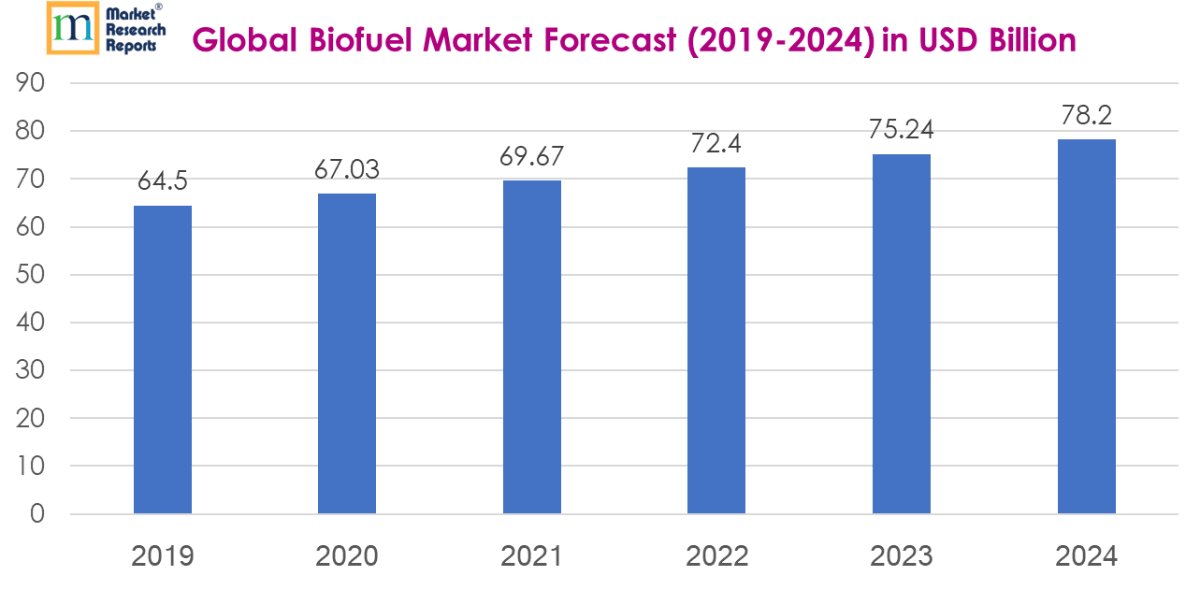
According to a new biofuel market research report, over the next five years, the Biofuels market will register a 3.93% CAGR in terms of revenue, the global market size will reach USD 78250 million by 2024, from USD 64580 million in 2019.
5. Global Ethanol Production in 2014-2025
6. Impact of COVID-19 on Global Biofuel Market
World's largest ethanol producer, the U.S. which had produced 1,190.2 thousand barrels/day in 2018, is cutting production like never before. Due to COVID lockdowns vehicles are off the roads, and demand for fuel has been decreased all over the country. The U.S alone holds 45% to 50% of the world’s biofuel production market.
The U.S. Energy Information Administration (EIA) increased its forecast for 2020 ethanol production but lowered its prediction for 2021 ethanol production in its latest Short-Term Energy Outlook, released on May 12. EIA said it is forecasting significant decreases in U.S. liquid fuel demand during the first half of 2020 as a result of COVID-19 travel restrictions and disruptions to business and economic activity. The EIA expects the largest impacts to occur in the second quarter of 2020 before gradually dissipating over the next 18 months.
The EIA’s most recent weekly data shows ethanol production averaged 598,000 barrels per day during the week ending May 1, up from 537,000 barrels per day the previous week. Weekly ethanol ending stocks for the week ending May 1 were at 25.612 million barrels down 26.337 million barrels the previous week.
The South American country, Brazil is the second-largest biofuel producer with an output of 693.2 thousand barrels/day in 2018. Brazil had a 26.5% share of the world’s total biofuel production in 2018. Brazil is also the second-ranked producer of biogasoline in the world with a 31.5% share.
Brazil has about 15 ethanol corn mills in operation, three in pre-operational stages, and 23 new plants are in the pipeline. The jump in corn prices and the demand plunge of oil made life difficult for corn-ethanol mills who buy the raw material directly from farmers. Analysts are predicting if oil prices stay near current levels, it’s likely only 40% of the plants will continue.
Sources: Bloomberg, EIA Website, OECD yearly trade data, and internal body of knowledge