


Wearable Computing in Healthcare, Gaming, Defence and other Industries
Wearable Computing in Healthcare, Gaming, Defence and other Industries

Technology has been a major driving force for innovation in the last few centuries where innovation and developments of devices, accessories and products in every aspect of human life.
Be it related to health, politics, medicine, utilities, energy or any small or big crucial factor, technology is a tool that has made life to be more simple, tasks to be more doable and more importantly, the technology to be an integral part of human existence and be able to better the existing one even more.
The benefit of wearable technology is immediacy. Devices can communicate with wearers about their environment and create or change a behavior in the moment. However, most of the current wearable technology offers limited user interactions. Instead of engaging with content on a wearable device, rich interactions are facilitated through another device like a tablet or smartphone.
- IHS predicts the global wearables market could reach US$30 billion in 2018.
- Juniper Research estimates that there will be nearly 70 million smart wearable devices sold in 2017.
- IMS Research on the world market for wearable technology found that 14 million wearable high-tech devices were shipped in 2011.
Several factors converging to facilitate wearable technology integration including expanded wireless capacity due to pervasive wireless such as WiFi, WiMAX, and LTE. Wearable technology presents the potential for massive transformation in many industries. The more obvious ones include consumer electronics and communications. Early adopter industries include clothing, healthcare, sports and fitness. However, many industries are adopting wearable technologies as computing and wireless communications integrate wearable into virtually every aspect of products and services.
An important design consideration for wearable technologies is understanding how to deliver as much information as possible to users before they transition their attention to another device. Wearable technologies ability to capture users' attention, provide immediate visual notifications, and stimulate a response from the wearer requires a different approach than text-heavy communications. The physical constraints of devices such as smartwatches that offer brands an opportunity to use a rich visual language to quickly communicate to users ideas that would otherwise require scrolling through lots of text.
In the coming decade, wearable technology is expected to touch nearly every aspect of human lives. It is definitely going to allow and open up many possibilities to bring the power of the Internet to everything we do and see. In the recent developments of venture capital funding for wearable technology recently suggest that the size of funding surpassed half a billion dollars and is rapidly accelerating. In the face of such optimism it is critical not to confuse novelty with value to the consumer. The best products in this space provide an ongoing utility beyond the novel location of the device. Different industries developing and functioning with the ongoing innovation and implementation of wearable technological accessories, devices and overall experience are listed in the following:
Gaming & Entertainment
The gaming industry has always been one of the major industries to take advantage of technological innovations, innovations and incorporation of technologies such as HTML5 and 3D, to improve the user experience, and it’s not stopping now with wearable technology in gaming taking the virtual reality concept, which has been around for many years, and make it possible to become mainstream.
Wearable technology is expected to soon initiate a new chapter of mobile entertainment and mass market games. Mind Pirate, a developer of mobile games and gaming technology that combine real and virtual worlds, recently announced plans for offering games and technology that go beyond the typical touchscreen-only design and tap into the full range of mobile sensing capabilities that are unique to current smartphones, tablets and next-generation devices such as Google Glass.
 For example one of the major companies in gaming wearable section is The Oculus Rift. The company manufactures an virtual reality head-mounted display. It is being developed by Oculus VR, who have raised US$91 million, of which $2.4 million was raised with crowdfunding via Kickstarter.
Clothing, Sports & Fitness
As wearable products become a more prominent piece in the technological playing field, their impact on sports will continue to grow exponentially. How various sporting games will be played and managed going forward will inevitably be persuaded by the advancement of technology. Teams, leagues, coaches and players will rely heavily on the introduction of new, innovative products. Sports have already begun dabbling in this new wave of wearable technology, with running being one of the most commonly associated with the trend. Introduction of Adidas miCoach Smart Run watch, and Nike Furl Band are some of the excellent inventions in the sports and technology combined industry. These bands and watches serve several purposes and offer value to runners, and any sport athlete who constantly seek to stay in tune with their training performances. The products, like many others newly introduced to the marketplace, takes advantage of GPS technology, allowing for a more accurate measure of distance and time.
 European online retailer, Blacksocks, manufacters Smarter Socks, the first socks use RFID technology to facilitate sorting and to ensure that each sock is correctly matched to its pair after washing. Smarter Socks are implanted with RFID chips that communicate with the Sock Sorter, which allows iPhones to be RFID-compliant.
Healthcare
Using new wearable electronics as light and thin as temporary tattoos, scientists have now taken a person's temperature and monitor not only their health but also their mental state. Taking a person's temperature can reveal more than a fever. For instance, analyzing tiny, regular variations in body temperature can reveal how blood vessels are constricting and dilating, which is linked to cardiovascular health. Monitoring changes in temperature can even shed light on a person's mental state.
The best existing technologies for measuring skin temperature include simple, paste-on sensors and sophisticated infrared cameras. Although paste-on sensors are cheap and help doctors monitor patients as they move freely, these devices cannot monitor changes in great detail, across the skin. Moreover, they irritate the skin, changing its natural responses. While infrared cameras enable high-precision temperature measurements in high detail across the skin, they are expensive, and require patients to keep still.

One of the good example of werable computing in healthcare projects is CuPiD. CuPiD stands for Closed-loop system for personalized and at-home rehabilitation of people with Parkinson's Disease, People with Parkinson’s disease (PD) suffer from motor and cognitive impairments that severely impact mobility, fall risk, and multiple key aspects of functional independence. for more information click on the CuPiD logo.
Industrial & Enterprise
As corporations see the benefits and embrace wearable technology, there will be an opportunity to sell or upgrade application firewalls in order to secure companies from malicious attacks. Corporations will need confidence that their application firewalls are both up to the task of stopping unauthorized access and of allowing authorized transactions. The two main ways are in the areas of access and end-point security. Enterprises need to prepare for the main modes of access being WiFi or Bluetooth. In the case of WiFi, careful attention needs to be paid to the infrastructure's ability to cope with the influx. From a security standpoint, gaining oversight and managing the data that goes through the network will be the biggest challenge. Firstly, determining that devices accessing the network or the information being transmitted are legitimate.
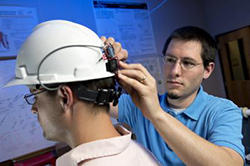 Scientists are developing wearable computing systems for construction industry and security for onsite workers are the major priorities for them, on the same line Virginia Tech students developed a wearable computing device which would be installed in a helmet to protect construction workers from carbon monoxide poisoning, a serious lethal threat in this industry. For more information regarding this project visit this link.
Military and Defense
The soldier of the future is most likely going to be the protagonist of the practical application of wearable technology. Armed forces from different countries are seeing the solution for many battle field necessities in the so-called ‘wearable computing’ field. These purely military applications are combined with others, which we have been talking about in the mobile health segment mHealth that make it possible to monitor the physical activity and various other parameters of the soldiers condition and detect and resolve any physical or health problems if necessary. An example of this are sensors like the BioHarness, which is integrated in a shirt and measures the stress levels of firemen, soldiers and even astronauts. For combat pilots there are some equally interesting proposals. Raytheon is developing systems for pilots of helicopters and other combat aircraft, which interestingly do not even require the pilots to be inside the aircraft.
What makes wearable technology click with today's generation and industrialists are some of the points in the following:
- Solve recurring and repetitive problems
- To be worn, the problem the wearable device purports to solve are substantive, recurrent, and easily articulated in a sentence.
- Can be started manually and not the machine and wearable tech device request attention, does not demand it.
- Since the device(s) will be with you everywhere, wearable tech should honor the present moment, not distract from it.
- Only enhances human capabilities, and not replace them.
- It should make the wearer better able to consume and experience the world and not replace or intervene with the wearer’s opportunity to experience it.
- In rendering a wearable solution, eliminates more problems than it introduces to one’s life.
- Enables deep and broad connectivity.
- Scale and flexibility are more readily achieved and the wearer's device capitalizes on existing behavior.
 Xybernaut mobile/wearable computers are used by law enforcement and other emergency first responders communities to enhance command, control, communications and knowledge management during critical incidents.
Related Reports