


India-Japan Trade at an Inflection Point: Mapping the 2026 Opportunity
India-Japan Trade at an Inflection Point: Mapping the 2026 Opportunity

MRR® Business Opportunity Analysis India-Japan · Trade Summit · Business 2.0
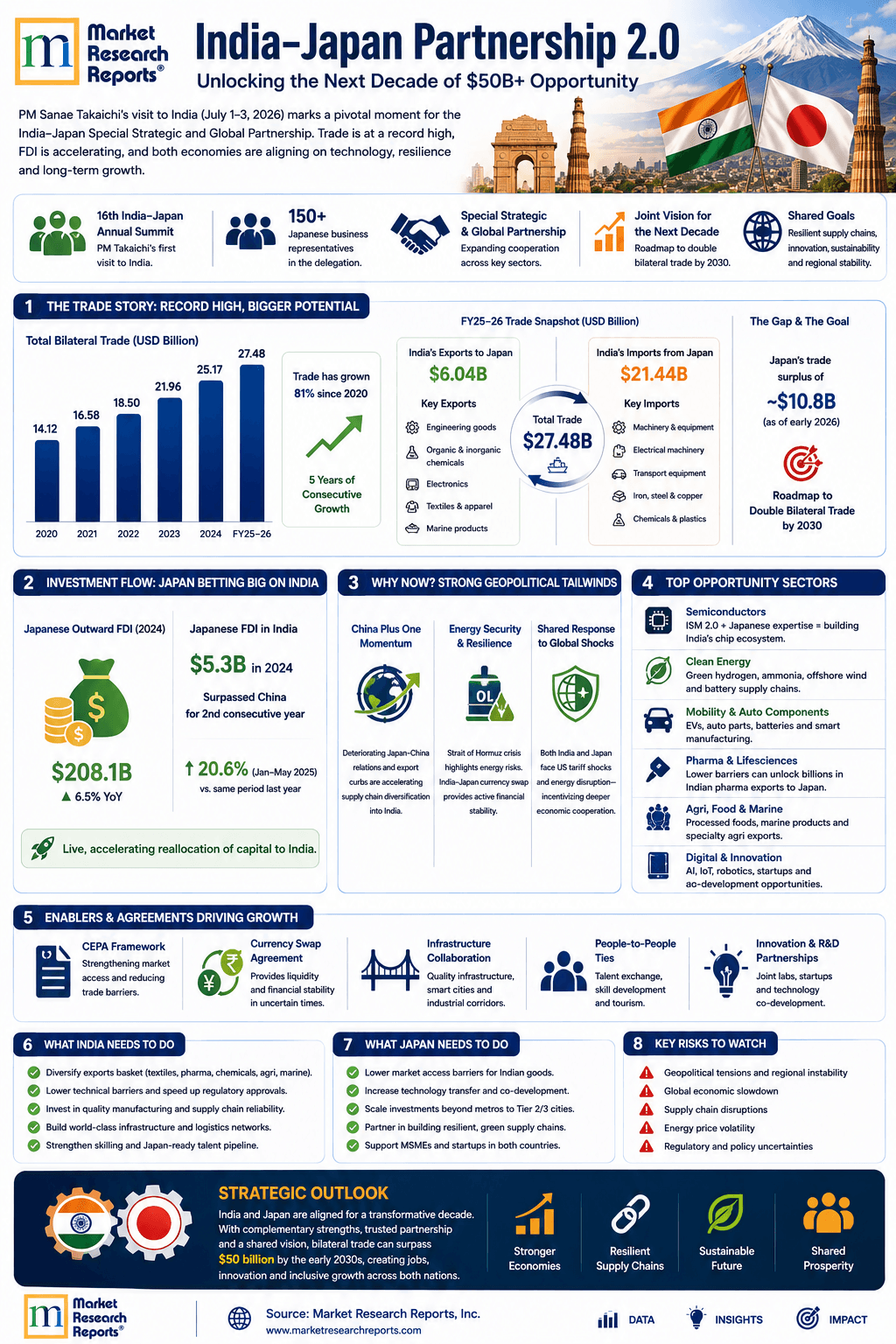
Japanese Prime Minister Sanae Takaichi is in New Delhi from July 1-3, 2026, for the 16th India–Japan Annual Summit — her first visit to India since taking office, and the first leader-level meeting since the two countries unveiled their "Joint Vision for the Next Decade" in Tokyo last August. The visit will see her hold summit-level talks with Prime Minister Modi, participate in the India-Japan Business Forum, and engage with business leaders as both sides look to expand their Special Strategic and Global Partnership. More than 150 representatives from Japan's business community are travelling with her for the India-Japan Economic Forum alone — a delegation size that itself signals how seriously corporate Japan is now taking the India opportunity.
The trade numbers back up the urgency. India's total trade with Japan in FY25-26 came in at USD 27.48 billion, with exports of USD 6.04 billion against much larger imports — a fresh record, up from the previous high of USD 25.17 billion in FY25, which was itself a record at the time. Put differently: bilateral trade has grown roughly 81% since 2020, when it stood at $14.12 billion, and the corridor has now compounded for five straight years without a down year.
Yet the same data reveals the opportunity hiding inside the headline. This is not a balanced trading relationship — it is a heavily lopsided one, and the imbalance is precisely where the growth is sitting unclaimed.
A trade relationship still finding its shape
Strip out the summit optics, and the structural story is simple: Japan sells India high-value industrial inputs; India sells Japan a comparatively narrow basket of finished goods and commodities. Japan's 2024 exports to India were led by copper cathodes ($1.95 billion), precious metal compounds and automotive gearboxes — the inputs of Indian manufacturing, not its outputs. On the other side, Japan's imports from India were led by vehicles in the 1000–1500cc segment ($588.5 million) and electronics ($460.4 million), with diamonds and heterocyclic chemicals rounding out a fairly concentrated export basket.
The result, confirmed at the most recent Joint Committee Meeting under the India-Japan CEPA (Tokyo, March 2026), is a trade gap of roughly $10.8 billion in Japan's favour as of early 2026, with India's Commerce Secretary pressing Japan's METI to lower technical barriers for Indian pharmaceuticals, textiles and agricultural products specifically to narrow it. That same meeting concluded with a roadmap to double bilateral trade by 2030 — an explicit, government-endorsed target businesses on both sides can plan against.
Two structural facts follow from this, and they define the opportunity map for the rest of this analysis:
- India's export basket to Japan is under-diversified relative to what India actually makes. Textiles, pharmaceuticals, processed foods, marine products, and specialty chemicals are all sectors where India has global cost and scale advantages that are barely showing up in the Japan trade numbers yet.
- Japan's capital and technology are actively looking for a second Asian base. Japanese outward FDI rose 6.5% year-on-year to $208.1 billion in 2024, with investment into India reaching $5.3 billion — surpassing investment into China for a second consecutive year, and investment into India grew a further 20.6% between January and May 2025 versus the same period a year earlier. This is a live, accelerating reallocation of capital, not a one-off announcement.
WHY NOW: the geopolitical tailwind is doing real economic work
It would be a mistake to read this summit purely as a ceremony. Three external shocks are pushing Tokyo and New Delhi closer together commercially, and each has a direct trade implication.
1. The "China Plus One" shift is no longer theoretical. Japan-China relations have deteriorated sharply after PM Takaichi's parliamentary remarks on Taiwan, with China imposing fresh export controls on 40 Japanese entities, including defence contractors and research institutions, just days before Takaichi departs for New Delhi. Beijing has also curbed Japanese seafood imports as a retaliatory measure. For Japanese manufacturers already hedging supply-chain concentration risk, India's pitch as an alternative production base has gone from "nice to have" to "urgent."
2. The Strait of Hormuz crisis has made energy-security cooperation concrete rather than symbolic. Asian economies account for 75% of oil and 59% of LNG exports transiting the strait, and QatarEnergy declared force majeure on LNG contracts after Iranian strikes damaged the Ras Laffan complex. The India-Japan currency swap, renewed days before the crisis erupted, is now functioning as an active stabilisation mechanism rather than a symbolic pillar — and it has opened the door to a much bigger financial-plumbing conversation (more on this below).
3. Both economies are also absorbing US tariff shocks. Both India and Japan have contended with arbitrary tariffs imposed by the Trump administration, on top of the Iran-related energy disruption - giving both governments a shared incentive to deepen a relationship that reduces third-country exposure.
Sector-by-sector: where the opportunity is concentrated
1. Semiconductors — the single biggest structural opening
This is arguably the most consequential shift in the entire relationship. India's semiconductor ambitions have moved from subsidy announcements to physical construction. As of March 2026, ten semiconductor units have been approved under the India Semiconductor Mission, including two fabrication plants and eight ATMP/OSAT facilities, with investment commitments of roughly ₹1.6 trillion ($17.3 billion); Micron's Sanand plant has begun commercial production, and three others are running pilot lines. The government has now shifted strategy with ISM 2.0, which focuses on building the ecosystem — equipment and materials manufacturing, chip design IP, and R&D — rather than chasing individual fabs, with ₹1,000 crore allocated for FY 2026-27 and ₹8,000 crore for the broader Modified Programme for Semiconductor and Display Manufacturing.
This is a direct invitation to Japan, which retains deep strength precisely in the layer India is now targeting. Japan has around 100 semiconductor manufacturing plants and ranks among the top five global players, with particular strength in wafers, chemicals, gases, manufacturing equipment, lenses and display technologies. The commercial proof point already exists: CG Power's joint venture with Japan's Renesas for a ₹7,600 crore OSAT plant is one of the headline projects, alongside Tata's fabs in Gujarat and Assam, with commercial chip production targeted for late 2026. Deloitte Japan's own read is that this is not a short-cycle trade: the firm's leadership called it "a grand plan," a multi-generational commitment requiring coordination between central and state governments and Japanese partners.
Business implication: the opportunity for Japanese firms is not "sell India a fab" — it's supplying the surrounding ecosystem: specialty gases, photomasks, lithography materials, wafer-cleaning systems, metrology tools, and OSAT/ATMP capability. For Indian ancillary manufacturers and precision engineering firms, this is a multi-year, high-margin subcontracting opportunity with a Japanese anchor client base already committing capital.
2. Defence manufacturing and dual-use technology
Japan's defence-export posture has changed fundamentally under Takaichi. The Takaichi cabinet has substantially revised Japan's Three Principles on Arms Transfer — a policy line that has restricted arms exports since 1967 — meaning Japan can now engage in genuine co-production and co-development with allies, not just non-lethal transfers. India is one of only seventeen countries with which Japan has a defence technology cooperation agreement, the precondition for offensive-systems transfer. Analysts at ORF are explicit that New Delhi must now use the Modi-Takaichi summit to convert this opening into an actual boost in defence manufacturing collaboration, rather than let the policy shift sit unused. Aerospace is already a live thread: a Japanese SME mission led by Mitsui's chairman visited Delhi and Bengaluru in December 2025, focused specifically on the aerospace sector.
3. Clean energy, EVs, and green infrastructure
This is a broad, multi-part front. Sources ahead of the current summit point to a large-scale green ammonia project proposed for Odisha, expanded biogas collaboration, and regional resilience work under the POWERR Asia framework, alongside outcome documents expected on energy resilience and MoUs covering batteries. On the mobility side, Suzuki and Toshiba have committed to battery giga-factory development in Gujarat, part of a broader Japanese push into Indian EV and battery-recycling capacity (including rare-earth recovery from used batteries). Japan's Asia Zero Emission Community initiative, which India participates in, gives this a durable multilateral scaffolding rather than a bilateral one-off.
4. Critical minerals and supply-chain resilience
On January 17, 2026, India and Japan held a strategic dialogue specifically on critical minerals, AI and defence ties, aimed at enhancing economic security and supply-chain resilience. This slots into the broader Economic Security Initiative the two countries launched at the last summit, which covers resilient supply chains and critical technologies including semiconductors, telecommunications, pharmaceuticals, clean energy and critical minerals. For Indian mining and refining companies, and for Japanese trading houses (the sogo shosha) that have historically brokered these flows globally, this is a natural area for joint ventures - India has the reserves and refining ambition; Japan has the offtake demand and processing technology.
5. Pharmaceuticals, textiles and agri-food — India's underused export leverage
This is the sector where Indian business houses arguably have the most immediate, addressable upside, precisely because it's the one India's own trade negotiators are pushing hardest on. India is explicitly requesting Japan, to lower the technical barriers for pharmaceutical, textile, and agricultural products to narrow the trade deficit — and an MoU on pharmaceuticals is among the outcome documents expected from this very summit. Indian pharma majors already eye Japan for clinical trials and market entry — Takeda, for instance, has separately been reported weighing India for global trial capacity. For Indian textile and agri-processing exporters, Japan's regulatory alignment (BIS/FSSAI-equivalent certifications, phytosanitary clearance) is the binding constraint, not demand — which makes this a policy-unlock opportunity rather than a market-discovery one.
6. Digital, AI, and fintech infrastructure
A separate joint statement on AI cooperation is expected to be announced during this visit, building on the Digital Partnership 2.0 renewed at the last summit covering semiconductors, AI, Digital Public Infrastructure, R&D and startups. Japan's JICA has already begun extending yen loans to Indian startups in Hyderabad, and Tokyo has signalled intent to expand official development assistance specifically to help Japanese and Japan-linked startups enter the Indian market — a channel Indian fintech and SaaS companies targeting Japan-market expansion should watch closely.
7. Cross-border finance — a genuinely new lever
Perhaps the least-discussed but most structurally important development: India and Japan are preparing a plan to enable trade settlement directly in yen and rupees, bypassing the US dollar, with the proposal expected to be discussed at this summit and potentially included in the joint statement - which would mark the first time currency cooperation has been formally reflected in a leaders' statement between the two countries. Under the proposed framework, Japanese non-residents would be able to open accounts with Indian banks, letting financial institutions in both countries settle cross-border payments directly. Japan has run a comparable system with Indonesia since 2019, where bilateral transactions reached $7.7 billion in 2025. If implemented, this materially reduces currency-conversion friction and hedging costs for mid-sized exporters and importers on both sides - a genuine, quantifiable cost reduction for business houses currently routing India-Japan trade through dollar-denominated contracts.
8. Infrastructure and human capital
Japan's Official Development Assistance has backed the Mumbai-Ahmedabad High-Speed Rail corridor, the Delhi-Mumbai Industrial Corridor, and major urban transport projects, and a new Mumbai-Haneda non-stop Air India route launches in June 2026, tightening business connectivity between the two countries' commercial capitals. On talent, the last summit's Action Plan for Human Resource Exchange envisages moving more than 500,000 personnel over five years, including 50,000 skilled Indian professionals to Japan — directly relevant for Indian IT services, healthcare staffing and engineering firms building a Japan-facing talent pipeline, and for Japanese firms in India facing their own demographic labour constraints at home.
The investment backdrop that business houses should factor in
Japan is India's fifth-largest investor, with cumulative FDI of $48.17 billion between April 2000 and March 2026, and roughly 1,400 Japanese companies now operate in India, close to half of them in manufacturing. The 10-year investment roadmap agreed at the last summit targets approximately $67.6 billion (JPY 10 trillion) of Japanese private investment into India over the next decade — roughly double the previous five-year target. Notable recent moves that illustrate the scale investors are now willing to commit: Japanese firms have taken a $1.6 billion stake in Yes Bank, and on the semiconductor side, Tata Electronics and ASML signed a strategic agreement in May 2026 to support India's first front-end fab in Dholera, Gujarat, backed by an estimated $11 billion investment — not a Japan-India deal directly, but illustrative of the scale of capital now converging on the same Indian industrial corridors Japanese investors are targeting.
Risks and headwinds analysts should not gloss over
The trade deficit is structural, not cyclical, and closing it depends on regulatory unlocks (Japanese technical/SPS barriers) more than on Indian competitiveness — meaning progress is gated by negotiation outcomes, not just market forces.
Geopolitical dependence cuts both ways. Much of the current momentum is being accelerated by a Japan-China rupture and a Hormuz-driven energy shock. A de-escalation on either front would reduce (though not eliminate) the urgency currently driving Japanese capital toward India.
Execution risk in semiconductors remains real. India's fabs are largely pre-revenue or early-stage; "late 2026" commercial production targets are still targets, not delivered output.
Currency-settlement mechanics are not yet finalised — this is a proposal under discussion at the current summit, not a live system businesses can use today.
What this means for business houses, practically
For Indian exporters: the clearest near-term win is in pharmaceuticals, textiles, processed food and marine products, where the constraint is regulatory access rather than competitiveness — worth engaging directly with CEPA implementation processes and JETRO/JCCI channels now, ahead of expected certification easing. For components and precision manufacturers, positioning as tier-2/tier-3 suppliers into Japanese-anchored semiconductor and EV-battery projects (Gujarat, Assam corridors) offers a multi-year revenue runway with credible anchor demand already committed.
For Japanese businesses: India's semiconductor ecosystem gap - equipment, materials, OSAT/ATMP, design IP — is the single largest addressable opening, reinforced by explicit government incentive design (ISM 2.0) built to attract exactly this capability. Clean energy (green ammonia, battery recycling, rare-earth recovery) and defence co-production are the next tier, now unlocked by policy changes that didn't exist a year ago.
For both: the yen-rupee settlement mechanism, if finalised at this summit, is worth tracking closely - it would be a rare, concrete reduction in transaction cost for exactly the kind of mid-market trade this analysis is written for, and would reward businesses that build banking relationships early.
This analysis draws on Indian and Japanese government sources (Ministry of External Affairs, Embassy of India Tokyo, Japan's Ministry of Foreign Affairs), the India Semiconductor Mission and NITI Aayog data, IBEF, and reporting on the ongoing 16th India-Japan Annual Summit (July 1–3, 2026). Trade and investment figures are subject to revision as official FY25-26 data is finalised.