


User-Generated Content in Gaming: The Next Platform Shift - and Where Capital Should Go Next
User-Generated Content in Gaming: The Next Platform Shift - and Where Capital Should Go Next
MRR® Emerging Industry Analysis Market Research · Gaming Industry
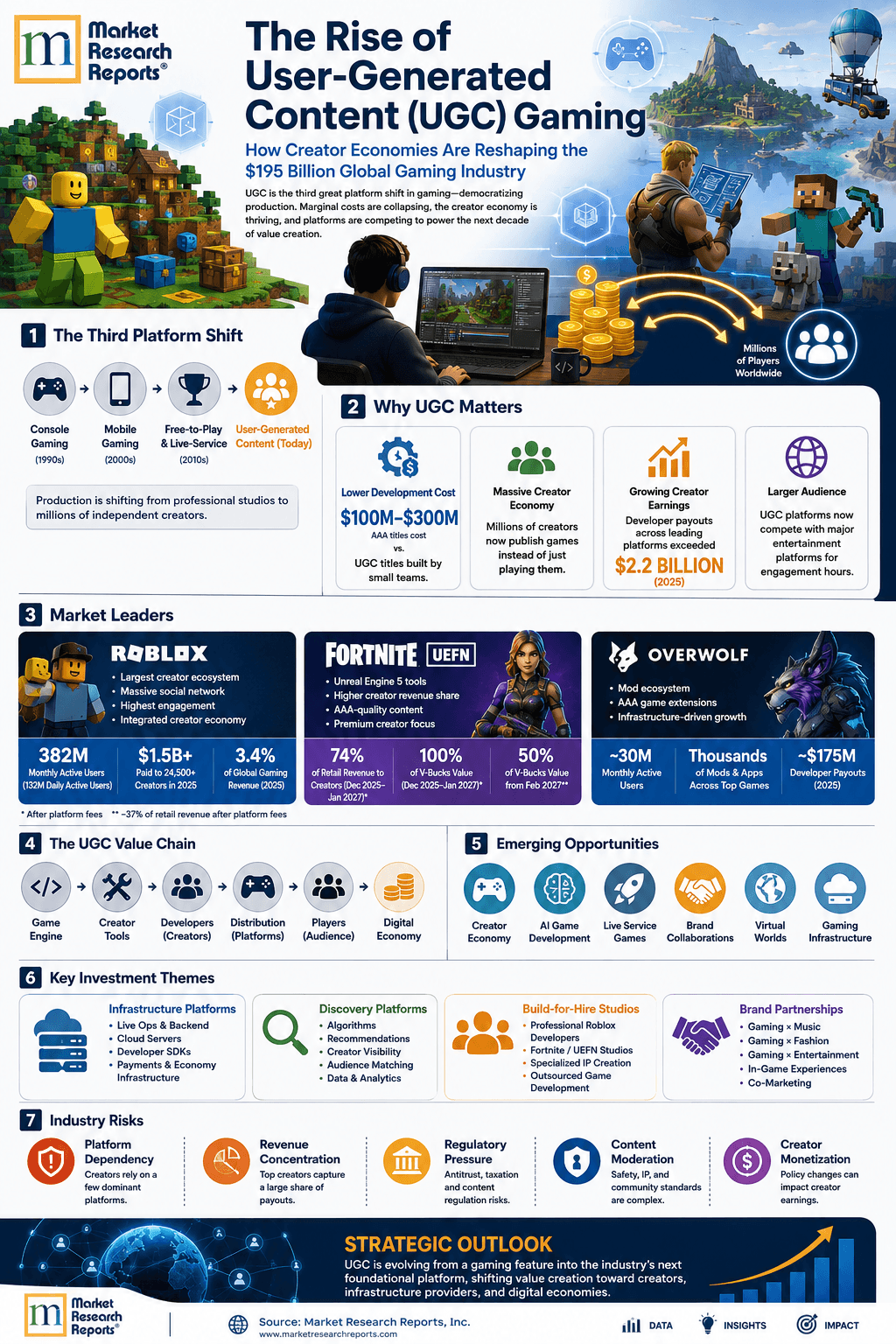
Gaming is in the midst of its third great platform transition. The first was the console-to-mobile shift of the 2000s, which democratized access. The second was free-to-play and live-service, which democratized monetization. The third - now well underway - is User-Generated Content (UGC), which is democratizing production itself. For the first time, the marginal cost of building a hit game is collapsing toward zero, and the talent pool capable of building one has expanded from a few thousand professional studios to tens of millions of independent creators.
This is not a niche trend. Industry surveys show that 40% of gamers now report consuming more UGC than a year ago, and creator-economy payouts on the two leading platforms alone are running well past $1.5 billion annually. Across the three largest UGC ecosystems — Roblox, Fortnite, and Overwolf — developer payouts reached roughly $2.2 billion in 2025, a 47% increase over the prior year. Roblox alone has captured 4.5% of all non-China consumer gaming spend and accounted for 60% of the industry's net growth since 2021 — a level of category capture that, in any other consumer sector, would already be drawing serious antitrust attention.
For investors, operators, and platform strategists, the question is no longer whether UGC matters. It is where the next decade of value creation sits inside this stack — infrastructure, tooling, IP, or the creators themselves — and which incumbents and challengers are best positioned to capture it.
1. Why UGC Is a Structural Shift, Not a Cycle
Every few years, the games industry declares a new business model the "future": free-to-play, battle passes, cloud gaming, the metaverse. Most of these turned out to be features, not platforms. UGC differs in three structural respects.
First, the economics have inverted. A traditional AAA title now costs $100–300 million and three to five years to build, with payback dependent on a single launch window. A UGC platform instead spends that capital once - on the engine, the social graph, and the payments rails - and then lets its user base supply an effectively infinite content pipeline at near-zero marginal cost to the platform. Roblox's most successful UGC titles, such as Grow a Garden and Steal a Brainrot, now rival CS: GO, Fortnite, and the entire Blizzard catalog in average monthly engagement hours — hits produced not by a 200-person studio, but by small independent teams.
AAA ("Triple-A") - Refers to the highest-budget, highest-production-value games made by large, established studios. Think of it like a Hollywood blockbuster. The "A" grading comes from the finance world — AAA = top-tier credit rating, borrowed to mean top-tier production.
Examples: GTA6 (Rockstar), Call of Duty (Activision), Red Dead Redemption, Elden Ring. These typically cost $100–300 million to make, take 3–5 years, need teams of 200–500+ people, and depend heavily on a single launch window to recoup costs.
In the blog post, when it quotes "UEFN gives creators access to AAA production values" - it means creators can now produce visuals and gameplay quality that previously only large studios could afford.
Second, engagement hours back it up. Roblox is now as large as Steam, PlayStation, and Fortnite combined in terms of engagement hours, averaging over 150 million daily active users at the end of 2025 - up 69% year over year and 3x since 2020. Its 13 billion average monthly engagement hours in 2025 are closing in on Netflix, which has held steady around 16 billion hours since 2023. When a gaming platform's attention metrics start being benchmarked against a global streaming incumbent, that is a signal the category has outgrown "gaming" as a label entirely — it is becoming a leisure-time operating system.
Third, the creator economy has gone professional. This is no longer modding-as-hobby. The top ten Roblox developers now average an extraordinary $33.9 million per year, with the top 1,000 averaging $820,000–$980,000. On Fortnite, roughly 4% of Creative developers now earn $20,000 or more annually, versus only about 0.1% of Roblox creators — evidence of a maturing, multi-tiered labor market with its own career ladders, agencies, and venture-backed studios.
 Navadhi Market Research · Technology & Software
On demand
Global User-Generated Game Content Platforms Market Strategic Research Report
The global user-generated game content (UGCC) platforms market has emerged as one of the most commercially significant intersections of interactive entertainment, cr…
▲ 13.2%CAGR2025–2032
$3,500.00 from
Forecast $16.2B by 2032
2. Mapping the Competitive Landscape: Two Models, One Race
Roblox: The Volume Flywheel
Roblox's strategic logic is reach-first, monetization-second. With roughly 382 million monthly active users (about 132 million daily) and more than $1.5 billion paid to over 24,500 creators in 2025, Roblox remains the most proven platform for building a creator career. DAUs and bookings jumped 52% and 55% year-over-year, respectively, in 2025, pushing Roblox to roughly 3.4% of global gaming revenue.
The trade-off is the take rate. Roblox's effective DevEx payout to creators is approximately 28% of standard content spend — the platform keeps roughly 72% of every dollar, after marketplace fees, Robux conversion costs, and the DevEx exchange rate stack up. Roblox is, in effect, running the App Store playbook on interactive content: take a large cut, but make it up in volume and breadth of audience no other platform can match.
Crucially, this is a network-effects business, and network effects compound. In industries driven by network effects, the winners tend to keep winning — Roblox's social fabric, its creator community, and the billions it is committing to R&D and capex are advantages that get stronger, not weaker, over time, even if 2025's hyper-growth rate (driven by breakout hits) is unlikely to repeat exactly.
Fortnite/UEFN: The Premium Studio Play
Epic Games has taken the opposite bet: fewer creators, but professional-grade tools and a far more generous revenue share, targeting a studio-quality build economy rather than a long tail of hobbyists. UEFN gives creators Unreal Engine 5-grade tools — Lumen global illumination, Nanite geometry, Blueprint visual scripting, and the Verse programming language, putting indie creators within reach of AAA production values for the first time.
Indie (Independent): Short for independent developer — a small team or solo creator building games without the backing of a major publisher or studio. Budget is usually a fraction of AAA, often under $1–2 million, sometimes just a passion project.
Examples: Hollow Knight, Stardew Valley, Among Us — all made by tiny teams, sometimes one or two people.
In the UGC context, the creators building experiences inside Roblox or Fortnite are essentially indie developers — they don't have big studio money, but the platform gives them the audience and the tooling to compete.
The economics are the headline. From December 2025 through January 2027, creators keep 100% of V-Bucks value from in-island sales, which, after platform fees, works out to roughly 74% of retail revenue — nearly three times Roblox's effective developer share. That rate steps down to 50% of V-Bucks value (about 37% of retail revenue) from February 2027 — still well above Roblox's standard payout.
This is a deliberate strategic wedge: Epic cannot yet match Roblox's audience scale, so it is competing on creator unit economics instead, in a bid to pull premium development talent — and the higher-production-value hits that talent produces — away from Roblox's volume model.
The results are starting to show. Epic paid $352 million in engagement-based creator payouts in 2024, and cumulative payouts since UEFN's launch had reached $722 million by September 2025, with seven creators individually earning more than $10 million. More strikingly, in December 2025, the creator-made title "Steal the Brainrot" crossed one million concurrent users and became the number-one experience on Fortnite on key weekends — for the first time, surpassing Epic's own first-party Battle Royale mode. That is the clearest evidence yet that UGC content on Fortnite has crossed from "filler between seasons" to genuine platform-defining IP.
The Honest Caveat
Fortnite's transformation has been slower than Epic hoped. Despite UEFN's launch with major fanfare in 2023 — essentially handing creators a professional-grade, skinned version of Unreal Engine 5 — UGC's share of Fortnite playtime has been comparatively stagnant around 40% of total hours, and Epic has not seen the hockey-stick growth that Roblox achieved. Still, creator-made islands now account for 47% of all Fortnite playtime (up from 38% a year earlier), with 11.2 billion hours logged across roughly 260,000 creator-built islands, and total UEFN payouts have now crossed $1 billion since the toolset opened to outside creators. This is a platform still finding its second gear, not a failed bet — but investors should price Fortnite's UGC arm as the higher-risk, higher-quality-per-unit option relative to Roblox's lower-risk, higher-volume model.
3. The First-Mover Map: Who Actually Got There First
Understanding "first mover advantage" in UGC gaming requires separating who pioneered the concept from who industrialized it.
1. Minecraft (Mojang/Microsoft) was arguably the original mass-market UGC sandbox, turning user-built worlds and mods into the best-selling video game of all time — but it never built the deep monetization and discovery infrastructure that later platforms did, leaving most of that value on the table for third-party marketplaces and YouTube creators instead of the platform itself.
2. Roblox industrialized UGC as a business model, not just a feature — building the engine, the social graph, the in-house currency (Robux), and the creator payout rails (DevEx) as one integrated stack. This is the platform that proved UGC could be a standalone, IPO-able company, not a feature bolted onto a game.
3. Epic/Fortnite is the fast-follower with the deepest pockets and the best underlying engine technology (Unreal Engine 5), now using superior creator economics as its catch-up wedge.
4. Overwolf, a less-discussed but increasingly relevant player, has quietly become the third major ecosystem by revenue. It is now tracked alongside Roblox and Fortnite as one of the top three UGC ecosystems by developer payouts, largely through enabling user-generated mods and content layered on top of existing AAA titles rather than building a sandbox from scratch — a capital-light model worth watching closely.
5. Zepeto (Naver), strong in the social/avatar layer particularly across Asia, has scaled to roughly 400 million users in Korea and beyond, illustrating that UGC dynamics are not confined to Western "hardcore" gaming platforms — they extend into social/avatar-first products as well.
The strategic lesson: first-mover advantage in UGC accrued not to the company that invented user-generated content (Minecraft), but to the one that built the full-stack economic infrastructure around it first (Roblox). That is the playbook that challengers and new entrants need to replicate, not just the sandbox mechanic itself.
4. Where the Value Pools Are Forming
Borrowing a classic strategy-consulting lens, we can map the UGC stack into four value pools, each with a distinct investment thesis.
Platform infrastructure (the picks-and-shovels layer). Engine providers, server/multiplayer backends, and live-ops tooling are becoming essential infrastructure for any UGC ambition, including for studios that don't want to build inside Roblox or Fortnite's walled gardens. Independent stacks such as Heroic Labs' game server and live-ops tooling suite are emerging specifically to let any developer — not just first-party platform teams — stand up Roblox-grade social, economy, and retention systems. This is the AWS-style layer of the UGC economy: less glamorous, but durable and platform-agnostic.
Distribution and discovery. Whoever solves discovery captures disproportionate economics, because in a world of millions of creators, attention — not content — is the scarce resource. This is where Roblox's algorithmic discovery system and Epic's "sponsored row" / engagement-pool mechanics are both, in effect, competing to become the de facto ad-tech and merchandising layer of interactive content.
Studio-as-a-service / build-for-hire. A genuinely underappreciated investment angle: regional development shops that build UGC content professionally on behalf of brands and IP holders. In India, studios including Juego Studios, ChicMic, StudioKrew and Logic Simplified now sell full-cycle Roblox and Fortnite Creative development as a service — Lua scripting, UGC item creation, branded worlds — at rates well below Western equivalents, echoing the IT-services outsourcing model now pointed at user-generated game worlds. The same build-for-hire model is spreading through Indonesia, the Philippines, and Vietnam. This is a capital-efficient, services-style exposure to UGC growth without taking platform concentration risk.
IP and brand integration. Major consumer brands are increasingly treating UGC platforms as a marketing channel in their own right. Fortnite's roster of crossovers spans everything from Nike to K-pop culture, and its audience skews older (60% aged 18–24) compared to Roblox's heavily under-16 base — making it the natural home for brand and music-industry collaborations rather than child-directed commerce. Expect brand licensing and music-rights deals inside UGC worlds to become a meaningful, high-margin revenue line for both platforms and IP holders over the next several years.
5. The Catalyst on the Horizon: GTA6
If there is a single event that could re-rate the entire UGC thesis, it is Rockstar's GTA6. The release is strongly expected to integrate UGC features along the lines of Roblox and Fortnite. Grand Theft Auto has always had an enormous unofficial modding community (GTA Online's RP servers are themselves a proof point of latent UGC demand within a single-IP franchise). If Rockstar formalizes and monetizes that energy with official creator tools, it would be the first time a top-tier, mature-rated AAA franchise validates the UGC model outside the Roblox/Fortnite youth-skewing duopoly — potentially unlocking a much larger, higher-spending adult demographic for the category as a whole.
Navadhi Market Research · Technology & SoftwareOn demand
Global Blockchain User-Generated Game Content Platforms Market Strategic Research Report
The global blockchain user-generated game content (UGC) platforms market sits at the intersection of decentralized technology and the $200 billion-plus gaming indust…
▲ 25.1%CAGR2025–2032
$3,500.00 from
Forecast $23B by 2032
Navadhi Market ResearchOn demand
Global Player-Driven Metaverses Creator Tools Market Strategic Research Report
The global player-driven metaverses creator tools market occupies a rapidly expanding intersection of gaming technology, user-generated content infrastructure, and d…
▲ 18.4%CAGR2025–2032
$3,500.00 from
Forecast $15.7B by 2032
6. Risks Investors Should Underwrite, Not Ignore
A credible bull case requires an honest bear case.
Regulatory tailwinds turning into headwinds. As Roblox cements itself as a childhood staple, regulators worldwide are increasing pressure to ensure its child safety standards meet rising expectations. 2026 is shaping up as the year video game regulation becomes a daily operational reality, with studios navigating a thickening alphabet soup of rules spanning online safety, app store conduct, digital fairness, and AI governance across multiple jurisdictions. Compliance cost and platform liability are real, rising line items.
Concentration risk in the creator base. Earnings inside these ecosystems are extremely power-law distributed — a handful of mega-hits and top creators capture outsized payouts while the median creator earns very little, which raises questions about the durability and breadth of the "creator middle class" narrative.
Platform dependency. Creators build their businesses entirely on infrastructure they do not own and cannot control. A single algorithm, fee structure, or policy change — Fortnite's own scheduled revenue-share step-down in 2027 is a built-in example — can reprice an entire creator's economics overnight.
Engagement plateauing where tooling lags. Fortnite's UGC share of playtime stagnated near 40% for an extended period despite world-class tooling, illustrating that powerful technology alone does not guarantee network-effect-style growth — distribution and discovery matter as much as production quality.
7. The Strategic Bottom Line
UGC gaming has moved decisively from "interesting experiment" to "structural category" within the broader $195 billion global games industry. The winners over the next cycle will not necessarily be the platforms with the best engines — they will be the ones that best solve the three-sided marketplace problem of creator incentives, discovery economics, and player trust, simultaneously and at scale.
For capital allocators, the most attractive entry points right now sit not solely in the two headline platforms — both already richly valued and well understood by the market — but in the adjacent infrastructure, discovery, and services layers building on top of them: live-ops and server tooling vendors, regional build-for-hire studios riding the IT-outsourcing playbook into virtual worlds, and brand/IP licensing intermediaries positioning for the next wave of crossover deals. As with every prior platform shift in gaming, the picks-and-shovels layer — not just the platforms themselves — is where some of the most durable, less-crowded returns are likely to be found.
The next GTA6-scale launch, the next regulatory cycle, and the next platform to crack the discovery problem will determine who captures the next leg of this curve. The direction of travel, however, is no longer in question.