


World's Top 10 Automotive Aftermarket Companies
World's Top 10 Automotive Aftermarket Companies
MRR® Automotive Industry Analysis Market Research · Competitive Intelligence
The global automotive aftermarket -spanning replacement parts, accessories, and OE-adjacent component supply -remains one of the largest and most resilient segments of the automotive value chain. Independent market research firms place the market's 2025 size in a cross-validated range of approximately USD 465 billion to USD 490 billion, estimating USD 464.83 billion (growing to USD 555.82 billion by 2030 at a 3.64% CAGR) and estimating USD 489.45 billion (growing to USD 643.78 billion by 2033 at a 3.4% CAGR from 2026). This represents substantial nominal growth from the market's 2019 baseline, when the original edition of this report cited a Qvartz/McKinsey estimate of roughly EUR 398 billion, expected to reach EUR 566 billion by 2025.
Growth continues to be driven by an aging global vehicle parc -U.S. vehicles now average a record 12.8 years old -alongside rising e-commerce parts distribution and Asia-Pacific's expanding vehicle population. At the same time, the industry faces a genuine structural transition: electrification is compressing traditional ICE-related aftermarket revenue pools even as it opens new categories in battery, thermal, and sensor service, while tariff policy has introduced fresh cost volatility largely absent from the 2019 landscape.
The supplier landscape has been reshaped by major corporate actions since 2019. Most significantly, Continental AG spun off its entire Automotive division as the independently listed AUMOVIO SE in September 2025, and Faurecia's 2022 acquisition of HELLA created the renamed FORVIA group. Robert Bosch GmbH remains the clear global leader with approximately €56.0 billion in 2025 Mobility-sector sales (~US$61.0 billion), while Hyundai Mobis and ZF Friedrichshafen have both overtaken Magna International in USD-equivalent revenue terms -a meaningful reshuffling from 2018/2019, when Magna ranked third and Hyundai Mobis seventh.
This research blog ranks the world's ten largest automotive component suppliers with significant OE and aftermarket exposure by 2025 fiscal-year revenue, profiles each company's recent performance and strategic developments, and outlines the key industry trends shaping the sector heading into 2026 and beyond.
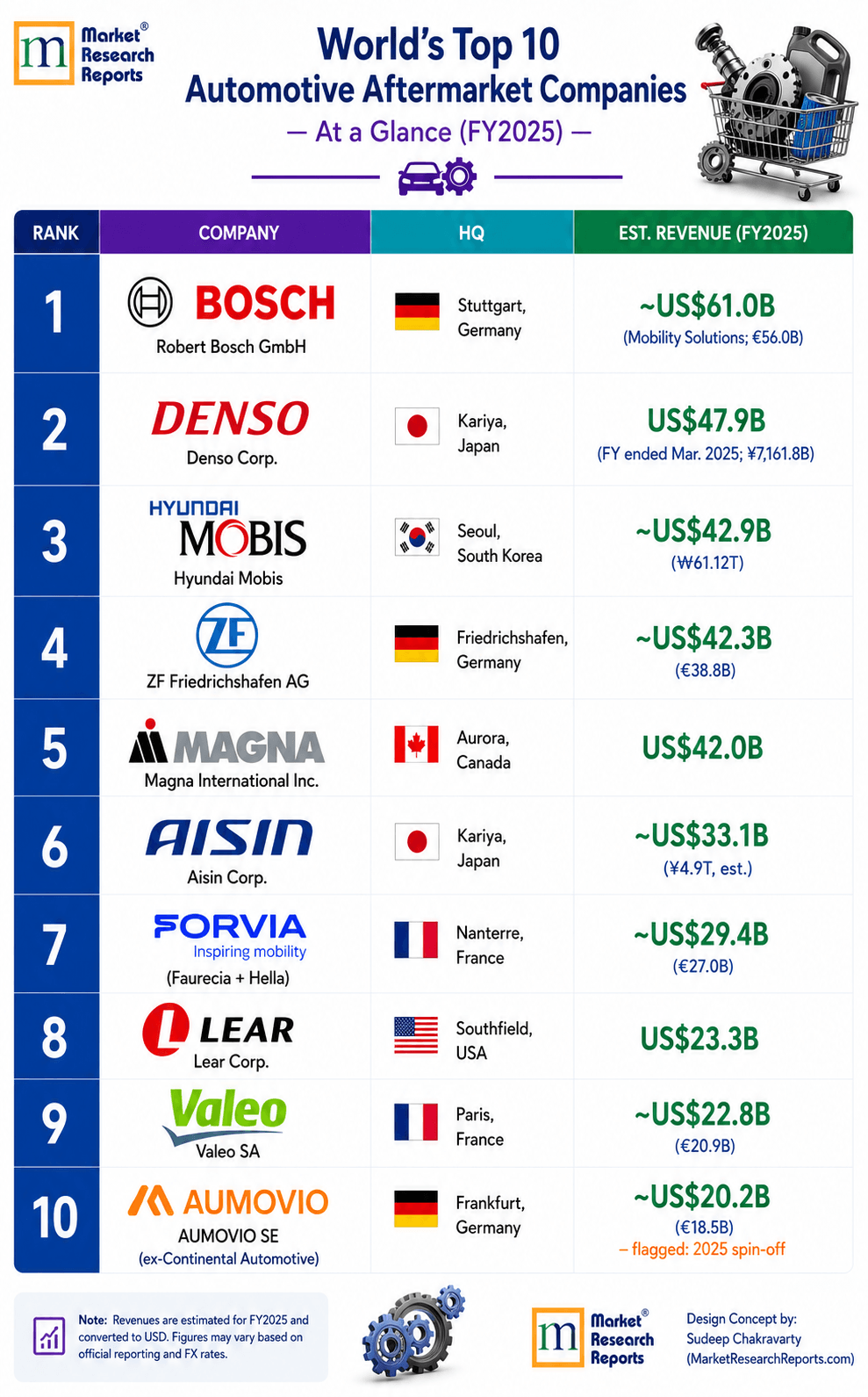
World's Top 10 Automotive Aftermarket Companies - At a Glance
| Rank | Company | HQ | Est. Revenue (FY2025) |
|---|---|---|---|
| 1 | Robert Bosch GmbH | Stuttgart, Germany | ~US$61.0B (Mobility Solutions; €56.0B) |
| 2 | Denso Corp. | Kariya, Japan | US$47.9B (FY ended Mar. 2025; ¥7,161.8B) |
| 3 | Hyundai Mobis | Seoul, South Korea | ~US$42.9B (₩61.12T) |
| 4 | ZF Friedrichshafen AG | Friedrichshafen, Germany | ~US$42.3B (€38.8B) |
| 5 | Magna International Inc. | Aurora, Canada | US$42.0B |
| 6 | Aisin Corp. | Kariya, Japan | ~US$33.1B (¥4.9T, est.) |
| 7 | FORVIA (Faurecia + Hella) | Nanterre, France | ~US$29.4B (€27.0B) |
| 8 | Lear Corp. | Southfield, USA | US$23.3B |
| 9 | Valeo SA | Paris, France | ~US$22.8B (€20.9B) |
| 10 | AUMOVIO SE (ex-Continental Automotive) | Frankfurt, Germany | ~US$20.2B (€18.5B) -flagged: 2025 spin-off |
Note: Revenue figures reflect each company's most recently reported fiscal-year 2025 (or FY2025-ending) results, converted to approximate USD equivalents using representative average annual exchange rates. Figures for AUMOVIO, Forvia, ZF, and Valeo reflect Group-level (not aftermarket-segment-specific) sales, consistent with the scope of the original 2019 report. Rankings for companies with revenue within ~2% of one another (Hyundai Mobis, ZF, and Magna) are currency-sensitive and may shift with exchange-rate movements.
Global Market Statistics
- Global automotive aftermarket market size: USD 466.13 billion to USD 493.45 billion
Projected 2030 market size: USD 558.12 billion to USD 599 billion, 3.4–3.5% CAGR. - Asia-Pacific holds the largest regional share: 29.4–37.7% of global revenue in 2024/2025, and the fastest regional growth rate (~3.7% CAGR).
- Passenger cars represent the largest vehicle-type segment, with ~51.3% market share in 2024, though two-wheelers are forecast to grow fastest (3.73% CAGR).
- Retail remains the leading distribution channel (47.6–54.2% share), though online platforms are growing fastest at ~3.7% CAGR, eroding traditional wholesaler share.
- Average U.S. vehicle age reached a record 12.8 years in 2024, extending the maintenance-and-replacement demand window.
- Combined 2025 revenue of the ten companies profiled in this report: approximately US$385 billion, underscoring the continued concentration of the global component-supply base among a relatively small number of Tier-1 suppliers.
- North America accounted for approximately 24 % of global aftermarket revenue in 2023, with the U.S. market alone valued at roughly US$131 billion in 2024
 Navadhi Market Research · Automotive & Mobility
On demand
Global Automotive Aftermarket EV Battery Replacement Market Strategic Research Report
The global automotive aftermarket EV battery replacement market has entered a pivotal growth phase, underpinned by the rapid maturation of the first-generation elect…
▲ 18.5%CAGR2025–2032
$3,500.00 from
Forecast $15.7B by 2032
Navadhi Market Research · Automotive & MobilityOn demand
Global Automotive Aftermarket Tire Replacement Service Market Strategic Research Report
The global automotive aftermarket tire replacement service market represents one of the most structurally resilient segments within the broader automotive services i…
▲ 5.4%CAGR2025–2032
$3,500.00 from
Forecast $166.8B by 2032
Navadhi Market Research · Textiles & ApparelOn demand
Global Automotive Leather Upholstery Market Strategic Research Report
The global automotive leather upholstery market occupies a strategically significant position at the intersection of premium vehicle manufacturing, materials science…
▲ 6.2%CAGR2025–2032
$3,500.00 from
Forecast $58.8B by 2032
Company Profiles
1. Robert Bosch GmbH
Robert Bosch GmbH, headquartered in Stuttgart, Germany, remains the world's largest automotive supplier and a privately held technology group employing roughly 412,000 people worldwide. Its Mobility business sector (renamed from "Mobility Solutions" in recent reporting) spans Powertrain Solutions, Chassis Systems Control, Mobility Aftermarket, Mobility Electronics, and Vehicle Motion, giving Bosch the broadest OEM aftermarket footprint of any supplier on this list.
For fiscal 2025, Bosch's Mobility business sector posted sales of approximately €56.0 billion, a modest nominal increase of 0.3% (3.1% currency-adjusted) despite what the company describes as a roughly €2.5 billion annual cost gap versus target margins caused by the industry's slow, uneven shift to electrification and intense price competition. Group-wide sales held stable at €91 billion in 2025, with China remaining Bosch's most resilient growth market (sales up 4.9%, now 20% of group revenue) even as the company announced further workforce reductions concentrated in Mobility, mainly in Germany.
• HQ: Stuttgart, Germany (privately held, Robert Bosch Stiftung majority ownership)
• 2025 Revenue: ~€56.0B / ~US$61.0B (Mobility business sector)
• Key Products: Powertrain Solutions, Chassis Systems Control, ADAS sensors, Mobility Aftermarket parts and diagnostics
• Segments: Passenger cars, commercial vehicles, two-wheelers; strong OE and independent aftermarket presence
• 2026 Update: Continues cost-restructuring program amid EV transition headwinds and price competition; expanding software-defined vehicle and China-localized R&D investment
2. Denso Corp.
DENSO Corporation, based in Kariya, Japan, is a core Toyota Group supplier and one of the world's largest mobility technology companies, producing thermal, powertrain, mobility, electrification, and electronic systems across roughly 180 facilities worldwide.
For fiscal year 2025 (ended March 31, 2025), DENSO reported record consolidated revenue of ¥7,161.8 billion (approximately US$47.9 billion), a 0.2% increase year-on-year, with operating profit up 36.4% to ¥519.0 billion. Growth came despite lower vehicle production volumes in Asia and Japanese-customer operational suspensions, aided by yen depreciation and stronger sales in electrification and safety products. Looking to fiscal 2026, DENSO flagged approximately ¥130.0 billion in potential added costs from U.S. tariff policy, which it plans to partly offset through customer price discussions.
• HQ: Kariya, Japan (Toyota Group affiliate)
• FY2025 Revenue: ¥7,161.8B / ~US$47.9B (record high)
• Key Products: Thermal systems, powertrain and electrification components, safety and ADAS sensors
• Segments: Passenger and commercial vehicles across nearly every global automaker
• 2026 Update: Navigating an estimated ¥130B U.S. tariff cost impact; record ~¥610B share buyback underway following Toyota Industries' announced sale of its DENSO stake
3. Hyundai Mobis
Hyundai Mobis, headquartered in Seoul, South Korea, is the core parts and after-sales affiliate of Hyundai Motor Group, supplying modules, core components, and after-sales parts for Hyundai, Kia, and Genesis vehicles worldwide. It is now considered the world's No. 6 automotive supplier by several industry rankings.
Hyundai Mobis closed 2025 with record annual revenue and profit: consolidated revenue rose 6.8% year-on-year to ₩61.12 trillion (approximately US$42.9 billion), while operating profit climbed 9.2% to ₩3.36 trillion, both all-time highs. Growth was led by the manufacturing (module/parts) division, up 5.9% to ₩47.8 trillion, and a strong after-sales parts business, up 10.2% to ₩13.3 trillion on robust global demand and favorable exchange rates. The company also agreed to explore the sale of its automotive lighting business to French supplier OPmobility as part of a broader portfolio realignment.
• HQ: Seoul, South Korea (Hyundai Motor Group affiliate)
• 2025 Revenue: ₩61.12T / ~US$42.9B (record high, +6.8% YoY)
• Key Products: Modules, core automotive parts, electrification components, after-sales (aftermarket) parts
• Segments: Auto Parts (manufacturing) and After-Sales Services
• 2026 Update: Signed MOU with OPmobility to explore sale of lighting business; record 32.8% total shareholder return in 2025
4. ZF Friedrichshafen AG
ZF Friedrichshafen AG, a privately held (Zeppelin Foundation-owned) German technology group headquartered in Friedrichshafen, supplies driveline, chassis, and safety systems across passenger cars, commercial vehicles, and industrial technology through divisions including Chassis Solutions, Commercial Vehicle Solutions, Industrial Technology, Electronics and ADAS, and ZF Lifetec.
ZF reported 2025 sales of €38.8 billion, down from €41.4 billion in 2024 (roughly 6% nominal decline, but approximately 0.6% organic growth), while adjusted EBIT margin improved to 4.5% from 3.5%, beating guidance.
The year featured major strategic moves: the sale of its Advanced Driver Assistance Systems (ADAS) business to Harman International for an enterprise value of €1.5 billion (expected to close H2 2026), the carve-out of its wind-power unit as a standalone business, and continued restructuring of its Electrified Powertrain Technology division amid slower-than-expected EV uptake, which drove a €2.1 billion net accounting loss for the year despite operational improvement.
• HQ: Friedrichshafen, Germany (privately held; Zeppelin Foundation, 93.8% owner)
• 2025 Revenue: €38.8B / ~US$42.3B (down from €41.4B in 2024)
• Key Products: Chassis systems, transmissions, driveline technology, ADAS (through 2026 divestment), commercial vehicle solutions
• Segments: Passenger cars, commercial vehicles, industrial technology
• 2026 Update: Selling ADAS unit to Harman (€1.5B EV); reducing German workforce by 11,000–14,000 positions amid restructuring
5. Magna International Inc.
Magna International Inc., headquartered in Aurora, Canada, is a diversified mobility technology company with roughly 174,000+ employees across manufacturing, engineering, and sales operations in nearly 30 countries, spanning Body Exteriors & Structures, Power & Vision, Seating Systems, and Complete Vehicles.
Magna reported full-year 2025 sales of US$42.0 billion, down modestly from US$42.8 billion in 2024, reflecting softer North American and European light-vehicle production and the wind-down of certain programs, including the Jaguar I-Pace/E-Pace and several Ford and Chevrolet models. Despite the sales decline, adjusted EBIT margin rose to 5.6% and free cash flow reached US$1.9 billion. In early 2026, Magna announced agreements to divest its Lighting and Rooftop Systems businesses (a combined ~US$1.1 billion in 2025 sales), sharpening its focus on core mobility technology segments.
• HQ: Aurora, Ontario, Canada
• 2025 Revenue: US$42.0B (down from US$42.8B in 2024)
• Key Products: Body exteriors and structures, seating systems, power and vision technology, complete vehicle assembly
• Segments: Global passenger vehicle OEMs across North America, Europe, and Asia
• 2026 Update: Divesting Lighting and Rooftop Systems businesses (~US$1.1B in 2025 sales) in transactions expected to close H2 2026.
6. Aisin Corp.
Aisin Corporation, formed through the 2021 merger of Aisin Seiki and Aisin AW, is a core Toyota Group affiliate headquartered in Kariya, Japan, spanning powertrain, chassis and vehicle safety systems, body components, and ICT & electronics across roughly 200 group companies. On April 1, 2025, Aisin Chemical Co., Ltd. was merged into Aisin Corporation, further consolidating the group's structure.
Aisin guided full-year revenue for fiscal 2025/26 (ending March 2026) of approximately ¥4.9 trillion (roughly US$33 billion), with first-half fiscal 2025 net sales of ¥2.47 trillion, up 5.1% year-on-year, driven by higher production of hybrid transmission units and other core components. The company faces tariff-related cost pressure similar to sibling Toyota Group suppliers and has been executing a large share buyback program, partly related to Toyota Industries Corporation's announced divestment of its Aisin shareholding.
• HQ: Kariya, Japan (Toyota Group affiliate)
• FY2025/26 Revenue (guidance): ~¥4.9T / ~US$33.1B
• Key Products: Transmissions, drivetrain components, chassis and vehicle safety systems, body and electronics
• Segments: Powertrain, Chassis & Vehicle Safety Systems, Body, ICT & Electronics
• 2026 Update: Absorbed Aisin Chemical (April 2025); large-scale share buyback amid Toyota Industries stake sale.
7. FORVIA (formerly Faurecia; includes HELLA)
FORVIA is the renamed, combined entity created when Faurecia acquired a controlling ~79.5% stake in German lighting and electronics specialist HELLA in a €5.3 billion deal completed in January 2022, forming what was then described as the world's 7th-largest automotive supplier. Faurecia and HELLA continue to operate as separate legal entities under the FORVIA umbrella, spanning six business groups: Interiors, Seating, Electronics, Clean Mobility, Lighting, and Lifecycle Solutions.
FORVIA reported full-year 2025 consolidated sales of approximately €27.0 billion, in line with prior-year levels, with a full-year net loss of €2.1 billion driven by non-cash exceptional charges tied to portfolio restructuring -most notably the planned divestiture of its Interiors business group to Apollo Funds, now in advanced negotiations and expected to cut net debt by more than €1 billion upon completion. Electronics (led by HELLA) was a standout growth area, with its order-intake share rising sharply as the group repositions around higher-margin, higher-growth segments.
• HQ: Nanterre, France (parent); Lippstadt, Germany (HELLA)
• 2025 Revenue: ~€27.0B / ~US$29.4B
• Key Products: Seating, interiors, clean mobility (incl. hydrogen systems), lighting, automotive electronics
• Segments: Interiors, Seating, Electronics, Clean Mobility, Lighting, Lifecycle Solutions
• 2026 Update: Interiors business group divestiture to Apollo Funds in advanced negotiations; targeting 1.5x leverage by end-2026
8. Lear Corporation
Lear Corporation, headquartered in Southfield, Michigan, is a global automotive technology leader in two segments: Seating and E-Systems (electrical distribution systems and electronic modules), serving virtually every major global automaker from more than 250 facilities in dozens of countries.
Lear reported full-year 2025 revenue of approximately US$23.3 billion, roughly flat versus 2024, with fourth-quarter revenue of US$6.0 billion, up 5% year-on-year. The company delivered its fifth consecutive year of adjusted EPS growth, secured approximately US$1.4 billion of E-Systems business awards, and won the largest seating conquest award in its history, positioning it for growth heading into 2026, for which it guided net sales of US$23.2–24.0 billion.
• HQ: Southfield, Michigan, USA
• 2025 Revenue: ~US$23.3B (flat YoY)
• Key Products: Complete seat systems, seat components, electrical distribution systems, electronic modules
• Segments: Seating and E-Systems
• 2026 Update: Guided 2026 sales of US$23.2–24.0B; largest seating conquest award in company history secured in 2025
9. Valeo SA
Valeo SA, headquartered in Paris, France, is a global automotive supplier and technology partner across four divisions organized under its "Elevate 2028" strategic plan, with particular strength in electrification, ADAS/software-defined vehicles, and thermal systems, alongside a meaningful aftermarket business.
Valeo reported 2025 sales of €20.9 billion, essentially flat (down 2.7% on a reported basis but up 0.5% like-for-like) versus 2024, with operating margin improving to 4.7% of sales and net profit up 23% to €200 million. Order intake surged 38% to €24.6 billion for the year, reflecting accelerating wins with Chinese automakers, who now represent 54% of original-equipment sales and 63% of order intake -up from roughly 50% and 60% in 2024 -as Valeo continues repositioning its customer base toward faster-growing Chinese OEMs.
• HQ: Paris, France
• 2025 Revenue: €20.9B / ~US$22.8B (roughly flat YoY)
• Key Products: Powertrain/thermal systems (POWER), driving-assistance and software (BRAIN), lighting (LIGHT) systems, aftermarket parts
• Segments: Original equipment and aftermarket, with growing exposure to Chinese OEMs
• 2026 Update: Order intake up 38% to €24.6B; guiding 2026 sales of €20–21B and continued margin improvement under Elevate 2028
10. AUMOVIO SE (successor to Continental AG's Automotive division)
AUMOVIO SE is a newly independent German automotive-technology company formed from the September 18, 2025 spin-off of Continental AG's former Automotive group sector, listed on the Frankfurt Stock Exchange (ticker AMV0). Continental shareholders received one AUMOVIO share for every two Continental shares held. AUMOVIO specializes in vehicle electronics, sensor solutions, display and cockpit electronics, braking and motion systems, and software architectures for software-defined and autonomous vehicles, employing approximately 82,000 people across more than 80 locations in 24 countries.
In its first full year as an independent company, AUMOVIO reported 2025 adjusted consolidated sales of €18.5 billion, down 5.0% year-on-year (2.5% organically) amid challenging market conditions, portfolio adjustments, and negative currency effects. Despite the revenue decline, adjusted EBIT rose 45.4% to €717 million, lifting adjusted EBIT margin to 3.9% from 2.5% -hitting the top end of guidance. The company set long-term ambitions at its inaugural Capital Markets Day for revenue exceeding €24 billion and an adjusted EBIT margin of 6–8%, with 2026 guidance of €17.0–18.5 billion in sales.
• HQ: Frankfurt am Main, Germany (newly independent; spun off from Continental AG)
• 2025 Revenue: €18.5B / ~US$20.2B (first full year as independent company; -5.0% YoY)
• Key Products: Sensor solutions, display/cockpit electronics, braking and comfort (motion) systems, ADAS and autonomous-driving architecture
• Segments: Autonomous Mobility, Safety and Motion, Architecture and Network Solutions, User Experience
• 2026 Update: Flagged entry -replaces Continental AG in this ranking following its September 2025 spin-off as an independent, separately listed company
Key Changes Since 2019
• Continental AG spun off its entire Automotive group sector as an independent, separately listed company, AUMOVIO SE, on the Frankfurt Stock Exchange on September 18, 2025 -Continental itself (now focused on Tires and ContiTech) exits this ranking, replaced by AUMOVIO as the legal and operational successor of the automotive-supply business, reporting 2025 sales of €18.5 billion.
• Faurecia acquired a controlling ~79.5% stake in German lighting and electronics specialist HELLA for €5.3 billion in a deal completed January 31, 2022, and the combined group rebranded as FORVIA -at the time hailed as the world's 7th-largest automotive supplier; FORVIA posted 2025 sales of approximately €27.0 billion, up from Faurecia's stand-alone €17.5 billion in 2018.
• Ranking order has reshuffled significantly: Bosch retains the #1 position, but Hyundai Mobis and ZF Friedrichshafen have both overtaken Magna International in 2025 revenue terms (in USD-equivalent), whereas in 2018 Magna ranked #3 and Hyundai Mobis #7.
• ZF Friedrichshafen agreed to sell its Advanced Driver Assistance Systems (ADAS) business to Harman International for an enterprise value of €1.5 billion (expected to close H2 2026) and carved out its wind-power unit as a standalone business, part of a broader strategic realignment that produced a €2.1 billion net accounting loss in 2025 despite improved operating performance.
• Global automotive aftermarket market size has grown from an estimated ~EUR 398 billion (2019 baseline, per Qvartz/McKinsey estimates cited in the original 2019 report) to a cross-validated USD 465–490 billion in 2025, -nominal growth of roughly 25–30% in USD terms over six years, notwithstanding significant currency effects.
• Hyundai Mobis posted record 2025 revenue and operating profit (₩61.12 trillion, +6.8% YoY) and signed an MOU to explore selling its automotive lighting business to French supplier OPmobility, while Magna International separately announced 2026 divestitures of its Lighting and Rooftop Systems businesses -signaling a broader industry-wide trend of suppliers shedding non-core product lines.
• Widespread restructuring and workforce reductions have swept the sector amid a slower-than-expected transition to electric vehicles: ZF is cutting 11,000–14,000 German positions, Bosch has announced further Mobility-sector job cuts concentrated in Germany, and AUMOVIO, Valeo, and Magna have all posted flat-to-declining revenue in 2025 despite improved profitability.
• U.S. tariff policy has emerged as a new, material cost factor absent from the 2019 baseline report: DENSO flagged an estimated ¥130 billion fiscal 2026 tariff impact, and both Aisin and Hyundai Mobis cited tariff-related cost pressures in their most recent results, prompting price-recovery negotiations with automaker customers across the sector.
Key Industry Trends
Electrification Reshapes Aftermarket Demand Patterns: As electric and hybrid vehicles gain share, the traditional aftermarket revenue pool tied to internal-combustion wear parts (exhaust systems, oil filters, spark plugs) faces structural erosion. EV powertrains could trim 30–40% of lifetime service revenue per vehicle. At the same time, electrification is opening new high-value categories in battery service, thermal management, high-voltage components, and specialized diagnostic tools, prompting suppliers such as Bosch, Valeo, and ZF to redirect R&D and aftermarket product development toward EV-specific offerings.
Aging Global Vehicle Parc Sustains Replacement-Parts Demand: The average vehicle age in the United States reached a record 12.8 years in 2024, with Europe's fleet hovering around 12 years. Longer ownership cycles and improved mechanical durability are extending the maintenance, repair, and replacement window for vehicles well past the OEM warranty period, directly supporting sustained aftermarket parts and service demand even as new-vehicle sales growth moderates in mature markets.
Supplier Consolidation and Corporate Restructuring Accelerate: The past several years have seen a wave of major corporate restructuring among top-tier automotive suppliers: Continental's spin-off of AUMOVIO, Faurecia's transformative acquisition of HELLA to form FORVIA, ZF's divestment of its ADAS unit to Harman, and both Magna's and Hyundai Mobis's moves to shed non-core lighting and rooftop-systems businesses. This consolidation and portfolio-sharpening reflects intensifying pressure on margins from slower EV uptake, Chinese OEM competition, and the capital intensity of software-defined vehicle development.
Digital and E-Commerce Channels Continue to Gain Share: Online platforms are advancing at an estimated 3.7% CAGR through 2030, eroding traditional wholesaler distribution share as consumers and independent repair shops increasingly source parts through e-commerce marketplaces. This shift is also reshaping pricing transparency and competitive dynamics, particularly in mature markets like North America and Western Europe where digital-native entrants continue to encroach on legacy distribution networks.
China's Rising Competitive and Customer Influence: China's role in the automotive aftermarket has evolved from a manufacturing base to a critical demand and competitive center. Chinese automakers now represent a majority of Valeo's order intake (63%) and original-equipment sales (54%), while Bosch, Denso, and other suppliers report China as a disproportionate share of both revenue growth and R&D localization investment. At the same time, homegrown Chinese component suppliers are increasingly competing for domestic and export share, intensifying pricing and technology pressure on established global Tier-1 suppliers.
Tariffs and Trade Policy Introduce New Cost Volatility: Unlike the 2019 baseline period, U.S. tariff policy has become a material line-item risk across the sector in 2025–2026. DENSO, Aisin, and Hyundai Mobis have all cited tariff-related cost headwinds in recent financial disclosures, with suppliers pursuing a mix of cost absorption, customer price-recovery negotiations, and localized manufacturing shifts to mitigate the impact -a dynamic likely to persist as trade policy remains in flux.
Sources
• MarketResearchReports.com - "World's Top 10 Automotive Aftermarket Suppliers" (original re port, July 2019)
• Robert Bosch GmbH -2025 Annual Report and fiscal-year 2025 press releases
• DENSO Corporation -Fiscal Year 2025 (ended March 2025) financial results
• Hyundai Mobis -2025 full-year results press release (The Korea Herald, AJU Press, The Investor)
• ZF Friedrichshafen AG -2025 Annual Result press release and Annual Report
• Magna International Inc. -Q4 and Full Year 2025 Results (SEC Form 6-K)
• Aisin Corporation -FY2025 Consolidated Financial Results and FY2025/26 guidance
• FORVIA -2025 Annual Results press release and Capital Markets Day materials
• Lear Corporation -Fourth Quarter and Full Year 2025 Results (SEC Form 8-K)
• Valeo SA -2025 Full-Year Results press release
• AUMOVIO SE - Fiscal Year 2025 results press release and Wikipedia company profile
• Continental AG - "Spin-Off Automotive" investor relations materials