


The Hybrid Gambit: Why Japan's EV Retreat Is Actually a Bet on Being Second, Smarter
The Hybrid Gambit: Why Japan's EV Retreat Is Actually a Bet on Being Second, Smarter
In 1997, Toyota gave the world the Prius and, with it, the modern hybrid — the single most important bridge technology between petrol and electric ever commercialized. For nearly three decades, Japanese automakers defined the global conversation on fuel efficiency and alternative powertrains.
In the space of a few months in mid-2026, that leadership visibly bent. Toyota shelved its flagship Lexus LF‑ZC electric sedan. Honda scaled back its ambitious "0 Series" EV program after posting its first annual loss since 1955. Subaru and Mazda pushed out their core EV launch timelines. Meanwhile, China's BYD posted the strongest overseas sales in its history, and Chinese brands now account for the majority of every battery-electric vehicle sold on the planet.
The easy conclusion is that Japan is retreating from EVs. The more useful read for operators, investors, and policymakers is narrower and more interesting: Japan is not retreating from electrification — it is repricing the bet on which electrification wins, and choosing to compete on hybrids, plug-in hybrids, and hydrogen rather than pure battery-electric vehicles (BEVs). That is a deliberate portfolio reallocation, not a loss of nerve — and it opens a distinct set of opportunities for suppliers, capital, and adjacent markets that a simple "China wins everything" narrative misses.
What Actually Happened
The clearest signal came from Toyota. The company confirmed it has discontinued development of the Lexus LF-ZC, a flagship electric sedan that had been positioned as the technology showcase for Lexus's next-generation EV platform — including high-performance prismatic batteries aimed at roughly double the range of conventional lithium-ion cells, gigacasting manufacturing, and a new Arene OS software platform. Toyota's own account of the decision was candid: the company cited fluctuations in market demand and the workload associated with vehicle planning and manufacturing as the reason for the cut, and confirmed the cancellation reflects a company-wide review of vehicle development projects rather than an abandonment of battery-electric R&D.
Honda's retrenchment is more structural. The company posted its first annual loss since 1955, joining General Motors, Ford, and Stellantis in absorbing large financial charges tied to an industry-wide overestimation of how fast the EV transition would move — Honda alone booked a hit of roughly 1.6 trillion yen, close to $10 billion, in the fiscal year ending in March. Mazda and Subaru have made similar, if less dramatic, adjustments to their electric timelines.
Crucially, none of this is a full stop on electrification. Toyota is shifting its near-term focus toward electric SUVs while continuing to develop the underlying battery and software technology from the cancelled sedan program, and is adding an electric Highlander alongside the bZ, bZ Woodland, and C-HR EV to its lineup. In fact, on a unit basis, Toyota and Lexus together sold about 199,000 fully electric vehicles worldwide in 2025, up more than 42% year over year — even as the flagship program was being cancelled. The story, in other words, is sequencing and product mix, not abandonment.
The Numbers at a Glance
| Metric | Figure | Period |
|---|---|---|
| Toyota + Lexus global BEV sales | ~199,000 units, +42% YoY | Full-year 2025 |
| Honda financial hit tied to EV pullback | ~¥1.6 trillion (~$10B) | FY ending March 2026 |
| Honda annual result | First annual loss since 1955 | FY2025/26 |
| GM / Ford / Stellantis EV-related charges | $7.2B / $17.4B / ~$29.7B | FY2025 |
| BYD overseas deliveries | 175,349 units, +95% YoY | June 2026 |
| BYD H1 2026 overseas deliveries | 792,256 units, +71% YoY (~44% of total NEV sales) | H1 2026 |
| BYD revised full-year overseas target | 1.5 million units (up from 1.3M) | FY2026 guidance |
| Chery exports | 177,573 units, +102% YoY (monthly record) | April 2026 |
| China's share of global BEV market | ~63% (2023–2025), easing to ~61% | Q1 2026 |
| China's share of global NEV passenger market | 68.3% (2025) → 61% | Q1 2026 |
Figures compiled from Electrek, Automotive News, The Electric Viking, Gasgoo, EVTech.News, BigGo Finance, and CNN Business reporting, cross-checked across sources where available.
 Navadhi Market Research · Automotive & Mobility
On demand
Global Electric Vehicle Market Strategic Research Report
The global electric vehicle (EV) market stands as one of the most consequential industrial transformations of the early twenty-first century, reshaping energy system…
▲ 15.6%CAGR2025–2032
$3,500.00 from
Forecast $1718.7B by 2032
Navadhi Market Research · Automotive & MobilityOn demand
Global Hybrid Electric Vehicle Battery Market Strategic Research Report
The global hybrid electric vehicle (HEV) battery market occupies a pivotal position at the intersection of automotive electrification and advanced energy storage tec…
▲ 12.1%CAGR2025–2032
$3,500.00 from
Forecast $63.2B by 2032
Navadhi Market Research · Automotive & MobilityOn demand
Global Electric Vehicle Battery Management System Market Strategic Research Report
The global Electric Vehicle Battery Management System (BMS) market represented a foundational layer of the electric mobility transition, valued at approximately USD …
▲ 14.9%CAGR2025–2032
$3,500.00 from
Forecast $24.9B by 2032
The Market Isn't Waiting
The reason this recalibration matters strategically is timing. While Japan pauses its BEV flagship bets, China's export machine is compounding.
BYD alone delivered a record 175,349 vehicles overseas in June 2026, a 95% year-over-year increase, and first-half overseas deliveries reached 792,256 vehicles, up more than 70% year over year and accounting for nearly 44% of total NEV sales in that period. Management has raised its full-year overseas target to 1.5 million units, up from an original 1.3 million, and BYD's chairman has stated publicly that the company intends to overtake Toyota to become the world's largest automaker by scale within five years.
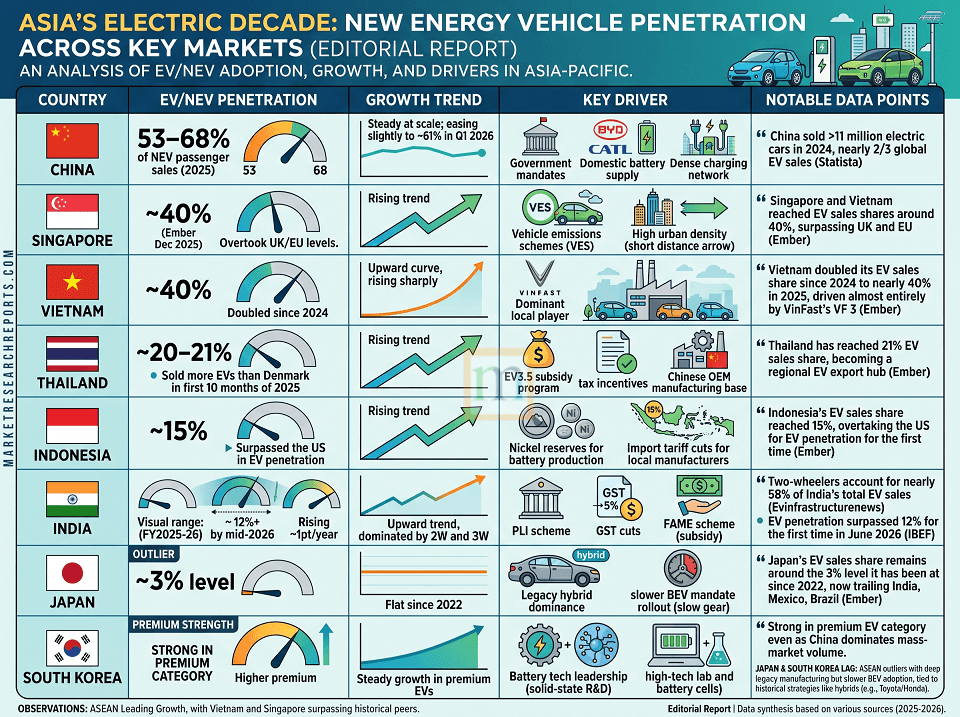
The share data tells the same story at the macro level. Chinese automakers' share of the global battery-electric vehicle market has held at roughly 63% from 2023 through 2025, and China accounted for 68.3% of the entire global new-energy passenger vehicle market in 2025, before easing modestly to around 61% in the first quarter of 2026 as domestic demand cooled. Export intensity is the real story beneath the headline share number: Chery's exports alone surged over 100% year over year to a record 177,573 units in a single month, and Chinese brands are now building local assembly in Hungary, Thailand, Brazil, Indonesia, and Uzbekistan to cement distribution advantages before tariff walls rise further.
This is the crux of the opportunity gap: every quarter Japanese OEMs spend re-sequencing their BEV roadmaps, Chinese brands are converting that white space into installed base, dealer networks, and brand recognition in markets — Europe, Southeast Asia, Latin America, the Gulf — that will be far more expensive to win back later than they are to contest now.
Reframing the Narrative: A Portfolio Bet, Not a Retreat
A framework is useful here because this is fundamentally a capital allocation decision under uncertainty, not an ideological one. Three things are true simultaneously:
1. Japan is hedging powertrain risk, not exiting electrification. Toyota, Honda, Mazda, and Subaru are collectively signaling that pure BEVs — at current battery costs, charging infrastructure maturity, and consumer demand in their core North American and Southeast Asian markets — are not yet the highest-return use of capital. Hybrids, plug-in hybrids, and (for Toyota and Honda specifically) hydrogen fuel cells remain areas where Japanese IP and manufacturing scale are genuinely differentiated and profitable today, rather than subsidized bets on a 2030 cost curve.
2. The U.S. policy environment has changed the payoff matrix. A meaningful share of this repricing follows the removal of the U.S. federal EV tax credit and the rollback of stricter emissions targets, which triggered multi-billion-dollar EV-related charges across GM, Ford, Stellantis, and Honda. For Japanese automakers, whose profit pools are heavily North America-weighted, this made the near-term economics of aggressive BEV rollouts considerably worse than they looked even twelve months ago.
3. China's advantage is structural, not just tactical. Vertical integration into battery cells, in-country rare-earth and LFP supply chains, and a home market large enough to underwrite scale before exporting give Chinese OEMs a durable cost advantage in pure BEVs specifically. Rather than fight that battle on China's terms, Japan's bet is to compete where the terms are different — hybrid powertrain complexity, engine efficiency, and brand trust in reliability-sensitive markets (India, ASEAN, parts of Africa and Latin America) where BEV infrastructure is still years away and total cost of ownership still favors hybrids.
Where the Opportunity Actually Sits
For operators and investors reading past the headlines, three whitespace areas stand out:
- Hybrid and PHEV supply chains in ICE-to-electric transition markets. Markets like India, Indonesia, and parts of Africa are structurally hybrid-first for the next decade, given charging infrastructure timelines. Japanese OEMs re-committing capital here — rather than fighting BYD on BEV cost curves — gives component suppliers (transmissions, power-split devices, smaller battery packs) a growth runway that is under-covered relative to the BEV narrative dominating headlines.
- Hydrogen and fuel-cell logistics for commercial fleets. Toyota and Honda's continued hydrogen investment, even as passenger BEV flagships pause, points to a bet on heavy-duty and fleet applications where refueling speed matters more than range anxiety — a segment BYD and Chinese peers have not prioritized.
- Localized manufacturing partnerships as a counter to Chinese export scale. Chinese brands are winning largely on landed cost and speed to market. Japanese OEMs and their supplier base have an opening to respond not by matching BEV price points, but by deepening local-assembly partnerships in markets where "Japanese reliability" remains a stronger brand asset than price alone — much as Japanese and Korean brands did decades earlier when entering Western markets.
The Bottom Line
Japan is not watching the EV future be built by someone else, as the framing suggests — it is choosing to build a different, adjacent future: one where hybrids, plug-in hybrids, and hydrogen carry the next decade of volume in markets where pure BEV economics don't yet work, while BEV R&D is paused rather than abandoned. The risk is real — every quarter of hesitation lets Chinese brands lock in export infrastructure and brand share that gets harder to dislodge. But the opportunity for suppliers, capital allocators, and adjacent markets is to recognize this as a genuine second strategic path in global mobility, not simply a slower version of China's.
Sources: Electrek, GreenCars, Automotive News, The Electric Viking, Gasgoo, EVTech.News, BigGo Finance, CarNewsChina, CNN Business, Dagens.com, ElectricCarsReport.