


Mapping the Invisible Chain: Inside the Real Monopolies and Duopolies Powering the Global HDD Boom
Mapping the Invisible Chain: Inside the Real Monopolies and Duopolies Powering the Global HDD Boom
MRR® Industry Intelligence Briefing Hard Disk Drive (HDD) · Semiconductors & Electronics · Supply Chain
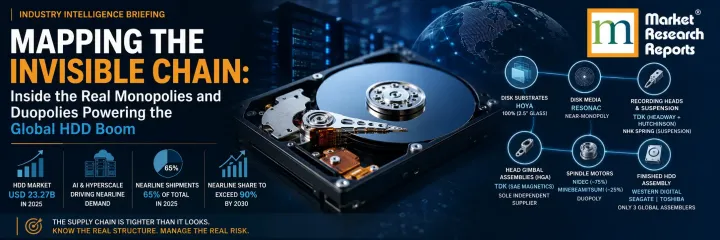
Every hard disk drive shipped by Western Digital, Seagate, or Toshiba depends on a supply chain most analysts get wrong. Not slightly wrong - structurally wrong, in a way that's been copy-pasted across market research reports for years. We spent the past several weeks rebuilding six HDD component markets from primary sources instead of aggregator databases, and what we found changes how you should think about supply risk in one of the most important - and least scrutinized - corners of the AI infrastructure buildout.
The number that should worry every hyperscaler procurement team: 1
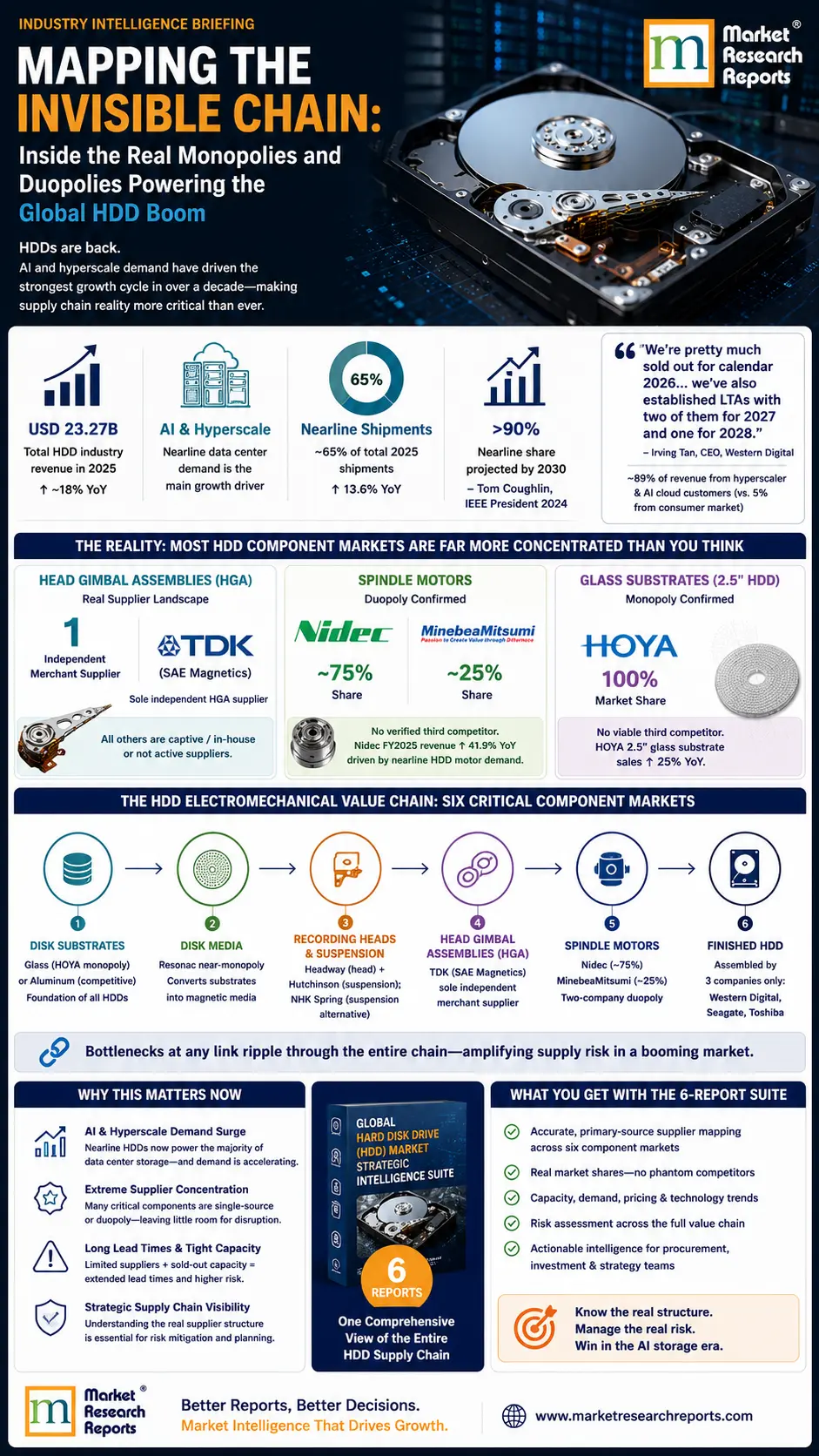
That's how many companies TrendFocus Inc. confirms manufacture head gimbal assemblies (HGAs) for the merchant market. Not three. Not four, the way most third-party reports frame it. One. TDK Corporation, via its SAE Magnetics subsidiary, is the sole independent HGA supplier - every other unit is either produced in-house by Western Digital or Seagate for their own captive use, or doesn't exist as a real, current supplier relationship at all.
This matters enormously right now, because our companion research - the Global Hard Disk Drive (HDD) Market Strategic Research Report - confirms the finished-drive market itself is in the middle of its strongest growth cycle in over a decade. Total industry revenue reached USD 23.267 billion in 2025, up approximately 18% year-over-year, driven almost entirely by one thing: AI and hyperscale nearline data center demand. Nearline shipments grew 13.6% year-over-year to roughly 65% of total 2025 shipments, and Tom Coughlin - IEEE President 2024, and one of storage's most credible independent analysts - projects that share will exceed 90% by 2030.
Every additional nearline drive shipped means more platters, more heads, more suspensions, more substrate. And a meaningful share of that additional demand runs through suppliers most procurement teams have never stress-tested.
The clearest illustration of how tight this has become came directly from Western Digital's own CEO. On the company's most recent earnings call, Irving Tan told investors: “We’re pretty much sold out for calendar 2026. We have firm POs with our top seven customers… we’ve also established LTAs with two of them for calendar 2027 and one of them for calendar 2028.” Western Digital’s hyperscaler and AI cloud customers now account for approximately 89% of revenue, versus just 5% from the consumer market - a ratio that would have been unrecognizable five years ago. When the demand side of a market moves this fast, the supply side’s actual structure - who can really make more, and who can’t - stops being a research footnote and starts being the whole story.
We debunked our own industry's phantom competitors
Before we published a single figure, we ran a dedicated verification pass specifically designed to catch a bias that's common across market research: cascading errors, where one report's mistaken company list gets copied into the next report, and the next, until an entire category of "competitors" exists only on paper.
Two findings stood out. First, the HDD spindle motor market - widely reported elsewhere as a four-to-five-company field - is, per verified primary sources, a genuine two-company duopoly: Nidec Corporation (an estimated ~75% share) and MinebeaMitsumi Inc. (~25%). A frequently-cited "third competitor," variously labeled "FUJI," "TI," or "Fujitsu" depending on which aggregator you check, does not resolve to any real, currently-operating manufacturer we could verify. Nidec's own FY2025 investor disclosures show spindle motor segment revenue up 41.9% year-over-year, explicitly attributed to higher-value-added nearline HDD motor sales - a figure no phantom-competitor-inflated market model would have led us to expect.
Second, in disk media, we found - and rejected - a recurring claim that three companies (HOYA, Resonac, and "Ohara") compete for HDD glass substrate supply. HOYA's own disclosures, corroborated independently by TrendForce and The Elec, confirm the company holds 100% share of the 2.5-inch glass substrate segment. There is no viable third competitor. HOYA disclosed 25% year-over-year glass substrate sales growth in its most recent quarter - a figure that only makes sense once you understand there's no meaningful competition diluting that demand.
What a genuinely mapped value chain looks like
Our six-report Global HDD Market Strategic Intelligence Suite is built around a structural pattern that repeats, with variation, at every stage of the HDD electromechanical assembly chain:
Disk Substrates → Disk Media. HOYA's glass substrate monopoly and Resonac's finished-media near-monopoly are two distinct, non-overlapping positions - not the same claim restated. Aluminum substrate, by contrast, is genuinely competitive: Kobe Steel holds an estimated 50-60% share, with Furukawa Electric and UACJ Corporation as real, named alternatives. Disk substrates carry the highest CAGR in the entire suite at 11.0%, directly tied to the accelerating glass-over-aluminum technology transition.
Recording Heads + Suspension → HGA. TDK's dominance isn't one undifferentiated business - it operates through distinct subsidiaries. Headway Technologies builds the bare recording head; Hutchinson Technology (acquired 2016) builds the suspension. NHK Spring remains the sole credible independent alternative for suspension assemblies specifically - the only real pathway to supply diversification in this segment.
Spindle Motors + HGA + Disk Media → Finished HDD, assembled by exactly three companies globally: Western Digital, Seagate, and Toshiba.
Three questions every storage procurement and investment team should be asking right now
1. How much of your critical component supply runs through a single-supplier bottleneck you haven't mapped? If your organization sources HGAs, glass substrate, or finished nearline drives, you are downstream of at least one confirmed sole-supplier relationship. That's not automatically a problem - but it's a risk that should be priced, not assumed away.
2. Is your growth forecast for storage hardware actually anchored to disclosed data, or to a number that's been re-estimated by three consecutive market reports? We anchored this suite's headline figures directly to Tom Coughlin's company-sourced quarterly disclosures rather than third-party aggregation - and found divergences of up to 3x between our verified total and figures still circulating elsewhere.
3. Which of your competitors have already modeled the captive-vs-merchant supply structure in their own component sourcing strategy? Toshiba's greater reliance on external suppliers relative to Western Digital and Seagate's captive production is a genuine competitive variable - one most market analyses don't even mention.
The Global HDD Market Strategic Intelligence Suite bundles all six reports - Global HDD Market, Spindle Motors, Head Gimbal Assembly, Disk Media, Disk Substrates, and Recording Heads & Suspension Assemblies - with a cross-market Executive Presentation, Summary Document, and Interactive Infographic, at a modest premium over the six reports' combined individual price. For intelligence scoped to your specific supply chain exposure, our custom research team can build an engagement around your exact question.