


The $10.5 Billion Bet on Copper and Glass: Why Amphenol Just Bought Its Way Into the Data Center Cabling Business
The $10.5 Billion Bet on Copper and Glass: Why Amphenol Just Bought Its Way Into the Data Center Cabling Business
MRR® Industry Intelligence Briefing Data Centers · Industrial Manufacturing · Capital Markets
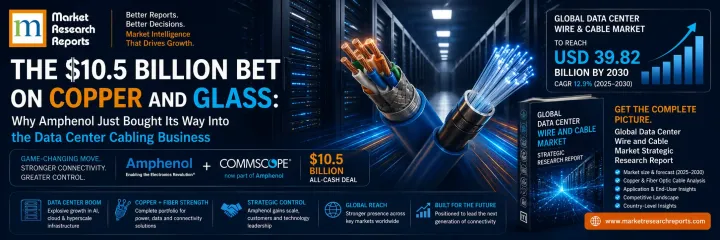
In August 2025, Amphenol Corporation agreed to pay US$10.5 billion for CommScope's Connectivity and Cable Solutions business - one of the largest acquisitions in the history of the physical data center infrastructure sector, and a bet on a product category most AI infrastructure coverage ignores entirely. Every story about the AI data center buildout centers on GPUs, power, and cooling. Almost none of them mention that every rack, every server, and every cross-connect in every one of those data centers is physically wired together - and that the company that makes those cables just spent $10.5 billion to make more of them.
Executive Summary
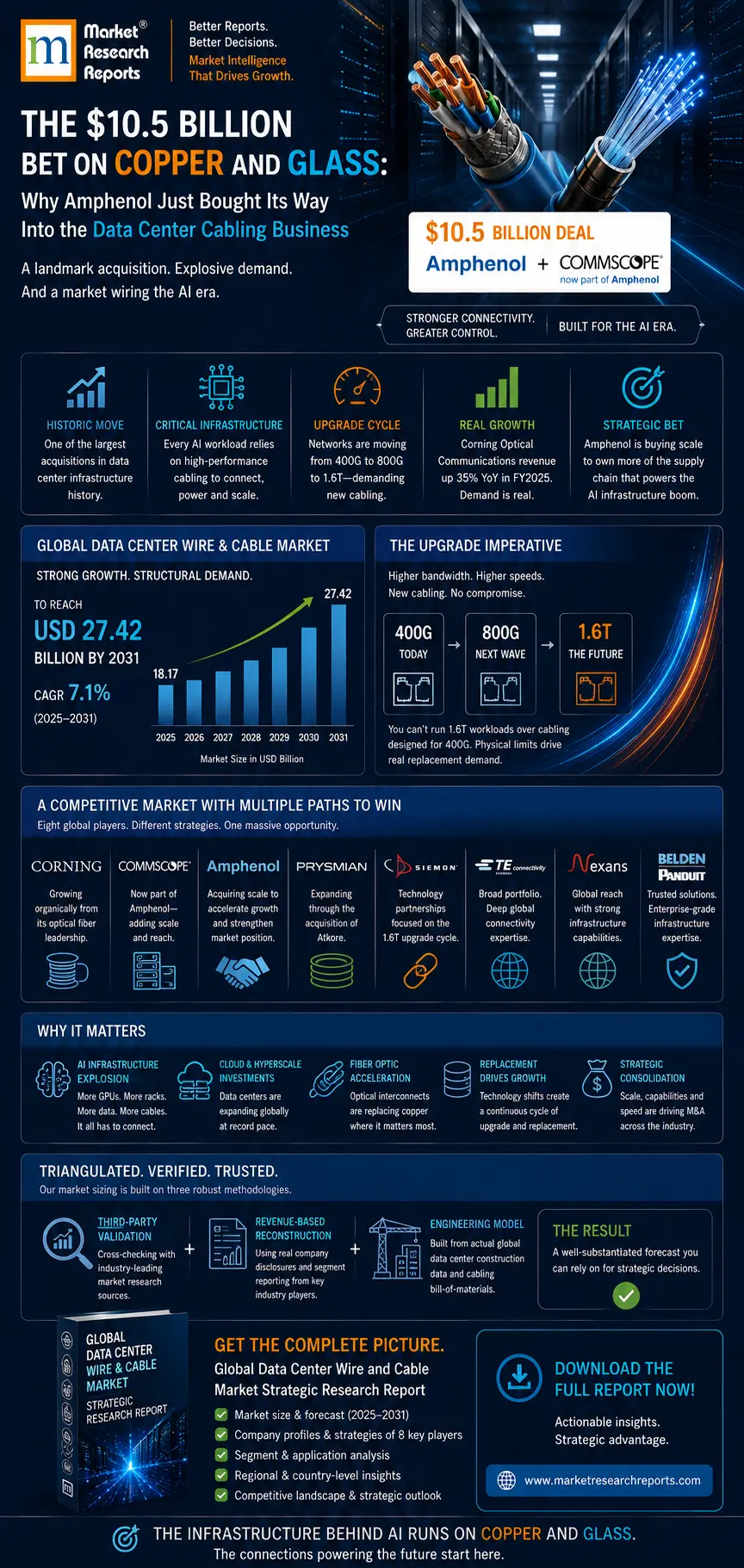
The global data center wire and cable market is estimated at US$18.17 billion in 2025, advancing to approximately US$27.42 billion by 2031, a 7.1% CAGR, according to Navadhi Market Research's Global Data Center Wire and Cable Market Strategic Research Report 2026-2031. This valuation reflects a multi-method triangulation - combining a third-party validation check, revenue-based bottom-up reconstruction from real company disclosures (Corning, CommScope, Amphenol), and an engineering/capacity-driven bottom-up model built from actual global data center construction data - rather than adoption of a single third-party figure. The single most important structural fact distinguishing this market from nearly every other component of the AI infrastructure buildout: it is genuinely fragmented and competitive, not a monopoly or duopoly. Eight companies are profiled in depth - Corning, CommScope, Amphenol, Prysmian Group, Siemon, TE Connectivity, Nexans, and Belden/Panduit - and the Amphenol-CommScope transaction is the clearest signal yet that consolidation, not organic growth alone, is how the largest players intend to capture share in the 400G/800G/1.6T network upgrade cycle ahead.
The Research Problem: Why the Least-Discussed AI Infrastructure Category Just Saw Its Largest Deal Ever
AI infrastructure investment coverage overwhelmingly concentrates on three categories: compute (GPUs), power, and cooling. The physical interconnect layer - the fiber optic and copper cabling connecting every server, switch, and storage array within a data center - receives a fraction of the analytical attention despite being a genuine structural bottleneck in its own right, for three specific reasons the Amphenol-CommScope deal makes concrete.
First, the network bandwidth upgrade cycle is not optional infrastructure - it is a hard physical requirement of AI workload scaling. The transition from 400G to 800G to 1.6T networking, driven directly by GPU cluster interconnect requirements for AI training and inference, requires physically different, higher-specification fiber optic and copper cabling than the infrastructure it replaces. Data centers cannot run 1.6T workloads over cabling designed for 400G - this is a genuine physical constraint, not a software upgrade.
Second, Corning's own disclosed financial results confirm the scale of the demand shift. Corning's Optical Communications segment reported FY2025 revenue growth of +35% year-over-year - a real, disclosed figure directly reflecting the AI-driven fiber optic demand surge, not an estimate. When a 170-year-old glass and ceramics manufacturer reports its optical communications segment growing at software-company rates, that is a direct financial confirmation of how significant the underlying infrastructure transition has become.
Third, the Amphenol-CommScope deal itself is the largest confirmed consolidation event in this specific market, and it happened for a specific structural reason: rather than build the connectivity and cable manufacturing capacity organically over a multi-year timeline, Amphenol chose to acquire an established US$10.5 billion revenue base outright, betting that owning existing manufacturing capacity, customer relationships, and product portfolio outright was a faster and more certain path to AI-cycle share than internal expansion.
Three Forces Driving the Cable Market's Growth
Force 1 - The Network Bandwidth Upgrade Cycle
The 400G-to-800G-to-1.6T transition is the single most direct driver of demand for higher-specification fiber optic and copper cabling in this market. Every hyperscale and colocation data center pursuing AI-cluster-scale networking must physically replace or supplement existing cable infrastructure to support the higher bandwidth requirements - a cycle that runs on a multi-year replacement timeline tied directly to AI infrastructure buildout schedules, not general IT refresh cycles.
Force 2 - Rising Power Cabling Demand from Higher-Density Racks
The same rack power density increases driving the AI data center power and cooling infrastructure market covered in Navadhi's companion briefing are simultaneously driving demand for higher-current, higher-specification power cabling within the data center wire and cable market. As racks move from 10-15kW to 40-100kW power draws, the busway and power distribution cabling connecting that power to the rack must be upgraded in parallel with the network cabling - meaning the same AI infrastructure buildout is a dual demand driver for this market, not a single one.
Force 3 - Consolidation as a Competitive Strategy
The Amphenol-CommScope transaction establishes acquisition-driven scale as a viable, proven competitive strategy in a market that has historically grown primarily through organic capacity expansion. With genuine fragmentation still characterizing the broader eight-company competitive landscape, further consolidation activity among the remaining major players is a reasonable strategic expectation through the remainder of the forecast period, as competitors respond to Amphenol's move.

The Competitive Landscape: Genuine Fragmentation, Not Consolidation - Yet
| Company | Primary Product Area | Confirmed 2025 Signal | Structural Position |
|---|---|---|---|
| Corning Incorporated | Optical fiber cables | Optical Communications segment +35% YoY (FY2025) | Directly disclosed, real financial confirmation of AI-driven fiber demand surge |
| CommScope / Amphenol (CCS) | Copper/structured cabling, connectivity | ~US$3.6B revenue base acquired by Amphenol (disclosed via Amphenol 8-K) | Largest confirmed consolidation event in this market's history (US$10.5B, announced Aug 2025) |
| Amphenol Corporation | Connectivity, cable assemblies | ~US$3.42B (pre-acquisition base) | Acquiring, not being acquired - the clearest signal of confidence in this market's AI-cycle growth |
| Prysmian Group | Fiber optic and power cables | US$24.8B TTM group revenue | Confirmed Aug 2026 acquisition of Atkore, expanding broader cable manufacturing scale |
| TE Connectivity | Connectivity, power/network cabling | US$4.75B (Q4 FY2025, +17% YoY) | Strong, disclosed growth directly tied to data center connectivity demand |
| Siemon | Structured cabling for AI factories | Krambu partnership (Oct 2025) targeting NVIDIA AI factory / 1.6T networking | Direct, named positioning around the AI-specific 1.6T upgrade cycle |
| Nexans | Power and fiber cables | - | European-anchored cable manufacturing scale |
| Belden / Panduit | Structured cabling, connectivity | - | Established structured cabling incumbents |
Source: Navadhi Market Research, Global Data Center Wire and Cable Market Strategic Research Report 2026-2031; individual company financial disclosures and 8-K filings, 2025-2026.
Analyst Insight
The most important thing this market's competitive landscape reveals is a genuine strategic divergence in how the largest players are choosing to compete for AI-cycle share. Corning is capturing growth organically, its optical fiber franchise scaling directly with disclosed +35% segment revenue growth. Amphenol chose acquisition instead, paying $10.5 billion for an established revenue base rather than building it. Prysmian is pursuing the same acquisitive strategy through its own Atkore deal. Siemon is positioning through a named technology partnership specifically targeting the 1.6T upgrade cycle. Four different companies, four different competitive strategies, all converging on the same underlying demand driver - this is what a genuinely fragmented, competitive market under structural demand pressure looks like, and it is a meaningfully different dynamic than the concentrated oligopolies characterizing the memory and NAND markets covered in Navadhi's companion briefings on the same broader AI infrastructure buildout.
Strategic Lessons for Market Participants
| Observation | Strategic Implication |
|---|---|
| Amphenol chose acquisition over organic build-out for the CommScope business | Competitors without existing connectivity manufacturing scale should expect further consolidation activity, not assume organic growth alone will be sufficient to capture AI-cycle share |
| Corning's disclosed +35% Optical Communications growth is a real, verifiable demand signal | Analysts should weight Corning's segment-level quarterly disclosures as a genuine leading indicator for fiber optic demand across the broader market, given its direct financial transparency |
| The 400G-800G-1.6T upgrade cycle is a hard physical requirement, not a discretionary IT refresh | Buyers and vendors should treat this replacement cycle as a multi-year, non-discretionary demand driver tied directly to AI cluster deployment schedules |
| The market remains genuinely fragmented despite the Amphenol-CommScope deal | New entrants and smaller competitors still have viable positioning opportunities, unlike the concentrated oligopoly structures in adjacent memory and NAND markets - this is a meaningfully more open competitive environment |
Frequently Asked Questions
Why did Amphenol acquire CommScope's connectivity business rather than expand organically?
Acquiring an established ~US$3.6 billion revenue base with existing manufacturing capacity, customer relationships, and product portfolio provides faster, more certain access to AI-cycle demand than a multi-year organic capacity build-out would. The US$10.5 billion price reflects a bet that the speed and certainty of acquisition outweighs the premium paid over building the equivalent capacity independently.
Is the data center cable market at risk of becoming a monopoly or duopoly like other AI infrastructure segments?
Based on current market structure, no - the eight-company competitive landscape remains genuinely fragmented, and the Amphenol-CommScope deal, while significant, does not create dominant market control. This distinguishes the cable market structurally from the memory and NAND markets, where five companies control the overwhelming majority of global supply.
What is driving the specific power cabling demand increase within this market?
The same rack power density increases (from 10-15kW to 40-100kW per rack) driving investment in the broader AI data center power and cooling infrastructure market are simultaneously requiring higher-current, higher-specification power cabling within the data center, creating a dual demand driver alongside the network bandwidth upgrade cycle.
How reliable is Corning's +35% Optical Communications growth as an indicator for the broader market?
It is one of the most reliable indicators available, because it is a directly disclosed, audited financial figure from a real company's quarterly reporting - not a modeled estimate. Corning's scale and market position make its Optical Communications segment performance a meaningful proxy for broader fiber optic demand trends across the data center cabling market.
Are further acquisitions likely in this market following the Amphenol-CommScope deal?
Prysmian Group's confirmed August 2026 acquisition of Atkore suggests the answer is already yes - at least one other major player has pursued a comparable acquisitive growth strategy following Amphenol's move, and the combination of genuine market fragmentation with strong structural demand growth creates conditions favorable to further consolidation activity among the remaining major competitors.
For full market sizing, regional forecasts, and vendor profiles across the global data center wire and cable landscape, see our Global Data Center Wire and Cable Market Strategic Research Report 2026-2031. For the power and cooling infrastructure driving parallel demand in the same data centers, read our companion briefing on the AI data center power and cooling infrastructure market. For bespoke infrastructure market analysis, commission custom research.