


The Company That Got Cut From Its Own Market Research Report - And Why That's the Real Story
The Company That Got Cut From Its Own Market Research Report - And Why That's the Real Story
MRR® Industry Intelligence Briefing Automotive Technology · Enterprise AI · Fleet Management
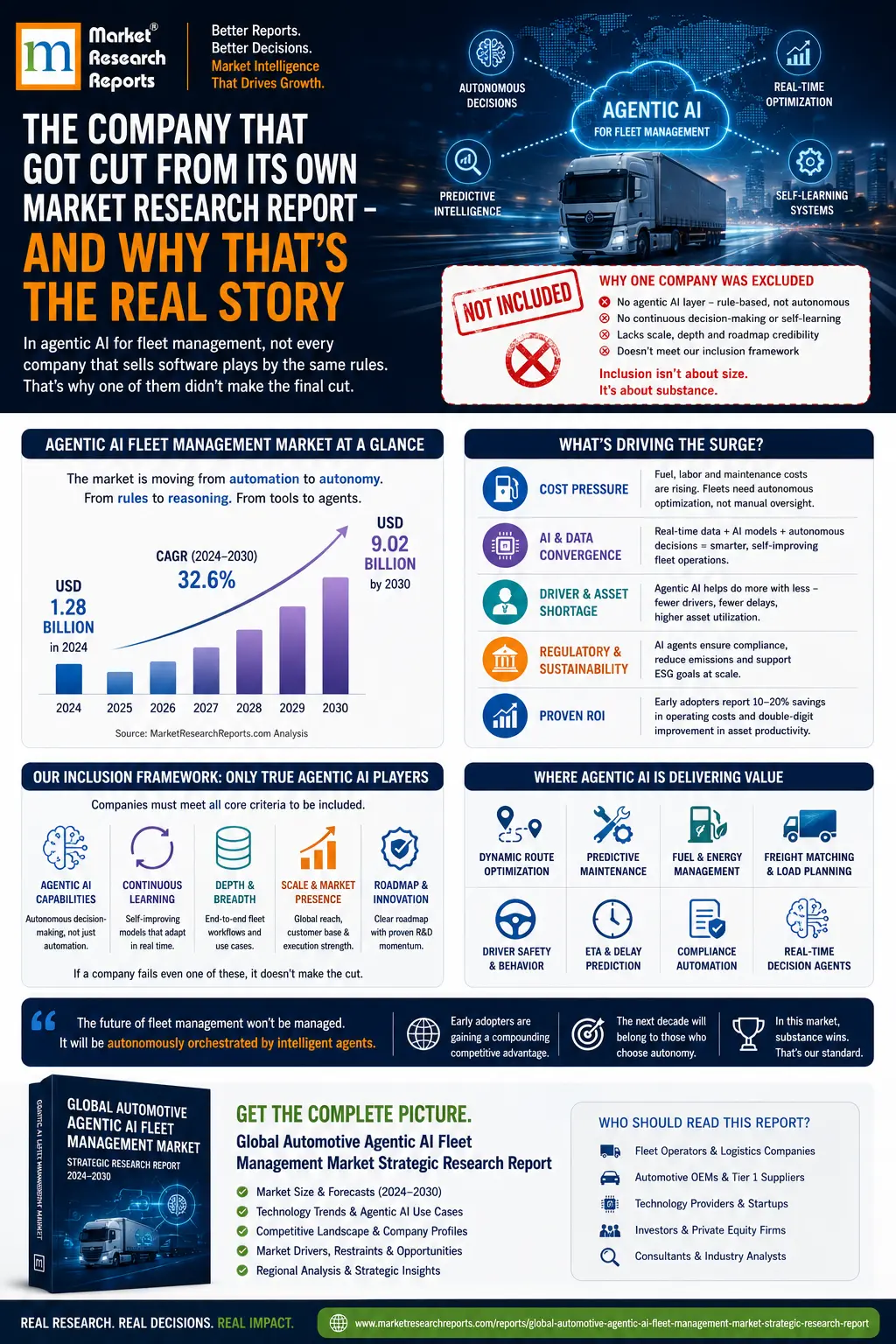
When we started building a market report on agentic AI fleet management, the client's initial company shortlist included Stellantis Free2Move Fleet - a reasonable inclusion on paper, backed by one of the world's largest automakers. It didn't survive verification. In its place: Locus, a dispatch-software company most fleet managers outside the logistics-technology world have never heard of. The reason for the swap turned out to be the most useful finding in the entire report.
Executive Summary
The global automotive agentic AI fleet management market is estimated at $6.40 billion in 2025, forecast to reach $29.56 billion by 2031 - a 29.0% compound annual growth rate, according to Navadhi Market Research's Global Automotive Agentic AI Fleet Management Market Strategic Research Report 2026-2031. This is a genuinely narrow, emerging segment sized via transparent parent-market decomposition: the real, converged Fleet Management Software market (approximately $32.0 billion in 2025, cross-validated across four independent research sources) combined with a disclosed agentic-AI-specific share rising from 10% in 2025 to 40% by 2031. Ten companies are profiled, and one substitution defines the report's central finding: Stellantis Free2Move Fleet, initially proposed as a key player, was replaced with Locus after verification found it narrowly scoped to Stellantis-brand vehicles only, with no confirmed agentic AI feature - while Locus turned out to be genuinely agentic-native, not agentic-branded, with its Dispatch, Orchestrator, and Carrier agents operating as one coordinated autonomous system.
The Research Problem: Why "Has AI" and "Is Agentic" Turned Out to Be Two Different Questions
Every major fleet telematics platform in 2026 markets itself as AI-powered. That claim is almost universally true and almost entirely uninformative, because it conflates two structurally different things: platforms that have added AI features to an existing telematics product, and platforms built around autonomous AI agents from the ground up. Distinguishing them required checking three things that a company's own marketing copy won't reliably tell you.
First, does the AI capability have a name and a specific, checkable function, or is it a general claim? Samsara's "Agentic Shipment Center" and Geotab's "Ace" assistant are both real, named, specific features - not marketing language, but products a customer can point to and describe. Motive's "integrated AI operations platform" is similarly specific. That is the first, most basic filter, and most platforms in this category pass it in 2026.
Second, is the AI capability autonomous and multi-step, or does it still require a human to review and approve each action? This is where the distinction gets real. Locus's architecture assigns three explicitly named, functionally distinct agents - a Dispatch agent that assigns and sequences work, an Orchestrator agent that handles exceptions autonomously, and a Carrier agent that coordinates multi-carrier networks - running as one coordinated system with routing that re-optimizes across 250+ constraints in real time. That is a materially different claim than "AI-powered route suggestions," and it is the reason Locus is classified in this report as genuinely agentic-native rather than agentic-enabled.
Third, and this is what actually disqualified Stellantis Free2Move Fleet: does the product's scope match the market being described? Free2Move Fleet is a real, functioning fleet analytics product - but it operates specifically as an OEM-embedded data layer for Stellantis-brand vehicles (powered by Mobilisights, Stellantis's own data-as-a-service arm), not a universal cross-brand platform like the other nine companies in this report. A Stellantis-only telematics layer is a genuinely different competitive category than a platform that works with any vehicle from any manufacturer, regardless of how sophisticated its underlying AI is. The timing reinforced the concern: Stellantis announced in August 2026 that it is selling its related Free2move car-sharing business to Mutares, a signal of reduced strategic priority for the Free2move brand generally.
Three Forces Behind the Market's 29% Growth Rate
Force 1 - Regulatory Compliance Is Building the Installed Base Agentic AI Will Colonize
FMCSA ELD mandates and equivalent international compliance requirements have already forced baseline telematics adoption across the commercial fleet sector - vehicles are already instrumented, already connected, already generating the real-time data agentic systems need. This report's structural thesis is that agentic AI is not creating a new market from scratch; it is capturing an increasing share of a market that compliance requirements already built. That is a meaningfully lower-risk growth story than one requiring net-new infrastructure adoption.
Force 2 - EV Fleet Transition Is Creating a Category With No Legacy Non-AI Equivalent
EV Fleet Charging Scheduling & Energy Cost Arbitrage is the fastest-growing application segment in this report (9% to 19% share, 2025-2031) for a specific structural reason: there is no meaningful "traditional telematics" version of this function to compete against. Diesel and gasoline fleets never needed charge-scheduling optimization; commercial EV fleets need it immediately and continuously. This is one of the few genuine greenfield categories within an otherwise mature market.
Force 3 - Contract Structure Is Becoming a Competitive Variable, Not Just a Pricing One
Independent 2026 platform comparisons confirm a real, disclosed pattern: Samsara's standard three-year minimum commitment creates switching friction that Motive's more flexible, sometimes month-to-month terms directly exploit. As agentic AI capability converges toward parity across major platforms - which this report's own share-of-parent-market trajectory implies will happen by 2031 - contract flexibility becomes a larger share of the actual competitive decision than raw feature comparison.
The Competitive Landscape: Ten Companies, Three Genuinely Different Strategic Postures
| Company | HQ | Confirmed Positioning | Strategic Posture |
|---|---|---|---|
| Samsara Inc. | USA | Q2 FY2026 ARR of $1.64B (disclosed); "Agentic Shipment Center," "Physical AI," 190+ patents, No. 1 rated across G2's Spring 2026 Grid Reports | Organic AI-feature expansion at scale |
| Geotab Inc. | Canada | Largest install base (4.6M+ vehicles); "Geotab Ace" AI assistant; 430+ marketplace integrations via 2,000+ reseller network | Organic AI-feature expansion, open platform |
| Motive Technologies | USA | Integrated AI operations platform; flexible contract terms as a confirmed competitive differentiator vs. Samsara | Organic AI-feature expansion, compliance focus |
| Verizon Connect | USA | 13%+ market share (largest single-vendor share cited across sources); carrier-network-backed reliability | Organic AI-feature expansion, enterprise scale |
| Omnitracs (Solera) | USA | 15,000 customers, 700M miles/week; consolidated under Solera Fleet Solutions with SmartDrive, Spireon | Platform consolidation via M&A |
| MiX Telematics / PowerFleet | South Africa / USA | Confirmed 2024 merger; PowerFleet also acquired Fleet Complete | Platform consolidation via M&A |
| Fleetio | USA | $450M funding round (2024) at $1.5B+ valuation; maintenance-management specialization | Specialist differentiation |
| Trimble Inc. | USA | CoPilot routing directly integrated into Geotab's stack | Infrastructure/routing provider to the ecosystem |
| Teletrac Navman | USA / NZ | Named among confirmed 2026 category leaders | Established enterprise incumbent |
| Locus | USA | Dispatch, Orchestrator, and Carrier agents operating as one coordinated system; 250+ real-time routing constraints | Purpose-built agentic-native entry |
Source: Navadhi Market Research, Global Automotive Agentic AI Fleet Management Market Strategic Research Report 2026-2031; company disclosures and independent 2026 industry comparisons.
Analyst Insight
The most useful output of this research wasn't the market-size forecast - it was the verification process that determined the company list in the first place. A market-research report that accepts a proposed company list without independently checking each candidate's actual product scope against the market being described will systematically overstate how crowded and mature an emerging category is. Stellantis Free2Move Fleet looked like a reasonable inclusion precisely because "automaker with a fleet product" is an intuitive category match - but intuitive category matches are exactly where verification research earns its keep. The nine incumbents in this report are all real, relevant, and competing hard on feature parity. The genuinely interesting competitive question for the next several years is whether that feature-parity race, well underway at Samsara, Geotab, and Motive, closes the architectural gap with purpose-built agentic-native entrants like Locus before those entrants can convert architectural advantage into market share - or whether, as this report's own share-of-parent-market trajectory suggests, the distinction stops mattering commercially well before it's resolved technically.
Strategic Lessons for Market Participants
| Observation | Strategic Implication |
|---|---|
| "AI-powered" is now a near-universal claim across fleet platforms, with limited differentiating value on its own | Buyers evaluating vendors should specifically ask whether AI features are autonomous and multi-step or require human approval at each action - the distinction Locus's Dispatch/Orchestrator/Carrier agent architecture makes explicit |
| Contract flexibility is becoming a real competitive variable as AI feature parity converges across major platforms | Fleet operators should weight contract-term flexibility more heavily in vendor selection as the underlying AI capability gap narrows through 2031 |
| OEM-embedded telematics (like Stellantis Free2Move Fleet) represents a structurally different competitive category than universal cross-brand platforms | Analysts and buyers comparing "fleet AI platforms" should explicitly separate OEM-tied and cross-brand-universal offerings rather than treating them as directly comparable competitors |
| The EV charging scheduling category has no legacy non-AI equivalent to displace | Vendors and investors should treat this specific application segment as a genuine greenfield opportunity, distinct from feature-upgrade competition in more mature categories like route optimization |
Frequently Asked Questions
Why was Stellantis Free2Move Fleet replaced with Locus in this report's company list?
Verification research found Free2Move Fleet is narrowly scoped to Stellantis-brand vehicles only, powered by Mobilisights (Stellantis's own data-as-a-service arm) - a structurally different, OEM-tied category compared to the universal, cross-brand platforms the other nine companies represent. No confirmed genuine agentic AI feature was identified for the product, and Stellantis's August 2026 announcement of selling its related Free2move car-sharing business to Mutares signaled reduced strategic priority for the Free2move brand generally. Locus was added as a confirmed, purpose-built agentic-native dispatch platform, a more precise fit for this report's specific scope.
What is the actual difference between "AI-powered" and "agentic AI" in fleet management?
AI-powered typically describes discrete features - predictive analytics, driver scoring, route suggestions - that assist a human decision-maker. Agentic AI describes autonomous, multi-step systems capable of independently executing complex tasks end-to-end, such as Locus's Dispatch agent assigning and sequencing work or its Orchestrator agent handling exceptions without human intervention. Most platforms in this market have real AI features; a smaller subset have genuinely agentic, autonomous capability.
How was the market size calculated given this is such a new category?
Via parent-market decomposition: the real, converged Fleet Management Software market (~$32.0 billion in 2025, cross-validated across Fortune Business Insights, Global Market Insights, MarketsandMarkets, and The Business Research Company) combined with a disclosed, transparently modeled agentic-AI-specific share, rising from 10% of the parent market in 2025 to 40% by 2031. This approach is used specifically because no independently published, agentic-AI-specific third-party market figure yet exists for this narrow, fast-emerging segment.
Which region and application segment are growing fastest?
Asia Pacific is the fastest-growing region (20% to 28% share, 2025-2031), consistent with the broader parent market. EV Fleet Charging Scheduling & Energy Cost Arbitrage is the fastest-growing application segment (9% to 19% share) specifically because it has no legacy non-AI equivalent competing against it, unlike more mature categories such as route optimization.
Should a fleet operator prioritize an established platform or a purpose-built agentic-native entrant like Locus?
That depends on the operator's priority. Established platforms (Samsara, Geotab, Motive) offer larger install bases, broader integration ecosystems, and lower switching risk, and are actively closing the agentic-capability gap through organic feature development. Purpose-built agentic-native platforms offer architectural advantages specifically in autonomous dispatch and exception handling today, without the burden of retrofitting AI onto a pre-agentic product. This report profiles both categories to support that specific evaluation.
For full market sizing, ten verified company profiles, and country-level detail across all five regions, see our Global Automotive Agentic AI Fleet Management Market Strategic Research Report 2026-2031. For bespoke automotive and fleet technology market analysis, commission custom research.