


The Three Supercycles Reshaping Oncology While Everyone Watches Checkpoint Inhibitors
The Three Supercycles Reshaping Oncology While Everyone Watches Checkpoint Inhibitors
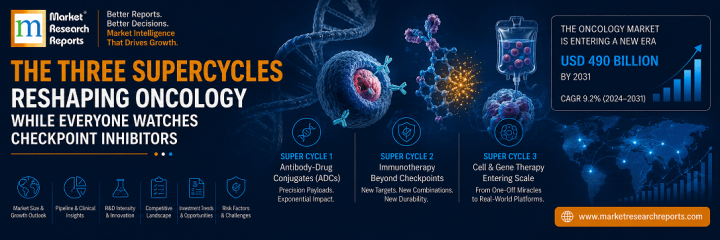
MRR® Industry Intelligence Briefing Oncology · Pharmaceuticals · Market Analysis
Most oncology market coverage still runs on a single storyline: checkpoint inhibitors got here first, and everything else is a footnote. That storyline was true in 2018. It stopped being true somewhere around the moment antibody-drug conjugates went from a niche modality to a 15%+ CAGR category on their own, and most market coverage hasn't caught up.
Executive Summary
The global oncology market is estimated at $278.6 billion in 2025, forecast to reach $521.0 billion by 2031 - an 11.0% compound annual growth rate - according to Navadhi Market Research's Global Oncology Market Strategic Research Report. The report's own framing is unusually direct about why growth is accelerating rather than plateauing: three overlapping pharmaceutical "supercycles" running simultaneously, not one dominant therapy class carrying the category alone. Ten companies are profiled in depth, and the more interesting story for anyone allocating capital into oncology right now isn't which company leads - it's which of the three supercycles they're actually positioned in, because that answer is changing faster than most competitive assessments account for.
The Research Problem: Checkpoint-Inhibitor Coverage Is Fighting the Last War
Immunotherapy and checkpoint inhibitors earned their outsized share of oncology market coverage honestly - Keytruda alone generated $31.7 billion in FY2025, up 7% year-on-year, making it the world's best-selling pharmaceutical product across more than 40 approved indications. A market narrative built entirely around that franchise's continued dominance isn't wrong about the present. It's incomplete about where growth is actually concentrating next.
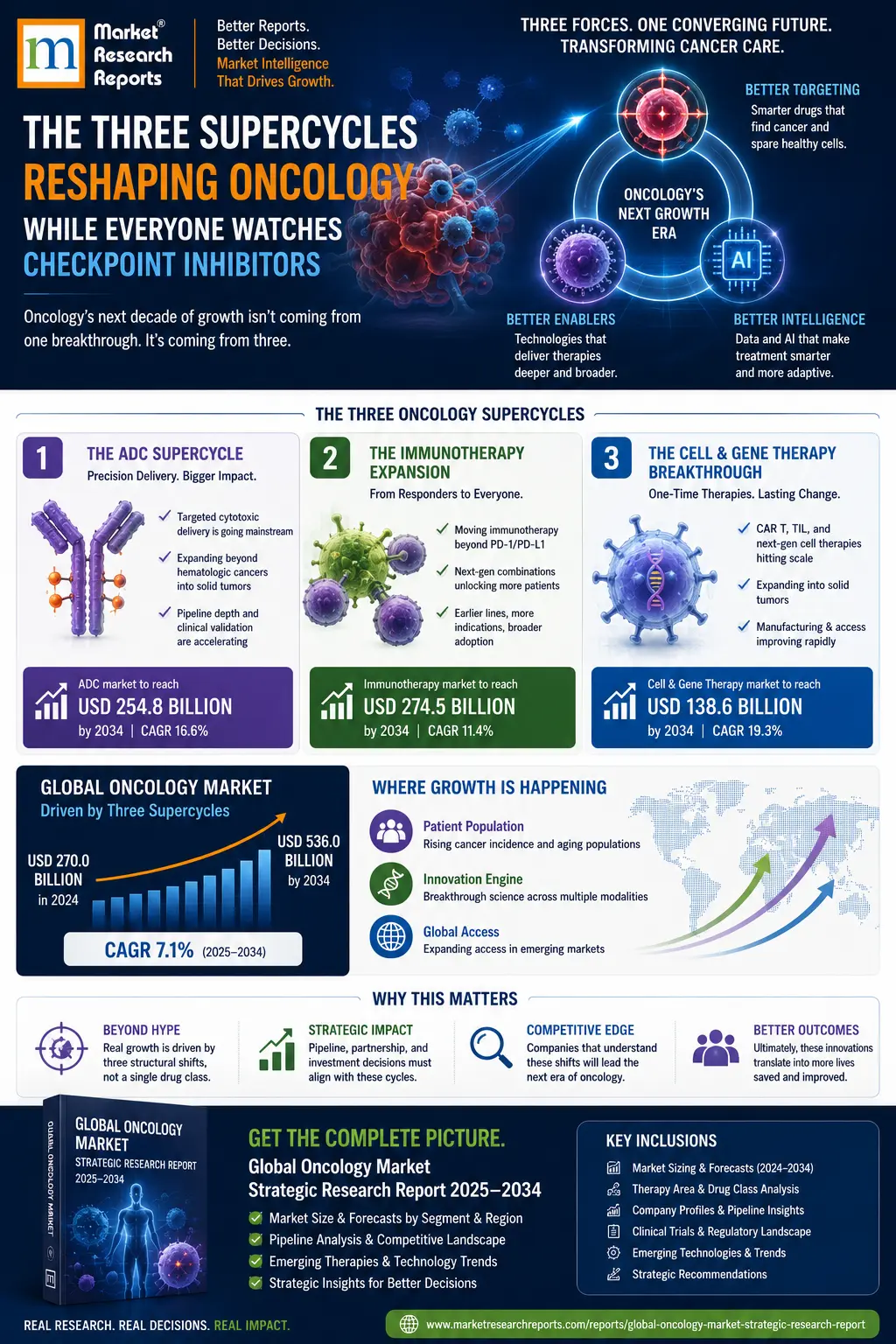
The category most underweighted in generalist coverage is antibody-drug conjugates. ADCs are advancing from roughly $20.4 billion in 2025 (about 8% of the total market) to an estimated $55.1 billion by 2031 - modeled at an 18.0% CAGR at the segment level, meaningfully faster than the market's 11.0% blended average. Enhertu's 88% year-on-year growth in FY2024 wasn't a one-off; it's the commercial proof-of-concept for a modality now producing 20+ new drug application submissions expected between 2025 and 2028, with next-generation linker and warhead technology addressing the tolerability constraints that limited earlier ADC generations.
The third supercycle - CAR-T and advanced cell therapy scaling - gets even less mainstream coverage than ADCs, despite representing a genuinely distinct manufacturing and commercial model from either checkpoint inhibitors or ADCs. A competitive assessment that treats "oncology" as a single undifferentiated category, rather than tracking which companies are building real positions in each of these three supercycles specifically, will misjudge where the next five years of category leadership actually gets contested.
Three Supercycles, Three Different Competitive Games
Supercycle One - Immunotherapy Expansion and Combination Deepening
Checkpoint inhibitors remain the category's largest single franchise, but the growth driver has shifted from new-drug launches to label expansion and combination therapy - Keytruda's 40+ approved indications reflect a strategy of deepening penetration within existing approvals rather than relying on net-new molecule launches. This is a maturing, defensible franchise, not a growth story in the way it was five years ago.
Supercycle Two - The ADC Commercial Wave
This is where the category's fastest real growth is concentrated. AstraZeneca's oncology portfolio, anchored substantially by Enhertu (trastuzumab deruxtecan) alongside its immunotherapy franchise, generates approximately $22 billion in total oncology revenue - a smaller headline number than Merck's, but disproportionately levered to the fastest-growing part of the market.
Supercycle Three - CAR-T and Advanced Cell Therapy Scaling
Structurally the least concentrated of the three, and the one where manufacturing complexity - not clinical efficacy - remains the binding constraint on how fast the category can scale, a genuinely different competitive bottleneck than either of the first two supercycles face.
Where the Ten Profiled Companies Sit Across the Three Supercycles
| Company | Primary Supercycle Position | What to Watch |
|---|---|---|
| Merck & Co. | Immunotherapy (Keytruda) | 2028–2032 patent cliff window; biosimilar competitive response strategy |
| Bristol-Myers Squibb | Immunotherapy | Combination therapy strategy as checkpoint-inhibitor growth matures |
| AstraZeneca | ADC (Enhertu) + Immunotherapy | Best-positioned major for the fastest-growing supercycle specifically |
| Roche | ADC + diversified oncology | Legacy franchise transition alongside newer ADC pipeline |
| Johnson & Johnson | Diversified, targeted therapy | Portfolio breadth across multiple modalities |
| Pfizer | Diversified oncology portfolio | Post-acquisition integration of oncology assets |
| Novartis | Radiopharmaceuticals + targeted therapy | A fourth, adjacent growth vector alongside the three core supercycles |
| AbbVie | Targeted therapy | Smaller, more concentrated oncology franchise than peers |
| Eli Lilly | Targeted therapy, emerging ADC | Oncology scale relative to its much larger metabolic-disease franchise |
| Gilead Sciences | Cell therapy (CAR-T) + ADC | Direct exposure to Supercycle Three's manufacturing-constrained growth |
Source: Navadhi Market Research, Global Oncology Market Strategic Research Report; company disclosures.
Analyst Insight
The most consequential number in this report for anyone doing competitive assessment isn't the $521.0 billion 2031 total - it's the segment-level CAGR spread underneath it. An 11.0% blended market growth rate sitting on top of an 18.0% ADC segment and a slower-growing checkpoint-inhibitor base tells you the category's center of gravity is actively shifting, not holding steady. A company with genuine ADC-platform depth is playing a different growth game than a company whose oncology revenue still runs primarily through a maturing immunotherapy franchise, even if their current headline oncology revenue numbers look comparable. That distinction matters more with each passing year through 2031, as Merck's own patent-cliff window - 2028 to 2032, depending on jurisdiction - starts to bite on the category's largest single franchise precisely as the ADC wave is reaching full commercial scale.
Strategic Lessons for Market Participants
| Observation | Strategic Implication |
|---|---|
| ADCs are growing at roughly 18% segment-level CAGR versus an 11% blended market average | Competitive positioning assessments should weight ADC-platform depth explicitly, not treat "oncology revenue" as a single undifferentiated figure |
| Keytruda's patent cliff window (2028–2032) approaches as the ADC wave reaches full scale | Merck's post-2028 trajectory depends heavily on how successfully it builds non-Keytruda growth vectors before the cliff, not just on defending the existing franchise |
| CAR-T scaling is manufacturing-constrained, not efficacy-constrained | Companies with genuine manufacturing scale advantages in cell therapy hold a structurally different kind of moat than clinical-data-driven advantages elsewhere in oncology |
| Ten profiled companies span meaningfully different supercycle exposure, not a single competitive tier | Peer-group comparisons should account for which supercycle(s) a company is actually competing in, not just aggregate oncology revenue scale |
Frequently Asked Questions
What is the size of the global oncology market?
The market is estimated at $278.6 billion in 2025, projected to reach $521.0 billion by 2031, a compound annual growth rate of approximately 11.0%.
What are the three "supercycles" driving oncology market growth?
Immunotherapy/checkpoint inhibitor expansion and combination deepening, the antibody-drug conjugate (ADC) commercial wave, and CAR-T/advanced cell therapy scaling - three overlapping growth drivers running simultaneously rather than a single dominant therapy class.
Which oncology segment is growing fastest?
Antibody-drug conjugates (ADCs), modeled at approximately 18.0% CAGR at the segment level - meaningfully faster than the market's 11.0% blended average - advancing from roughly $20.4 billion in 2025 to $55.1 billion by 2031.
Which companies are profiled in this report?
Ten companies: Merck & Co, Bristol-Myers Squibb, Roche, AstraZeneca, Johnson & Johnson, Pfizer, Novartis, AbbVie, Eli Lilly, and Gilead Sciences.
When does Keytruda face patent expiry?
Core patents begin expiring in the 2028–2032 range depending on jurisdiction, representing the most commercially significant approaching loss of exclusivity in the oncology market.
For full segment, application, regional, and country-level detail, complete methodology and cross-validation against the companion Pharma Industry report, and all ten company profiles, see our Global Oncology Market Strategic Research Report. For bespoke oncology market analysis, commission custom research.