


World's Leading GLP-1 Drug Manufacturers
World's Leading GLP-1 Drug Manufacturers
MRR® GLP-1 Industry Analysis Market Research · Competitive Intelligence
The GLP-1 Manufacturing Growth-Share Matrix: Mapping the Capacity Race Behind the World's Fastest-Growing Drug Class
The global GLP-1 drug manufacturing and supply chain market is projected to expand from US$45.0 billion in 2025 to US$180.1 billion by 2031, a 26% CAGR — one of the steepest growth trajectories tracked across the pharmaceutical industry today. The defining feature of this market, as opposed to the therapeutics market it feeds, is that capacity investment, not patient demand, is the binding constraint: every major player in this value chain is racing to build sterile fill-finish lines, peptide synthesis capacity, and delivery-device manufacturing fast enough to keep pace with a demand curve that has already outrun supply for several years running.
Seven organizations anchor this value chain across two distinct roles: originators who manufacture largely in-house (Eli Lilly, Novo Nordisk) and CDMO/packaging partners who supply capacity to the broader industry (Novo Holdings via Catalent, Samsung Biologics, Lonza, WuXi Biologics, and Biocon Biologics). This briefing applies the BCG growth matrix framework to each company's disclosed manufacturing capacity, contract value, and capital investment — using only what the seven majors have themselves reported in FY2025–FY2026 filings, earnings releases, and investor presentations.
Market Sizing Snapshot, 2025–2031
| Metric | Figure |
|---|---|
| Base market size (2025) | US$45.0 Billion |
| Forecast market size (2031) | US$180.1 Billion |
| CAGR (2025–2031) | 26.0% |
| Largest single value-chain stage | Drug Product Formulation and Fill-Finish |
| Primary near-term constraint | Manufacturing capacity, not patient demand |
| Regions covered | Asia Pacific, Latin America, MEA, Europe, North America |
Source: Global GLP-1 Drug Manufacturing & Supply Chain Market Strategic Research Report, Market Research Reports Inc.
The Growth-Share Lens, Applied to GLP-1 Manufacturing
Unlike a therapeutics-revenue matrix, this market's growth-share dynamics play out across manufacturing value-chain stages rather than drug brands:
- Sterile fill-finish and drug product formulation — the single largest and most capacity-constrained stage, where originators and CDMOs alike are deploying billions in capital simply to catch up with demand.
- GLP-1 API peptide synthesis — a highly specialized, technically demanding stage where a small number of CDMOs (and increasingly, acquired peptide specialists) hold disproportionate pricing power.
- Biosimilar and generic GLP-1 manufacturing — an earlier-stage but fast-emerging category, opening as first-generation GLP-1 molecules like liraglutide face patent expiry in markets outside the U.S. and EU.
Company-by-Company Positioning
Eli Lilly and Company — the originator scaling in-house capacity at unprecedented speed
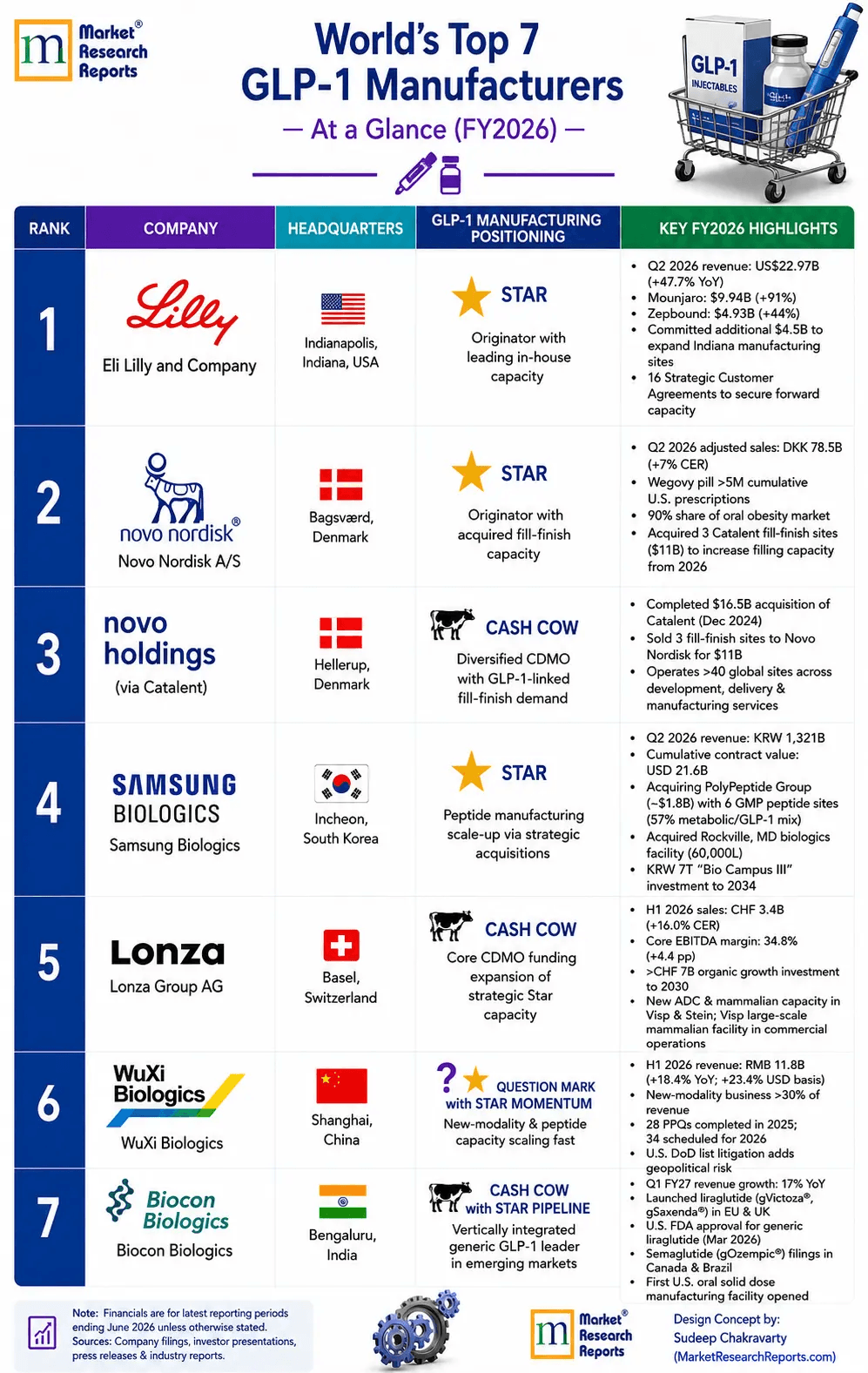
Lilly's Q2 2026 revenue reached $22.97 billion, up 47.7% year-over-year, propelled by Mounjaro ($9.94 billion, +91%) and Zepbound ($4.93 billion, +44%). Alongside these results, the company committed an additional $4.5 billion to expand its Indiana manufacturing sites, on top of prior multibillion-dollar U.S. capacity build-outs, and has signed 16 Strategic Customer Agreements industry-wide (a separate initiative, disclosed in Lilly's broader manufacturing commentary) to lock in forward capacity commitments with major customers.
Lilly's in-house manufacturing footprint is a Star by any measure — dominant and rapidly compounding volume in the industry's fastest-growing drug category, funded by aggressive, disclosed capital commitments rather than reliance on third-party CDMO capacity.
Novo Nordisk A/S — the originator whose capacity strategy now includes acquired fill-finish sites
Novo Nordisk's Q2 2026 adjusted sales rose 7% at constant exchange rates to DKK 78.5 billion, with the Wegovy pill surpassing 5 million cumulative U.S. prescriptions and capturing roughly 90% share of the oral obesity market; the U.K. launch alone added an estimated 300,000 patients within three weeks. To support this volume, Novo Nordisk in 2024 acquired three Catalent fill-finish sites (Anagni, Italy; Bloomington, Indiana; Brussels, Belgium) for $11 billion, a transaction the company has confirmed is expected to gradually increase its filling capacity from 2026 onward.
Novo Nordisk's manufacturing base is a Star under direct strain from its own demand — the acquired Catalent sites represent a textbook case of an originator buying its way into additional Star-segment capacity rather than waiting for organic build-out.
Novo Holdings (via Catalent) — the CDMO parent now split between GLP-1-dedicated and diversified capacity
Novo Holdings completed its $16.5 billion acquisition of Catalent in December 2024, in an all-cash transaction that included the concurrent $11 billion sale of three fill-finish sites to Novo Nordisk. The remaining Catalent business continues to operate as an independent CDMO under Novo Holdings' ownership, supplying development, delivery-technology, and multi-modality manufacturing services to more than 40 global sites for pharma and biotech customers beyond the Novo Nordisk relationship.
The three transferred fill-finish sites are now embedded in Novo Nordisk's own Star capacity base; the remainder of Catalent under Novo Holdings functions as a diversified Cash Cow CDMO business, with GLP-1-linked fill-finish demand as one growth vector among several rather than its sole focus.
Samsung Biologics — the CDMO buying its way into peptide manufacturing at scale
Samsung Biologics reported Q2 2026 revenue of KRW 1,321 billion and cumulative contract value of USD 21.6 billion, remaining on track for the upper end of its 2026 guidance after full-year 2025 revenue grew 30.3% to KRW 4,557 billion. The company's most consequential 2026 move was the all-cash tender offer to acquire PolyPeptide Group for approximately $1.8 billion, a Swiss CDMO whose metabolic-disease (largely GLP-1) share of total sales rose from 22% in 2021 to 57% in 2025, adding six GMP-certified peptide manufacturing sites across Europe, the U.S., and India. Samsung also completed the acquisition of a 60,000-liter biologics facility in Rockville, Maryland, giving it its first U.S. manufacturing footprint, and has outlined a KRW 7 trillion "Bio Campus III" investment program through 2034.
The PolyPeptide acquisition is Samsung Biologics' direct entry into the peptide-synthesis Star segment — a company with essentially zero prior peptide/GLP-1 capability buying an established 57%-metabolic-mix CDMO outright rather than building organically, while its core antibody-CDMO business remains a large, stable Cash Cow funding the expansion.
Lonza — the pure-play CDMO expanding capacity ahead of demand
Lonza reported H1 2026 sales of CHF 3.4 billion, up 16.0% at constant exchange rates, with core EBITDA margin expanding 4.4 percentage points to 34.8%. Having completed the divestment of its Capsules & Health Ingredients business to become a pure-play CDMO, Lonza is deploying over CHF 7 billion in organic growth investment through 2030, including newly announced ADC-related capacity expansions in Visp and Stein, Switzerland, and confirmed that its large-scale mammalian manufacturing asset in Visp began commercial operations in H1 2026. The company's Vacaville, California site remains a focal point for customer interest in large-scale capacity, with peak sales expected in the early 2030s.
Lonza's integrated biologics and advanced-synthesis platforms sit as a broad Cash Cow funding a deliberate strategic pivot; its expanding mammalian and bioconjugate manufacturing capacity — directly relevant to GLP-1-adjacent biologics demand — is the Star segment the company is now explicitly prioritizing capital toward.
WuXi Biologics — the Chinese CRDMO scaling new-modality and peptide capacity
WuXi Biologics reported H1 2026 revenue of RMB 11.8 billion, up 18.4% year-over-year (23.4% on a USD basis), with manufacturing revenue as a key growth driver supported by 28 process performance qualifications (PPQs) completed in 2025 and 34 more scheduled for 2026. New-modality business — spanning nucleic acids, antibody-drug conjugates, and peptides — has grown to represent more than 30% of revenue at affiliated WuXi entities, reflecting the group's broader pivot toward the complex-modality manufacturing segment that includes GLP-1 peptide production.
WuXi Biologics' new-modality/peptide manufacturing segment is a Question Mark with Star momentum — growing fast off a smaller base than Samsung or Lonza's dedicated peptide capacity, and carrying incremental geopolitical risk (the group disclosed U.S. Department of Defense list designation litigation in 2026) that differentiates its risk profile from Western CDMO peers.
Biocon Biologics — the vertically integrated biosimilar and generic-GLP-1 manufacturer
Biocon Biologics, now fully integrated into Biocon Limited as of FY26, posted Q1 FY27 (June 2026 quarter) revenue growth of 17% year-over-year, with the broader group's Biopharma segment revenue also up 17%. The company has launched liraglutide (gVictoza) for diabetes and (gSaxenda) for obesity in the Netherlands and the U.K., received U.S. FDA approval for generic liraglutide in March 2026, commenced regulatory filings for semaglutide (gOzempic) in markets including Canada and Brazil, and opened its first U.S. oral solid dose manufacturing facility. Management describes Biocon as the only company globally with both a biosimilar insulin portfolio and a generic GLP-1 pipeline.
Biocon's generic/biosimilar GLP-1 franchise is a clear Question Mark — early-stage relative to the originator-dominated core market, but positioned in exactly the segment (ex-U.S./EU markets where first-generation GLP-1 patents are lapsing) most likely to convert into a Star as biosimilar entry accelerates through the back half of the decade.
Consolidated Growth-Share Matrix — GLP-1 Manufacturing Value Chain, 2026
| High Relative Share | Low Relative Share | |
|---|---|---|
| High Market Growth | STARS — Lilly in-house fill-finish/API capacity (Indiana); Novo Nordisk in-house + acquired Catalent fill-finish sites; Samsung Biologics/PolyPeptide peptide synthesis; Lonza mammalian & bioconjugate expansion (Visp, Vacaville) | QUESTION MARKS — WuXi Biologics new-modality/peptide segment; Biocon Biologics generic GLP-1 (gOzempic, gVictoza/gSaxenda) |
| Low Market Growth | CASH COWS — Lonza's broader integrated biologics/small-molecule CDMO base; Novo Holdings' diversified Catalent business (ex-transferred sites); Samsung Biologics' core antibody-CDMO franchise | DOGS — None disclosed among the seven majors; every profiled company's capacity is either directly GLP-1-linked or being actively repositioned toward it, reflecting the value chain's early-stage, capacity-constrained structure |
As with the memory semiconductor oligopoly, the absence of a populated Dogs quadrant here is itself informative — this is a market still defined by chronic undersupply rather than mature competitive shakeout, and every disclosed capital commitment from the seven companies profiled points toward expansion rather than retrenchment.
Strategic Imperatives for 2026–2031
- Capacity acquisition is now faster than capacity construction. Novo Nordisk's $11 billion purchase of three operating Catalent fill-finish sites and Samsung Biologics' $1.8 billion PolyPeptide acquisition both demonstrate that buying existing, qualified GMP capacity has become the preferred route to closing the supply-demand gap — materially faster than greenfield build-out, even at a premium price.
- Peptide synthesis specialization is consolidating into fewer, larger hands. PolyPeptide's absorption into Samsung Biologics, alongside WuXi's rapid new-modality scale-up, suggests the CDMO landscape for GLP-1 API synthesis specifically is moving toward a smaller number of vertically capable players rather than remaining fragmented among specialist boutiques.
- Geographic and geopolitical diversification is becoming a stated capacity-planning input. Samsung's Rockville, Maryland acquisition and PolyPeptide's U.S./Europe/India footprint, alongside WuXi Biologics' disclosed litigation over U.S. defense-list designation, both point to originators and CDMOs alike now treating geographic risk exposure as a formal input into where new capacity gets sited.
- Biosimilar/generic GLP-1 capacity is the next capital wave to watch. Biocon's early liraglutide and semaglutide filings signal that manufacturing investment will need to extend beyond originator-branded capacity as first-generation GLP-1 patents begin lapsing outside the largest markets — a Question Mark segment today that several of the profiled CDMOs are already positioning to serve.
Outlook
With the underlying market projected to roughly quadruple by 2031, and every one of the seven profiled companies currently expanding rather than defending capacity, the central strategic question for 2026–2031 is not whether GLP-1 manufacturing capacity will grow, but which combination of originator in-house investment, CDMO acquisition, and biosimilar-focused build-out closes the supply gap fastest. On the disclosed evidence, Novo Nordisk and Lilly are moving fastest on captive capacity, Samsung Biologics is moving fastest on inorganic peptide-specific capability, and Biocon Biologics represents the clearest early mover into the segment's next growth wave.
This analysis draws on company-reported earnings releases, investor presentations, and public regulatory filings (SEC/6-K, HKEX, NSE/BSE) from Eli Lilly and Company, Novo Nordisk A/S, Novo Holdings/Catalent, Samsung Biologics, Lonza, WuXi Biologics, and Biocon Biologics, current through August 2026, together with the market-sizing framework of the Global GLP-1 Drug Manufacturing & Supply Chain Market Strategic Research Report.