


The Franchise Machine - How Ten Companies Quietly Built a $387 Billion Expansion Engine
The Franchise Machine - How Ten Companies Quietly Built a $387 Billion Expansion Engine
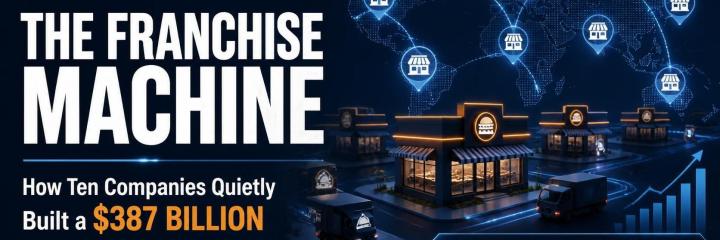
MRR® Industry Intelligence Briefing Franchise Economics · Quick-Service Restaurants · Global Expansion
Walk into an airport, a highway service plaza, a university food court, or a hospital lobby almost anywhere in the world today, and there is a good chance you are standing in front of a franchise. Fast food franchising has become so structurally embedded in how the world eats that it is easy to miss the scale of what it actually is: a $387.1 billion global capital-deployment machine, growing at 6.3% a year, that now touches roughly 45% of all commercial restaurant units on the planet.
That is not a statement about hamburgers. It is a statement about franchise system revenue - fees, royalties, and new-unit development capital - flowing through a network that employs an estimated 25 million people worldwide. And the machine is accelerating in places most Western diners never think about.
The Asset-Light Playbook Has Gone Global
The defining structural shift in this market is not menu innovation. It is a financing model. McDonald's, Yum! Brands, and Restaurant Brands International have each pushed company-owned unit exposure below 5%, redirecting capital that used to sit in owned real estate and equipment toward funding someone else's expansion instead. Restaurant Brands International's own FY2025 numbers make the scale explicit: nearly $45 billion in systemwide sales generated from 33,041 restaurants, over 95% of them franchised.
This is franchising as a capital allocation strategy, not just a distribution strategy. The franchisor keeps the brand, the training systems, and the supply chain leverage; the franchisee puts up the capital and takes the local operating risk. It is a structure built for speed, and speed is exactly what the current growth phase demands.
Where the Next Billion Transactions Are Coming From
North America still holds the largest share of the market, at roughly 34% of total value, reflecting decades of franchise-system density. But it is not where the growth is. Asia Pacific is expanding at an estimated 8.7% CAGR through 2032 - meaningfully faster than the global average - powered by two very different stories running in parallel.
In China, domestic brands are scaling alongside the international operators that have been present for decades, while Yum China's KFC and Pizza Hut networks continue dense infill expansion. In India, Western-brand penetration is accelerating through master-franchise structures: Jubilant FoodWorks runs Domino's, Devyani International runs KFC and Pizza Hut, and both are executing aggressive unit-growth targets that would have seemed implausible a decade ago.
The Philippines tells a third story entirely. Jollibee Foods Corporation posted FY2025 consolidated revenue of roughly $5.2 billion, up 13% year-over-year, built on the most aggressive acquisition-led international expansion strategy in the sector - a reminder that the next great global franchise platform does not have to start in the United States.
The Financing Squeeze Nobody's Menu Board Shows You
None of this expansion is free money. Rising commercial lending rates since 2022 have materially increased the cost of multi-unit development agreements - the contracts where a single franchisee commits to opening ten, twenty, or fifty units over several years. That has stretched the timeline between a signed agreement and an opened restaurant, particularly in markets without deep small-business lending infrastructure.
It is a genuine headwind, but it has not stopped the largest operators from betting on the model. McDonald's is investing €500 million in Spain alone between 2025 and 2028, specifically to grow its footprint toward 800 locations in a market it has operated in for decades - proof that even in mature Europe, there is still runway when the financing model is asset-light enough to move fast.
The Segment Reshaping Fastest Is the One You'd Least Expect
By cuisine category, burger-led American fast food remains the largest segment, anchored by McDonald's and Burger King. But it is Asian and Pan-Asian quick service that is growing fastest globally, and coffee, bakery, and snack-beverage concepts are close behind - a category defined by Starbucks' continued international expansion and rising coffee-culture adoption in markets that had none a generation ago.
Meanwhile, Mexican and Latin-style fast casual is the one category losing relative share, with growth concentrated in existing Latin American core markets - a useful reminder that "global expansion" is not evenly distributed even within a single company's brand portfolio. Alsea S.A.B. de C.V., the Mexico-based master franchisee behind Starbucks, Domino's, and Burger King operations across Latin America and Europe, now runs more than 4,800 units across twelve countries, led by Mexico's 2,502 and Spain's 1,086 - a single operator's footprint that rivals some national restaurant markets outright.
Three Intelligence Questions for Franchise Strategists
- Which markets can absorb multi-unit development capital fastest right now? The financing squeeze means franchisee balance-sheet strength is becoming as important as brand fit when selecting expansion territories.
- Is your master-franchise structure built for the India/Philippines playbook, or the Spain playbook? Emerging-market entry via master franchisee and mature-market densification via direct investment are structurally different plays requiring different capital and different partners.
- Which non-traditional venues remain untapped in your category? Airports, highway service areas, universities, stadiums, and hospital campuses have already been normalized by the leaders - the next inventory of accessible locations will require identifying the next non-traditional format before competitors do.
The full Global Fast Food Franchise Expansion Market Strategic Research Report provides detailed forecasts across ten countries and ten leading operators, segmented by franchise model type and cuisine category, through 2032. For a customized analysis of a specific market or brand's expansion opportunity, our custom research team can help.