


Medical Devices Has No Nvidia - Why That's the More Interesting Story Right Now
Medical Devices Has No Nvidia - Why That's the More Interesting Story Right Now

MRR® Industry Intelligence Briefing Medical Devices · Healthcare · Market Analysis
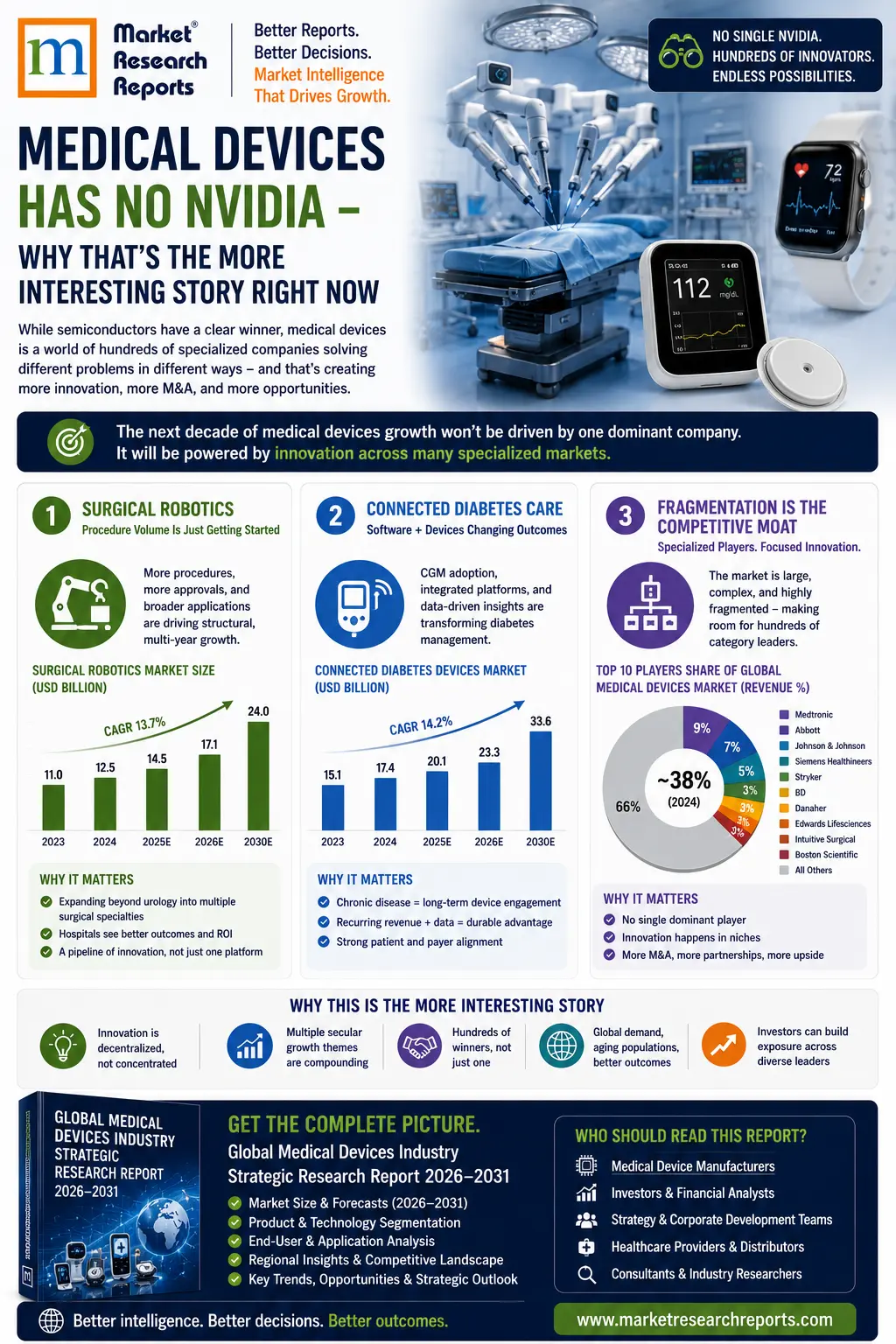
Medical devices has no Nvidia. Medtronic, the largest pure-play medtech company by revenue, holds an estimated 3.1% of the global market - a fraction of the concentration you'd find at the top of semiconductors or almost any other technology-adjacent industry. Most coverage treats that fragmentation as a footnote. It's actually the story, because it means the real competitive battles in this industry are being fought and won inside a handful of specific, fast-moving categories rather than at the level of the market as a whole.
Executive Summary
The global medical devices industry reached $581.1 billion in 2025, derived as the average of four independently published market research estimates converging tightly within a $572-586 billion range, and is forecast to reach $825.5 billion by 2031, a compound annual growth rate of approximately 6.0%, according to Navadhi Market Research's Global Medical Devices Industry Strategic Research Report. Twenty-five companies are profiled in depth, and the more useful story for anyone assessing competitive position right now isn't the industry's steady blended growth rate - it's that even the largest company in the sector controls barely 3% of it, which means outsized returns are concentrated in specific categories growing far faster than the market average, not spread evenly across incumbents by size.
The Research Problem: A Fragmented Market Hides Concentrated Winners
A market with no dominant player is easy to read as a market with no interesting competitive dynamics. That reading is backwards. Precisely because no single company can set category-wide pricing or standards the way a dominant leader can elsewhere, the companies that do win decisively inside a specific category - surgical robotics, continuous glucose monitoring - capture outsized growth without ever threatening to "dominate" the broader medical devices market the way a single company might dominate a more concentrated industry.
The shift most underweighted in generalist coverage is surgical robotics. Surgical & Minimally Invasive/Robotic Devices is the fastest-growing device category tracked in this report, with its share of total market value projected to rise from 8.5% in 2022 to 13.6% by 2031 - the largest structural shift in this report's entire segmentation. Intuitive Surgical pioneered this category with its da Vinci platform and remains the clear leader, but Medtronic's Hugo platform and Stryker's Mako platform are both actively expanding to challenge that position, meaning the category's own growth doesn't tell you who's actually capturing it.
The second underweighted story is connected diabetes care. Insulet grew revenue approximately 30% in 2025 - the fastest confirmed or estimated growth rate of any company profiled in this report, medtech or otherwise. Dexcom grew roughly 15% over the same period. Both companies are benefiting from the same structural trend: patients and physicians increasingly favor connected, home-monitored diabetes management systems over episodic in-clinic care, a trend that shows no sign of decelerating.
Four Structural Shifts, Four Different Competitive Games
Shift One - The Surgical Robotics Arms Race
Intuitive Surgical grew revenue approximately 16.7% in 2025 and remains the undisputed category leader in surgical robotics, but it is no longer competing in an empty field. Medtronic's Hugo platform and Stryker's Mako platform are both real, well-funded competitive responses from companies with the balance sheets and distribution networks to sustain a multi-year fight for share. This is the single most consequential competitive dynamic in the entire medical devices industry right now - not because the category is the largest, but because it's the fastest-growing and the incumbent leader is facing its first genuine competitive pressure in over a decade.
Shift Two - Connected Diabetes Care Is the Quiet Growth Story
Insulet's roughly 30% growth rate and Dexcom's roughly 15% growth rate both reflect the same underlying shift: continuous glucose monitoring and connected insulin delivery are displacing older, less integrated diabetes management approaches faster than almost any other trend in the broader Patient Monitoring & Diabetes Care category, which itself is gaining share industry-wide. Abbott's FreeStyle Libre franchise, alongside Dexcom, forms a duopoly at the center of the CGM category specifically - a smaller, faster-growing market within the broader device landscape.
Shift Three - Care Is Moving Out of Hospitals, and Device Makers Have to Follow
Hospitals' share of medical devices demand is projected to decline from 51.0% in 2022 to 46.5% by 2031, even as absolute hospital-setting device spend continues to grow throughout the forecast. Ambulatory Surgical Centers and Home Healthcare are the direct beneficiaries. This mirrors the same structural shift documented in Navadhi's companion Healthcare Industry report's care-delivery-model segmentation, and it has a direct product design implication: device makers whose portfolios remain built around large, hospital-installed capital equipment face a materially different growth trajectory than those designing smaller, more portable systems suited to non-hospital settings.
Shift Four - Growth Concentration Doesn't Follow Company Size
Boston Scientific grew revenue approximately 20.3% in 2025 - the fastest growth rate among the entire top 10 medtech companies by revenue, driven by strength in interventional cardiology and endoscopy. Meanwhile GE HealthCare and Philips, both established diagnostic imaging leaders, grew at a comparatively modest 4.6%. Company size and growth rate are only loosely correlated in this industry; category exposure explains far more of the variance than scale does.
Where the Top Companies Sit Across the Four Shifts
| Company | Primary Shift Exposure | What to Watch |
|---|---|---|
| Medtronic | Surgical robotics (Hugo) + broad diversification | Whether Hugo can meaningfully dent Intuitive Surgical's category lead |
| Intuitive Surgical | Surgical robotics (category leader) | First genuine multi-year competitive pressure from Medtronic and Stryker |
| Stryker Corporation | Surgical robotics (Mako) + orthopedics | Mako's expansion pace beyond orthopedic applications |
| Boston Scientific | Interventional cardiology, endoscopy | Fastest growth of any top-10 company; sustainability of the pace |
| Insulet Corporation | Connected diabetes care (insulin delivery) | Fastest growth of any company in the report; competitive response from Medtronic/Tandem |
| Dexcom | Connected diabetes care (CGM) | Duopoly dynamics with Abbott's FreeStyle Libre franchise |
| Johnson & Johnson MedTech | Orthopedics, surgery, vision, interventional | Integration of the $13.1B Shockwave Medical acquisition |
| Siemens Healthineers | Diagnostic imaging (hospital-setting concentrated) | Exposure to the hospital-to-ambulatory demand shift |
Source: Navadhi Market Research, Global Medical Devices Industry Strategic Research Report; company disclosures.
Analyst Insight
The most consequential fact in this report for competitive assessment purposes isn't the $825.5 billion 2031 total - it's that Medtronic, the largest company in the industry, controls barely 3% of it. In a market this fragmented, category exposure matters far more than company size when predicting who actually captures the next several years of growth. Boston Scientific's 20.3% growth and Insulet's 30% growth, both achieved by companies well outside the very largest tier by revenue, make that case directly: the surgical robotics arms race and the connected diabetes care boom are creating winners based on category positioning, not balance sheet scale. A competitive assessment anchored to company size alone will systematically miss where the next several years of medical devices growth actually accrue.
Strategic Lessons for Market Participants
| Observation | Strategic Implication |
|---|---|
| Even the largest company in medical devices holds only ~3.1% market share | Competitive assessment should weight category exposure far more heavily than company size - scale alone predicts little about growth trajectory in this industry |
| Surgical robotics is projected to nearly double its share of total market value, 2022-2031 | Intuitive Surgical's category leadership is facing its first genuine multi-year competitive test from Medtronic and Stryker - this rivalry is worth tracking as closely as any single growth statistic in the sector |
| Insulet and Dexcom are growing faster than any other companies in the report, medtech or otherwise | Connected diabetes care is a structurally distinct, faster-growing sub-market within the broader Patient Monitoring & Diabetes Care category, not simply riding the same tailwind as the rest of it |
| Hospitals' device-demand share is declining even as absolute hospital-setting spend keeps growing | Device makers with portfolios concentrated in large, hospital-installed capital equipment face a structurally slower growth trajectory than those building smaller, ambulatory- and home-suited systems |
Frequently Asked Questions
What is the size of the global medical devices market?
The market reached $581.1 billion in 2025, projected to reach $825.5 billion by 2031, a compound annual growth rate of approximately 6.0%.
Why doesn't Medtronic dominate the medical devices market the way large companies dominate other industries?
The medical devices industry is genuinely fragmented across many distinct device categories - cardiovascular, orthopedic, diagnostic imaging, in-vitro diagnostics, surgical, monitoring, ophthalmic, and dental - each with its own competitive dynamics and leaders. No single company has meaningful presence across all of them at a scale that could translate into market-wide dominance.
Which medical device category is growing fastest?
Surgical & Minimally Invasive/Robotic Devices, projected to rise from 8.5% of total market value in 2022 to 13.6% by 2031, led by Intuitive Surgical's da Vinci platform with Medtronic and Stryker both actively expanding competing robotic platforms.
Which individual companies are growing fastest?
Insulet (approximately 30% in 2025) and Dexcom (approximately 15%), both in connected diabetes care, alongside Boston Scientific (approximately 20.3%), the fastest-growing company among the entire top 10 by revenue.
Which companies are profiled in this report?
Twenty-five companies spanning the medical devices value chain, including Medtronic, Johnson & Johnson MedTech, Abbott Laboratories, Medline Industries, Siemens Healthineers, Stryker, Becton Dickinson, GE HealthCare, Philips, and Boston Scientific among the top 10 by revenue.
For full segment, application, regional, and country-level detail, complete methodology, and all twenty-five company profiles, see our Global Medical Devices Industry Strategic Research Report. For bespoke medical devices market analysis, commission custom research.