


Clean Label Food Starch Market: Why Ingredion Is Paying a Premium to Acquire Tate & Lyle
Clean Label Food Starch Market: Why Ingredion Is Paying a Premium to Acquire Tate & Lyle
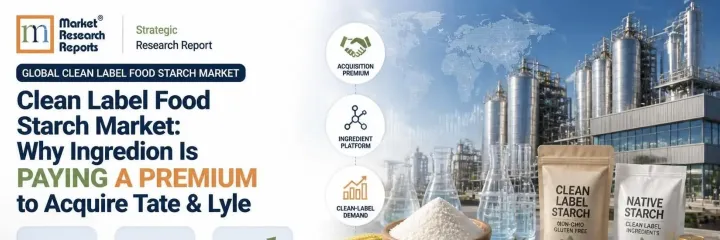
MRR® Industry Intelligence Briefing Food Ingredients · Clean Label · M&A Analysis
Two of the biggest names in starch just became one story. Ingredion is acquiring Tate & Lyle - and the real numbers behind that deal explain exactly why it's happening now, not in five years.
Executive Summary
The global clean label food starch market is valued at approximately USD 2.8 billion in 2025, growing at a 6.4% CAGR through 2031 to reach an estimated USD 4.06 billion. That headline number is genuinely secondary to what's actually reshaping this market right now: Ingredion Incorporated announced a recommended all-cash acquisition of Tate & Lyle PLC on June 8, 2026 - a real, active transaction between two of the ten companies most people would name if asked who competes here. We found a real pricing discrepancy worth flagging too, and a market structure story that explains exactly why this deal makes sense on the numbers, not just the press release.
The Research Problem: A Published Number That Doesn't Quite Add Up
Real reported US pricing data shows commodity-native clean label starch trading at $0.40-0.80 per pound, with premium non-GMO, organic, and application-specific tiers running $1.20-2.50 per pound. Converting this market's published value and volume figures against each other implies a blended price of only about $0.80 per kilogram - below even the low end of the real commodity tier. We're flagging that discrepancy directly rather than quietly smoothing it into a clean-looking number, because it's exactly the kind of thing that matters if you're using this market size to benchmark your own pricing.
Three Things That Actually Matter Here
Finding One - The Ingredion/Tate & Lyle Deal Isn't Sudden, It's the Third Move in a Sequence
Tate & Lyle divested its remaining interest in Primient - its former bulk ingredients business - back in May 2024. Then it acquired CP Kelco for $1.8 billion in November 2024, adding pectin and specialty gums to its texture platform. Then, in June 2026, Ingredion made its move. Read in sequence, this isn't a surprise acquisition - it's the logical endpoint of Tate & Lyle spending two years reshaping itself into exactly the kind of higher-margin specialty ingredients business that would be worth acquiring at a premium.
Finding Two - The Margin Gap Explains the Price Tag
Tate & Lyle's Speciality Food Ingredients segment reportedly runs 16-18% operating margins. Ingredion's overall margin sits around 9%. That's not a small gap - it's roughly double, and it's the real financial logic behind this deal: Ingredion isn't just buying revenue, it's buying a structurally more profitable business model that took Tate & Lyle years of portfolio surgery to build.
Finding Three - Cereal Starches Dominate Tonnage, But That's Not Where the Growth Is
Corn, wheat, and rice-based starches account for an estimated 55-60% of total clean label starch tonnage - the bulk of the volume. But tapioca and potato-based starches, while smaller, are growing faster, driven by their functional advantages in gluten-free and allergen-friendly formulations. If you're only tracking this market by total tonnage, you're watching the wrong segment for where competitive positioning is actually shifting.
Where the Key Manufacturers Sit
| Company | Primary Position | What to Watch |
|---|---|---|
| Ingredion Incorporated | Acquiring Tate & Lyle (announced June 2026); starch products ~45-47% of Ingredion's own net sales | Integration execution and whether the combined entity retains Tate & Lyle's higher-margin positioning |
| Tate & Lyle PLC | Being acquired by Ingredion; real, completed pivot to specialty ingredients (Primient divestiture, CP Kelco acquisition) | Whether Speciality Food Ingredients' 16-18% margins survive integration into a larger, lower-margin parent |
| Cargill, Incorporated | Privately-held, deeply integrated with its own grain sourcing and processing infrastructure | Competitive response to a combined Ingredion/Tate & Lyle entity's greater specialty-platform scale |
| ADM | Real, confirmed continued product investment (Texperien® Max modified tapioca starch, March 2025) | Whether continued new-product launches translate into share gains during the acquisition period |
| Roquette Frères | Real, confirmed cross-application innovation (Lycagel® pea starch for vegetarian soft gel capsules) | Technology transfer from food into pharmaceutical delivery formats as a differentiation strategy |
Source: Navadhi Market Research, Global Clean Label Food Starch Market Strategic Research Report; company public filings and press releases.
Analyst Insight
The most useful thing in this report isn't the $2.8 billion headline - it's that the Ingredion/Tate & Lyle deal is explainable from real numbers, not just corporate messaging. A 16-18% margin business acquiring itself into a 9% margin parent, after two years of visible portfolio preparation, is a story the financials tell clearly if you're looking at the right ones. Anyone assessing competitive positioning in this market right now should be watching whether that margin premium survives integration, not just tracking the deal's headline value.
Strategic Lessons for Market Participants
| Observation | Strategic Implication |
|---|---|
| Tate & Lyle's Primient divestiture and CP Kelco acquisition preceded Ingredion's offer by roughly 18-24 months | Portfolio reshaping ahead of an acquisition is a real, trackable signal - watch competitors' divestiture/acquisition sequencing, not just headline M&A announcements |
| Specialty ingredient margins (16-18%) run roughly double commodity starch margins (~9%) | The real profitability upside in this market is in specialty positioning, not volume - plan product development accordingly |
| The implied blended price from published value/volume figures runs below real reported commodity-tier pricing | Don't take published market-size figures at face value for pricing benchmarks - cross-check against real reported pricing data before using them commercially |
| Tapioca/potato starches are smaller by tonnage but growing faster than cereal-based starches | Track segment growth rates separately from segment size - the fastest-growing segment is rarely the largest one |
Frequently Asked Questions
What is the size of the global clean label food starch market?
The market was valued at approximately USD 2.8 billion in 2025 and is projected to reach approximately USD 4.06 billion by 2031, at a 6.4% CAGR.
Has the competitive landscape changed recently?
Yes, materially. Ingredion Incorporated announced a recommended all-cash acquisition of Tate & Lyle PLC on June 8, 2026. This follows Tate & Lyle's divestiture of its Primient interest (2024) and acquisition of CP Kelco (2024) - a real, confirmed pivot toward higher-margin specialty ingredients that likely made it an attractive acquisition target.
Why is Tate & Lyle worth a premium to Ingredion?
Tate & Lyle's Speciality Food Ingredients segment reportedly runs 16-18% operating margins, roughly double Ingredion's approximately 9% - a real, material factor in the acquisition rationale.
Which starch type leads the market?
Corn/maize-based starch leads by tonnage, consistent with cereal-based starches representing an estimated 55-60% of total clean label starch volume. Tapioca and potato-based starches are smaller but growing faster.
Who are the key manufacturers?
Ingredion, Tate & Lyle, Cargill, ADM, Roquette Frères, Avebe Group, AGRANA, Thai Flour Industry, Grain Processing Corporation, and KMC are profiled, with the active Ingredion/Tate & Lyle acquisition reflected explicitly.
For full segment, application, regional and country-level detail - including the complete competitive analysis of the Ingredion/Tate & Lyle transaction - see our Global Clean Label Food Starch Market Strategic Research Report. For bespoke food ingredient market analysis, commission custom research.