


India's Water Reckoning: Why Mandatory Wastewater Recycling Is the Next Infrastructure Bet
India's Water Reckoning: Why Mandatory Wastewater Recycling Is the Next Infrastructure Bet
MRR® Business Opportunity Analysis Waste Water Recycling · India
A structural water deficit is colliding with a $50B+ industrial buildout. The policy response — mandatory recycling — will not just fix a crisis. It will create one of India's most durable capital goods and services markets over the next decade.
Executive Summary
India's water crisis has moved past the point of being a sustainability talking point. It is now a binding constraint on industrial siting decisions, agricultural output, and urban livability. The old playbook - extract more groundwater, dump more effluent, hope the monsoon cooperates - has run out of road.
The fix is not novel technology. Membrane bioreactors, reverse osmosis, and constructed wetlands are mature, proven systems already deployed at scale elsewhere. What has been missing is the regulatory forcing function that makes recycling the default rather than the exception. Once mandated - through Zero Liquid Discharge norms for industry and decentralized treatment requirements for large housing developments - recycling stops being a compliance cost and becomes a multi-decade capital cycle spanning equipment manufacturing, systems integration, and operations.
This is the thesis: policy mandate creates market. The market creates a value chain. Value chain creates winners at every price point, from ultra-luxury townships to peri-urban SME clusters.
1. The Problem Is Structural, Not Cyclical
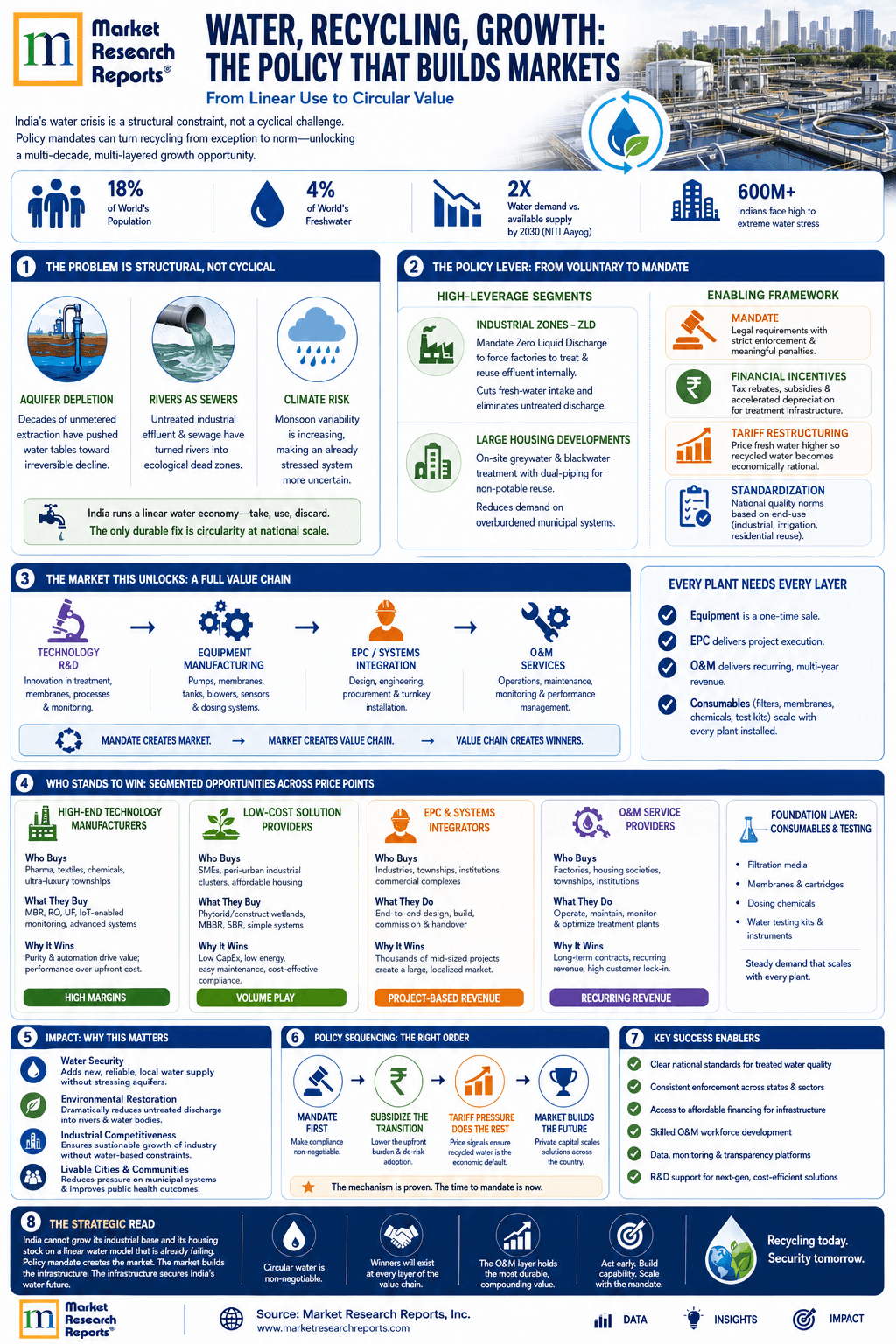
Three forces are converging simultaneously, and none of them are self-correcting:
- Aquifer depletion. Decades of unmetered agricultural and urban groundwater extraction have pushed water tables in several states toward irreversible decline. This is not a drought story — it is a stock-depletion story, and stocks don't refill on their own timeline.
- River systems as sewers. Untreated industrial effluent and municipal sewage have converted stretches of India's major rivers into ecological dead zones, imposing downstream costs on agriculture, fisheries, and public health that rarely show up on any single balance sheet.
- Climate-amplified monsoon risk. An agrarian economy that still leans heavily on monsoon timing is exposed to a climate variable that is becoming less predictable, not more.
The common thread: India has been running a linear water economy — take, use, discard — in a country that increasingly cannot afford the "discard" step. The only durable fix is circularity, and circularity at national scale requires regulation, because voluntary adoption curves are too slow relative to the depletion curve.
2. The Policy Lever: From Voluntary Best Practice to Legal Mandate
Two segments carry disproportionate leverage, because they concentrate both the problem and the fix:
Industrial zones - Zero Liquid Discharge (ZLD):
Mandating ZLD forces factories to treat and internally reuse effluent rather than discharging it. This does double duty: it collapses fresh-water withdrawal on the input side and eliminates untreated discharge on the output side. For water-intensive sectors — textiles, chemicals, pharmaceuticals — this is the single highest-leverage regulatory intervention available.
 Navadhi Market Research · Environmental Services & Sustainability
On demand
Global Industrial Wastewater Zero Liquid Discharge (ZLD) Systems Market Strategic Research Report
The global industrial wastewater Zero Liquid Discharge (ZLD) systems market has reached a pivotal inflection point, valued at approximately USD 9.4 billion in 2024 a…
▲ 9.3%CAGR2025–2032
$3,500.00 from
Forecast $17.5B by 2032
Navadhi Market Research · Environmental Services & SustainabilityOn demand
India Commercial Building Wastewater Recycling and Greywater Treatment Systems Market Strategic Research Report
India's commercial building wastewater recycling and greywater treatment systems market occupied a valuation of approximately USD 0.68 billion in 2024, reflecting a …
▲ 9.6%CAGR2025–2032
$1,195.00 from
Forecast $1.3B by 2032
Large housing developments - decentralized treatment:
Requiring on-site greywater and blackwater treatment above a defined project size shifts load away from overwhelmed municipal sewage infrastructure. Paired with dual-piping for non-potable reuse (flushing, landscaping, vehicle washing), this converts millions of liters of daily fresh-water demand into recycled-water demand — at the point of consumption, not centrally.
The enabling framework - a carrot-and-stick architecture:
| Lever | Mechanism |
|---|---|
| Legislation & enforcement | Mandatory recycling plants above defined size thresholds; meaningful penalties for non-compliance |
| Financial incentives | Tax rebates, accelerated depreciation, capital subsidies for treatment infrastructure |
| Tariff restructuring | Raising the price of fresh groundwater/municipal water for industrial use until recycled water is the economically rational default |
| Standardization | National quality benchmarks calibrated by end-use — industrial cooling water need not meet the same bar as irrigation or residential reuse |
This is a familiar regulatory pattern — comparable in structure to how emissions or energy-efficiency mandates have historically catalyzed entire industries. The mechanism is the same: make the compliant path unavoidable, then let the market build the infrastructure to serve it.
3. The Market That Gets Unlocked
A mandate doesn't just solve an environmental problem - it manufactures demand across an entire value chain, with distinct economics at each layer.
Value chain: Technology R&D → Equipment Manufacturing → EPC / System Integration → O&M Services
High-end manufacturing
- Who buys: Pharmaceuticals, textiles, chemicals, ultra-luxury townships.
- What they buy: Membrane Bioreactors (MBR), Reverse Osmosis (RO), Ultrafiltration (UF), IoT-enabled monitoring.
- Why it wins: Purity, automation, and chemical recovery matter more than upfront cost to this buyer — margin lives in performance, not price.
Mid-and-low-end manufacturing
- Who buys: SMEs, peri-urban industrial clusters, affordable housing developments.
- What they buy: Phytorid/constructed wetlands, Moving Bed Biofilm Reactors (MBBR), Sequential Batch Reactors (SBR).
- Why it wins: Low CapEx, low energy draw, easy maintenance — this segment optimizes for compliance-at-minimum-cost, not performance ceiling.
The service layer — where the durable revenue actually sits
Equipment is a one-time sale. The two layers around it are recurring:
- EPC / systems integration: Every mandated plant needs a designer and installer, and demand will be intensely localized — thousands of mid-sized projects rather than a handful of mega-plants.
- Operation & Maintenance: This is the overlooked prize. Neither factories nor housing societies have in-house expertise to run treatment plants long-term, which converts a capital sale into a multi-year service contract. In infrastructure markets, this is almost always where the annuity-like economics live — the equipment sale funds year one; O&M funds the next fifteen.
Layered beneath all of this: a steady, boring, high-visibility demand stream for filtration media, membranes, dosing chemicals, and water-testing kits — the picks-and-shovels layer that scales with plant count, not plant sophistication.
Who Stands to Win: The Wastewater Treatment Companies
A mandate of this scale creates a layered playing field rather than a single winner. Global technology majors — the VA Techs, Suez-lineage players, and Xylem-type equipment providers — are best positioned at the high end, supplying MBR and RO systems to pharma, textile, and chemical plants where performance and automation justify premium pricing.
Domestic EPC and engineering firms with strong on-ground execution capability sit in the highest-leverage spot: thousands of mid-sized mandated projects need local design, installation, and commissioning, and this is not a segment global players can serve efficiently from outside India.
A third tier — smaller manufacturers of MBBR, SBR, and constructed-wetland systems — will capture the SME and affordable-housing segment, where low CapEx and simplicity beat performance. And running quietly beneath all three tiers is the O&M layer: companies that can convert a one-time equipment sale into a multi-year maintenance contract will likely generate the most durable, compounding revenue in the entire value chain, since neither factories nor housing societies will build this expertise in-house.
Bottom Line
For policymakers, the sequencing matters: mandate first, subsidize the transition, then let tariff pressure do the rest of the work. Move too slowly on enforcement, and the market stays fragmented and underinvested; move too fast without incentives, and compliance costs get passed straight to industrial competitiveness.
For capital and industry, the segmentation is an opportunity. This is not a single market — it's at least four: a high-performance technology market, a low-cost mass-compliance market, a fragmented but essential EPC market, and a recurring-revenue O&M market that most entrants will underprice on their way in.
The underlying logic is simple and, at this point, close to inevitable: India cannot grow its industrial base and its housing stock on a linear water model that is already failing. The only question is how fast the mandate arrives — and who is positioned to build the infrastructure once it does.
Navadhi Market Research · Environmental Services & SustainabilityOn demand
Global Automated Factory Wastewater Treatment Infrastructure Market Strategic Research Report
The global automated factory wastewater treatment infrastructure market represents a critical intersection of industrial compliance, water stewardship, and process a…
▲ 6.8%CAGR2025–2032
$3,500.00 from
Forecast $13.3B by 2032