


How a Market Research Report Is Actually Built: Our 47-Point Methodology
How a Market Research Report Is Actually Built: Our 47-Point Methodology
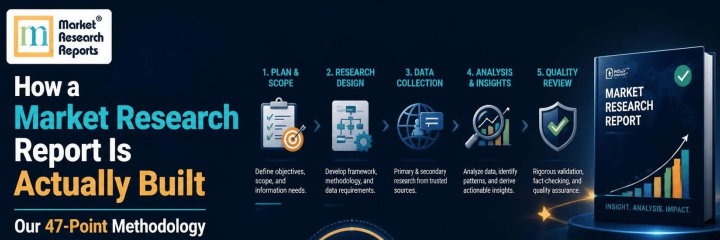
Most buyers of market research have never seen inside the process that produces the reports they rely on for strategy decisions. They see the finished product - the executive summary, the forecast charts, the competitive landscape tables - but not the sequence of decisions, sources, and validation steps that determined whether those numbers are trustworthy.
We think that opacity is a problem. A methodology that cannot withstand transparency is a methodology that should not be relied upon. This is a detailed account of how every MarketResearchReports.com report is built, from scope definition through to delivery.
What is market research methodology?
Market research methodology is the structured set of processes, data sources, validation techniques, and quality standards a research firm uses to collect, analyse, and verify market intelligence. A methodology is not a description of what a firm aspires to do. It is a documented, auditable sequence of steps that every report passes through before it is delivered. The quality of a methodology is the single most important predictor of whether a market research report's numbers can be trusted for high-stakes decisions.
Phase 1 - Scope definition and research architecture
Every report begins with precise scope architecture. Before any data is collected, analysts define the target market's geographic boundaries, base year, forecast horizon, currency baseline, and segmentation taxonomy. For a report on the global industrial robotics market, this means deciding whether to include collaborative robots, whether to measure by unit shipments or revenue, which regional boundaries to use, and which year's data to treat as the baseline for the forecast model.
These decisions are not administrative. They determine what the report can and cannot answer, and getting them wrong produces beautifully presented incorrect results. A market sizing that mixes unit-count and revenue measures, or that applies inconsistent geographic boundaries across regional segments, will contain arithmetic that cannot be internally consistent because the underlying scope was never internally consistent.
For custom research, this phase includes a structured scoping call with the client to align on research questions, deliverable format, and success criteria before fieldwork begins.
Phase 2 - Secondary research and source triangulation
Secondary research draws on a curated library of 400+ trusted source categories. Government statistical agencies and central bank databases provide the macro-economic and sector-level data that anchor market sizing. Trade associations provide production, shipment, and consumption figures that are often unavailable in public sources. Company annual reports and regulatory filings provide revenue, capacity, and strategic direction data at the company level. Patent databases provide technology adoption curves. Academic and scientific literature provides credible data on emerging technologies where commercial databases are not yet current.
Source triangulation is mandatory. Every significant market size figure must be independently supportable from at least two sources before it enters the data model. Where sources conflict - as they frequently do, because different sources apply different scope definitions, time periods, or currency conventions - analysts document the discrepancy, assess which source is more authoritative for this specific data point, and either reconcile the difference or flag it explicitly in the report's methodology section. Reports that present a market size figure without disclosing that it required reconciliation across conflicting sources are obscuring a data quality issue.
Phase 3 - Primary research and expert validation
For reports where secondary sources are insufficient - niche technologies, emerging markets, proprietary competitive data, or markets where public disclosure is limited - we conduct primary research through structured expert interviews, industry surveys, and supply chain interviews. Our global analyst network conducts primary conversations in over thirty countries.
Primary research is particularly critical for validating market share figures (which are rarely disclosed publicly), confirming pricing dynamics (which are almost never disclosed publicly), and capturing recent developments that postdate published secondary sources. A market disrupted by a new competitor, a regulatory change, or a raw material supply shock in the past six months will not be accurately described by any secondary source. Primary conversations with industry participants capture what the published record has not yet reflected.
Every primary source is documented: the date of the conversation, the role and geographic market of the source, and the specific data points attributed to that source. Full audit traceability is not a compliance measure - it is what makes the intelligence defensible when questioned.
Phase 4 - Data modelling and market sizing
Raw data becomes intelligence through structured analytical modelling. We use three primary modelling approaches, selected based on data availability and market structure.
Top-down modelling starts from macro-level variables - GDP, sector output, trade flows, per-capita consumption - and allocates proportionally to market sub-segments using known share data. It is useful for markets where high-quality macro data exists and where the relationship between macro drivers and market demand is well-established.
Bottom-up modelling aggregates from the volume and value of individual product and service categories. It is more data-intensive than top-down but produces estimates that can be directly verified at the segment level. For any market where segment-level data is available, bottom-up modelling is the more defensible approach.
Hybrid modelling triangulates both approaches, using each as a check on the other. Where top-down and bottom-up estimates diverge by more than an acceptable tolerance, the divergence triggers analyst investigation rather than averaging. The resolution - which approach was right and why - becomes part of the documented methodology.
CAGR calculations are derived from verified start and end-point values, never assumed independently. A stated compound annual growth rate that cannot be arithmetically derived from the base year and forecast year figures in the same report is an error.
Phase 5 - AI-assisted data validation
Before any report reaches human analyst review, it passes through an automated validation layer that runs systematic checks across the entire data model. This is not AI-generated research - it is AI-accelerated quality assurance, performing checks that are impossible to run consistently at human speed across a full data model.
Mathematical consistency checks verify that all segment totals sum correctly to market totals at every level of the model, that stated CAGR values are arithmetically derivable from their base and forecast year figures, and that percentage breakdowns total 100%. Outlier detection flags data points that deviate beyond statistically expected ranges for the market type, triggering mandatory analyst review. Source currency verification flags any data point sourced from materials older than 24 months, requiring either re-verification from a current source or explicit disclosure in the methodology section.
Every flag generated by this layer is reviewed by an analyst. Flags are not automatically resolved - they are investigated and closed with a documented decision.
Phase 6 - The 47-point human analyst quality checklist
Every report passes a structured 47-point human analyst review before it is approved for delivery. This is the irreplaceable layer of the methodology. Experienced analysts apply contextual judgment, industry knowledge, and source authority assessment that no automated system can replicate.
Analysts are assigned by industry vertical - a semiconductor report is reviewed by a semiconductor specialist. This sector specialisation is what allows our analysts to detect the subtle errors that automated validation cannot catch: an incorrectly attributed market driver, a competitive positioning that contradicts recently disclosed financial data, or a forecast assumption that contradicts a regulatory development from last quarter.
The 47-point checklist spans seven categories: scope and definitions, data integrity, source quality, market drivers, competitive landscape, presentation accuracy, and final certification. A report cannot be approved for delivery unless all 47 checkpoints are cleared. No exceptions are made for delivery timelines. The named analyst who clears the checklist is professionally accountable for the sign-off.
Phase 7 - Formatting, translation, and delivery
Once a report clears the 47-point checklist, it enters production and delivery. Reports are formatted for professional presentation across all required output formats: PDF for the complete formatted deliverable, Excel for raw datasets and forecasting models, PowerPoint for board-ready presentation summaries, and Word for editable documents intended for internal adaptation.
Multilingual delivery is handled by professional translators who are native speakers with domain expertise in the relevant industry. Machine translation is not used for final deliverables - the mistranslation of a technical term or a numeric value in a language that an analyst cannot review creates an unacceptable quality risk.
Standard delivery SLA is 24–48 hours from research completion for syndicated reports, or from final brief confirmation for custom engagements. Time-critical requests receive priority queue treatment at no additional cost.
Why methodology transparency matters
A research provider who publishes their methodology in detail is making a commitment that their process can withstand scrutiny. A provider who describes their methodology only in vague terms - "rigorous multi-source research" - is telling you that either the methodology does not exist as a defined process, or that it does not withstand detailed examination.
The decisions your organisation makes on the basis of market intelligence are consequential. The methodology behind that intelligence should be held to the same standard of transparency as any other evidence base for a major strategic or capital allocation decision. See the full details of our approach on our research methodology page, or discuss the methodology for your specific research question with our custom research team.