

Research Methodology
How Every MRR® Report Is Actually Built
Most research providers guard their methodology. We publish ours — because transparency is itself a quality signal. This page details the 7 phases and 47 quality checkpoints behind every report we deliver.
What is market research methodology?
Market research methodology is the structured set of processes, data sources, validation techniques, and quality standards a research firm uses to collect, analyse, and verify market intelligence. A transparent, rigorous methodology is the single most important indicator of whether a market research report's numbers can be trusted for high-stakes strategic decisions.
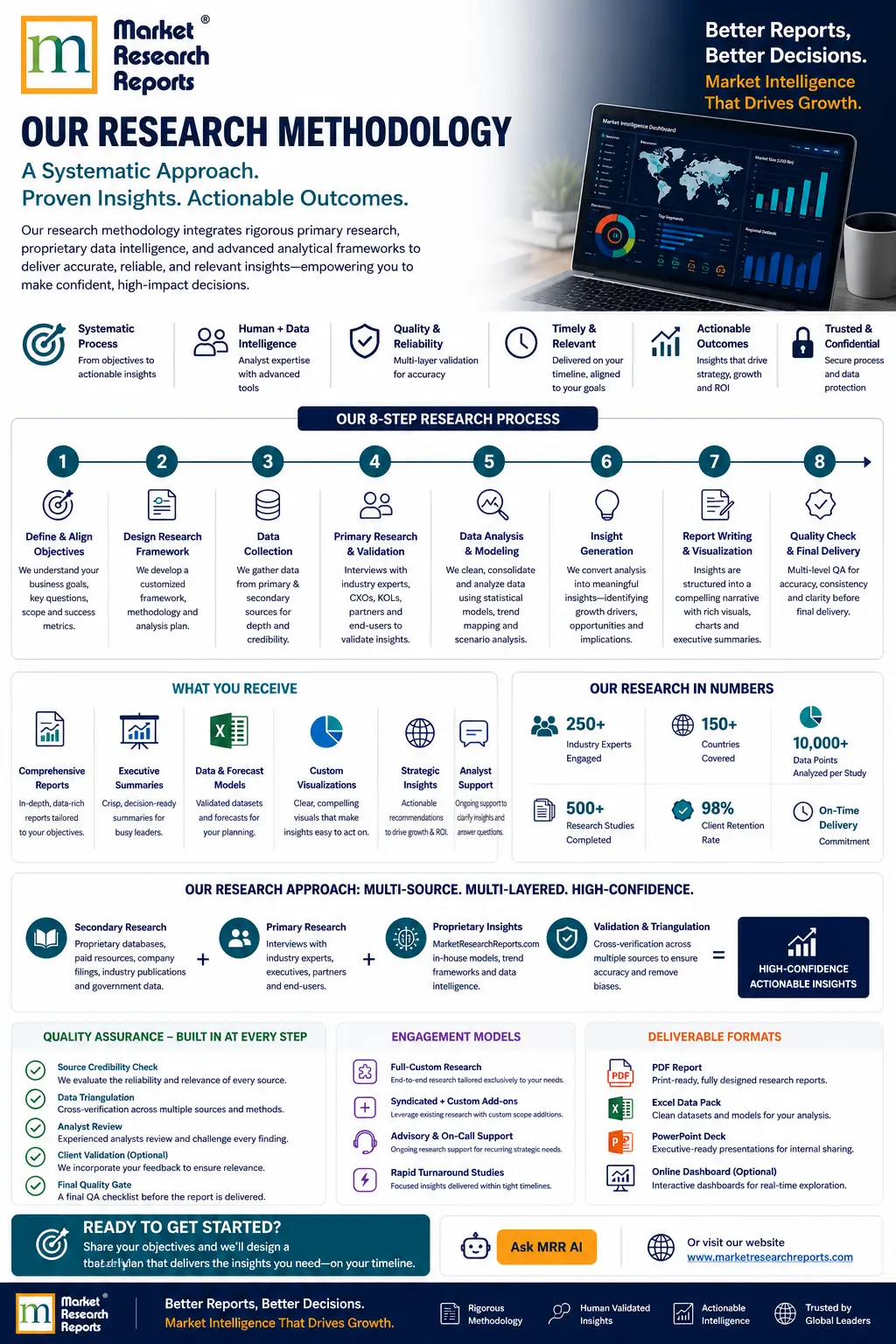
Our 7-Phase Process
From Research Brief to Board-Ready Intelligence
Every syndicated and custom research report passes through all seven phases before delivery — no exceptions, no shortcuts.
- 1
Scope Definition & Research Architecture
Every report begins with precise scope architecture — not approximate assumptions. Our analysts define the target market's geographic boundaries, base year, forecast horizon, currency baseline, and segmentation taxonomy before a single data point is collected. For custom research, this phase includes a structured scoping call with the client to align research questions, deliverable format, and success criteria.
Key decisions made here: market definition (value vs. volume measurement), primary segmentation schema (by end-use, geography, technology, or distribution channel), and competitive universe selection.
- 2
Secondary Research & Source Triangulation
Our secondary research phase draws on a curated library of 400+ trusted source categories — spanning government statistical agencies, central bank databases, trade associations, regulatory filings, company annual reports, patent databases, customs and trade data, industry journals, and academic publications. We do not rely on a single source for any material data point.
Source triangulation is mandatory: every significant market size figure must be independently supportable from at least two sources before it enters our data model. Where sources conflict, our analysts document the discrepancy, assess source authority, and either reconcile the variance or flag it explicitly in the methodology section.
- 3
Primary Research & Expert Validation
For reports where secondary sources are insufficient — niche technologies, emerging markets, or proprietary competitive data — we conduct primary research through structured expert interviews, industry surveys, and supply chain interviews. Our global analyst network enables primary conversations in over 30 countries. Every primary source is documented with date, role, and geographic market to maintain full audit traceability.
- 4
Data Modelling & Market Sizing
Raw data becomes intelligence through structured analytical modelling covering historical market sizing (typically 5 years prior), current-year estimates, and a forecast period (typically 5–10 years forward). We use three modelling approaches: top-down (from macro-level variables — GDP, sector output, trade flows), bottom-up (aggregating from individual product/service categories), and hybrid (triangulating both). CAGR calculations are derived from verified start and end-point values, not assumed independently.
- 5
AI-Assisted Data Validation
We deploy a proprietary AI validation layer that runs systematic checks across every data model before it reaches human analyst review. This is not AI-generated research — it is AI-accelerated quality assurance: mathematical consistency checks (segment totals, CAGR arithmetic, percentage breakdowns), outlier detection (flagging statistically unexpected data points), and source currency verification (flagging data points older than 24 months for re-verification).
- 6
Human Analyst Validation: The 47-Point Quality Checklist
Every report passes a structured 47-point human analyst review before approval. Analysts are assigned by industry vertical — a semiconductor report is reviewed by a semiconductor specialist. The 47-point checklist spans seven categories: scope & definitions, data integrity, source quality, market drivers, competitive landscape, presentation accuracy, and final certification. A report cannot be approved for delivery unless all 47 checkpoints are cleared. No exceptions are made for delivery timelines.
- 7
Formatting, Translation & Delivery
Once a report clears the 47-point checklist, it enters production and delivery. Multilingual delivery is handled by professional human translators — native speakers with domain expertise, not machine translation. Standard delivery SLA is 24–48 hours from research completion for syndicated reports, or from final brief confirmation for custom engagements. Time-critical requests receive priority queue treatment at no additional cost.
Data Sources
Where Our Data Comes From
Every figure in every MRR® report is traceable to at least one of the following source categories. Triangulation across multiple source types is standard practice, not the exception.
Government & Regulatory Bodies
National statistics offices, central banks, trade ministries, customs agencies, FDA, EMA, USPTO, and equivalent regulators across 130+ countries.
Industry Associations
Global and regional trade associations with direct membership data — production volumes, shipment figures, and market structure reporting not available elsewhere.
Company Disclosures
Annual reports, SEC/exchange filings, earnings transcripts, investor presentations, and press releases from companies in the relevant market.
Licensed Commercial Databases
Subscription access to specialised industry data providers, trade flow databases, and sector-specific intelligence platforms across our 25 covered industries.
Academic & Scientific Literature
Peer-reviewed journals, conference proceedings, and research institution publications — particularly for emerging technology markets.
Primary Expert Interviews
Structured interviews with industry executives, supply chain managers, distributors, and independent domain experts — conducted in 30+ countries.
Quality Assurance
The 47-Point Analyst Quality Checklist
Every report clears all 47 checkpoints before delivery. No checkpoint is optional, and no exceptions are made for delivery timelines.
Market boundary accuracy
Confirms the market definition matches the report title and scope statement. Verifies geographic inclusions and exclusions are consistent throughout the full report.
Segmentation consistency
Verifies all sub-segment definitions are mutually exclusive and collectively exhaustive. No overlap between segments, no unexplained gaps in coverage.
Segment totals reconciliation
Arithmetic verification that all segment figures sum correctly to the total market value at every level of the model — globally and by region.
CAGR mathematical derivation
Every stated CAGR is independently calculated from the base year and forecast year values. Any discrepancy triggers automatic rejection of that section.
Currency and unit consistency
All monetary values use the declared base currency and conversion rate. Units (USD millions vs. billions) are consistent across all tables, charts, and text.
Source authority assessment
Every primary data source is assessed for publication authority, recency, and potential bias. Low-authority sources require corroboration from at least one high-authority source.
Source currency verification
Data points older than 24 months are flagged and either re-verified from current sources or disclosed with explicit caveats in the methodology section.
Driver–forecast alignment
Confirms the identified market drivers logically support the forecast direction. Bullish forecasts require bullish driver evidence; bearish forecasts require stated restraints.
Company profile accuracy
Key company data (revenue, geography, product portfolio, market position) is cross-referenced against the most recent company disclosures or authoritative secondary sources.
Market share plausibility
Stated market share figures are assessed for plausibility against known company revenues and total market size. Implausible figures trigger mandatory re-investigation.
Chart–data consistency
Every chart and graph is verified to accurately represent the underlying data. Visual misrepresentation — truncated axes, misleading scales — is identified and corrected.
Named analyst sign-off
The reviewing analyst certifies by name that all applicable checklist items have been assessed and cleared. Reports without named sign-off cannot be delivered to clients.
The full 47-point checklist spans all seven categories. The 12 checkpoints above represent the most frequently referenced items. Additional checks cover data modelling assumptions, forecast scenario documentation, regional data completeness, regulatory environment coverage, and primary source interview protocols.
Deliverables
Format-Ready Intelligence for Every Workflow
Every report is available in multiple formats. Custom research deliverables are formatted to the client's specific requirements and language preferences.
Fully formatted, print-ready report with executive summary, charts, tables, methodology section, and appendices. The complete intelligence deliverable.
Raw datasets, cross-tabulated data models, and forecasting spreadsheets with transparent formulas — ready for integration into your own analytical workflows.
Structured presentation deck summarising key findings, designed for direct use in board and stakeholder presentations without reformatting.
Fully editable Word document for internal customisation, annotation, and collaboration. Ideal for incorporating findings into larger strategic documents.
Professional human translation in English, German, French, Chinese, Japanese, Spanish, Korean, Arabic, Dutch, Portuguese (Brazil), and Russian.
Research Types
Same Rigorous Methodology — Applied Two Ways
MarketResearchReports.com offers both syndicated and custom research. The 47-point quality standard applies equally to both.
| Dimension | Syndicated Research | Custom Research |
|---|---|---|
| Research scope | Pre-defined by MRR analysts based on market demand | Defined by the client's specific strategic questions |
| Data ownership | Licensed to buyer; MRR retains ownership | Fully proprietary to the commissioning client |
| Delivery timeline | 24–48 hours from purchase | 24–48 hours from brief confirmation (standard) |
| Primary research | Included where data requires it | Designed to client specifications |
| 47-point checklist | ✔ All 47 points | ✔ All 47 points |
| Format options | PDF, XLS, PPT, DOC, 10+ languages | All formats + custom formatting to client spec |
| Best for | Market overview, competitive benchmarking, trend monitoring | M&A due diligence, market entry, investor briefings, proprietary positioning |
Frequently Asked Questions
Methodology Questions, Answered
01How do I know the data in your reports is accurate?
Every report passes our 47-point analyst quality checklist, which includes mandatory source triangulation (minimum two independent sources per material data point), mathematical consistency checks across the entire data model, and senior analyst sign-off. Our AI validation layer also performs automated cross-checks before any report reaches human review. The methodology section of each report documents the specific sources used and flags any material data limitations.
02What base year do your reports use?
Most reports use the most recently completed calendar year as the base year, with current-year estimates provided where sufficient data exists. The base year is clearly stated in the scope definition section of every report. For custom research, the base year is agreed with the client during the scoping phase.
03Do you use AI to write your market research reports?
No. Our AI layer performs data validation and quality checking — it does not generate the research content. Every MRR® report is researched and written by human analysts with sector-specific expertise. AI assists by accelerating data verification (mathematical checks, outlier detection, source currency flags), freeing analysts to focus on the higher-value work: interpretation, contextualisation, and strategic insight.
04How current is the data in syndicated reports?
Our source currency verification checkpoint flags any data point older than 24 months, requiring re-verification or explicit disclosure. Most syndicated reports are updated on an annual basis. The publication date is clearly stated on every report page. If data currency is critical for your application, our custom research service can provide an engagement built around the most current available data.
05What happens if I disagree with a finding?
Our analyst team reviews all substantive data challenges. If you identify what you believe to be a factual error, contact us with the specific data point and your alternative authoritative source. We commit to reviewing every challenge within 5 business days. If the challenge is substantiated by authoritative evidence, we issue a corrected version.
06Do custom research reports follow the same methodology?
Yes — all custom research engagements follow the same 7-phase process and 47-point quality checklist as our syndicated reports, with Phase 1 extended through a structured client scoping call. Custom research additionally incorporates primary research designed specifically to address the client's unique questions, and the final deliverable is tailored to the client's format and language requirements. Learn more about our custom research service.
07What primary and secondary sources do you use?
Secondary sources span 400+ categories including government statistics offices, central banks, trade associations, regulatory filings (SEC, FDA, EMA, USPTO and equivalents in 130+ countries), company annual reports, patent databases, customs and trade data, industry journals, and academic publications. Primary sources include structured expert interviews and industry surveys through our global analyst network covering 30+ countries. Every source is documented and traceable.
Research Built to Be Trusted
Explore our analyst-validated reports — or commission intelligence built precisely for your strategic question.