


How to Do Market Research: A Practical Framework for Business Decisions
How to Do Market Research: A Practical Framework for Business Decisions
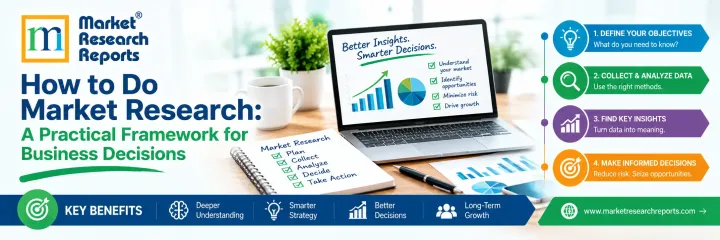
Most companies approach market research reactively - commissioning a study when a decision is already in motion, under time pressure, with an imprecisely defined question. The result is intelligence that arrives too late, answers a slightly different question than the one that matters, or lacks the depth required to change a conclusion that has already been informally reached. Doing market research well is primarily a matter of doing it earlier and more deliberately than most organisations currently do.
What is market research?
Market research is the systematic collection, analysis, and interpretation of information about a market - its size, structure, participants, customer behaviour, and competitive dynamics - to support business decisions. It encompasses both the gathering of data that exists in published sources and the generation of new data through primary research with market participants. The purpose is always the same: to reduce the uncertainty of a decision by replacing assumption with evidence.
Before you start - defining the research question
This is the most important step and the most frequently rushed one. The research question is not the topic you want to know about. It is the specific question whose answer will change or improve a specific decision.
The test is simple: if the research answer comes back as X rather than Y, will you make a different decision or make the same decision with greater confidence? If the answer is no - if the research result would not change what you do - then the question is not sufficiently connected to a real decision to justify the research investment.
A useful exercise before starting any research project: write down the decision being made, the options being evaluated, and the information that would cause you to choose one option over another. That information is your research question. A technology company evaluating whether to expand into Southeast Asia might frame it as: "If the market for our product category in Vietnam is above $200M and growing at above 10% CAGR, and if there are fewer than three well-funded local competitors, we will proceed. The research needs to tell us those three things."
The 5-step market research framework
Step 1: Define. Define the research question, the scope (geographies, market segments, time horizon), and the decision it will inform. Produce a one-page research brief before collecting any data. Teams that skip this step routinely collect a great deal of interesting but not directly useful information.
Step 2: Source. Identify the sources most likely to contain the data that answers your question. For market sizing, government statistical databases, trade association reports, and company disclosures are the primary secondary sources. For customer behaviour and competitive dynamics, primary research with actual market participants is usually necessary. Assess source quality before spending time on extraction - not all sources are equally reliable.
Step 3: Collect. Extract the relevant data points from identified sources. Document every extraction with its source, date, and any definitional caveats that affect how it should be interpreted. Data collected without provenance documentation cannot be verified later and cannot be cited credibly.
Step 4: Analyse. Assemble the collected data into a coherent analytical picture. This means reconciling conflicting data points from different sources, identifying gaps that require additional collection or primary research, building quantitative models where the question requires sizing or projection, and drawing conclusions that go beyond simply reporting what the sources say.
Step 5: Apply. Translate the findings into the specific decision context. A market research output that sits in a folder is not research - it is a cost. The value of the research is realised only when it changes or improves the decision it was commissioned to inform. Plan the application (the presentation, the workshop, the decision meeting) before the research is complete so that the findings are immediately integrated rather than filed.
Choosing between primary and secondary research
Secondary research - drawing on data that already exists in published sources - is faster, less expensive, and the right starting point for almost any research question. It establishes the market context: the overall size, the historical trajectory, the key players, the published competitive picture. Its limitation is that it can only describe what has been publicly disclosed, which is often not the most strategically valuable information.
Primary research - generating new data through direct engagement with market participants - is slower, more expensive, and essential for answering questions that secondary sources cannot. Customer purchase decision drivers, competitive pricing in opaque markets, technology adoption intent, supply chain economics, and market share in markets with limited public disclosure all require primary research. For most strategic decisions of any significance, a combination of both is required.
Free vs. paid sources - what each gives you
Free sources - government statistical databases, central bank publications, publicly available trade association summaries, company investor relations pages, patent databases - provide the macro-level and company-level data that anchors market analysis. They are authoritative, citable, and sufficient for a market overview in well-documented industries. Their limitations: they are often one to two years behind current market conditions, they cover industries at a level of aggregation that may be too broad for specific questions, and they require significant time to search and extract from.
Paid sources - syndicated market research reports, licensed data platforms, specialised industry databases - provide pre-compiled, validated market intelligence at the research firm's scope and timeline. The value is in the compilation and validation, not in the underlying data (which is often derived from the same government and trade sources available for free). For time-constrained research, the efficiency gain of buying compiled intelligence rather than building it from primary sources is often worth the cost many times over.
How analysts turn data into decisions
The most common failure in self-conducted market research is stopping at data collection and treating the collected data as the research output. Data is not intelligence. Intelligence is what you conclude from data - the synthesis of multiple data points into a coherent picture, the identification of the implications for the specific decision being made, and the honest acknowledgment of what the data cannot tell you.
Professional analysts distinguish between what the data says, what it implies, and what it does not say. A market growing at 18% CAGR is a fact. That this growth makes the market attractive for entry is an implication - which may or may not be valid depending on competitive intensity, capital requirements, and regulatory barriers that require separate analysis. That the data says nothing about whether your specific product can compete at the required price point is an honest acknowledgment of a gap that requires further research or primary validation.
When DIY research is enough - and when it is not
Self-conducted secondary research is adequate for: general market orientation before a deeper question is defined, monitoring established markets with good public data availability, and gathering the context needed to scope a professional research engagement effectively.
Professional research - whether syndicated reports or commissioned custom research - is worth the investment when: the decision involves significant capital or strategic commitment; the relevant market is complex or data-sparse enough that self-research produces unreliable results; primary research with market participants is required; the timeline does not permit thorough self-research; or the result will be presented to an external audience (investors, board, partners) who will scrutinise the source.
A 7-question checklist before starting any research project
- What specific decision will this research inform?
- What information would change my answer to that decision - and is that information actually researchable?
- What is the geographic and market scope that is relevant to this decision?
- What are the 3–5 most important questions the research must answer?
- Does this question require primary research, or is secondary research sufficient?
- What is my timeline, and is it realistic for the research depth required?
- What will I do with the findings - and who needs to be involved in that process?
Answering all seven questions before collecting any data produces better research, faster, with less wasted effort than starting with data collection and defining the question as you go.
For market intelligence built to professional standards, browse our syndicated report library or commission custom research designed specifically for your question. For a detailed account of how professional market research is produced, see our research methodology page.