


Compute Was Never the Constraint - Power Was: How AI Infrastructure Spending Created a $164.8 Billion Power and Cooling Market
Compute Was Never the Constraint - Power Was: How AI Infrastructure Spending Created a $164.8 Billion Power and Cooling Market
MRR® Industry Intelligence Briefing AI Infrastructure · Energy · Data Centers
In September 2023, Microsoft signed a 20-year Power Purchase Agreement with Constellation Energy to restart Unit 1 of Three Mile Island Nuclear Generating Station - a 835-megawatt reactor that had been shut down in 2019 due to economic unviability. The reason was not sentiment. Microsoft's AI data centre buildout in the Mid-Atlantic region was consuming power faster than the PJM Interconnection queue could approve new generation connections, and a direct nuclear PPA was the only mechanism that delivered the volume, reliability, and carbon profile the company's commitments required. When the world's second-largest company by market capitalisation restarts a shut-down nuclear power plant because the grid cannot accommodate its power requirements, the constraint is not the compute. It is the power. Here is what a USD 52.8 billion market in 2025 growing at 20.9% CAGR to USD 164.8 billion by 2031 looks like from the inside.
Executive Summary
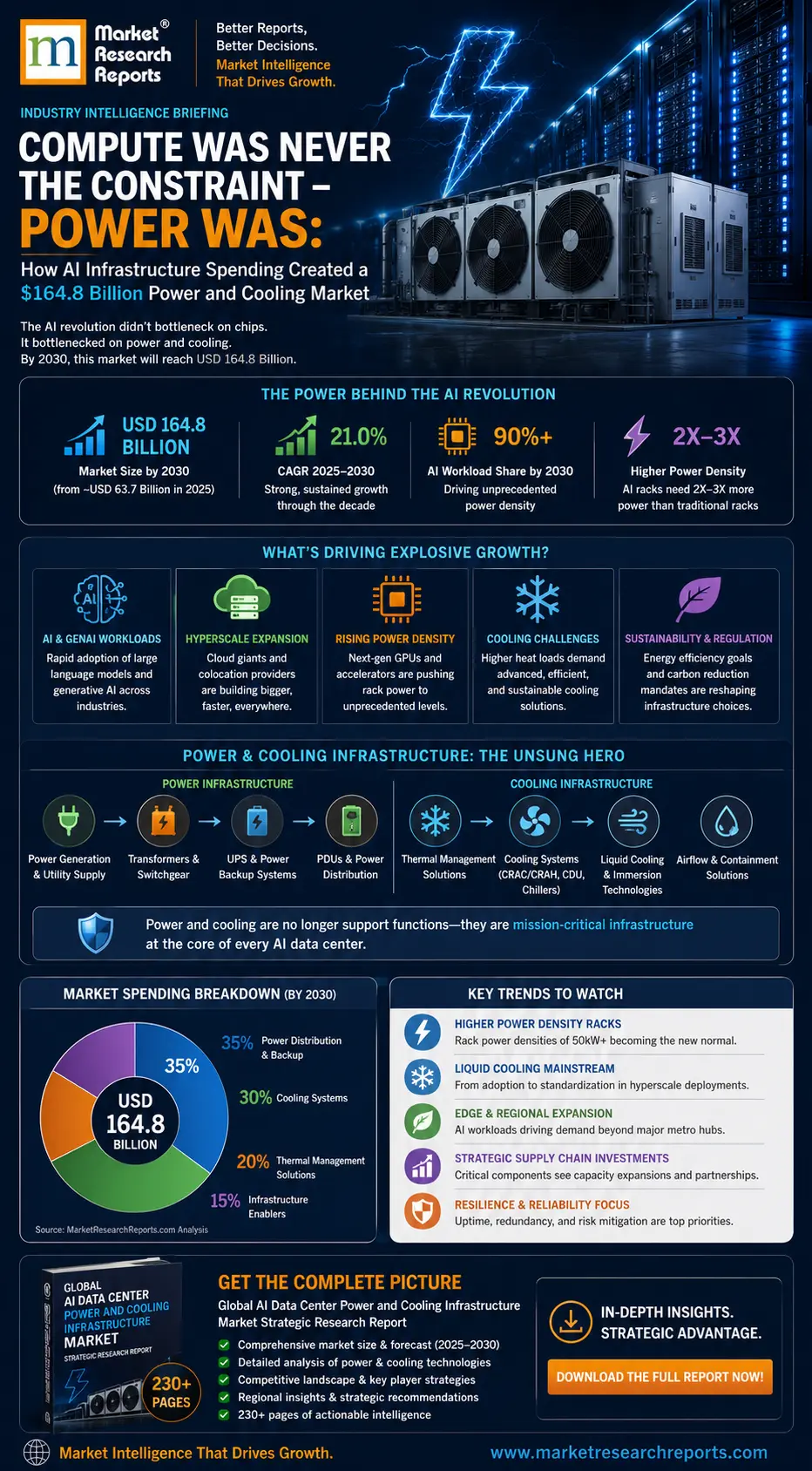
The global AI data centre power and cooling infrastructure market reached USD 52.8 billion in 2025 and is projected to reach USD 164.8 billion by 2031 at a 20.9% CAGR, according to Navadhi Market Research's Global AI Data Center Power and Cooling Infrastructure Market Strategic Research Report 2026–2031. This growth reflects a structural transformation in data centre design that is more consequential than any prior technology cycle in the sector: the replacement of air-cooled, general-purpose compute with liquid-cooled, GPU-dense AI infrastructure operating at rack power densities four to six times higher than the equipment being displaced, and requiring not just incremental power and cooling investment but the wholesale re-engineering of power delivery, thermal management, and energy sourcing at every major hyperscaler facility globally. The four largest hyperscalers - Microsoft, Amazon, Alphabet, and Meta - spent a combined USD 340+ billion on capital expenditure in 2025, with data centre infrastructure representing the largest single allocation within that figure. Physical infrastructure costs - power delivery, cooling, structural buildout - account for 25–35% of total data centre construction spend, placing the addressable procurement opportunity for infrastructure vendors in the USD 85–120 billion range annually, against which the current USD 52.8 billion market estimate captures only the equipment supply layer. The single most important structural observation in this market is the rack density discontinuity: a standard enterprise server rack historically consumed 10–15 kilowatts. A rack populated with NVIDIA H100 or H200 GPUs consumes 40–100 kilowatts. The same floor space that previously carried 15kW of electrical load now carries 40–100kW - a 4–6x increase in power density per square metre - and existing air cooling infrastructure, designed for the prior generation, cannot dissipate the heat output at the new density. Every hyperscaler deploying AI infrastructure at scale is simultaneously navigating this constraint, which is creating a sustained, multi-year investment cycle in liquid cooling, power distribution, and energy sourcing that has no clear ceiling within the forecast horizon.
The Research Problem: Why a Power and Cooling Crisis Is the Hidden Constraint in AI Infrastructure
The market narrative around AI infrastructure in 2024–2026 has concentrated on GPU availability - the supply constraints on NVIDIA H100 and H200 units, the lead times, the allocation politics. That framing is accurate but incomplete. For the companies that have successfully secured GPU supply, the binding constraint has shifted downstream to power availability and thermal dissipation. Three separate data points establish this concretely.
First, Microsoft's Three Mile Island PPA. Constellation Energy's 2023 annual report and subsequent SEC filings disclose a 20-year agreement to supply 835 megawatts of nuclear power to Microsoft - a volume equivalent to the electricity consumption of approximately 800,000 homes - at a commercially undisclosed but market-rate premium to compensate for the restart investment. The transaction only makes economic sense if grid-connected power on a comparable timeline cost more, carried higher reliability risk, or could not be secured at that volume through conventional interconnection applications. Constellation's Q2 2024 filing confirms the plant restart at Crane Clean Energy Centre (the renamed facility) is proceeding on schedule, with first power delivery targeted for 2028. Google has followed with its own nuclear PPA with Kairos Power for small modular reactors, and AWS has acquired a campus adjacent to a nuclear generating station in Pennsylvania. The pattern is not coincidental: hyperscalers are buying power assets and power agreements directly because conventional grid access cannot accommodate their demand at the required speed.
Second, the rack density inflection. NVIDIA's published thermal design guidelines for its HGX H100 server platform specify a thermal design power of 700 watts per GPU, with eight GPUs per server, yielding 5.6 kilowatts per server unit. A standard 42-unit rack populated with HGX H100 servers would therefore produce approximately 235 kilowatts of heat - approximately 16 times the historical average rack power density. In practice, full rack density for AI workloads at 2025 production deployments runs in the 40–80 kilowatt range per rack rather than theoretical maximums, but this still represents a 3–5x increase over the 10–15 kilowatt historical baseline. Air cooling systems designed for the prior density regime cannot handle this output without supplemental liquid cooling, and in many cases cannot handle it at all at the required PUE (Power Usage Effectiveness) targets.
Third, the Vertiv backlog signal. Vertiv Holdings - the largest publicly traded pure-play data centre power and cooling infrastructure vendor - reported order backlog at levels significantly exceeding prior-year figures throughout 2024 and 2025, with the company raising its revenue and margin guidance multiple times across those two fiscal years as hyperscaler demand for liquid cooling and power distribution equipment accelerated beyond initial projections. Vertiv's results function as a real-time demand signal for the infrastructure layer with a shorter lag than hyperscaler capex announcements, since Vertiv equipment is ordered 12–18 months ahead of data centre energisation.
Three Forces Simultaneously Reshaping the Infrastructure Stack
Force 1 - The Cooling Technology Transition: From Air to Liquid
Air cooling - the dominant thermal management approach for data centres since the industry's inception - is reaching its practical limit for AI-dense deployments. The physics are straightforward: air has low heat capacity relative to water, requiring high airflow volumes to dissipate high heat loads, and creating significant noise, energy consumption, and spatial constraints at the rack densities AI infrastructure demands. The industry is transitioning across a spectrum of liquid cooling approaches:
Direct Liquid Cooling (DLC) delivers coolant directly to CPU and GPU cold plates via a manifold system within the rack, removing 60–70% of heat at source and reducing dependence on facility-level air cooling. DLC is the most widely deployed liquid cooling approach in hyperscale AI deployments as of 2025, supported by NVIDIA's thermal design recommendations for its GPU server platforms.
Rear-Door Heat Exchangers (RDHx) attach to existing rack infrastructure and use liquid-cooled doors to capture exhaust heat before it enters the hot aisle, providing a retrofit path for legacy facilities. RDHx is the lowest-disruption deployment option for operators upgrading existing facilities.
Immersion Cooling submerges compute hardware in thermally conductive dielectric fluid - either single-phase (PUE approaching 1.02–1.03) or two-phase (boiling dielectric fluid with near-zero pumping energy) - achieving the highest cooling efficiency of any available approach. Immersion adoption is fastest in new-build greenfield facilities where no legacy air cooling infrastructure exists to retrofit around.
The market is not adopting a single approach: operators are deploying combinations of DLC, RDHx, and immersion depending on deployment vintage, facility type, and workload density. The common thread is that every major hyperscaler has disclosed a liquid cooling roadmap, and the share of new data centre capacity deploying some form of liquid cooling is projected to increase from approximately 15–20% in 2023 to 40–50% of new deployments by 2028.
Force 2 - Power Delivery Architecture: Re-Engineering From the Grid In
The power delivery stack within a data centre - from utility substation connection through transformers, switchgear, UPS systems, generators, and busway distribution to individual rack PDUs - was designed for a power draw profile that AI infrastructure is obsoleting. Two specific changes are driving investment across the entire power delivery chain simultaneously.
Higher facility power totals require larger transformer ratings, more sophisticated switchgear, and larger UPS capacity - infrastructure changes that are driven by the same aggregate power growth that is creating the interconnection queue crisis in the broader grid. A 100MW hyperscale AI campus requires a dedicated utility substation connection at 345kV or above, plus full redundancy for the power delivery infrastructure to meet the uptime guarantees embedded in the hyperscalers' own contractual commitments to enterprise customers.
Higher power density per rack also requires higher-current rack-level power distribution - traditional 208V rack PDUs are increasingly being replaced by 400V distribution architectures that reduce resistive losses at high current, and busway distribution systems that allow more flexible power allocation across changing rack configurations. This busway and high-density PDU replacement market is one of the highest-growth sub-segments within the broader infrastructure market.
Force 3 - Energy Sourcing: The Nuclear and Renewable PPA Wave
The hyperscalers' direct energy procurement activity - Microsoft's Three Mile Island PPA, Google's Kairos Power SMR agreement, Amazon's nuclear campus acquisition, Meta's long-term renewable agreements - reflects a fundamental shift in how large-scale power consumers are accessing electricity. Conventional utility supply agreements cap procurement at the utility's available headroom; hyperscale AI deployments require power at a scale and reliability level that frequently exceeds what conventional supply routes can deliver within the required timeline. The result is direct energy asset acquisition, long-term PPAs with nuclear operators, and co-location agreements adjacent to generation assets that effectively bypass the conventional utility supply chain for capacity that utility interconnection queues cannot accommodate in time.
Comparative Market Positions: The Infrastructure Vendor Landscape
| Company | Primary AI Data Centre Product Area | 2024–2025 Revenue Signal | Structural Position |
|---|---|---|---|
| Vertiv Holdings | Thermal management (liquid cooling, precision AC), power distribution (UPS, busway, PDUs) | Multiple guidance raises through 2024–2025; backlog at record levels; publicly traded (VRTV NYSE) | Largest pure-play listed data centre infrastructure vendor; direct hyperscaler relationship with all major cloud providers |
| Schneider Electric | EcoStruxure data centre management, UPS (APC brand), power distribution, DCIM software | Energy Management segment (including data centres) among largest corporate revenue contributors; consistent margin expansion 2023–2025 | Broadest portfolio across power and cooling; software layer creates switching cost via DCIM lock-in |
| Eaton Corporation | UPS systems, power distribution units, rack-level power management, eMobility (adjacent) | Electrical segment grew steadily through 2024–2025; data centre described as primary growth vertical in investor communications | Strong US market position; benefits from IIJA-driven grid investment as complementary demand alongside AI data centre cycle |
| nVent Electric | Thermal management, liquid cooling enclosures, rack solutions | Raised full-year guidance mid-2025; data centre described as top-performing end market; publicly traded (NVT NYSE) | Specialised thermal management and enclosure position; growing direct liquid cooling share |
| Legrand | Power distribution, rack PDUs, cable management, data centre infrastructure (Raritan brand) | Data centre end market consistently identified as priority growth vertical | Strong rack-level power distribution position; brand portfolio covers US and European hyperscaler supply chains |
| Constellation Energy | Nuclear power generation (Three Mile Island/Crane Clean Energy Centre, Calvert Cliffs) | USD 835M+ committed revenue from Microsoft PPA alone; raised earnings guidance post-PPA announcement | Emerging as critical AI infrastructure counterparty via direct nuclear power agreements; publicly traded (CEG NASDAQ) |
| NVIDIA | GPU hardware with embedded thermal design requirements that drive infrastructure procurement | FY2026 Data Center segment revenue USD 115B+; GPU thermal requirements directly mandate liquid cooling adoption | Sits above infrastructure vendors in value chain but effectively mandates liquid cooling through published GPU thermal design power specifications |
Note: Revenue figures represent publicly disclosed financial results or analyst consensus estimates from company filings and earnings communications 2024–2025. Market sizing sourced from Navadhi Market Research, Global AI Data Center Power and Cooling Infrastructure Market Strategic Research Report 2026–2031.
The Regional Demand Topology
North America is the primary demand concentration for AI data centre power and cooling infrastructure, reflecting the geographic clustering of hyperscaler campuses in Northern Virginia, Silicon Valley, Phoenix, Chicago, and the Pacific Northwest. The PJM interconnection queue situation - which the Three Mile Island PPA directly addresses - is most acute in Northern Virginia, which hosts the highest concentration of hyperscale data centre capacity of any geography on earth and is simultaneously constrained by Dominion Energy's transmission infrastructure limitations.
Europe represents the fastest-growing geographic market outside North America, driven by hyperscaler commitments in Ireland (AWS, Google, Meta), the Netherlands (Equinix, Digital Realty), and Germany, combined with EU data sovereignty requirements that are creating sovereign cloud buildout demand independent of the hyperscaler AI cycle. European deployments face additional complexity from stricter water usage regulations in several jurisdictions - cooling tower water consumption is regulated in Netherlands and Germany - which is accelerating adoption of waterless cooling approaches including closed-loop liquid systems and immersion cooling.
Asia-Pacific is the largest absolute market outside North America, driven by hyperscaler regional infrastructure in Singapore, Tokyo, Seoul, and Sydney, combined with significant domestic cloud provider infrastructure buildout in China (which operates its own supply chain substantially independent of Western vendors).
Analyst Insight
The most consequential structural observation about this market is the lag between hyperscaler capex commitment and infrastructure vendor revenue recognition. When Microsoft, Amazon, Alphabet, and Meta collectively guide to USD 725 billion in capex for calendar 2026, that figure includes substantial physical infrastructure procurement that flows through to Vertiv, Schneider Electric, Eaton, and nVent over an 18–36 month order-to-delivery-to-installation cycle. Vertiv's 2024–2025 backlog expansion is the leading indicator that 2026–2027 vendor revenues will continue accelerating, even if hyperscaler capex guidance moderates from current levels. The risk to this market is not demand destruction from AI spending deceleration - it is supply chain disruption in the transformer and liquid cooling component supply chains, exactly mirroring the equipment supply chain constraint that is binding the broader grid modernisation market. When the same physical infrastructure inputs (large transformers, copper, aluminium conductors) are simultaneously demanded by grid modernisation programmes and hyperscale AI data centre buildouts, the binding constraint shifts from capital to component availability. That intersection is the market dynamic most likely to produce upside surprises in infrastructure vendor pricing power through 2027.
Strategic Lessons for Market Participants
| Observation | Strategic Implication |
|---|---|
| Rack density inflection mandates liquid cooling adoption on a non-discretionary basis | Air cooling vendors without a credible liquid cooling roadmap are structurally disadvantaged in any hyperscale procurement cycle from 2025 onward; the technology transition is demand-driven, not preference-driven |
| Nuclear PPAs represent a new category of AI infrastructure counterparty | Constellation Energy, Kairos Power, and equivalent nuclear operators have effectively become AI infrastructure vendors through direct energy supply agreements; investors and analysts evaluating AI infrastructure exposure should include the energy sourcing layer in their competitive landscape mapping |
| Vertiv backlog duration is the most reliable leading indicator in this supply chain | With 12–18 month order-to-delivery cycles for major thermal management and power distribution equipment, Vertiv's disclosed backlog provides better forward revenue visibility than most enterprise software companies; backlog trajectory is the primary due diligence metric for this market |
| European data sovereignty regulation is creating incremental demand independent of the hyperscaler AI cycle | The GDPR and evolving AI Act data residency requirements are forcing cloud providers to build European sovereign cloud infrastructure that would not otherwise exist in this location or at this scale; European infrastructure vendors with local manufacturing and service capability benefit from procurement preferences that North American competitors cannot easily replicate |
Frequently Asked Questions
What is PUE and why does it matter for this market?
Power Usage Effectiveness (PUE) is the ratio of total data centre power to IT equipment power - a PUE of 1.0 means 100% of facility power reaches compute; a PUE of 2.0 means equal amounts of power go to cooling and IT infrastructure. Legacy air-cooled data centres typically operate at PUE of 1.4–1.6; hyperscale operators with modern infrastructure target 1.1–1.15; liquid-cooled AI-dense facilities can achieve PUE of 1.03–1.05. The economic significance is that a 100MW AI data centre running at PUE 1.5 rather than 1.1 wastes 40MW of capacity on cooling overhead - equivalent to approximately USD 25–30 million in annual electricity cost at commercial rates - creating a strong economic incentive for liquid cooling adoption independent of thermal feasibility requirements.
Why are hyperscalers signing nuclear PPAs rather than buying renewable energy?
Renewable energy (solar and wind) is intermittent. An AI training cluster running a multi-week training run at 100MW cannot tolerate power interruptions without losing substantial compute work. Nuclear generation operates at approximately 92–95% capacity factor year-round with no weather dependency, providing the reliability profile that AI infrastructure requires. The carbon profile of nuclear power also satisfies corporate net-zero commitments that coal or natural gas supply would not. The Three Mile Island PPA is not an energy ideology statement - it is a procurement decision driven by the intersection of reliability, carbon, volume, and availability-within-required-timeline that only nuclear, among the carbon-free generation options, could satisfy at 835MW scale in the Mid-Atlantic market.
What share of AI data centre construction spend goes to power and cooling versus compute?
Physical infrastructure costs - power delivery from utility connection through transformer, UPS, switchgear, busway, and PDUs to rack, plus thermal management from chiller plant through CRAC units or liquid cooling distribution to rack - account for approximately 25–35% of total data centre construction spend. At the USD 340+ billion in hyperscaler capex for 2025, the addressable procurement opportunity for infrastructure vendors is in the USD 85–120 billion range, against which the USD 52.8 billion market estimate captures the equipment supply layer. The gap between addressable spend and current market sizing reflects in-house procurement, regional construction contractor intermediation, and long-cycle project finance structures that accrue equipment costs over multiple years.
Is the liquid cooling transition creating winners and losers among established vendors?
Yes. Vendors with legacy revenue concentrated in precision air cooling (CRAC/CRAH units, aisle containment) face revenue shift toward lower-margin products as their primary installed base becomes less relevant for new deployments. Vendors that have invested in direct liquid cooling product lines - Vertiv's Liebert RDU, Schneider Electric's APC liquid cooling range, nVent's Eldon liquid cooling enclosures - are growing share within a growing total market. The transition is not displacing incumbents entirely, since existing facilities require continued air cooling maintenance, but the growth capital in the category is flowing overwhelmingly toward liquid-cooled products, and vendors without credible liquid cooling offerings are effectively ceding the new-build market to competitors who have them.
How does this market interact with the global grid modernisation investment cycle?
Directly and significantly. The AI data centre electrification demand is one of the two primary near-term demand drivers for grid modernisation investment - alongside renewable energy integration - that the companion briefing in this series addresses. The same transformer shortage, the same interconnection queue congestion, and the same permitting timeline constraints that bind the grid modernisation market are also the primary supply-side risks for hyperscaler data centre power access. The Microsoft Three Mile Island PPA is itself a grid bypass strategy: by contracting directly with a nuclear generator for long-term dedicated supply, Microsoft removes its incremental demand from the interconnection queue entirely, ensuring its Virginia campus power requirements do not depend on queue outcomes that could delay delivery by five-plus years.
For full market sizing, regional forecasts, and vendor profiles across the AI data centre power and cooling landscape, see our Global AI Data Center Power and Cooling Infrastructure Market Strategic Research Report 2026–2031. For a broader view of how power infrastructure constraints are shaping AI economics, read our companion briefing on the global grid modernisation investment supercycle. For bespoke infrastructure analysis, commission custom research.