


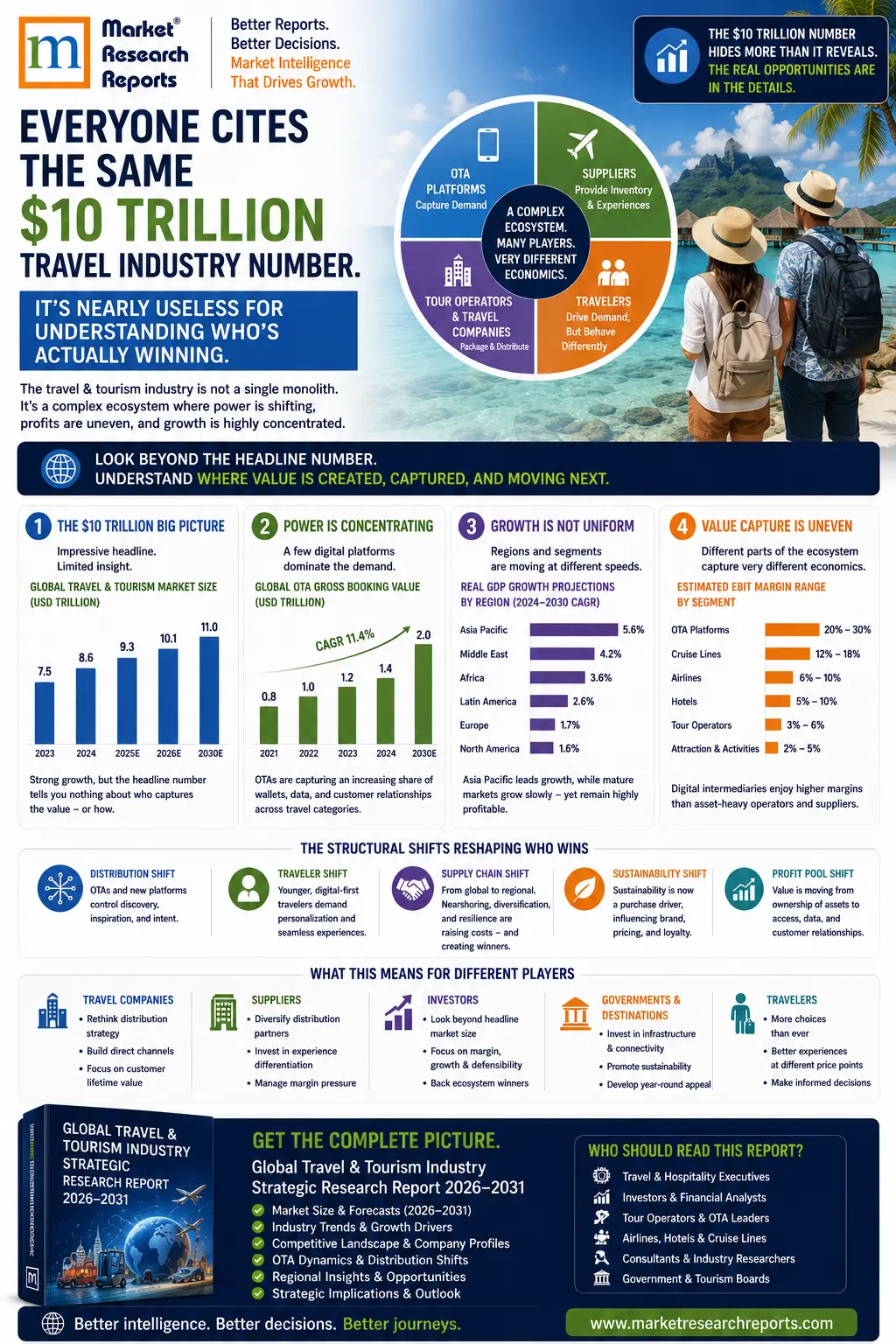
Everyone Cites the Same $10 Trillion Travel Industry Number. It's Nearly Useless for Understanding Who's Actually Winning.
Everyone Cites the Same $10 Trillion Travel Industry Number. It's Nearly Useless for Understanding Who's Actually Winning.

MRR® Industry Intelligence Briefing Travel & Tourism · Hospitality · Market Analysis
Every travel industry report cites the same number: $10 trillion. It's the WTTC's total economic contribution figure, and it's almost useless for understanding who's actually winning right now, because it treats airlines, OTAs, hotels, and cruise lines as one undifferentiated mass. The real competitive battle in travel is happening in three much narrower places, and none of them show up in the headline number at all.
Executive Summary
The global travel, tourism, and hospitality industry reached an estimated $10.0 trillion in total economic contribution in 2025, forecast to reach $13.79 trillion by 2031, a compound annual growth rate of approximately 5.5%, according to Navadhi Market Research's Global Travel, Tourism & Hospitality Industry Strategic Research Report. Twenty-five companies are profiled in depth, and the more useful story for anyone assessing competitive position right now isn't the industry's steady blended growth rate - it's three structural shifts moving beneath that headline number: a distribution and loyalty land-grab among the largest OTAs, a capital-markets mispricing problem visible in TUI's 2024 delisting, and Asia-Pacific's unusual position as simultaneously the largest and the fastest-growing region.
The Research Problem: A $10 Trillion Number That Explains Almost Nothing About Competitive Position
The WTTC-aligned total economic contribution methodology - direct, indirect, and induced effects across the full value chain - is the right way to measure travel's importance to the global economy. It is close to useless for figuring out which companies are gaining ground. Airlines, hotels, cruise lines, and OTAs face completely different competitive dynamics, cost structures, and growth trajectories, and blending them into one $10 trillion figure obscures every one of those differences.
The shift most underweighted in generalist coverage is what's happening in distribution specifically. Online Travel Agencies are projected to rise from approximately 28% of booking channel share in 2025 to approximately 37% by 2031 - the fastest-moving share shift in this report's entire segmentation - while Booking Holdings and Expedia Group have spent the past three years making increasingly aggressive moves to consolidate loyalty and distribution power specifically, not just grow revenue generally.
The second underweighted story is what TUI Group's 2024 delisting from the London Stock Exchange actually signals. A vertically integrated tour operator spanning hotels, airlines, and cruises voluntarily simplified its capital markets structure, consolidating its primary listing in Frankfurt - a move that reads less like company-specific weakness and more like a broader signal that public markets still don't have a clean way to value integrated travel companies against single-category peers.
Three Structural Shifts, Three Different Competitive Games
Shift One - The Distribution and Loyalty Land-Grab
Booking Holdings has deepened its strategic investment in Meituan (China) and sustained its equity stake in Grab (Southeast Asia) - not primarily to grow revenue, but as a distribution penetration mechanism into markets where its own brand awareness trails Trip.com Group specifically. Expedia completed a more substantive integration of Vrbo into its One Key loyalty framework in 2023, a move explicitly aimed at Airbnb's alternative-accommodation share rather than at organic growth. This is a land-grab for distribution and loyalty position, not a race for market size - and it's happening entirely inside the 28%-to-37% OTA channel-share shift that the $10 trillion headline number never surfaces.
Shift Two - What TUI's Delisting Actually Signals
TUI Group's 2024 move to consolidate its primary listing in Frankfurt after delisting from London wasn't a company in distress - it was a company simplifying its capital markets exposure. Vertically integrated travel companies spanning hotels, airlines, and cruises are structurally harder for public markets to value cleanly against single-category peers (a pure-play airline, a pure-play hotel chain), and TUI's move is worth reading as evidence of that mispricing problem, not just a one-off corporate decision. Any competitive assessment that treats "integrated" and "specialized" travel companies as directly comparable on standard multiples is likely missing this structural distinction.
Shift Three - Asia-Pacific Is Both the Largest and the Fastest-Growing Region, Simultaneously
Asia-Pacific holds approximately 36% of global travel and tourism value in 2025 - already the largest region - and is also the fastest-growing, driven by China outbound travel recovery and India's Incredible India 2.0 initiative. A region that's simultaneously largest and fastest-growing is a genuinely unusual combination; in most industries, scale and growth rate trade off against each other. Companies and investors underweighting Asia-Pacific on the assumption that "it's already big, so growth must be slowing elsewhere" are working against what the data actually shows.
Where the Top Companies Sit Across the Three Shifts
| Company | Primary Shift Exposure | What to Watch |
|---|---|---|
| Booking Holdings | Distribution/loyalty land-grab (Meituan, Grab stakes) | Whether Asia-Pacific distribution investments close the gap with Trip.com |
| Expedia Group | Distribution/loyalty land-grab (Vrbo/One Key vs. Airbnb) | One Key integration's effect on alternative-accommodation share |
| Airbnb | Alternative accommodation (defending share from Expedia/Vrbo) | Competitive response to OTA loyalty program consolidation |
| TUI Group | Capital markets mispricing of integrated travel models | Whether the Frankfurt-only listing improves valuation multiples |
| Trip.com Group | Asia-Pacific distribution dominance | Pace of Western OTA encroachment via Meituan/Grab-style stakes |
| Hilton Worldwide | Capital-light loyalty expansion (Graduate Hotels, SLH licensing) | Loyalty redemption network growth without balance-sheet commitment |
| IAG (International Airlines Group) | Consolidation (Air Europa acquisition) | Madrid hub dominance following prolonged EC regulatory scrutiny |
| Carnival Corporation | Cruise category concentration | Post-pandemic demand recovery sustainability |
Source: Navadhi Market Research, Global Travel, Tourism & Hospitality Industry Strategic Research Report; company disclosures.
Analyst Insight
The most consequential fact in this report for competitive assessment purposes isn't the $13.79 trillion 2031 total - it's that the industry's headline growth number and its real competitive dynamics are almost entirely decoupled from each other. Booking Holdings and Expedia aren't fighting over the $10 trillion figure; they're fighting over the 9-percentage-point shift in OTA channel share between now and 2031, a much smaller and more specific battlefield. TUI's delisting suggests that even sophisticated capital markets participants are still working out how to value companies that don't fit cleanly into single-category comparisons. And Asia-Pacific's unusual largest-and-fastest position means the region deserves more strategic attention than its "already mature" reputation might suggest to anyone reading only the aggregate numbers.
Strategic Lessons for Market Participants
| Observation | Strategic Implication |
|---|---|
| OTA channel share is projected to rise from 28% to 37% of bookings, 2025-2031 | Distribution and loyalty positioning matters more than overall market growth for predicting which companies capture the next several years of value - track channel-share moves specifically, not just revenue growth |
| TUI Group voluntarily simplified its listing structure in 2024 rather than being forced to by distress | Integrated travel companies may be structurally undervalued by public markets relative to single-category peers - worth factoring into how competitive and investment analysis treats vertically integrated players |
| Asia-Pacific is simultaneously the largest region (36% share) and the fastest-growing | The usual assumption that scale and growth rate trade off against each other doesn't hold here - strategic attention to Asia-Pacific shouldn't decline just because the region is already large |
| Recent M&A activity concentrates specifically at the distribution/loyalty intersection, not broad-based consolidation | Competitive threats and opportunities are narrower and more targeted than "the OTAs are consolidating the industry" - they're specifically fighting over loyalty and distribution position |
Frequently Asked Questions
What is the size of the global travel and tourism market?
The industry reached an estimated $10.0 trillion in total economic contribution in 2025, projected to reach $13.79 trillion by 2031, a compound annual growth rate of approximately 5.5%.
Why does this report use a $10 trillion figure when some sources cite closer to $1 trillion?
The $10 trillion figure reflects the WTTC-aligned total economic contribution methodology (direct, indirect, and induced effects across the full value chain). Narrower direct-revenue-only estimates, which independent sources place closer to $1.0-1.1 trillion for 2025, reflect a materially different, smaller scope - not a competing estimate of the same thing.
Which distribution channel is growing fastest?
Online Travel Agencies, projected to rise from approximately 28% of booking channel share in 2025 to approximately 37% by 2031, as direct booking and traditional travel agent shares gradually decline.
Which region leads the global travel and tourism market?
Asia-Pacific holds approximately 36% share in 2025 - already the largest region - and is also the fastest-growing, driven by China outbound travel recovery and India's Incredible India 2.0 initiative.
What does TUI Group's 2024 delisting from the London Stock Exchange signal?
TUI consolidated its primary listing in Frankfurt in 2024, a move that suggests public capital markets still struggle to cleanly value vertically integrated travel companies (spanning hotels, airlines, and cruises) against single-category peers, rather than reflecting company-specific distress.
For full segment, application, regional, and country-level detail, complete methodology, and all twenty-five company profiles, see our Global Travel, Tourism & Hospitality Industry Strategic Research Report. For bespoke travel and tourism market analysis, commission custom research.