

Global Humanoid Robotics Commercial Deployment Market Strategic Research Report

By Type: Bipedal Full-Humanoid Robots, Wheeled/Semi-Humanoid Service Robots, Teleoperation & Supervised Humanoids, Humanoid Robot-as-a-Service (RaaS), Humanoid AI Software & Middleware, Humanoid Components & Spare Parts, Other Humanoid Systems
By Application: Manufacturing & Industrial Automation, Logistics & Warehouse Operations, Healthcare & Elder Care Assistance, Retail, Hospitality & Customer Service, Defence & Public Safety, Construction & Infrastructure, R&D, Education & Training
Regional Forecast: Asia Pacific, Latin America, MEA, Europe, North America
Key Players: Tesla Inc., Boston Dynamics (Hyundai Motor Group), Agility Robotics (Amazon), Figure AI, Unitree Robotics, 1X Technologies, Apptronik, Sanctuary AI, Fourier Intelligence, UBTECH Robotics
نظرة عامة
The global humanoid robotics-industry-strategic-research-report" title="Global Robotics Industry Strategic Research Report">robotics commercial deployment market stands at a definitive inflection point, representing one of the most consequential emerging technology transitions in modern industrial history.
This report covers the full spectrum of humanoid robotics industry across all major global markets for the forecast period 2026–2031, with 2025 as the base year.
As per this report, the global humanoid robotics market, which was worth USD 2 billion in 2025, is expected to grow at a CAGR of 38.56% between 2026 and 2031. This exceptional growth trajectory reflects the convergence of three decades of advances in AI, actuator technology, power systems, and sensor fusion that are now enabling commercially viable humanoid robots for the first time. The global humanoid robotics market is expected to be worth USD 14.3 billion by 2031. Global humanoid robotics commercial deployment market is expected to be worth USD 14.3 billion by 2031.
This expected growth places humanoid robotics among the fastest-growing technology deployment markets globally - comparable in growth dynamics to the early commercialization phases of cloud computing infrastructure and electric vehicle adoption, yet structurally differentiated by its direct substitution economics against human labor across the world's largest employment categories.
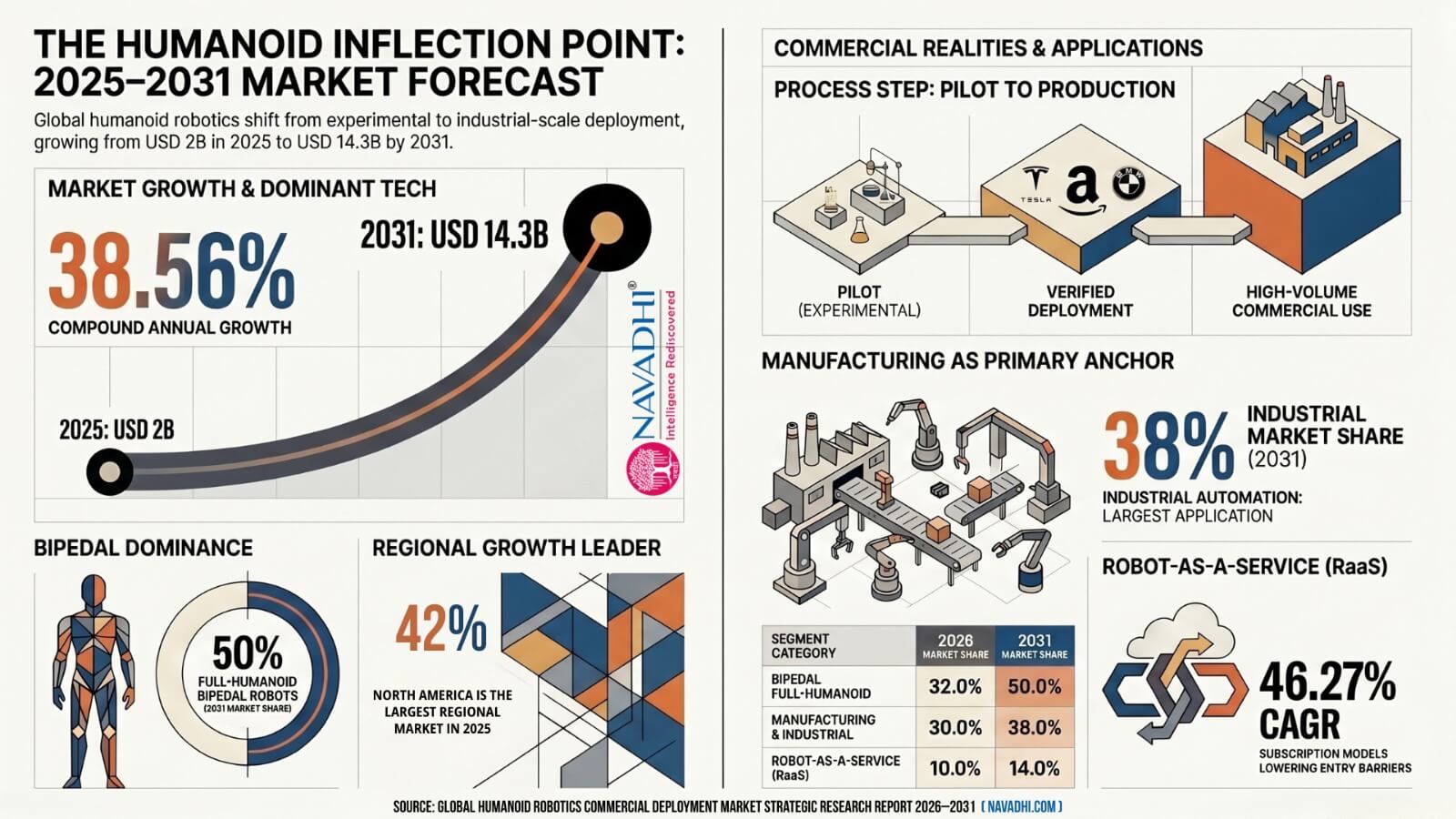
The market's ascent is not speculative. It is grounded in verified commercial deployments documented across multiple primary corporate disclosure sources: Tesla's FY2024 Form 10-K confirming approximately 1,500 Optimus units deployed in internal factory operations; Amazon's FY2024 Annual Report confirming Agility Robotics' Digit humanoids operational across Amazon fulfillment center infrastructure; BMW Group's FY2024 Annual Report documenting Figure AI's bipedal humanoid pilot at the Spartanburg manufacturing facility; and UBTECH Robotics' Hong Kong Stock Exchange IPO Prospectus reporting FY2023 revenues of HK$929 million alongside commercial Walker X deployments at BMW Shenyang and Foxconn Shenzhen - representing the first high-volume, documented commercial humanoid deployments at industrial scale globally.
These verified deployment events collectively signal the market's transition from technology demonstration to commercial production - a qualitative shift that fundamentally repositions the risk profile of the humanoid robotics investment thesis.
Bipedal Full-Humanoid Robots is the largest segment type in the global humanoid robotics market at estimated 32% market share by value in 2026 and is expected to grow at a CAGR of 48.8% during 2026-2031 and reach 50.0% market share by 2031. This growth is underpinned by the verified commercial deployments of Tesla Optimus, Agility Digit, Figure 02, and Boston Dynamics Atlas, alongside a cost curve trajectory that projects sub-USD 20,000 pricing for capable bipedal humanoids by the mid-forecast period.
Humanoid Robot-as-a-Service (RaaS) segment anchored by the Moxi subscription model (USD 3,000–5,000 per month), the Agility-Amazon commercial structure, and the Figure AI-BMW pilot arrangement, is estimated to have 10% market share by value in 2026 and is expected to grow second fastest at a CAGR of 46.27% during 2026-2031 and reach 14.0% market share by 2031.
Wheeled and Semi-Humanoid Service Robots segment is expected to grow at a CAGR of 27.43% during 2026-2031. Despite retaining significant absolute revenue growth, this segment is projected to experience relative market share decline from 26.0% to approximately 16.0% as fully bipedal alternatives achieve cost-competitive pricing.
Manufacturing & Industrial Automation is the largest application segment in the global humanoid robotics market at estimated 30% market share by value in 2026 and is expected to grow at a CAGR of 43.99% during 2026-2031 and reach 38.0% market share by 2031. This growth is driven by automotive assembly, electronics manufacturing, and general-purpose factory material handling representing the primary deployment use cases, with verified demand anchors including Tesla's internal Optimus deployment, BMW's Figure AI partnership, and UBTECH's Walker X installations at BMW Shenyang and Foxconn Shenzhen.
Logistics and Warehousing represents the second-largest and second-fastest growing application segment, expected to grow at approximately 43.25% CAGR during 2026-2031. This growth is driven principally by the Amazon-Agility Robotics deployment relationship and the structural imperative of e-commerce fulfillment operators to automate last-touch picking and sorting operations.
Healthcare & Elder Care Assistance application segment, while growing at the comparatively modest CAGR of approximately 31.44% during 2026-2031, represent a long-duration, high-value deployment opportunity as hospital service robot adoption broadens from early adopter academic medical centers to mainstream community hospital systems.
North America is the largest regional market in 2025, representing approximately 42.0% of global market value - a function of U.S.-headquartered leadership across the most commercially advanced humanoid platforms (Tesla, Agility Robotics, Figure AI, Boston Dynamics, Sanctuary AI) and the concentration of high-wage manufacturing and logistics operations that generate the most compelling substitution economics.
However, North America's share is projected to moderate to approximately 35.0% by 2031 as Asia-Pacific - led by China's vertically integrated humanoid robotics manufacturing ecosystem (Unitree, Fourier Intelligence, UBTECH, Agibot) - and the Middle East & Africa region scale rapidly.
The Middle East & Africa is identified as the fastest-growing regional market over the forecast period, at approximately 49.0% CAGR, driven by Saudi Arabia's Vision 2030 industrial automation investments, which underpin that country's status as the single fastest-growing national market globally at approximately 50.0% CAGR.
The global humanoid robotics commercial deployment market has demonstrably transitioned from a technology development phase to an early commercial deployment phase as of 2024–2025. The convergence of embodied AI maturity, actuator cost reduction, compelling labor substitution economics, and verified deployments across leading global manufacturers provides a structurally credible foundation for the 38.8% CAGR forecast through 2031. The market's USD 14.3 billion 2031 projection should be understood as a base-case estimate - one that assumes measured rather than accelerated deployment velocity and reflects a conservative interpretation of Tesla Optimus commercial scale relative to management guidance.
For strategic planners, technology investors, and procurement executives across manufacturing, logistics, and healthcare sectors, the central analytical conclusion of this report is unambiguous: the question of whether humanoid robots will achieve broad commercial deployment is resolved. The operative strategic questions are now when at what scale, at what price point, and by which platform vendors the majority of that deployment value will be captured - and those questions form the analytical core of the detailed segmentation, regional, and competitive analysis contained in the sections that follow.
Scope of Global Humanoid Robotics Commercial Deployment Market Strategic Research Report 2026–2031
- This report provides forecast data by value (in USD billion) till 2031 for the global humanoid robotics commercial deployment market.
- This report provides segment by type (Bipedal Full-Humanoid Robots, Wheeled/Semi-Humanoid Service Robots, Teleoperation & Supervised Humanoids, Humanoid Robot-as-a-Service (RaaS), Humanoid AI Software & Middleware, Humanoid Components & Spare Parts and Other Humanoid Systems) forecast data by value (in USD billion) for the global humanoid robotics commercial deployment market till 2031.
- This report provides application segments (Manufacturing & Industrial Automation, Logistics & Warehouse Operations, Healthcare & Elder Care Assistance, Retail, Hospitality & Customer Service, Defence & Public Safety, Construction & Infrastructure and R&D, Education & Training) forecast data by value (in USD billion) for the global humanoid robotics commercial deployment market till 2031.
- This report provides region-wise (Asia-Pacific, North America, Europe, Middle East & Africa, Latin America) forecast data by value (in USD billion) for the global humanoid robotics commercial deployment market till 2031.
- This report also provides country-wise forecast data by value (in USD billion) and volume (in billion dosage units) for USA, Canada, Mexico, China, Japan, South Korea, Singapore, Rest of Asia Pacific, Germany, United Kingdom, France, Netherlands, Sweden, Rest of Europe, UAE, Saudi Arabia, Israel, Rest of Middle East & Africa, Brazil and Rest of Latin America.
- This report identifies key growth drivers and inhibitors (pain points) affecting the global humanoid robotics commercial deployment market.
- This report provides SWOT (Strengths, Weaknesses, Opportunities and Threats) analysis , company profile including revenue (in USD billion) and gross margin (%) for 2024-2025 along with competitive landscape for 10 key companies (Tesla Inc., Boston Dynamics (Hyundai Motor Group), Agility Robotics (Amazon), Figure AI, Unitree Robotics, 1X Technologies, Apptronik, Sanctuary AI, Fourier Intelligence and UBTECH Robotics) in the global humanoid robotics commercial deployment market.
- This report provides Porter’s Five Forces analysis for global humanoid robotics commercial deployment market.
- This report provides PESTLE (political, economic, social, technological, legal and environmental) analysis for global humanoid robotics commercial deployment market.
- This report provides SWOT (Strengths, Weaknesses, Opportunities and Threats) analysis for global humanoid robotics commercial deployment market.
- This report identifies key future trends in the global humanoid robotics commercial deployment market.
Segment by Type in Global Humanoid Robotics Commercial Deployment Market
- Bipedal Full-Humanoid Robots
- Wheeled/Semi-Humanoid Service Robots
- Teleoperation & Supervised Humanoids
- Humanoid Robot-as-a-Service (RaaS)
- Humanoid AI Software & Middleware
- Humanoid Components & Spare Parts
- Other Humanoid Systems
Segment by Application in Global Humanoid Robotics Commercial Deployment Market
- Manufacturing & Industrial Automation
- Logistics & Warehouse Operations
- Healthcare & Elder Care Assistance
- Retail, Hospitality & Customer Service
- Defence & Public Safety
- Construction & Infrastructure
- R&D, Education & Training
Segment by Region in Global Humanoid Robotics Commercial Deployment Market
- Asia-Pacific
- China
- Japan
- South Korea
- Singapore
- Rest of Asia Pacific
- North America
- USA
- Canada
- Mexico
- Europe
- Germany
- United Kingdom
- France
- Netherlands
- Sweden
- Rest of Europe
- Middle East & Africa
- UAE
- Saudi Arabia
- Israel
- Rest of Middle East & Africa
- Latin America
- Brazil
- Mexico
- Rest of Latin America
Who can use the Global Humanoid Robotics Commercial Deployment Market Research Report?
This research report is ideal for people who wish to gain a thorough understanding of the humanoid robotics commercial deployment market. Some of intended user for this report are:
- C-level executives
- Company Directors
- Industry consultants
- Marketing professionals
- Business development professionals
- Management consultants
- Investment managers
- Financial professionals
- Venture Capitalists
- Bank Managers
- M&A Managers
- Auditors
- Anyone operating in humanoid robotics commercial deployment industry value chain.
Market snapshot
Global Humanoid Robotics Commercial Deployment Market Strategic Research Report snapshot, 2025–2031
 © MarketResearchReports.comDisclaimer: The actual data may vary in the final report which undergoes verification check post order confirmation.
Segments covered in this report
Table of contents
01Executive Summary
- 1.1 Executive Summary
- 1.1.1 Market Overview and Strategic Significance
- 1.1.2 Structural Convergence: The Technology and Economics Case for 2025–2031
- 1.1.3 Key Market Metrics at a Glance
- 1.1.4 Market Size and Historical Context
- 1.1.5 Segmentation Summary: Product and Application Dimensions
- 1.1.6 Regional Dynamics
- 1.1.7 Competitive Landscape and Investment Environment
- 1.1.8 Critical Risk Factors
- 1.1.9 Analyst Conclusion
02Industry Overview & Forecast
- 2.1 Global Humanoid Robotics Commercial Deployment Market: 2022–2031
- 2.2 Market Introduction and Strategic Context
- 2.3 Historical Market Performance: 2022–2024
- 2.3.1 Market Genesis and Early Commercial Proof Points (2022–2023)
- 2.3.2 The 2024 Inflection: Multiple Simultaneous Commercial Validations
- 2.4 Base Year Assessment: 2025 (USD 2.0 Billion)
- 2.5 Market Forecast: 2026–2031
- 2.5.1 Overall Market Trajectory
- 2.5.2 Near-Term Forecast: 2026–2027 — Commercial Launch and First-Wave Adoption
- 2.5.3 Mid-Term Forecast: 2028–2029 — Scale Deployment and RaaS Maturation
- 2.5.4 Long-Term Forecast: 2030–2031 — Industrial Mainstream and Consumer Threshold
- 2.6 Market Segmentation by Product Type: Structural Shifts 2025–2031
- 2.6.1 Bipedal Full-Humanoid Robots: The Dominant Growth Engine
- 2.6.2 Wheeled/Semi-Humanoid Service Robots: Mature Segment Under Structural Pressure
- 2.6.3 Robot-as-a-Service: The Fastest-Growing Commercial Model
- 2.7 Regional Market Dynamics and Forecast
- 2.7.1 Regional Overview: A Shifting Geographic Centre of Gravity
- 2.8 Market Forecast Cross-Validation and Scenario Analysis
- 2.8.1 Bottom-Up Corporate Disclosure Validation
- 2.8.2 Scenario Analysis
- 2.9 Key Demand Catalysts and Market Drivers: 2026–2031
03Market Segmentation by Type
- 3.1 Segment Overview and Structural Dynamics
- 3.2 Bipedal Full-Humanoid Robots
- 3.2.1 Market Size and Growth Trajectory
- 3.2.2 Commercial Deployment Evidence and Unit Economics
- 3.2.3 Price Curve Dynamics: The Commercialisation Catalyst
- 3.2.4 Key Sub-Segment Drivers: Manufacturing Vertical Concentration
- 3.3 Wheeled/Semi-Humanoid Service Robots
- 3.3.1 Market Size and Growth Trajectory
- 3.3.2 Segment Definition and Key Players
- 3.3.3 The Disruption Dynamic: When Bipedal Robots Reach Price Parity
- 3.4 Teleoperation & Supervised Humanoids
- 3.4.1 Market Size and Growth Trajectory
- 3.4.2 Key Commercial Deployments and Technology Providers
- 3.4.3 Segment Trajectory: The Autonomy Transition Risk
- 3.5 Humanoid Robot-as-a-Service (RaaS)
- 3.5.1 Market Size and Growth Trajectory
- 3.5.2 Commercial Model Validation: Moxi as the RaaS Template
- 3.5.3 Structural Drivers of RaaS Acceleration
- 3.6 Humanoid AI Software & Middleware
- 3.6.1 Market Size and Growth Trajectory
- 3.6.2 Technology Stack and Commercial Monetisation Models
- 3.7 Humanoid Components & Spare Parts
- 3.7.1 Market Size and Growth Trajectory
- 3.8 Other Humanoid Systems
- 3.8.1 Market Size and Growth Trajectory
- 3.9 Segment Convergence: Cross-Segment Dynamics and 2026–2031 Structural Themes
- 3.9.1 Theme 1: Bipedal Absorption of Adjacent Segments
- 3.9.2 Theme 2: Hardware-to-Software Margin Migration
- 3.9.3 Theme 3: Ecosystem Concentration and Supplier Leverage
- 3.10 Segment Sizing Summary and Forecast Reconciliation
04Market Segmentation by Application
- 4.1 Overview
- 4.1.1 Table 5.1 — Revenue Forecast by Application Segment, 2022–2031 (USD Million)
- 4.2 Manufacturing & Industrial Automation
- 4.2.1 Deployment Evidence and Revenue Composition
- 4.2.2 Economic Case for Humanoid Adoption in Manufacturing
- 4.2.3 Segment Trajectory and Share Gain Rationale
- 4.3 Logistics & Warehouse Operations
- 4.3.1 Amazon / Agility Robotics: The Defining Commercial Deployment
- 4.3.2 Third-Party Logistics Adoption: The GXO / Apptronik Signal
- 4.3.3 The Structural Advantage of Humanoid Form Factor in Logistics
- 4.3.4 Segment Growth Profile and Competitive Dynamics
- 4.4 Healthcare & Elder Care Assistance
- 4.4.1 Hospital Logistics: Moxi and the Clinical ROI Model
- 4.4.2 Elder Care: Demographic-Driven Long-Range Demand
- 4.4.3 Growth Constraints and Share Dynamics
- 4.5 Retail, Hospitality & Customer Service
- 4.5.1 Sanctuary AI and Retail Deployment Validation
- 4.5.2 Hospitality and the Customer Interaction Frontier
- 4.5.3 Segment Growth Constraints
- 4.6 Defence & Public Safety
- 4.6.1 Institutional Deployment: NASA, DARPA, and Sovereign Programmes
- 4.6.2 Public Safety and Emergency Response Applications
- 4.7 Construction & Infrastructure
- 4.7.1 Inspection and Monitoring: The Boston Dynamics Spot Precedent
- 4.7.2 Infrastructure and Utility Applications
- 4.8 R&D, Education & Training
- 4.8.1 University and Research Deployment: Unitree and Fourier Intelligence
- 4.8.2 Corporate Training and Simulation Applications
- 4.8.3 Declining Share Rationale
- 4.9 Segment Composition: Share Shift Analysis 2025–2031
05Regional Market Forecast
- 5.1 North America
- 5.1.1 Regional Overview
- 5.1.2 Key Growth Drivers
- 5.1.3 Regulatory & Infrastructure Landscape
- 5.1.4 Country-Level Analysis
- 5.1.4.1 United States — USD 0.773 Billion (2025) → USD 4.555 Billion (2031)
- 5.1.4.2 Canada — USD 0.042 Billion (2025) → USD 0.275 Billion (2031)
- 5.1.4.3 Mexico — USD 0.025 Billion (2025) → USD 0.175 Billion (2031)
- 5.1.5 Market Forecast 2025–2031
- 5.1.5.1 Forecast Commentary and Scenario Analysis
- 5.1.5.2 Application Segment Forecast — North America
- 5.2 Asia-Pacific
- 5.2.1 Regional Overview
- 5.2.2 Key Growth Drivers
- 5.2.3 Regulatory & Infrastructure Landscape
- 5.2.4 Country-Level Analysis
- 5.2.5 Market Forecast 2025–2031
- 5.3 Europe
- 5.3.1 Regional Overview
- 5.3.2 Key Growth Drivers
- 5.3.3 Regulatory & Infrastructure Landscape
- 5.3.4 Country-Level Analysis
- 5.3.4.1 Germany — USD 0.09 Billion (2025) → USD 0.541 Billion (2031)
- 5.3.4.2 United Kingdom — USD 0.057 Billion (2025) → USD 0.350 Billion (2031)
- 5.3.4.3 France — USD 0.045 Billion (2025) → USD 0.270 Billion (2031)
- 5.3.4.4 Netherlands — USD 0.035 Billion (2025) → USD 0.230 Billion (2031)
- 5.3.4.5 Sweden — USD 0.029 Billion (2025) → USD 0.180 Billion (2031)
- 5.3.4.6 Rest of Europe — USD 0.064 Billion (2025) → USD 0.431 Billion (2031)
- 5.3.5 Market Forecast 2025–2031
- 5.4 Middle East & Africa
- 5.4.1 Regional Overview
- 5.4.2 Key Growth Drivers
- 5.4.3 Regulatory & Infrastructure Landscape
- 5.4.4 Country-Level Analysis
- 5.4.4.1 United Arab Emirates — Market Leader (2025: USD 0.031 Bn → 2031: USD 0.317 Bn)
- 5.4.4.2 Saudi Arabia — Fastest Growing Country (~50% CAGR) (2025: USD 0.024 Bn → 2031: USD 0.275 Bn)
- 5.4.4.3 Israel — Innovation Hub and Niche Precision Deployer (2025: USD 0.014 Bn → 2031: USD 0.137 Bn)
- 5.4.4.4 Rest of MEA — Emerging Frontier (2025: USD 0.011 Bn → 2031: USD 0.129 Bn)
- 5.4.5 Market Forecast 2025–2031
- 5.4.5.1 Consolidated Regional Forecast Table
- 5.4.5.2 Country-Level Forecast Summary
- 5.4.5.3 Growth Phase Analysis
- 5.4.5.4 Risk-Adjusted Scenario Analysis
- 5.5 Latin America
- 5.5.1 Regional Overview
- 5.5.2 Key Growth Drivers
- 5.5.3 Regulatory & Infrastructure Landscape
- 5.5.4 Country-Level Analysis
- 5.5.4.1 Brazil — Market Leader, USD 0.03 Bn (2025) → USD 0.21 Bn (2031)
- 5.5.4.2 Mexico — Near-Shoring Catalyst, USD 0.018 Bn (2025) → USD 0.133 Bn (2031)
- 5.5.4.3 Rest of Latin America — USD 0.012 Bn (2025) → USD 0.086 Bn (2031)
- 5.5.5 Market Forecast 2025–2031
06Country-Level Market Forecast
- 6.1 North America
- 6.1.1 USA
- 6.1.2 Canada
- 6.1.3 Mexico
- 6.2 Asia-Pacific
- 6.2.1 China
- 6.2.2 Japan
- 6.2.3 South Korea
- 6.2.4 Singapore
- 6.2.5 Rest of APAC
- 6.3 Europe
- 6.3.1 Germany
- 6.3.2 UK
- 6.3.3 France
- 6.3.4 Netherlands
- 6.3.5 Sweden
- 6.3.6 Rest of Europe
- 6.4 Middle East & Africa
- 6.4.1 UAE
- 6.4.2 Saudi Arabia
- 6.4.3 Israel
- 6.4.4 Rest of MEA
- 6.5 Latin America
- 6.5.1 Brazil
- 6.5.2 Mexico
- 6.5.3 Rest of LATAM
07Growth Drivers & Inhibitors
- 7.1 Executive Summary
- 7.2 Key Growth Drivers
- 7.2.1 Driver 1: Tesla Optimus — Catalysing Mass-Market Price Discovery
- 7.2.2 Driver 2: Amazon–Agility Robotics — Enterprise Deployment at Infrastructure Scale
- 7.2.3 Driver 3: China's National Humanoid Robot Industrial Strategy
- 7.2.4 Driver 4: Structural Labour Market Deficit in Global Manufacturing
- 7.2.5 Driver 5: AI Foundation Models — Enabling General-Purpose Robot Intelligence
- 7.3 Key Inhibitors
- 7.3.1 Inhibitor 1: Unit Economics — Cost Barrier at Current Commercial Price Points
- 7.3.2 Inhibitor 2: Mechanical Reliability — Uptime Gap Relative to Industrial Robot Standards
- 7.3.3 Inhibitor 3: Regulatory Framework — Absence of Humanoid-Specific Safety Standards
- 7.3.4 Inhibitor 4: Power Density and Battery Life Limitations
- 7.3.5 Inhibitor 5: AI Reliability — Edge Case Failure Risk in Unstructured Environments
- 7.4 Driver–Inhibitor Balance Assessment
08Company Profiles
- 8.1 Tesla Inc.
- 8.1.1 Company Overview
- 8.1.2 Financial Performance
- 8.1.3 Product Portfolio
- 8.1.4 Geographic Presence
- 8.1.5 Business Strategy
- 8.1.6 SWOT Analysis
- 8.1.7 Recent Developments
- 8.2 Boston Dynamics (Hyundai Motor Group)
- 8.2.1 Company Overview
- 8.2.2 Financial Performance
- 8.2.3 Product Portfolio
- 8.2.4 Geographic Presence
- 8.2.5 Business Strategy
- 8.2.6 SWOT Analysis
- 8.2.7 Recent Developments
- 8.3 Agility Robotics (Amazon)
- 8.3.1 Company Overview
- 8.3.2 Financial Performance
- 8.3.3 Product Portfolio
- 8.3.4 Geographic Presence
- 8.3.5 Business Strategy
- 8.3.6 SWOT Analysis
- 8.3.7 Recent Developments
- 8.4 Figure AI
- 8.4.1 Company Overview
- 8.4.2 Financial Performance
- 8.4.3 Product Portfolio
- 8.4.4 Geographic Presence
- 8.4.5 Business Strategy
- 8.4.6 SWOT Analysis
- 8.4.7 Recent Developments
- 8.5 Unitree Robotics
- 8.5.1 Company Overview
- 8.5.2 Financial Performance
- 8.5.3 Product Portfolio
- 8.5.4 Geographic Presence
- 8.5.5 Business Strategy
- 8.5.6 SWOT Analysis
- 8.5.7 Recent Developments
- 8.6 1X Technologies
- 8.6.1 Company Overview
- 8.6.2 Financial Performance
- 8.6.3 Product Portfolio
- 8.6.4 Geographic Presence
- 8.6.5 Business Strategy
- 8.6.6 SWOT Analysis
- 8.6.7 Recent Developments
- 8.7 Apptronik
- 8.7.1 Company Overview
- 8.7.2 Financial Performance
- 8.7.3 Product Portfolio
- 8.7.4 Geographic Presence
- 8.7.5 Business Strategy
- 8.7.6 SWOT Analysis
- 8.7.7 Recent Developments
- 8.8 Sanctuary AI
- 8.8.1 Company Overview
- 8.8.2 Financial Performance
- 8.8.3 Product Portfolio
- 8.8.4 Geographic Presence
- 8.8.5 Business Strategy
- 8.8.6 SWOT Analysis
- 8.8.7 Recent Developments
- 8.9 Fourier Intelligence
- 8.9.1 Company Overview
- 8.9.2 Financial Performance
- 8.9.3 Product Portfolio
- 8.9.4 Geographic Presence
- 8.9.5 Business Strategy
- 8.10 UBTECH Robotics
- 8.10.1 Company Overview
- 8.10.2 Financial Performance
- 8.10.3 Product Portfolio
- 8.10.4 Geographic Presence
- 8.10.5 Business Strategy
- 8.10.6 SWOT Analysis
- 8.10.7 Recent Developments
09Competitive Landscape
- 9.1 Global Humanoid Robotics Commercial Deployment Market Strategic Research Report 2026–2031
- 9.2 Competitive Landscape Overview
- 9.3 Competitive Intensity Assessment
- 9.3.1 Porter's Five Forces Applied to Humanoid Robotics Commercialization
- 9.4 Detailed Competitor Profiles and Strategic Positioning
- 9.4.1 Tesla, Inc. — *The Disruptive Incumbent*
- 9.4.2 Boston Dynamics (Hyundai Motor Group) — *The Technical Benchmark*
- 9.4.3 Amazon / Agility Robotics — *The Logistics Deployment Leader*
- 9.4.4 UBTECH Robotics — *The Chinese Market Leader*
- 9.4.5 Figure AI — *The Best-Capitalized Pure-Play*
- 9.4.6 Unitree Robotics — *The Price Disruptor*
- 9.4.7 Sanctuary AI (Canada) — *The General Intelligence Pioneer*
- 9.5 Competitive Landscape Strategic Synthesis
10Porter's Five Forces Analysis
- 10.1 Global Humanoid Robotics Commercial Deployment Market (2026–2031)
- 10.2 Executive Overview
- 10.3 Force 1: Competitive Rivalry Among Existing Players
- 10.3.1 Overall Assessment: Very High and Escalating
- 10.3.2 Competitor Landscape and Market Concentration
- 10.3.3 Dimensions of Competitive Rivalry
- 10.3.4 Rivalry Trajectory: 2026–2031 Outlook
- 10.4 Force 2: Threat of New Entrants
- 10.4.1 Overall Assessment: High in Near Term; Moderating by 2028–2030
- 10.4.2 Structural Barriers to Entry
- 10.4.3 Entry Enablers: Forces Lowering the Barrier
- 10.4.4 Most Credible Near-Term Entrant Threats
- 10.4.5 New Entrant Threat Trajectory: 2026–2031
- 10.5 Force 3: Bargaining Power of Buyers
- 10.5.1 Overall Assessment: Currently Moderate; Increasing to High by 2028–2031
- 10.5.2 Buyer Segmentation and Power Analysis
- 10.5.3 Buyer Power Dynamics: Total Cost of Ownership Analysis
- 10.5.4 Buyer Concentration and the "Anchor Customer" Dynamic
- 10.6 Force 4: Bargaining Power of Suppliers
- 10.6.1 Overall Assessment: Currently High; Moderating with Market Scale
- 10.6.2 Critical Component Categories and Supplier Power
- 10.6.3 Supplier Power Mitigation Strategies
- 10.6.4 Supplier Power Trajectory: 2026–2031
- 10.7 Force 5: Threat of Substitute Products
- 10.7.1 Overall Assessment: Moderate and Application-Dependent; Declining Over Forecast Period
- 10.7.2 Primary Substitute Categories by Application Segment
- 10.7.3 Switching Cost Analysis
- 10.7.4 Substitute Threat Trajectory: 2026–2031
- 10.8 Integrated Five Forces Summary and Strategic Implications
- 10.8.1 Consolidated Force Intensity Matrix
- 10.8.2 Strategic Implications for Market Participants
- 10.8.3 Force Interaction and Systemic Risk
11PESTLE Analysis
- 11.1 Global Humanoid Robotics Commercial Deployment Market: Macro-Environmental Assessment
- 11.1.1 Executive Summary
- 11.1.2 PESTLE Framework Overview
- 11.2 Political Factor Analysis
- 11.2.1 Overview
- 11.2.2 China: Proactive National Industrial Policy
- 11.2.3 United States: Executive AI Strategy and Federal Evaluation Mandate
- 11.2.4 Japan: Targeted Industrial Subsidy Programme
- 11.2.5 European Union: Regulatory Governance Framework
- 11.2.6 Political Risk Summary and Strategic Implications
- 11.3 Economic Factor Analysis
- 11.3.1 Overview
- 11.3.2 Structural Labour Market Shortages: The Primary Demand Driver
- 11.3.3 Unit Economics: The ROI Calculation That Drives Enterprise Decisions
- 11.3.4 Labour Cost Inflation: An Accelerating Driver
- 11.3.5 Capital Cost Environment: Interest Rate Normalisation
- 11.3.6 Recession Risk: The Primary Economic Headwind
- 11.4 Social Factor Analysis
- 11.4.1 Overview
- 11.4.2 Demographic Aging: The Structural Social Driver
- 11.4.3 Labour Displacement Anxiety: The Primary Social Headwind
- 11.4.4 Public Fascination and Consumer Appetite
- 11.4.5 Social Factor: Geographic Variance Summary
- 11.5 Technological Factor Analysis
- 11.5.1 Overview
- 11.5.2 AI Foundation Models: The Central Enabling Technology
- 11.5.3 Actuator Technology: Cost Reduction and Performance Improvement
- 11.5.4 Battery and Energy Storage Technology
- 11.5.5 Connectivity and Edge AI: Enabling Autonomous Operation
- 11.5.6 Technology Convergence: The 2023–2025 Breakthrough Period
- 11.6 Legal and Regulatory Factor Analysis
- 11.6.1 Overview
- 11.6.2 Safety Standards: The Critical Absent Framework
- 11.6.3 Product Liability: The Unresolved Legal Question
- 11.6.4 EU AI Act: High-Risk Classification Implications
- 11.6.5 Data Privacy: GDPR and the Humanoid Robot Surveillance Risk
- 11.6.6 Workers' Compensation: New Legal Frameworks Required
- 11.6.7 Regulatory Trajectory: From Vacuum to Framework (2026–2031)
- 11.7 Environmental Factor Analysis
- 11.7.1 Overview
- 11.7.2 Manufacturing Environmental Costs: Materials Footprint
- 11.7.3 Deployment Environmental Benefits: The Positive Case
- 11.7.4 Critical Uncertainties: Lifecycle Analysis
- 11.7.5 Supply Chain Resilience: Rare Earth Dependencies
- 11.8 PESTLE Synthesis and Strategic Conclusions
- 11.8.1 Integrated Impact Assessment
- 11.8.2 Strategic Implications for Market Participants
12SWOT Analysis
- 12.1 Strategic Framework Overview
- 12.2 Part I: Market-Level SWOT Analysis
- 12.2.1 Market-Level Strengths
- 12.2.1.1 S1 — Commercial Proof-of-Concept Across Multiple Verticals Achieved
- 12.2.1.2 S2 — Unprecedented Capital Formation and Strategic Investor Quality
- 12.2.1.3 S3 — Accelerating AI Capability Convergence with Hardware
- 12.2.1.4 S4 — Structural Labor Market Tailwinds in Core Target Verticals
- 12.2.2 Market-Level Weaknesses
- 12.2.2.1 W1 — Hardware Reliability and Uptime Remain Unproven at Scale
- 12.2.2.2 W2 — Software Development and Deployment Ecosystems Immature
- 12.2.2.3 W3 — Price-Performance Gap Persists for Dexterous Task Categories
- 12.2.3 Market-Level Opportunities
- 12.2.3.1 O1 — Factory Labor Replacement: Quantifiable ROI at Sub-$30K Price Points
- 12.2.3.2 O2 — Robotics-as-a-Service (RaaS) Model Lowers Adoption Friction and Improves Unit Economics
- 12.2.3.3 O3 — Chinese Government Humanoid Robot Industrial Policy Creates National Champion Acceleration
- 12.2.3.4 O4 — Adjacency to AI Platform Economy Creates Flywheel Dynamics
- 12.2.4 Market-Level Threats
- 12.2.4.1 T1 — Regulatory Uncertainty Around Humanoid Safety Standards Could Delay Enterprise Adoption
- 12.2.4.2 T2 — Geopolitical Fragmentation Creates Technology Decoupling Risk
- 12.2.4.3 T3 — Established Automation Alternatives Capture Target Markets Before Humanoid Maturity
- 12.3 Part II: Company-Level SWOT Profiles
- 12.3.1 Tesla Robotics (Optimus)
- 12.3.2 Boston Dynamics (Hyundai Motor Group)
- 12.3.3 Agility Robotics (Amazon)
- 12.3.4 Figure AI
- 12.3.5 UBTECH Robotics (2474.HK)
- 12.3.6 Unitree Robotics
- 12.3.7 1X Technologies
- 12.3.8 Apptronik
- 12.3.9 Sanctuary AI
- 12.4 Part III: Cross-Competitor SWOT Matrix Summary
- 12.5 Part IV: Strategic Implications for Market Participants
- 12.5.1 For Enterprise Buyers (2026–2028 Deployment Decisions)
- 12.5.2 For Investors
- 12.5.3 For Technology Partners and Systems Integrators
13Future Trends & Outlook
- 13.1 Executive Summary of Forward-Looking Analysis
- 13.2 Trend 1: Tesla Optimus Commercial Launch — The Industry-Defining Catalyst (2025–2027)
- 13.2.1 Current Status and Disclosed Metrics
- 13.2.2 Revenue and Market Share Implications
- 13.2.3 Systemic Market Disruption Pathway
- 13.3 Trend 2: Sub-USD 10,000 Price Threshold — Consumer Market Inflection (2028–2030)
- 13.3.1 Price Curve Trajectory and Enabling Mechanisms
- 13.3.2 Consumer Market Addressable Opportunity
- 13.4 Trend 3: Robot-as-a-Service (RaaS) Emerges as the Dominant Commercial Deployment Model (2026–2028)
- 13.4.1 Commercial Template Validation
- 13.4.2 RaaS Adoption Curve Projection
- 13.4.3 Financial Model Implications
- 13.5 Trend 4: Chinese Manufacturers Enter Global Markets — Structural Price Competition (2026–2028)
- 13.5.1 Export Expansion Evidence and Trajectory
- 13.5.2 Structural Price Advantage Analysis
- 13.5.3 Regulatory Headwinds and Market Segmentation
- 13.6 Trend 5: Healthcare and Elder Care Emerge as High-Value Growth Verticals (2027–2031)
- 13.6.1 Demographic and Policy Drivers
- 13.6.2 Purpose-Built Healthcare Humanoid Segment Emergence
- 13.7 Trend 6: AI Foundation Model Integration Enables Near-Fully Autonomous Operation (2028–2031)
- 13.7.1 Current Autonomy Constraints and Commercial Implications
- 13.7.2 AI Capability Development Trajectory
- 13.7.3 Deployment Economics Transformation
- 13.8 Trend 7: Emerging Market Adoption — Middle East and South Asia as High-Growth Vectors (2027–2031)
- 13.8.1 Middle East Strategic Investment Framework
- 13.8.2 India Manufacturing Sector Opportunity
- 13.8.3 Regional Growth Rate Implications
- 13.9 Integrated Trend Interaction Matrix and Scenario Implications
- 13.10 Outlook Summary: Probability-Weighted Market Trajectory
Tables and figures
List of Exhibits
- Exhibit 2.1: Forecast of Global (in USD Bn)
- Exhibit 2.2: Forecast of North America (in USD Bn)
- Exhibit 2.3: Forecast of Asia-Pacific (in USD Bn)
- Exhibit 2.4: Forecast of Europe (in USD Bn)
- Exhibit 2.5: Forecast of Middle East & Africa (in USD Bn)
- Exhibit 2.6: Forecast of Latin America (in USD Bn)
- Exhibit 3.7: Forecast of Bipedal Full-Humanoid Robots (in USD Bn)
- Exhibit 3.8: Forecast of Wheeled/Semi-Humanoid Service Robots (in USD Bn)
- Exhibit 3.9: Forecast of Teleoperation & Supervised Humanoids (in USD Bn)
- Exhibit 3.10: Forecast of Humanoid Robot-as-a-Service (RaaS) (in USD Bn)
- Exhibit 3.11: Forecast of Humanoid AI Software & Middleware (in USD Bn)
- Exhibit 3.12: Forecast of Humanoid Components & Spare Parts (in USD Bn)
- Exhibit 3.13: Forecast of Other Humanoid Systems (in USD Bn)
- Exhibit 4.14: Forecast of Manufacturing & Industrial Automation (in USD Bn)
- Exhibit 4.15: Forecast of Logistics & Warehouse Operations (in USD Bn)
- Exhibit 4.16: Forecast of Healthcare & Elder Care Assistance (in USD Bn)
- Exhibit 4.17: Forecast of Retail, Hospitality & Customer Service (in USD Bn)
- Exhibit 4.18: Forecast of Defence & Public Safety (in USD Bn)
- Exhibit 4.19: Forecast of Construction & Infrastructure (in USD Bn)
- Exhibit 4.20: Forecast of R&D, Education & Training (in USD Bn)
- Exhibit 5.21: Forecast of North America (in USD Bn)
- Exhibit 5.22: Forecast of USA (in USD Bn)
- Exhibit 5.23: Forecast of Canada (in USD Bn)
- Exhibit 5.24: Forecast of Mexico (in USD Bn)
- Exhibit 5.25: Forecast of Asia-Pacific (in USD Bn)
- Exhibit 5.26: Forecast of China (in USD Bn)
- Exhibit 5.27: Forecast of Japan (in USD Bn)
- Exhibit 5.28: Forecast of South Korea (in USD Bn)
- Exhibit 5.29: Forecast of Singapore (in USD Bn)
- Exhibit 5.30: Forecast of Rest of APAC (in USD Bn)
- Exhibit 5.31: Forecast of Europe (in USD Bn)
- Exhibit 5.32: Forecast of Germany (in USD Bn)
- Exhibit 5.33: Forecast of UK (in USD Bn)
- Exhibit 5.34: Forecast of France (in USD Bn)
- Exhibit 5.35: Forecast of Netherlands (in USD Bn)
- Exhibit 5.36: Forecast of Sweden (in USD Bn)
- Exhibit 5.37: Forecast of Rest of Europe (in USD Bn)
- Exhibit 5.38: Forecast of Middle East & Africa (in USD Bn)
- Exhibit 5.39: Forecast of UAE (in USD Bn)
- Exhibit 5.40: Forecast of Saudi Arabia (in USD Bn)
- Exhibit 5.41: Forecast of Israel (in USD Bn)
- Exhibit 5.42: Forecast of Rest of MEA (in USD Bn)
- Exhibit 5.43: Forecast of Latin America (in USD Bn)
- Exhibit 5.44: Forecast of Brazil (in USD Bn)
- Exhibit 5.45: Forecast of Mexico (in USD Bn)
- Exhibit 5.46: Forecast of Rest of LATAM (in USD Bn)
Research Methodology
All MarketResearchReports.com strategic research reports follow a rigorous, multi-stage methodology combining AI-assisted data synthesis with expert analyst validation.
Systematic collection from 500+ verified sources including SEC filings, industry databases (Bloomberg, Statista, OECD), regulatory filings, trade publications, patent databases, and company annual reports. AI-assisted extraction identifies relevant data points across 10,000+ documents per report.
Dual-validation approach: bottom-up sizing aggregates segment-level production, consumption, and trade data; top-down sizing cross-validates against macroeconomic indicators and total addressable market estimates. Discrepancies >5% trigger analyst review.
Company profiles built from public financial disclosures, product launches, M&A activity, job postings (as capability proxies), and supply chain mapping. Market share estimates triangulated across revenue, capacity, and shipment data.
CAGR projections use time-series regression on 5-10 years of historical data, adjusted for identified demand drivers (technology adoption curves, regulatory catalysts, demographic shifts) and demand inhibitors (cost barriers, substitution risk). Scenario modeling covers base, optimistic, and conservative cases.
All quantitative outputs reviewed by a domain-specialist analyst before publication. Data triangulation requires minimum 3 independent sources for every key figure. Reports undergo a structured peer review against our 47-point quality checklist covering methodology, data citations, logical consistency, and formatting standards.
On-demand reports are generated at time of purchase, incorporating the most recent available data. Static reports are republished when underlying market conditions shift by >10% from baseline assumptions. Purchasers receive update notifications for 12 months.
Related reports
 Navadhi Market Research · Industrial Machinery & Robotics
Global Construction Equipment Market Strategic Research Report
The global construction equipment market is successfully transitioning from a highly volatile, cyclical recovery phase into a structurally resilient, long-term infra…
Navadhi Market Research · Industrial Machinery & RoboticsGlobal Robot Hands / Dexterous Grippers Market Strategic Research Report
The Global Robot Hands & Dexterous Grippers market represents one of the fastest-evolving intersections of industrial automation, artificial intelligence, and hu…
Navadhi Market Research · Industrial Machinery & RoboticsGlobal Automated Guided Forklift (AGF) Intralogistics Market Strategic Research Report
The global Automated Guided Forklift (AGF) intralogistics market represents one of the most consequential intersections of industrial automation and supply chain mod…
Need a customized version?
Get country-, segment- or company-specific intelligence tailored to your exact requirements.
Request custom research →Request a free sample
Receive a sample of Global Humanoid Robotics Commercial Deployment Market Strategic Research Report before you buy.
Customize This Report
Describe your specific requirements and our analysts will scope and deliver a tailored version.
Request Invoice
We will email a proforma invoice within 24 hours. Report access is granted upon payment confirmation.
Leading Brands in This Industry






