

Global Petrochemical Market Strategic Research Report

By Type: Ethylene, Propylene, Benzene / BTX Aromatics, Methanol, Xylene / Toluene, Butadiene, Others
By Application: Packaging, Building & Construction, Automotive & EVs, Agriculture / Fertilizers, Consumer & Industrial Goods, Textiles / Synthetic Fibers, Pharmaceuticals & Healthcare, Aerospace, Other
Regional Forecast: Asia Pacific, Latin America, MEA, Europe, North America
Key Players: Sinopec (China Petroleum &, Chemical Corporation), BASF SE, Dow Inc., LyondellBasell Industries N.V., SABIC (Saudi Basic Industries Corporation), ExxonMobil Chemical (ExxonMobil Corporation), Reliance Industries Limited, INEOS Group Holdings, TotalEnergies Petrochemicals (TotalEnergies SE), LG Chem Ltd.
개요
The global petrochemical industry has transitioned rapidly from a cyclical slowdown in 2024–2025 to a geopolitical supply shock in 2026, driven by the Iran conflict and disruption of critical trade routes.
The Strait of Hormuz-through which a significant portion of global petrochemical trade flows-has been severely disrupted, impacting shipments of polyethylene, polypropylene, methanol, and fertilizers.
Polymer prices have surged by ~40%+ in some markets. Packaging costs have risen 20%+ due to Polyethylene (PE) / Polypropylene (PP) inflation. Companies such as Dow and peers have implemented aggressive price hikes to pass through costs.
Naphtha and gas supply constraints are affecting Asia and Europe disproportionately. Production outages (e.g., methanol, polymers, LNG-linked chemicals) have emerged in the Middle East.
The industry has shifted from oversupply-driven margin pressure to supply-constrained inflationary environment, fundamentally altering pricing dynamics.
As per this report, the global petrochemical market which was worth USD 582 billion in 2025 is expected to grow at a CAGR of 5.53% between 2026 and 2031. The global petrochemical market is expected to be worth USD 803.30 billion by 2031.
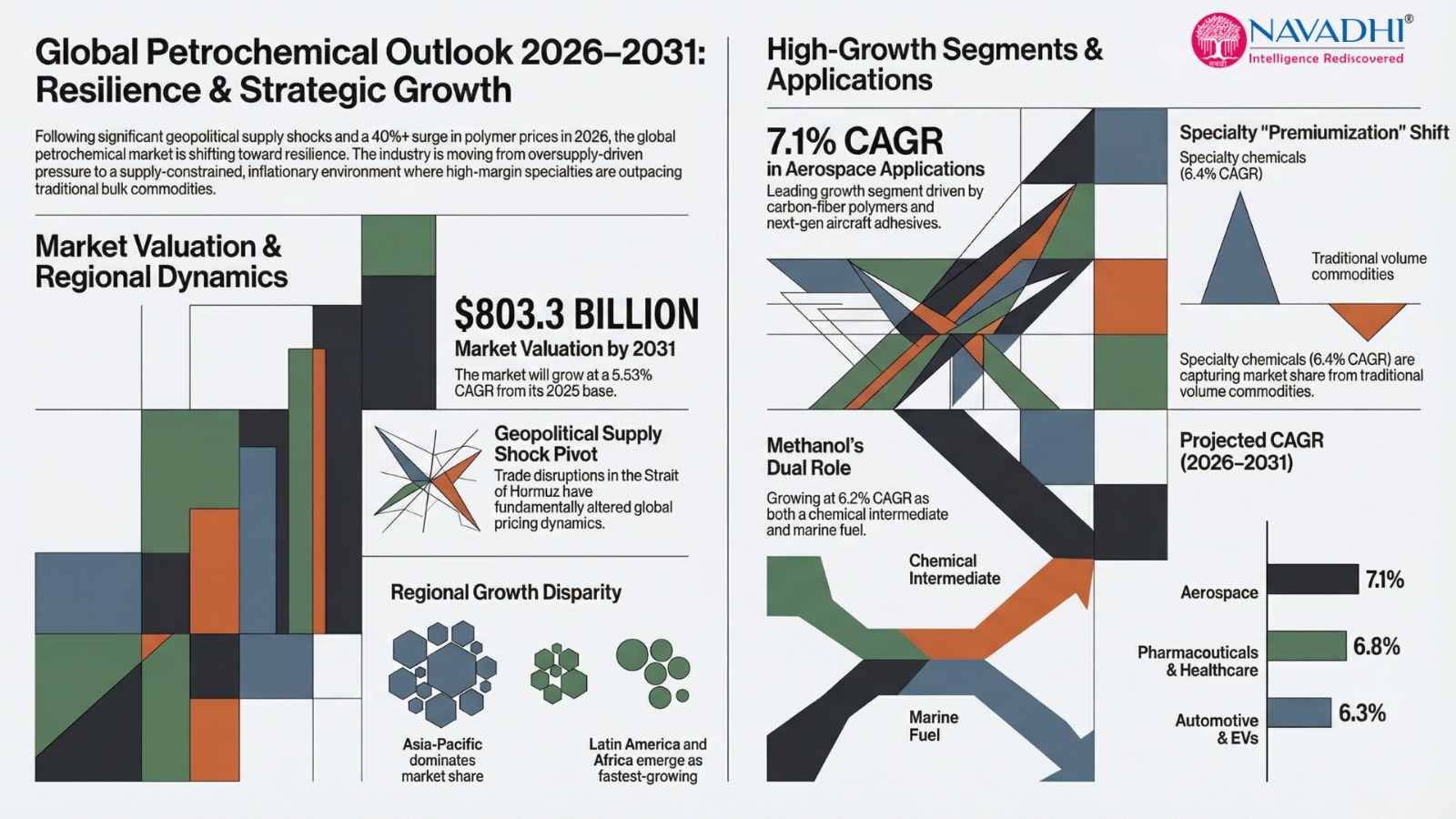
The Asia-Pacific region dominates the global petrochemical landscape and maintains its leadership through the forecast period. Latin America and the Middle East & Africa stand out as the fastest-growing regions, albeit from smaller bases. Europe faces structural headwinds from elevated energy costs, while North America retains a competitive gas-based feedstock advantage.
Ethylene and Propylene collectively account for nearly 46% of the global petrochemical market in 2025, cementing their position as the foundational olefins underpinning downstream plastics, resins, and chemical intermediates. Methanol is the fastest-growing named segment at 6.2% CAGR, reflecting rising demand for methanol-to-olefins (MTO) routes in China and methanol's emerging role as a marine fuel. The 'Others' category - encompassing specialty chemicals, acrylics, and downstream intermediates - grows at ~6.4% CAGR and increases its share from 18.6% to 19.5%, signalling a structural mix-shift toward higher-margin specialties.
Ethylene is the largest segment in global petrochemical market at 27.8% share and is expected to grow at a 5.5% CAGR during 2026-2031, anchored by polyethylene demand in packaging and consumer goods which is consistent with Dow's ethylene value chain representing around 60% of its USD 44.6 Bn sales base.
Propylene is expected to record a CAGR growth of 5.4% during the 2026-2031 period, which shows stable growth.
Benzene / BTX Aromatics segment is expected to grow at 4.8% and face competitive pressure from bio-based substitution in downstream PET and nylon markets, particularly in Europe post-2027.
Methanol is expected to show the highest CAGR growth at 6.2% CAGR during the forecast period, driven by methanol-to-olefins (MTO) capacity in Asia and its emerging dual role as a marine fuel and hydrogen carrier, supported by OCI N.V. and Methanex capacity guidance.
Xylene / Toluene segment is expected to grow at a CAGR of 5.1% during the forecast period.
Butadiene is expected to record slowest growth at 4.4% CAGR, reflecting structural moderation in synthetic rubber demand as EV penetration reduces need for traditional tyre formulations over the long term.
The 'Others' segment encompassing specialty chemicals, acrylics, and downstream intermediates like polyurethane intermediates, and electronic chemicals is expected to grow fastest at 6.4% CAGR and increase its share from 18.6% to 19.5%, adding around 48 billion over the period, signaling a structural mix-shift toward higher-margin specialties.
Packaging is the dominant segment by application at 35% of the total market in 2025, though its share moderates slightly to 34.4% by 2031 as high-growth specialty segments gain relative importance. The packaging petrochemical segment is expected to grow at a CAGR of 5.2% during 2026-2031.
Building & Construction petrochemical segment which has second largest market share in the global petrochemical market is expected to grow at 5.4% CAGR and retain its market share till 2031 mainly due to LyondellBasell's Advanced Polymer Solutions providing a commercial anchor and urbanisation trends in Asia and Middle East which will drive volume.
Automotive & EVs petrochemical segment is expected to register the growth of 6.3% CAGR till 2031 due to EV-driven demand for battery separators, thermal management polymers, and lightweighting composites providing a structural +1.5pp growth premium vs. the prior cycle.
Agriculture / Fertilizers petrochemical segment is expected to record slowest growth at 4.5% CAGR till 2031 reflecting tighter nitrogen fertilizer margins, some crop nutrient substitution trends, and policy-driven efficiency mandates in key agricultural markets.
Consumer & Industrial Goods petrochemical segment is expected to grow at a CAGR of 5% while textiles / synthetic fibers petrochemical segment will grow at 5.5% during 2026-2031.
Pharmaceuticals & healthcare petrochemical segment is expected to grow second fastest at 6.8% CAGR till 2031 due to benefits from expanding biopharma manufacturing globally, rising demand for high-purity chemical intermediates, and health infrastructure build-out in emerging markets.
Aerospace petrochemical segment is expected to record highest CAGR growth at 7.1% in the global petrochemical market, albeit from the smallest market share of 2% in 2025, driven by commercial aviation recovery and increased use of carbon-fibre reinforced polymers and specialty adhesives in next-generation aircraft.
This report identifies emerging market industrialisation & polymer demand, packaging industry expansion & e-commerce surge, automotive lightweighting & ev material transition, north American shale gas feedstock advantage, middle east crude-to-chemicals integration wave, specialty & high-performance polymer premiumisation, circular economy & chemical recycling scale-up, construction & infrastructure boom in South/South East Asia and government policy & sovereign industrial mandates as nine key growth drivers for the global petrochemical market during the forecast period of 2026-2031.
Structural overcapacity - china-driven supply glut, US-China tariff escalation & trade war impact, crude oil & feedstock price volatility, plastic regulation & single-use bans (EU, global), Europe deindustrialisation & energy cost crisis, bio-based & green chemistry substitution risk, EV adoption reducing downstream fuel-chemical co-production, permitting delays & environmental regulatory headwinds and weak consumer demand & global economic slowdown risk were identified as the nine key growth inhibitors / key pain areas affecting the global petrochemical market during the forecast period of 2026-2031.
Scope of Global Petrochemical Market Strategic Research Report 2026-2031
- This report provides forecast data till 2031 for the global petrochemical market, its segments by type (Ethylene, Propylene, Benzene / BTX Aromatics, Methanol, Xylene / Toluene, Butadiene, Others), application segments (Packaging, Building & Construction, Automotive & EVs, Agriculture / Fertilizers, Consumer & Industrial Goods, Textiles / Synthetic Fibers, Pharmaceuticals & Healthcare, Aerospace, Other) and regions (Asia-Pacific, North America, Europe, Middle East & Africa, Latin America) thus covering all aspects of the industry.
- This report identifies key growth drivers and inhibitors (pain points) affecting the global petrochemical market.
- This report provides SWOT (Strengths, Weaknesses, Opportunities and Threats) analysis and competitive landscape for 10 key companies (Sinopec (China Petroleum & Chemical Corporation), BASF SE, Dow Inc., LyondellBasell Industries N.V., SABIC (Saudi Basic Industries Corporation), ExxonMobil Chemical (ExxonMobil Corporation), Reliance Industries Limited, INEOS Group Holdings, TotalEnergies Petrochemicals (TotalEnergies SE) and LG Chem Ltd.) in the global petrochemical market.
- This report provides Porter’s Five Forces analysis for global petrochemical market.
- This report provides PESTLE (political, economic, social, technological, legal and environmental) analysis for global petrochemical market.
- This report provides SWOT (Strengths, Weaknesses, Opportunities and Threats) analysis for global petrochemical market.
- This report identifies key future trends in the global petrochemical market.
Segment by Region in Global Petrochemical Market
- Asia-Pacific
- North America
- Europe
- Middle East & Africa
- Latin America
Segment by Type in Global Petrochemical Market
- Ethylene
- Propylene
- Benzene / BTX Aromatics
- Methanol
- Xylene / Toluene
- Butadiene
- Others
Segment by Application in Global Petrochemical Market
- Packaging
- Building & Construction
- Automotive & EVs
- Agriculture / Fertilizers
- Consumer & Industrial Goods
- Textiles / Synthetic Fibers
- Pharmaceuticals & Healthcare
- Aerospace
- Other
Who can use the Global Petrochemical Market Research Report?
This research report is ideal for people who wish to gain a thorough understanding of the petrochemical market. Some of intended user for this report are:
- C-level executives
- Company Directors
- Industry consultants
- Marketing professionals
- Business development professionals
- Management consultants
- Investment managers
- Financial professionals
- Venture Capitalists
- Bank Managers
- M&A Managers
- Auditors
- Anyone operating in petrochemical industry value chain.
Market snapshot
Global Petrochemical Market Strategic Research Report snapshot, 2025–2031
 © MarketResearchReports.comDisclaimer: The actual data may vary in the final report which undergoes verification check post order confirmation.
Segments covered in this report
Table of contents
01Executive Summary
- Scope of Global Petrochemical Market Strategic Research Report 2026-2031
- Research Methodology
02Forecast for Global Petrochemical Market 2026-2031
- 2.1 Overall Global Petrochemical Market Forecast 2026-2031
- 2.2 Region-Wise Market Share in Global Petrochemical Market 2026
- 2.2.1 Asia-Pacific Petrochemical Market Forecast 2026-2031
- 2.2.2 North America Petrochemical Market Forecast 2026-2031
- 2.2.4 Europe Petrochemical Market Forecast 2026-2031
- 2.2.4 Middle East & Africa Petrochemical Market Forecast 2026-2031
- 2.2.5 Latin America Petrochemical Market Forecast 2026-2031
- 2.3 Segment by Type Market Share in Global Petrochemical Market 2026
- 2.3.1 Global Ethylene Market Forecast 2026-2031
- 2.3.2 Global Propylene Market Forecast 2026-2031
- 2.3.3 Global Benzene / BTX Aromatics Market Forecast 2026-2031
- 2.3.4 Global Methanol Market Forecast 2026-2031
- 2.3.5 Global Xylene / Toluene Market Forecast 2026-2031
- 2.3.6 Global Butadiene Market Forecast 2026-2031
- 2.3.7 Global Other Petrochemical by Type Market Forecast 2026-2031
- 2.4 Segment by Application Market Share in Global Petrochemical Market 2026
- 2.4.1 Global Packaging Petrochemical Market Forecast 2026-2031
- 2.4.2 Global Building & Construction Petrochemical Market Forecast 2026-2031
- 2.4.3 Global Automotive & EVs Petrochemical Market Forecast 2026-2031
- 2.4.4 Global Agriculture / Fertilizers Petrochemical Market Forecast 2026-2031
- 2.4.5 Global Consumer & Industrial Goods Petrochemical Market Forecast 2026-2031
- 2.4.6 Global Textiles / Synthetic Fibers Petrochemical Market Forecast 2026-2031
- 2.4.7 Global Pharmaceuticals & Healthcare Petrochemical Market Forecast 2026-2031
- 2.4.8 Global Aerospace Petrochemical Market Forecast 2026-2031
- 2.4.9 Global Other Petrochemical by Application Market Forecast 2026-2031
03Key Growth Drivers for Global Petrochemical Market
- 3.1 Emerging Market Industrialisation & Polymer Demand
- 3.3 Automotive Lightweighting & EV Material Transition
- 3.4 North American Shale Gas Feedstock Advantage
- 3.5 Middle East Crude-to-Chemicals Integration Wave
- 3.6 Specialty & High-Performance Polymer Premiumisation
- 3.7 Circular Economy & Chemical Recycling Scale-up
- 3.8 Construction & Infrastructure Boom in South/Southeast Asia
- 3.9 Government Policy & Sovereign Industrial Mandates
04Key Pain Areas / Growth Inhibitors for Global Petrochemical Market
- 4.1 Structural Overcapacity - China-Driven Supply Glut
- 4.2 US-China Tariff Escalation & Trade War Impact
- 4.3 Crude Oil & Feedstock Price Volatility
- 4.4 Plastic Regulation & Single-Use Bans (EU & Global)
- 4.5 Europe Deindustrialisation & Energy Cost Crisis
- 4.6 Bio-based & Green Chemistry Substitution Risk
- 4.7 EV Adoption Reducing Downstream Fuel-Chemical Co-production
- 4.8 Permitting Delays & Environmental Regulatory Headwinds
- 4.9 Weak Consumer Demand & Global Economic Slowdown Risk
05Porter’s Five Forces Analysis of Global Petrochemical Market
- 5.1 Bargaining Power of Suppliers: High (Geopolitically Tiered)
- 5.2 Bargaining Power of Buyers: Medium–High (Segment Dependent)
- 5.3 Threat of New Entrants: Low
- 5.4 Threat of Substitution: Low–Medium (Segment Dependent)
- 5.5 Intensity of Competitive Rivalry: Very High
06Key Players in Global Fertilizers Market – Competitive Landscape and SWOT Analysis
- 6.1 Sinopec (China Petroleum & Chemical Corporation)
- 6.1.1 SWOT Analysis of Sinopec
- 6.2 BASF SE
- 6.2.1 SWOT Analysis of BASF SE
- 6.3 Dow Inc.
- 6.3.1 SWOT Analysis of Dow Inc.
- 6.4 LyondellBasell Industries N.V.
- 6.4.1 SWOT Analysis of LyondellBasell Industries N.V.
- 6.5 SABIC (Saudi Basic Industries Corporation)
- 6.5.1 SWOT Analysis of SABIC (Saudi Basic Industries Corporation)
- 6.6 ExxonMobil Chemical (ExxonMobil Corporation)
- 6.6.1 SWOT Analysis of ExxonMobil Chemical (ExxonMobil Corporation)
- 6.7 Reliance Industries Limited
- 6.7.1 SWOT Analysis of Reliance Industries Limited
- 6.8 INEOS Group Holdings
- 6.8.1 SWOT Analysis of INEOS Group Holdings
- 6.9 TotalEnergies Petrochemicals (TotalEnergies SE)
- 6.9.1 SWOT Analysis of TotalEnergies Petrochemicals (TotalEnergies SE)
- 6.10 LG Chem Ltd.
- 6.10.1 SWOT Analysis of LG Chem Ltd.
- 6.11 Competitive Landscape of Key Players in the Global Petrochemical Market
07PESTLE Analysis of Global Petrochemical Market
- 7.1 Political (P)
- 7.2 Economic (E)
- 7.3 Social (S)
- 7.4 Technological (T)
- 7.5 Legal (L)
- 7.6 Environmental (E)
08SWOT Analysis of Global Petrochemical Market
- 8.1 Strengths
- 8.2 Weaknesses
- 8.3 Opportunities
- 8.4 Threats
09Future Trends in Global Petrochemical Market
- 9.1 Geopolitical Bifurcation & Supply Chain Fracture
- 9.2 Industry Consolidation Wave - Commodity Rationalisation
- 9.3 Chemical Recycling & Circular Feedstock Scale-up
- 9.4 Green & Low-Carbon Chemistry Premium Market
- 9.5 EV & Clean Energy Materials - A New Specialty Demand Wave
- 9.6 South & Southeast Asia - The New Demand Growth Engine
- 9.7 AI, Digitalisation & Smart Manufacturing Revolution
- 9.8 Crude-to-Chemicals Integration - NOC Industrial Strategy
- 9.9 Specialty Polymer Crossing Commodity Olefins - The Bifurcation Milestone
- 9.10 Bio-based & Alternative Feedstock Transition
- List of Exhibits
- Notes
- Company Information
Tables and figures
List of Exhibits
- Exhibit 1.1 Global Petrochemical Market 2026-2031 Infographic
- Exhibit 2.1 Forecast of Global Petrochemical Market 2026-2031 (in USD billion)
- Exhibit 2.2 Region-Wise Market Share in Global Petrochemical Market 2026 (in % and USD billion)
- Exhibit 2.3 Region-Wise CAGR Growth Rate in Global Petrochemical Market 2026-2031 (in %)
- Exhibit 2.4 Forecast of Asia-Pacific Petrochemical Market 2026-2031 (in USD billion)
- Exhibit 2.5 Forecast of North America Petrochemical Market 2026-2031 (in USD billion)
- Exhibit 2.6 Forecast of Europe Petrochemical Market 2026-2031 (in USD billion)
- Exhibit 2.7 Forecast of Middle East & Africa Petrochemical Market 2026-2031 (in USD billion)
- Exhibit 2.8 Forecast of Latin America Petrochemical Market 2026-2031 (in USD billion)
- Exhibit 2.9 Segment by Type Market Share in Global Petrochemical Market 2026 (in % and USD billion)
- Exhibit 2.10 Segment by Type CAGR Growth Rate in Global Petrochemical Market 2026-2031 (in %)
- Exhibit 2.11 Forecast of Global Ethylene Market 2026-2031 (in USD billion)
- Exhibit 2.12 Forecast of Global Propylene Market 2026-2031 (in USD billion)
- Exhibit 2.13 Forecast of Global Benzene / BTX Aromatics Market 2026-2031 (in USD billion)
- Exhibit 2.14 Forecast of Global Methanol Market 2026-2031 (in USD billion)
- Exhibit 2.15 Forecast of Global Xylene / Toluene Market 2026-2031 (in USD billion)
- Exhibit 2.16 Forecast of Global Butadiene Market 2026-2031 (in USD billion)
- Exhibit 2.17 Forecast of Global Other Petrochemical by Type Market 2026-2031 (in USD billion)
- Exhibit 2.18 Segment by Application Market Share in Global Petrochemical Market 2026 (in % and USD billion)
- Exhibit 2.19 Segment by Application CAGR Growth Rate in Global Petrochemical Market 2026-2031 (in %)
- Exhibit 2.20 Forecast of Global Packaging Petrochemical Market 2026-2031 (in USD billion)
- Exhibit 2.21 Forecast of Global Building & Construction Petrochemical Market 2026-2031 (in USD billion)
- Exhibit 2.22 Forecast of Global Automotive & EVs Petrochemical Market 2026-2031 (in USD billion)
- Exhibit 2.23 Forecast of Global Agriculture / Fertilizers Petrochemical Market 2026-2031 (in USD billion)
- Exhibit 2.24 Forecast of Global Consumer & Industrial Goods Petrochemical Market 2026-2031 (in USD billion)
- Exhibit 2.25 Forecast of Global Textiles / Synthetic Fibers Petrochemical Market 2026-2031 (in USD billion)
- Exhibit 2.26 Forecast of Global Pharmaceuticals & Healthcare Petrochemical Market 2026-2031 (in USD billion)
- Exhibit 2.27 Forecast of Global Aerospace Petrochemical Market 2026-2031 (in USD billion)
- Exhibit 2.28 Forecast of Global Other Petrochemical by Application Petrochemical Market 2026-2031 (in USD billion)
- Exhibit 3.1 Key Growth Drivers for Global Petrochemical Market
- Exhibit 4.1 Key Pain Areas / Growth Inhibitors for Global Petrochemical Market
- Exhibit 5.1 Porter’s Five Forces Analysis for Global Petrochemical Market
- Exhibit 6.1 SWOT Analysis of Sinopec
- Exhibit 6.2 SWOT Analysis of BASF SE
- Exhibit 6.3 SWOT Analysis of Dow Inc.
- Exhibit 6.4 SWOT Analysis of LyondellBasell Industries N.V.
- Exhibit 6.5 SWOT Analysis of SABIC (Saudi Basic Industries Corporation)
- Exhibit 6.6 SWOT Analysis of ExxonMobil Chemical (ExxonMobil Corporation)
- Exhibit 6.7 SWOT Analysis of Reliance Industries Limited
- Exhibit 6.8 SWOT Analysis of INEOS Group Holdings
- Exhibit 6.9 SWOT Analysis of TotalEnergies Petrochemicals (TotalEnergies SE)
- Exhibit 6.10 SWOT Analysis of LG Chem Ltd.
- Exhibit 6.11 Competitive Landscape of Key Players in the Global Petrochemical Market
- Exhibit 7.1 PESTLE Analysis for Global Petrochemical Market
- Exhibit 8.1 SWOT Analysis of Global Petrochemical Market
- Exhibit 9.1 Key Future Trends of Global Petrochemical Market
Research Methodology
All MarketResearchReports.com strategic research reports follow a rigorous, multi-stage methodology combining AI-assisted data synthesis with expert analyst validation.
Systematic collection from 500+ verified sources including SEC filings, industry databases (Bloomberg, Statista, OECD), regulatory filings, trade publications, patent databases, and company annual reports. AI-assisted extraction identifies relevant data points across 10,000+ documents per report.
Dual-validation approach: bottom-up sizing aggregates segment-level production, consumption, and trade data; top-down sizing cross-validates against macroeconomic indicators and total addressable market estimates. Discrepancies >5% trigger analyst review.
Company profiles built from public financial disclosures, product launches, M&A activity, job postings (as capability proxies), and supply chain mapping. Market share estimates triangulated across revenue, capacity, and shipment data.
CAGR projections use time-series regression on 5-10 years of historical data, adjusted for identified demand drivers (technology adoption curves, regulatory catalysts, demographic shifts) and demand inhibitors (cost barriers, substitution risk). Scenario modeling covers base, optimistic, and conservative cases.
All quantitative outputs reviewed by a domain-specialist analyst before publication. Data triangulation requires minimum 3 independent sources for every key figure. Reports undergo a structured peer review against our 47-point quality checklist covering methodology, data citations, logical consistency, and formatting standards.
On-demand reports are generated at time of purchase, incorporating the most recent available data. Static reports are republished when underlying market conditions shift by >10% from baseline assumptions. Purchasers receive update notifications for 12 months.
Related reports
 Navadhi Market Research · Chemicals & Advanced Materials
Global Paints & Coatings Market Strategic Research Report
The global paints and coatings industry stands as one of the most broadly deployed material sectors in the world economy, functioning as an indispensable enabler acr…
Navadhi Market Research · Chemicals & Advanced MaterialsGlobal Nano-Cellulose Sustainable Packaging Market Strategic Research Report
The global nano-cellulose sustainable packaging market occupies a pivotal position at the intersection of advanced materials science and the accelerating corporate c…
Navadhi Market Research · Chemicals & Advanced MaterialsGlobal Recycled Carbon Fiber Composites Market Strategic Research Report
The global recycled carbon fiber Market Strategic Research Report">carbon fiber (rCF) composites market occupies an increasingly strategic position within the bro…
Need a customized version?
Get country-, segment- or company-specific intelligence tailored to your exact requirements.
Request custom research →Request a free sample
Receive a sample of Global Petrochemical Market Strategic Research Report before you buy.
Customize This Report
Describe your specific requirements and our analysts will scope and deliver a tailored version.
Request Invoice
We will email a proforma invoice within 24 hours. Report access is granted upon payment confirmation.
Leading Brands in This Industry




