Global Glutathione Market Strategic Research Report
By Type: Reduced Glutathione (GSH), Oxidized Glutathione (GSSG)
By Application: Pharmaceuticals & API, Nutraceuticals / Health Products, Cosmetics & Personal Care, Food & Beverage, Other (Reagent, Diagnostic)
Regional Forecast: Asia Pacific, Latin America, MEA, Europe, North America
Key Players: Kyowa Hakko Bio Co. Ltd., KOHJIN Life Sciences Co. Ltd., Shandong Jincheng Pharmaceutical Group, Merck KGaA, Kaneka Corporation, Gnosis by Lesaffre
개요
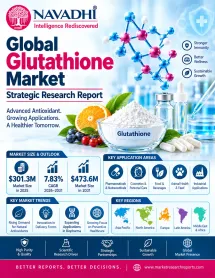
The global glutathione market is estimated at approximately USD 301.3 million in 2025, growing at a 7.83% CAGR to approximately USD 473.6 million by 2031. This figure reflects a rigorous triangulation methodology: independently published market research estimates were screened for scope consistency and cross-validated for convergence, since different publishers define this market differently -- our base-year anchor is our own synthesis of the estimates found to share a consistent, comparable scope, not a figure adopted directly from any single source.
Real, Current Competitive Intelligence
Kyowa Hakko Bio's amino acid and HMO business -- which historically included bulk glutathione-adjacent fermentation manufacturing -- was divested to a Chinese fermentation-technology acquirer for approximately JPY 10.5 billion (~$68 million), completed July 1, 2025. Setria® Glutathione itself was retained by Kyowa Hakko Bio as a branded specialty product, reflecting a deliberate strategic refocus toward higher-margin specialty ingredients. Separately, KOHJIN Life Sciences' current parent company is confirmed across multiple independent, current sources, ensuring this report reflects today's verified corporate structure.
Scope of the Global Glutathione Market Strategic Research Report
This report provides market sizing (value and volume) across type and application segments, and regional/country splits, through 2031, grounded in real, current competitive intelligence.
Segment by Type
- Reduced Glutathione (GSH)
- Oxidized Glutathione (GSSG)
Segment by Application
- Pharmaceuticals & API
- Nutraceuticals / Health Products
- Cosmetics & Personal Care
- Food & Beverage
- Other (Reagent, Diagnostic)
Who Can Use This Report?
This research report is ideal for people who need a granular, evidence-based view of the global glutathione market grounded in real, current competitive developments. Some of the intended users are:
- Procurement and sourcing teams evaluating supplier stability following recent ownership and portfolio changes among key manufacturers
- Corporate strategy and M&A teams assessing competitive positioning in specialty fermentation ingredients
- Nutraceutical and cosmetic formulators tracking branded-ingredient supply relationships
- Investment analysts requiring current, verified competitive-landscape detail
Market snapshot
Global Glutathione Market Strategic Research Report snapshot, 2026–2031
 © MarketResearchReports.comDisclaimer: The actual data may vary in the final report which undergoes verification check post order confirmation.
Segments covered in this report
Table of contents
01Executive Summary
- 1.1 Market Synopsis
- 1.2 Structural Market Context
- 1.3 Key Findings
- 1.4 Methodology Transparency and Competitive-Intelligence Differen…
- 1.5 Forecast Summary and Investment Relevance
02Industry Overview & Forecast
- 2.1 Market Definition & Scope
- 2.2 Market Value & Volume Forecast, 2026–2031
- 2.2.1 Headline Market Sizing
- 2.2.2 Value Forecast Summary Table
- 2.3 Volume Analysis
- 2.3.1 Year-by-Year Volume Progression
- 2.3.2 Volume Trend and Demand Drivers
- 2.4 Third-Party Estimate Reconciliation
- 2.5 Historical Market Review, 2022–2025
- 2.6 Scenario Analysis: Base, Bull, and Bear Cases
- 2.6.1 Base Case
- 2.6.2 Bull Case
- 2.6.3 Bear Case
03Market Segmentation by Type
- 3.1 Market by Type Overview
- 3.2 Reduced Glutathione (GSH)
- 3.2.1 Value Analysis
- 3.2.2 Volume Analysis
- 3.3 Oxidized Glutathione (GSSG)
- 3.3.1 Value Analysis
- 3.3.2 Volume Analysis
- 3.4 Comparative Type Analysis
04Market Segmentation by Application
- 4.1 Market by Application Overview
- 4.2 Pharmaceuticals & API
- 4.2.1 Segment Scale and Forecast Trajectory
- 4.2.2 Demand Drivers and Therapeutic Applications
- 4.2.3 Grade Requirements and Supplier Implications
- 4.2.4 Volumetric Outlook
- 4.3 Nutraceuticals / Health Products
- 4.3.1 Segment Scale and Forecast Trajectory
- 4.3.2 Demand Drivers
- 4.3.3 Branded Specialty Dynamics: The Setria® and OPITAC™ Context
- 4.3.4 Volume and Pricing Dynamics
- 4.4 Cosmetics & Personal Care
- 4.4.1 Segment Scale and Forecast Trajectory
- 4.4.2 Demand Drivers and Application Context
- 4.4.3 Regulatory Risk and Restraints
- 4.4.4 Competitive and Sourcing Implications
- 4.5 Food & Beverage
- 4.5.1 Segment Scale and Forecast Trajectory
- 4.5.2 Application Detail
- 4.5.3 Growth Constraints
- 4.6 Other: Reagent and Diagnostic
- 4.6.1 Segment Scale and Forecast Trajectory
- 4.6.2 Reagent and Research-Grade Demand
- 4.6.3 Diagnostic and Bioprocessing Growth Drivers
- 4.6.4 Strategic Note on Segment Sizing
- 4.7 Cross-Segment Synthesis and Strategic Implications
05Regional Market Forecast
- 5.1 Asia Pacific
- 5.1.1 Regional Overview
- 5.1.2 Key Growth Drivers
- 5.1.3 Regulatory & Infrastructure Landscape
- 5.1.4 Country-Level Analysis
- 5.1.4.1 China
- 5.1.4.2 Japan
- 5.1.4.3 India
- 5.1.4.4 South Korea
- 5.1.4.5 Rest of Asia Pacific
- 5.1.5 Market Forecast 2025–2031
- 5.2 Europe
- 5.2.1 Regional Overview
- 5.2.2 Key Growth Drivers
- 5.2.3 Regulatory & Infrastructure Landscape
- 5.2.4 Country-Level Analysis
- 5.2.5 Market Forecast 2025–2031
- 5.3 North America
- 5.3.1 Regional Overview
- 5.3.2 Key Growth Drivers
- 5.3.3 Regulatory & Infrastructure Landscape
- 5.3.4 Country-Level Analysis
- 5.3.5 Market Forecast 2025–2031
- 5.4 Latin America
- 5.4.1 Regional Overview
- 5.4.2 Key Growth Drivers
- 5.4.3 Regulatory & Infrastructure Landscape
- 5.4.4 Country-Level Analysis
- 5.4.5 Market Forecast 2025–2031
- 5.5 Middle East & Africa
- 5.5.1 Regional Overview
- 5.5.2 Key Growth Drivers
- 5.5.3 Regulatory & Infrastructure Landscape
- 5.5.4 Country-Level Analysis
- 5.5.5 Market Forecast 2025–2031
06Country-Level Market Forecast
- 6.1 Asia Pacific
- 6.1.1 China
- 6.1.2 Japan
- 6.1.3 India
- 6.1.4 South Korea
- 6.1.5 Rest of Asia-Pacific
- 6.2 Europe
- 6.2.1 Germany
- 6.2.2 United Kingdom
- 6.2.3 France
- 6.2.4 Rest of Europe
- 6.3 North America
- 6.3.1 USA
- 6.3.2 Rest of North America
- 6.4 Latin America
- 6.4.1 Brazil
- 6.4.2 Rest of Latin America
- 6.5 Middle East & Africa
- 6.5.1 Saudi Arabia
- 6.5.2 Rest of Middle East & Africa
07Growth Drivers & Inhibitors
- 7.1 Market Dynamics Framework
- 7.2 Nutraceutical and Healthy-Aging Demand Growth
- 7.2.1 Structural Demand Trajectory
- 7.2.2 Immune Health Positioning as a Demand Accelerant
- 7.2.3 Branded Ingredient Infrastructure as a Demand Enabler
- 7.3 Cosmetic and Skin-Brightening Demand
- 7.3.1 Regional Concentration and Market Significance
- 7.3.2 Regulatory Environment as a Dual-Edged Factor
- 7.4 Branded Specialty Positioning Following Real 2025 Portfolio Re…
- 7.4.1 The Strategic Significance of Kyowa Hakko Bio's 2025 Divestiture
- 7.4.2 Implications for Competitive Positioning
- 7.4.3 KOHJIN Life Sciences and the Role of Corporate Ownership Struc…
- 7.5 Pharmaceutical Demand Foundations
- 7.5.1 Established and Durable API Demand
- 7.5.2 Emerging Biopharma and Diagnostic Demand
- 7.6 Market Restraints: Data Opacity and Competitive Instability
- 7.6.1 Structural Data Opacity as a Genuine Market Friction
- 7.6.2 Competitive Instability Risk Following Real Ownership Changes
- 7.6.3 Fragmented Chinese Competitive Base and Price Discovery Challe…
- 7.7 Opportunities and White-Space Analysis
- 7.7.1 Premiumization as the Primary Value-Creation Vector
- 7.7.2 Competitive Consolidation as a Structural Opportunity
- 7.7.3 Diagnostic and High-Purity Reagent Market Development
- 7.8 Summary Assessment of Dynamic Balance
08Key Company Profiles
- 8.1 Kyowa Hakko Bio Co., Ltd.
- 8.1.1 Company Overview
- 8.1.2 Key Products & Segments
- 8.1.3 Financial Performance (2023–2025)
- 8.1.4 Business Strategy
- 8.1.5 SWOT Analysis
- 8.1.6 Strategic Implications (2025–2031)
- 8.2 KOHJIN Life Sciences Co., Ltd.
- 8.2.1 Company Overview
- 8.2.2 Key Products & Segments
- 8.2.3 Financial Performance (2023–2025)
- 8.2.4 Business Strategy
- 8.2.5 SWOT Analysis
- 8.2.6 Strategic Implications (2025–2031)
- 8.3 Shandong Jincheng Pharmaceutical Group
- 8.3.1 Company Overview
- 8.3.2 Key Products & Segments
- 8.3.3 Financial Performance (2023–2025)
- 8.3.4 Business Strategy
- 8.3.5 SWOT Analysis
- 8.3.6 Strategic Implications (2025–2031)
- 8.4 Merck KGaA
- 8.4.1 Company Overview
- 8.4.2 Key Products & Segments
- 8.4.3 Financial Performance (2023–2025)
- 8.4.4 Business Strategy
- 8.4.5 SWOT Analysis
- 8.4.6 Strategic Implications (2025–2031)
- 8.5 Kaneka Corporation
- 8.5.1 Company Overview
- 8.5.2 Key Products & Segments
- 8.5.3 Financial Performance (2023–2025)
- 8.5.4 Business Strategy
- 8.5.5 SWOT Analysis
- 8.5.6 Strategic Implications (2025–2031)
- 8.6 Gnosis by Lesaffre
- 8.6.1 Company Overview
- 8.6.2 Key Products & Segments
- 8.6.3 Financial Performance (2023–2025)
- 8.6.4 Business Strategy
- 8.6.5 SWOT Analysis
- 8.6.6 Strategic Implications (2025–2031)
09Competitive Landscape
- 9.1 Competitive Landscape Overview
- 9.1.1 Estimated Market Share: Top 5 Players, 2025
- 9.1.2 Competitive Intensity: Moderate-to-High
- 9.2 Competitive Intensity Assessment
- 9.2.1 Tier Classification and Revenue Context
- 9.2.2 Capacity vs. Demand Dynamics
- 9.2.3 Pricing Environment
- 9.2.4 Barriers to Entry and Exit
- 9.3 Key Player Strategies & Positioning
- 9.4 Competitive Dynamics & Strategic Outlook
- 9.4.1 Emerging Competitive Threats
- 9.4.2 Consolidation vs. Fragmentation Outlook
- 9.4.3 Competitive Response Matrix
- 9.4.4 Strategic Recommendations for 2025–2031
10Porter's Five Forces Analysis
- 10.1 Threat of New Entrants
- 10.2 Bargaining Power of Buyers
- 10.3 Bargaining Power of Suppliers
- 10.4 Threat of Substitutes
- 10.5 Competitive Rivalry
11PESTLE Analysis
- 11.1 Political Factors
- 11.1.1 Regulatory Posture Toward Nutraceutical and Cosmetic Active In…
- 11.1.2 Geopolitical Dynamics and Supply Chain Politics
- 11.1.3 Trade Policy and Tariff Exposure
- 11.2 Economic Factors
- 11.2.1 Global Market Size and Growth Trajectory
- 11.2.2 Consumer Spending Patterns and Premiumisation
- 11.2.3 Raw Material and Energy Cost Dynamics
- 11.2.4 Currency Dynamics and Export Economics
- 11.2.5 Healthcare Expenditure and Pharmaceutical Demand
- 11.3 Social and Demographic Factors
- 11.3.1 Ageing Demographics and Antioxidant Demand
- 11.3.2 The Wellness Economy and Self-Directed Health Management
- 11.3.3 Beauty Standards and Skin-Brightening Cultural Dynamics
- 11.3.4 Dietary and Lifestyle Influences
- 11.4 Technological Factors
- 11.4.1 Fermentation Technology and Production Efficiency
- 11.4.2 Bioavailability Innovation and Delivery Technology
- 11.4.3 Analytical and Quality Assurance Technology
- 11.4.4 Digital Health and Personalised Nutrition Technology
- 11.5 Legal and Regulatory Factors
- 11.5.1 Ingredient Classification and Permissibility
- 11.5.2 Pharmaceutical Good Manufacturing Practice Compliance
- 11.5.3 Cosmetic Regulatory Frameworks
- 11.5.4 Intellectual Property and Brand Protection
- 11.6 Environmental Factors
- 11.6.1 Fermentation Sustainability and Resource Intensity
- 11.6.2 Carbon Footprint and Climate Risk
- 11.6.3 Packaging and Circular Economy Pressures
- 11.6.4 Biodiversity and Biosafety of Fermentation Organisms
12SWOT Analysis
- 12.1 Introduction
- 12.2 Market-Level Strengths
- 12.2.1 Scientifically Validated Biological Relevance
- 12.2.2 Diversified Multi-Sector Application Base
- 12.2.3 Established, High-Barrier Fermentation Production Technology
- 12.2.4 Branded Ingredient Infrastructure and Traceability Premium
- 12.2.5 Favorable Demographic and Epidemiological Tailwinds
- 12.3 Market-Level Weaknesses
- 12.3.1 Bioavailability Controversy and Oral Delivery Limitations
- 12.3.2 Absence of Segment-Level Financial Transparency
- 12.3.3 Supply Chain Geographic Concentration Risk
- 12.3.4 Premium Pricing Vulnerability in Commodity-Grade Segments
- 12.4 Strategic Opportunities
- 12.4.1 Liposomal and Next-Generation Delivery Technology Adoption
- 12.4.2 Asian Skin-Brightening and Cosmeceutical Market Expansion
- 12.4.3 Functional Food and Beverage Channel Development
- 12.4.4 Strategic M&A and Industry Consolidation
- 12.4.5 Pharmaceutical Pipeline Expansion and Clinical Indication Deve…
- 12.5 External Threats
- 12.5.1 Regulatory Tightening on Health Claims and Cosmeceutical Labeling
- 12.5.2 Ingredient Competition from Substitute Antioxidants and Precur…
- 12.5.3 Geopolitical and Trade Friction Risk
- 12.5.4 Consumer Credibility Risk from Market Adulteration and Label F…
- 12.5.5 Macroeconomic Sensitivity in Discretionary Supplement Channels
- 12.6 Integrated SWOT Assessment
13Future Trends & Outlook
- 13.1 Continued Premiumization and Branded Specialty Positioning
- 13.2 Competitive Consolidation Following Real 2025 Ownership Changes
- 13.3 Long-Term Market Outlook (2032–2035)
- 13.4 Investment & M&A Activity Outlook
Tables and figures
- 2.1 Exhibit 2.1: Forecast of Global Market YoY Growth Rate & CAGR Summary (in %)
- 2.2 Exhibit 2.2: Forecast of Global Market YoY Growth Rate & CAGR Summary (in %)
- 2.3 Exhibit 2.3: Forecast of Global (in USD Mn)
- 2.4 Exhibit 2.4: Forecast of Asia Pacific (in USD Mn)
- 2.5 Exhibit 2.5: Forecast of Europe (in USD Mn)
- 2.6 Exhibit 2.6: Forecast of North America (in USD Mn)
- 2.7 Exhibit 2.7: Forecast of Latin America (in USD Mn)
- 2.8 Exhibit 2.8: Forecast of Middle East & Africa (in USD Mn)
- 2.9 Exhibit 2.9: Forecast of Global (in mt)
- 2.10 Exhibit 2.10: Forecast of Asia Pacific (in mt)
- 2.11 Exhibit 2.11: Forecast of Europe (in mt)
- 2.12 Exhibit 2.12: Forecast of North America (in mt)
- 2.13 Exhibit 2.13: Forecast of Latin America (in mt)
- 2.14 Exhibit 2.14: Forecast of Middle East & Africa (in mt) 2.14
- 3.15 Exhibit 3.15: Forecast of Reduced Glutathione (GSH) (in USD Mn)
- 3.16 Exhibit 3.16: Forecast of Reduced Glutathione (GSH) (in mt)
- 3.17 Exhibit 3.17: Forecast of Oxidized Glutathione (GSSG) (in USD Mn)
- 3.18 Exhibit 3.18: Forecast of Oxidized Glutathione (GSSG) (in mt)
- 4.19 Exhibit 4.19: Forecast of Pharmaceuticals & API (in USD Mn)
- 4.20 Exhibit 4.20: Forecast of Pharmaceuticals & API (in mt)
- 4.21 Exhibit 4.21: Forecast of Nutraceuticals / Health Products (in USD Mn)
- 4.22 Exhibit 4.22: Forecast of Nutraceuticals / Health Products (in mt)
- 4.23 Exhibit 4.23: Forecast of Cosmetics & Personal Care (in USD Mn)
- 4.24 Exhibit 4.24: Forecast of Cosmetics & Personal Care (in mt)
- 4.25 Exhibit 4.25: Forecast of Food & Beverage (in USD Mn)
- 4.26 Exhibit 4.26: Forecast of Food & Beverage (in mt)
- 4.27 Exhibit 4.27: Forecast of Other (Reagent, Diagnostic) (in USD Mn)
- 4.28 Exhibit 4.28: Forecast of Other (Reagent, Diagnostic) (in mt)
- 6.29 Exhibit 6.29: Forecast of Asia Pacific (in USD Mn)
- 6.30 Exhibit 6.30: Forecast of China (in USD Mn)
- 6.31 Exhibit 6.31: Forecast of Japan (in USD Mn)
- 6.32 Exhibit 6.32: Forecast of India (in USD Mn)
- 6.33 Exhibit 6.33: Forecast of South Korea (in USD Mn)
- 6.34 Exhibit 6.34: Forecast of Rest of Asia-Pacific (in USD Mn)
- 6.35 Exhibit 6.35: Forecast of Asia Pacific (in mt)
- 6.36 Exhibit 6.36: Forecast of China (in mt)
- 6.37 Exhibit 6.37: Forecast of Japan (in mt)
- 6.38 Exhibit 6.38: Forecast of India (in mt)
- 6.39 Exhibit 6.39: Forecast of South Korea (in mt)
- 6.40 Exhibit 6.40: Forecast of Rest of Asia-Pacific (in mt)
- 6.41 Exhibit 6.41: Forecast of Europe (in USD Mn)
- 6.42 Exhibit 6.42: Forecast of Germany (in USD Mn)
- 6.43 Exhibit 6.43: Forecast of United Kingdom (in USD Mn)
- 6.44 Exhibit 6.44: Forecast of France (in USD Mn)
- 6.45 Exhibit 6.45: Forecast of Rest of Europe (in USD Mn)
- 6.46 Exhibit 6.46: Forecast of Europe (in mt)
- 6.47 Exhibit 6.47: Forecast of Germany (in mt)
- 6.48 Exhibit 6.48: Forecast of United Kingdom (in mt)
- 6.49 Exhibit 6.49: Forecast of France (in mt)
- 6.50 Exhibit 6.50: Forecast of Rest of Europe (in mt)
- 6.51 Exhibit 6.51: Forecast of North America (in USD Mn)
- 6.52 Exhibit 6.52: Forecast of USA (in USD Mn)
- 6.53 Exhibit 6.53: Forecast of Rest of North America (in USD Mn)
- 6.54 Exhibit 6.54: Forecast of North America (in mt)
- 6.55 Exhibit 6.55: Forecast of USA (in mt)
- 6.56 Exhibit 6.56: Forecast of Rest of North America (in mt)
- 6.57 Exhibit 6.57: Forecast of Latin America (in USD Mn)
- 6.58 Exhibit 6.58: Forecast of Rest of Latin America (in USD Mn)
- 6.59 Exhibit 6.59: Forecast of Latin America (in mt)
- 6.60 Exhibit 6.60: Forecast of Rest of Latin America (in mt)
- 6.61 Exhibit 6.61: Forecast of Middle East & Africa (in USD Mn)
- 6.62 Exhibit 6.62: Forecast of Middle East & Africa (in USD Mn)
- 6.63 Exhibit 6.63: Forecast of Middle East & Africa (in mt)
- 6.64 Exhibit 6.64: Forecast of Middle East & Africa (in mt)
Frequently asked questions
What is the size of the global glutathione market?
Has the competitive landscape changed recently?
What is glutathione used for?
Does this report cover Latin America and Middle East & Africa at the country level?
Who are the key manufacturers?
Research Methodology
All MarketResearchReports.com strategic research reports follow a rigorous, multi-stage methodology combining AI-assisted data synthesis with expert analyst validation.
Systematic collection from 500+ verified sources including SEC filings, industry databases (Bloomberg, Statista, OECD), regulatory filings, trade publications, patent databases, and company annual reports. AI-assisted extraction identifies relevant data points across 10,000+ documents per report.
Dual-validation approach: bottom-up sizing aggregates segment-level production, consumption, and trade data; top-down sizing cross-validates against macroeconomic indicators and total addressable market estimates. Discrepancies >5% trigger analyst review.
Company profiles built from public financial disclosures, product launches, M&A activity, job postings (as capability proxies), and supply chain mapping. Market share estimates triangulated across revenue, capacity, and shipment data.
CAGR projections use time-series regression on 5-10 years of historical data, adjusted for identified demand drivers (technology adoption curves, regulatory catalysts, demographic shifts) and demand inhibitors (cost barriers, substitution risk). Scenario modeling covers base, optimistic, and conservative cases.
All quantitative outputs reviewed by a domain-specialist analyst before publication. Data triangulation requires minimum 3 independent sources for every key figure. Reports undergo a structured peer review against our 47-point quality checklist covering methodology, data citations, logical consistency, and formatting standards.
On-demand reports are generated at time of purchase, incorporating the most recent available data. Static reports are republished when underlying market conditions shift by >10% from baseline assumptions. Purchasers receive update notifications for 12 months.
Related reports
 Navadhi Market Research · Chemicals & Advanced Materials
Global Paints & Coatings Market Strategic Research Report
The global paints and coatings industry stands as one of the most broadly deployed material sectors in the world economy, functioning as an indispensable enabler acr…
Navadhi Market Research · Chemicals & Advanced MaterialsGlobal Petrochemical Market Strategic Research Report
The global petrochemical industry has transitioned rapidly from a cyclical slowdown in 2024–2025 to a geopolitical supply shock in 2026, driven by the Iran conflict …
Navadhi Market Research · Chemicals & Advanced MaterialsGlobal Nano-Cellulose Sustainable Packaging Market Strategic Research Report
The global nano-cellulose sustainable packaging market occupies a pivotal position at the intersection of advanced materials science and the accelerating corporate c…
Need a customized version?
Get country-, segment- or company-specific intelligence tailored to your exact requirements.
Request custom research →Request a free sample
Receive a sample of Global Glutathione Market Strategic Research Report before you buy.
Customize This Report
Describe your specific requirements and our analysts will scope and deliver a tailored version.
Request Invoice
We will email a proforma invoice within 24 hours. Report access is granted upon payment confirmation.
Leading Brands in This Industry