


Economic Impact of COVID-19 on Poland and its Policy Response
Economic Impact of COVID-19 on Poland and its Policy Response
Poland’s economy is expected to be adversely affected by COVID-19 pandemic in 2020. The growth of real gross domestic product (GDP) of Poland is expected to shrink, unemployment level to increase and current account balance to reduce due to COVID-19 this year. As of 07th Aug 2020, Poland had 49,515 confirmed COVID-19 cases out of which 35,642 people have recovered from the disease while 1,774 have lost their lives.
This blog post covers economic impact of COVID-19 pandemic along with fiscal, monetary, employment and social policy measures taken by Poland government under following sections –
-
Impact of COVID-19 on Poland Economy in 2020
-
COVID-19 Containment Measures of Poland
-
COVID-19 Related Fiscal Policy Measures by Poland
-
COVID-19 Related Monetary Policy Measures by Poland
-
COVID-19 Related Employment Policy Measures by Poland
-
COVID-19 Related Social Policy Measures by Poland


1. Impact of COVID-19 on Poland Economy in 2020
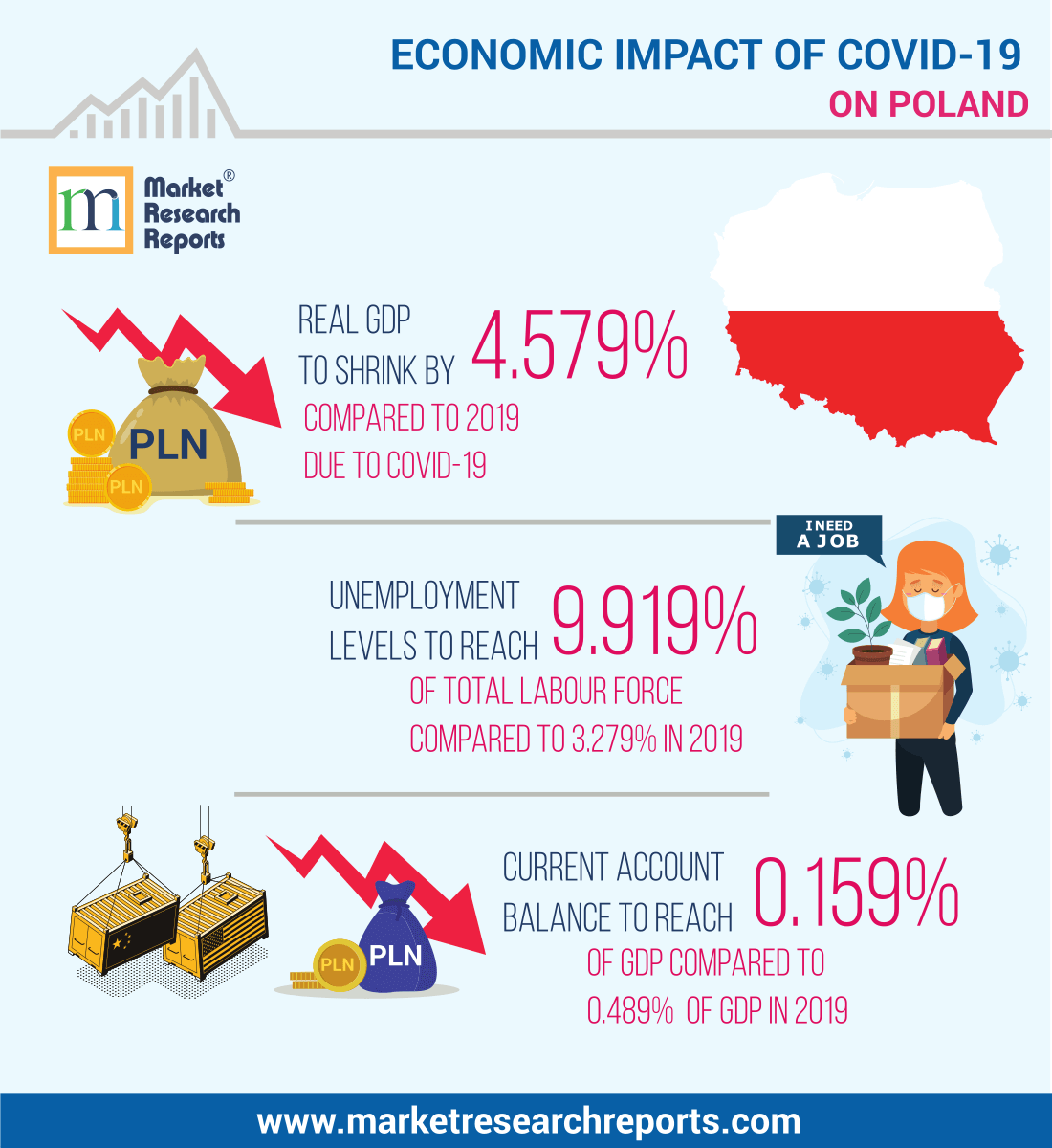
Poland’s real gross domestic product (GDP) was PLN 1,983.37 billion in 2019 and due to COVID-19 outbreak it is estimated to decrease by 4.579% to be around PLN 1,892.55 billion in 2020.
Poland’s unemployment rate was 3.279% of total labor force in 2019. Due to slowdown in global economic activity due to COVID-19 pandemic the unemployment is expected to increase by 66.94% and reach 9.919% in 2020. Unemployment is further estimated to decrease in 2021 by 23.49% and reach 8.032% of total labor force in Poland.
Poland’s current account balance in 2020 is expected to be at 0.159% of GDP compared to 0.489% of GDP in 2019. This means Poland will remain net lender to rest of the world in 2020.
As of 20th July 2020, the Poland government has taken following fiscal, monetary, employment and social related policy measures to contain coronavirus (COVID-19) pandemic.
2. Coronavirus (COVID-19) Containment Measures of Poland
Quarantine/Confinement
On 08th March 2020, the President signed a bill on extraordinary measures to contain the spread of the virus, including easier conditions to telework for persons subject to quarantine or epidemiological surveillance and additional powers for provincial governors to take containment measures at the local level.
On 13th March 2020, the state of epidemic emergency was declared and a fine of PLN 5000 for violating quarantine was introduced.
On 20th March 2020, fines for violating quarantine rules were increase from PLN 5,000 to PLN 30,000.
On 24th March 2020, the Prime Minister announced strict lockdown measures that considerably restricted people's movement and gatherings. It became forbidden to leaving home unless absolutely necessary. People could only go out to buy food and medicine, go to work, consult a physician or walk their pets. Gatherings of three or more persons became prohibited unless they are family members. The maximum number of persons taking part in religious ceremonies and funerals was cut to five. For means of public transportation, the limit of passengers was defined at half of seats. The lockdown was expected to remain in force until 11 April.
On 31st March 2020, the lockdown measures were tightened further, notably by closing hotels, temporary accommodation services, hairdressers and public parks, by reducing the number of allowed customers in shops, and by dedicating specific hours for the shopping of older persons. Wearing protective gloves became mandatory for all customers in shops. A ban on operations of home improvement retailers on weekends was introduced. Persons below 18 years old were not allowed go out unless accompanied by an adult. Pedestrians had to keep at least 2-metres distance from each other, even when walking together.
On 09th April 2020, it became compulsory to cover nose and mouth in public using masks and the strict lockdown measures were prolonged.
On 04th May 2020, the first measures to ease the lockdown came into force: shopping centers, hotels and other accommodation facilities were allowed to reopen. The number of customers in such centers was limited to one customer per 15 square meters and social distancing rules still applied. Restaurants and other type of businesses (e.g. fitness clubs, hair and beauty salons, cinemas and travel agents) remained closed.
On 06th May 2020, nurseries and preschools were allowed to reopen again, as well as cultural institutions (libraries, museums, art galleries) and physiotherapy centers.
On 18th May 2020, lockdown measures were eased again. Restaurants, hairdresser's, and beauty parlors were allowed to open under a strict a sanitary regime. So did open-air cinemas, art schools and recording studios. The permitted number of people on football pitches and in stadiums was increased and it became possible to organize sport activities indoors. More travelers (30% of the maximum number) were allowed aboard public transport.
On 25th May 2020, the youngest children (grades 1-3) were able to go back to schools and teachers started to organize consultations for eighth graders and A-level pupils. At the same time the childcare allowance was kept, so that parents could choose whether to send their kids to school or not.
On 30th May 2020, lockdown measures were eased again. Wearing face masks in public spaces was no longer mandatory if maintaining two metre distance is possible. Wearing masks was still be obligatory in shops, churches, cinemas, on public transport and during social interaction at distances shorter than two metres. The limit on the number of customers entering shops, restaurants and bars was also abolished. However, in small retail and catering premises customers still had to wear face masks. Similar rules applied to churches. Public gatherings of up to 150 persons were permitted again. Participants were required to maintain two metre distance from each other or wear masks.
On 06th June 2020, cinemas, theatres, philharmonic halls, sports and recreation facilities were allowed to reopen. Weddings and other family events were also allowed to take place, with the number of guests limited to 150.
Travel bans/restrictions
On 06th March 2020, bilateral parliamentary journeys to other countries were suspended.
On 10th March 2020, as a reaction to the expected rapid growth in the number of confirmed cases, sanitary inspections were introduced at four border crossings with Germany and one with the Czech Republic. The inspections mainly concerned passengers of buses and coaches. Inspections were also planned for railway traffic in borderland areas.
Starting 13th March 2020, all passengers flying into Poland had to undergo border checks involving measurement of body temperature. During the night of the 13-14 March, Poland also introduced full checks on its border crossings with Schengen zone until the 24 of March. Restrictions on border traffic between Poland and Russia, Poland and Ukraine and Poland and Belarus were introduced until further notice. Right to enter the country has been limited to Polish citizens and some foreign citizens, including spouses and dependents of Polish citizens, foreign citizens with temporary and permanent residence permits and work permits.
On 09th April 2020, the government also suspended international passenger air traffic and international railway traffic.
On 04th May 2020, the government lifted the compulsory 14-day quarantine for citizens crossing the border with neighboring EU countries for professional, business and learning purposes. All other restrictions and bans remained in place.
On 13th May 2020, border controls with other EU states were extended until June 12. Controls were also extended for seaports and airports.
On 13th June 2020, Poland restored full border traffic with EU member states. As a result, Poles returning from abroad are no longer placed under 14-day quarantine. Border checks are still performed at random, like before the lockdown.
On 16th June 2020, international flights resumed. However, Poles were still not able to travel freely to all countries. Poland was still not included on the list of safe countries in Slovenia, Slovakia or Austria. On July 1st, travelling within the EU borders became possible again. The EU re-opened its borders to 15 non-EU countries. The list of non-EU countries will be updated every two weeks.
Closure of schools/universities
On 10th March 2020, the Prime Minister announced that the decision of school closures was left to local governments.
On 12th March 2020, the Prime Minister finally announced that all nurseries, kindergartens, schools and higher education institutions would remain closed for two weeks starting from Monday 16 of March.
On 16th March 2020, the Ministry of Education published a guide for organizing online classes, but those remained voluntary since there was no regulations to enforce it. The grading of online classes was not regulated either.
On 20th March 2020, the President announced that schools closure would be extended until Easter.
On 08th April 2020, the government announced that schools would remain closed until May.
On 09th April 2020, the government announced that final and junior high-school exams would be rescheduled.
On 06th May 2020, nurseries and preschools were allowed to reopen again.
On 25th May 2020, the youngest children (grades 1-3) were able to go back to schools and teachers started to organize consultations for eighth graders and A-level pupils. At the same time the childcare allowance was kept, so that parents could choose whether to send their kids to school or not.
Cancellation of public events / Closure of public places
On 08th March 2020, the Chief Sanitary Inspector recommended to put on hold any public gatherings of more than 1,000 people due to the threat of transmission of the novel coronavirus. On March 10, all mass events were cancelled, including large sports events.
On 12th March 2020, Culture Minister Piotr Glinski informed that cultural institutions such as theatres, museums and cinemas would close for two weeks.
On 24th March 2020, the Prime Minister announced strict lockdown measures that considerably restricted people's movement and gatherings. Gatherings of three or more persons became prohibited unless they are family members. The maximum number of persons taking part in religious ceremonies and funerals was cut to five. For means of public transportation, the limit of passengers was defined at half of seats. The lockdown was expected to remain in force until 11 April.
On 09th April 2020, the government announced that the strict lockdown measures were prolonged.
On 04th May 2020, the first measures to ease the lockdown came into force: shopping centers, hotels and other accommodation facilities were allowed to reopen. The number of customers in such centers was limited to one customer per 15 square meters and social distancing rules still applied. Restaurants and other type of businesses (e.g. fitness clubs, hair and beauty salons, cinemas and travel agents) remained closed.
On 06th May 2020, cultural institutions (libraries, museums, art galleries) and physiotherapy centers were allowed to reopen.
On 18th May 2020, lockdown measures were eased again. Restaurants, hairdresser's, and beauty parlors were allowed to open under a strict a sanitary regime. So did open-air cinemas, art schools and recording studios. The permitted number of people on football pitches and in stadiums was increased and it became possible to organize sport activities indoors. More travelers (30% of the maximum number) were allowed aboard public transport.
On 22nd May 2020, the Presidential election, originally planned for May 10, was rescheduled to June 28.
On 30th May 2020, lockdown measures were eased again. Wearing face masks in public spaces was no longer mandatory if maintaining two-meter distance is possible. Wearing masks was still be obligatory in shops, churches, cinemas, on public transport and during social interaction at distances shorter than two meters. The limit on the number of customers entering shops, restaurants and bars was also abolished. However, in small retail and catering premises customers still had to wear face masks. Similar rules applied to churches. Public gatherings of up to 150 persons were permitted again. Participants were required to maintain two meter distance from each other or wear masks.
Obligatory shut down of economic activities
On 08th March 2020, the President signed a bill allowing the suspension of the public procurement law and construction law in extraordinary situations related to the spread of the virus.
On 12th March 2020, Culture Minister Piotr Glinski informed that cultural institutions such as theatres, museums and cinemas would close for two weeks.
On 24th March 2020, strict lockdown measures were implemented. The maximum number of persons taking part in religious ceremonies and funerals was cut to five. For means of public transportation, the limit of passengers was defined at half of seats. Shopping malls and restaurants were closed. Shopping activities were severely limited since people were only allowed to go out to buy food and medicine, go to work, consult a physician or walk their pets.
On 31st March 2020, the lockdown measures were tightened further, notably by closing hotels, temporary accommodation services, hairdressers and public parks, by reducing the number of allowed customers in shops, and by dedicating specific hours for the shopping of older persons. Wearing protective gloves became mandatory for all customers in shops. A ban on operations of home improvement retailers on weekends was introduced. Persons below 18 years old were not allowed go out unless accompanied by an adult. Pedestrians had to keep at least 2-metres distance from each other, even when walking together.
On 04th May 2020, the first measures to ease the lockdown came into force: shopping centers, hotels and other accommodation facilities were allowed to reopen. The number of customers in such centers was limited to one customer per 15 square meters and social distancing rules still applied. Restaurants and other type of businesses (e.g. fitness clubs, hair and beauty salons, cinemas and travel agents) remained closed.
On 06th May 2020, cultural institutions (libraries, museums, art galleries) and physiotherapy centers were allowed to reopen.
On 18th May 2020, lockdown measures were eased again. Restaurants, hairdresser's, and beauty parlors were allowed to open under a strict a sanitary regime. So did open-air cinemas, art schools and recording studios. The permitted number of people on football pitches and in stadiums was increased and it became possible to organize sport activities indoors. More travelers (30% of the maximum number) were allowed aboard public transport.
On 30th May 2020, lockdown measures were eased again. Wearing face masks in public spaces was no longer mandatory if maintaining two-meter distance is possible. Wearing masks was still be obligatory in shops, churches, cinemas, on public transport and during social interaction at distances shorter than two meters. The limit on the number of customers entering shops, restaurants and bars was also abolished. However, in small retail and catering premises customers still had to wear face masks. Similar rules applied to churches. Public gatherings of up to 150 persons were permitted again. Participants were required to maintain two-meter distance from each other or wear masks.
On 08th June 2020, the government decided in favor of a temporary suspension of production in two of JSW's coal mines and 10 mines owned by PGG, citing a rise in the number of new coronavirus infections among miners. Miners received 100 percent of downtime pay.
3. Coronavirus (COVID-19) Related Fiscal Policy Measures by Poland
Overall fiscal measures
On 08th March 2020, the President signed a bill on extraordinary measures to contain the spread of coronavirus. Measures included the attribution of care allowance for parents whose children would be affected by closures of nurseries and schools.
On 11th March 2020, a support fund of PLN 1 billion was announced for firms whose revenues would shrink by at least 15 percent due to the coronavirus outbreak.
On 12th March 2020, the Prime Minister announced that PLN 470 million from reserves had been allocated to fight the coronavirus.
On 19th March 2020, the government passed a fiscal package, including the establishment of a public infrastructure investment fund, with approximately PLN 67 billion (3 percent of GDP) from the state budget, in addition to PLN 75 billion (3.2 percent of GDP) in guarantees and micro loans for firms and entrepreneurs (up to the amount of PLN 5,000).
On 08th April 2020, the government announced an extension of its anti-crisis package. The cost of that expansion was estimated at nearly PLN 18.5 billion, including PLN 11.5 billion in new spending and PLN 6.9 billion in revenue losses.
On 24th June 2020, the fourth extension of the anti-crisis package was signed by the president. The legislation states that entrepreneurs who received micro-loans of PLN 5,000 will not have to reimburse them if the company operates for 3 months after receiving it. The new legislation introduces subsidies to interest on loans for firms put in a difficult position by the pandemic. The new regulation is also supposed to prevent hostile takeovers of Polish companies by foreign enterprises from the outside of the EU, with such transactions to be audited by the Office for Competition and Consumer Protection (UOKiK). Furthermore, local governments will be allowed to have higher debts in order to counteract the pandemic. Richer local governments will be exempt from paying the Robin Hood tax in June and July. The extension of the anti-crisis package also introduces regulations on credit holidays, allowing people to suspend repayment for up to three months.
On 20th July 2020, the government launched a PLN-500-worth tourist voucher programme to support the tourism industry. Vouchers, entitled to all families with at least one children, will be valid until March 2022 and can be used to pay for accommodation, agritourism, summer camps, among others, provided they are located in Poland.
Health system measures
On 08th March 2020, the authorities unlocked EUR 23.3 million EUR (PLN 98 million) additional funding for hospitals. In cases when patients' health was at risk, qualified pharmacists were allowed to issue prescriptions for pharmaceuticals directly.
On 13th March 2020, 19 hospitals in Poland were transformed into dedicated centres for patients infected with coronavirus.
On 19th March 2020, the Government announced an additional 7,5 billion PLN package for the health sector.
On 08th April 2020, the government announced that further investments would be made in the health care sector, drawing from available EU Funds. Poland dedicated PLN 550 million from the Infrastructure and Development Programme for the purchase of health care equipment. Extra funds for personal protection equipment were also made available to rescue services, fire services, police and the railway sector.
Income support measures for individuals and households excluding tax and contribution changes
On 08th March 2020, the President signed a bill on extraordinary measures to contain the spread of coronavirus. Measures included the attribution of care allowance for parents whose children would be affected by closures of nurseries and schools.
On 11th March 2020, the President promised additional reliefs for people having financial problems because of the coronavirus, possibly through loan rescheduling.
On 19th March 2020, the government announced the details of its rescue package. The government committed to subsidize the employees' salaries, for firms meeting some criteria related to recorded losses and fall in turnover, by up to 40% of the average wage. Employers had to pay the same share of the employees' salaries, and employees had to agree to decrease their salaries by one fifth. The subsidy was provided under the condition that benefiting firms would not dismiss any employee. The government also subsidized the income of the self-employed, service employees, sole traders or those employed on the basis of a contract of mandate or contract for specific work, among other forms of temporary and atypical employment contracts, by up to 80% of the statutory minimum wage. Such subsidy was exempted from social security contributions and taxes. To be eligible, individuals would have to prove that they experienced a significant drop in activity at least 30 days prior to the application for the benefit, that their revenues in the preceding month was 300-percent lower than their average monthly gross pay, that their revenue dropped by at least 15 percent compared to the previous calendar month, and that they started their economic activity prior to March 1st this year and have not suspended it since.
On 08th April 2020, as part of the extension of the anti-crisis package, the government announced that the above subsidy for self-employed and atypical workers, originally planned as a one-off payment, could be demanded three times. The government also announced that farmers would obtain a benefit of 50 percent the statutory minimum wage if they could not work due to the coronavirus. After the mandated closure of mines on June 8, miners received 100 percent of downtime pay.
On 22nd June 2020, the government introduced a solidarity benefit of PLN 1,400 per month for people who lost their jobs after 15 March 2020. The subsidy can be received for up to three months.
On 20th July 2020, the government launched a PLN 500 worth tourist voucher programme to support the tourism industry. Vouchers, entitled to all families with at least one children, will be valid until March 2022 and can be used to pay for accommodation, agritourism, summer camps, among others, provided they are located in Poland.
Tax and contribution policy changes
On 19th March 2020, the government announced the details of its rescue package. It included the deduction of 2020's losses for firms' and self-employed 2021 tax settlement.
On 24th June 2020, the fourth ammendment to the anti-crisis package was signed by the president. Richer local governments will be exempt from paying the Robin Hood tax in June and July 2020.
On 1st July 2020, the government announced that payers of PIT, CIT, VAT and excise duties may benefit from prolonged deadlines in the payment of these taxes. Local authorities were also allowed to defer the payment of property tax instalments.
Public sector subsidies to businesses
On 11th March 2020, a support fund of PLN 1 billion was announced for firms whose revenues would shrink by at least 15 percent due to the coronavirus outbreak.
On 19th March 2020, the government announced the details of its rescue package. The government committed to subsidize the employees' salaries, for firms meeting some criteria related to recorded losses and fall in turnover, by up to 40% of the average wage. Employers had to pay the same share of the employees' salaries, and employees had to agree to decrease their salaries by one fifth. The subsidy was provided under the condition that benefiting firms would not dismiss any employee. The government also subsidized the income of the self-employed, service employees, sole traders or those employed on the basis of a contract of mandate or contract for specific work, among other forms of temporary and atypical employment contracts, by up to 80% of the statutory minimum wage. Such subsidy was exempted from social security contributions and taxes. To be eligible, individuals would have to prove that they experienced a significant drop in activity at least 30 days prior to the application for the benefit, that their revenues in the preceding month was 300-percent lower than their average monthly gross pay, that their revenue dropped by at least 15 percent compared to the previous calendar month, and that they started their economic activity prior to March 1st this year and have not suspended it since.
On 08th April 2020, as part of the extension of the anti-crisis package, the government announced that the above subsidy for self-employed and atypical workers, originally planned as a one-off payment, could be demanded three times. The government also announced that farmers would obtain a benefit of 50 percent the statutory minimum wage if they could not work due to the coronavirus. The government also announced an unprecedented loan scheme worth PLN 100 billion. The funds were made available directly to enterprises in the form of loans to help them maintain liquidity and protect jobs. PLN 75 billion were offered to SMEs, while PLN 25 billion were made available to large enterprises which pay taxes in Poland. In order to apply for the funds, firms were required to show a 25 percent drop in their revenues. Micro-firms could apply for loans up to PLN 324,000, small and medium companies could receive up to PLN 3.5 million, while large enterprises could be granted up to PLN 1 billion. The loans were awarded for three years, with zero interests, and repayments will start in the second year. Up to 75 percent of the value of the loans can be disbursed in the form of grants, provided firms keep their employees during the entire loan period.
On 24th June 2020, the fourth extension of the anti-crisis package was signed by the president. The new regulation states that entrepreneurs who received micro-loans of PLN 5,000 will not have to reimburse them if the company operates for 3 months after receiving it. The new legislation also introduces subsidies to interest on loans for firms put in a difficult position by the pandemic.
Deferral of taxes and social security contributions and bringing forward expenditures within current fiscal year
On 11th March 2020, the government announced the details of its rescue package. It included the postponement of social contributions and the possible deferral, cancellation or payment in installments for taxes. Self-employed and micro-firms who experienced at least a 50-percent drop in revenues since February were eligible for exemption from payment of social insurance premiums for three months, provided that their revenues in March did not exceed 300 percent of the average pay. The budget cost of this remittal is estimated at PLN 14bn.
On 08th April 2020, as part of the extension for the anti-crisis package, firms with between 10 and 49 employees were also allowed to seek the cancellation of their social security contributions for three months. On May 4, the Sejm passed third revision to the anti-crisis package. The bill provided for wider availability of social insurance contribution remittal for self-employed persons.
Public sector loans or capital injections to businesses
From 1st April 2020 onwards and under the anti-crisis legislation, investments and financing on preferential conditions by the Polish Development Fund (PFR) were facilitated. The Fund had the possibility of investing in subscription warrants, shares, bonds and credits. Companies in financial trouble could ask for PFR to purchase their shares in order to increase their capital base. However, PFR committed not to take over companies. The aim was to make it a support programme and not to use the difficult condition of firms for acquisitions.
On 08th April 2020, as part of the government's extension to the anti-crisis package, the government announced an unprecedented loan scheme worth PLN 100 billion. The funds were made available directly to enterprises in the form of loans to help them maintain liquidity and protect jobs. PLN75 billion were offered to SMEs, while PLN 25 billion were made available to large enterprises which pay taxes in Poland. In order to apply for the funds, firms were required to show a 25 percent drop in their revenues. Micro-firms could apply for loans up to PLN 324,000, small and medium companies could receive up to PLN 3.5 million, while large enterprises could be granted up to PLN 1 billion. The loans were awarded for three years, with zero interests, and repayments will start in the second year. Up to 75 percent of the value of the loans can be disbursed in the form of grants, provided firms keep their employees during the entire loan period. The government also announced that further capital injections would be financed by drawing on available EU Funds: PLN 500 million from the Eastern Poland programme were dedicated to provide working capital to enterprises in the Lubelskie, Podkarpackie, Podlaskie, Swietokrzyskie and Warminsko-Mazurskie provinces.
Loan guarantees by the state benefiting private borrowers
On 19th March 2020, the government announced the details of its rescue package, which included PLN 75 billion in government liquidity support to firms, including micro firms. The State Development Bank (BGK) also increased its loan guarantees for private-sector firms by PLN 22 billion. The State Development Bank (BGK) will guarantee loans and current investments of medium sized and big companies to ensure their liquidity. These public guarantees will be extended until the end of 2020 and will cover a maximum period of 2 years. The fees and interest rates are not to exceed the limits set in the temporary state aid framework.
On 28th April 2020, the government announced that Poland had tapped into PLN 400 million in funds from the EU to be used for the anti-crisis loan fund for companies. The plan is being carried out in cooperation with state-controlled development bank BGK.
4. Coronavirus (COVID-19) Related Monetary Policy Measures by Poland
Monetary policy
On 17th March 2020, the National Bank of Poland (NBP) reduced its policy interest rate 50 bps to 1%, its lombard rate by 100 bps to 1.5%, while the deposit rate was left unchanged at 0.5%. Regarding non-conventional monetary policy, the NBP re-introduced repo operations to provide liquidity to the banking sector and announced the purchase of Polish Treasury securities in the secondary market in the value of PLN 8.3 billion (0.4 percent of GDP). The NBP also announced the introduction of a program to provide funding for bank lending to the non-financial private enterprises (similar to the ECB's TLTRO).
On 19th March 2020, the NBP announced an additional PLN 70 billion package in liquidity support for private sector firms.
On 08th April 2020, the Monetary Policy Council (RPP) reduced interest rates again by 50 base points. The reference rate was set to 0.5 percent per annum; the Lombard rate was set at 1 percent per annum; deposit rate at 0 percent per annum; the promissory note rediscount rate to 0.55 percent per annum; and the promissory note discount rate at 0.6 percent per annum. These interest rates are the lowest in history. The National Bank of Poland (NBP) reiterated its comittment to supply the banking sector with liquidity through repo transactions.
On 28th April 2020, the Polish Development Fund (PFR) managed to raise PLN 16.3 billion via the issue of “coronavirus bonds” to finance the government's rescue package. The four-year bonds with a 1.375 percent coupon rate were oversubscribed. The bonds are guaranteed by the State Treasury and were all claimed by banks. The government initially wanted the NBP to directly purchase the bonds, but that would be against Polish and EU regulations. The NBP may still buy the bonds from the subscribing banks in the secondary market.
On 11th May 2020 the Polish Development Fund (PFR) issued five-year bonds worth PLN18.5bn, as part of the bond issuance programme with the total value up to PLN 100 billion. The bonds have the interest rate of 1.625 percent per annum and their term of maturity is 31 March 2025. The nominal value of a single bond is PLN1m and the issue price is PLN 995,870.
On 28th May 2020, the Monetary Policy Council (RPP) decided to reduce most interest rates. The reference rate was cut from 0.5 to 0.1 percent per annum, which is the lowest value it has ever reached. The lombard rate was reduced from 1 to 0.5 percent, whereas the rediscount rate was slashed from 0.55 to 0.11 percent, and the discount rate on bills of exchange was capped from 0.6 to 0.12 percent. The deposit rate remained at 0 percent per annum.
Prudential regulation
On 17th March 2020, the National Bank of Poland (NBP) lowered the reserve requirement from 3.5% to 0.5%, while raising the interest on mandatory reserves from 0.5% to 1%. The Ministry of Finance, following the recommendation by the Financial Stability Committee, repealed the 3 percent systemic risk buffer for bank capital requirements. The Polish Financial Supervisory Authority (PFSA) also announced a package of measures (SSP- Supervisory Stimulus Package) related to provisions and the reclassification of loans to existing SMEs/micro enterprises. This included measures to enable the smoothing of credit losses over a longer period, to allow some flexibility in how banks meet capital requirements, and more flexible bank liquidity requirements. The PFSA also announced a flexible approach to valuation under Solvency II for the insurance sector. Additionally, the Polish Banking Association recommended the voluntary deferral of loan repayments for affected borrowers for up to three months.
Support to individuals and households
On 17th March 2020, the head of the Association of Polish Banks (ZBP) announced that in the face of the coronavirus pandemic, banks operating in Poland would make it possible for clients to take a three-month mortgage payment holiday, with possibility of further extension if needed. Applications for postponed payment were free of charge and involved minimum procedures. This solution was available to both companies and individual customers with mortgages and cash loans.
On 24th June 2020, the President signed the fourth extension to the anti-crisis package. The extension of the anti-crisis package introduces regulations on credit holidays, allowing people to suspend repayment for up to three months.
Support to firms
On 17th March 2020, the head of the Association of Polish Banks (ZBP) announced that in the face of the coronavirus pandemic, banks operating in Poland would make it possible for clients to take a three-month mortgage payment holiday, with possibility of further extension if needed. Applications for postponed payment were free of charge and involved minimum procedures. This solution was available to both companies and individual customers with mortgages and cash loans.
Other measures including structural policy measures
On 19th March 2020, the government announced that the introduction of the tax on retail sales turnover, planned for 2020, would be postponed until the end of the year.
On 09th April 2020, additional measures in support of farming activities were introduced: funds allocated for the promotion of agri-food products could finally be used for market-recovery measures; flexible working hours for farmers; prolongation of expired visas and residence permits of migrant workers in the agri-foods sector
- they became able to stay in Poland up to 30 days after the epidemic measures were lifted.
On 04th May 2020, the Sejm approved the third revision of the anti-crisis package. Among the new measures: VoD platforms shall pay a new levy, set at 1.5 percent of their revenues; hiring foreigners is to be easier, as work permits shall be prolonged automatically during the pandemic; the capital of the Industrial Development Agency shall be raised by PLN 900 million; railway and road passenger carriers shall be offered compensations, if they provide public service; and finally, the list of administrative procedures that can be handled online shall be expanded.
On 06th May 2020, the Climate ministry announced that the government was willing to delay some requirements concerning the development of electric car charging stations, which were included in the bill on electro mobility and alternative fuels.
On 15th May 2020, the government announced that two important reforms of the pension insurance system:
- the extension of the Employee Capital Plans (PPK) scheme onto new groups of enterprises and
- the abolition of open pension funds (OFE) would be delayed due to the coronavirus pandemic.
On 18th May 2020, the PM Mateusz Morawiecki announced that the monthly unemployment benefit would be increased from the current level of PLN 860 to PLN 1,200 and PLN 942.3 after 3 months. Moreover, he added that there would be another temporary benefit for 3 months at the level of PLN 1,300.
On 27th May 2020, the Polish government adopted a draft amendment of the Public Finance Act which enables suspension of application of the stabilizing spending rule during the time of the epidemic. The measure enables Poland to provide additional financial support to the economy if necessary. The spending rule will be reintroduced in the next two to four years. Without these modifications, the expenses incurred as a result of the adoption of the anti-crisis shield would have had to be compensated by means of restricting other expenses within bodies subject to the spending rule.
On 17th June 2020, the PM Mateusz Morawiecki announced the introduction of the so-called Estonian CIT in Poland: enterprises with a turnover of up to PLN 50 million (97 percent of businesses operating in Poland) will be exempt from CIT as long as they refrain from paying dividends. This is to encourage enterprises to develop and invest. The PM hopes that the Estonian CIT will strengthen Polish capital but also attract foreign entrepreneurs to the country.
On 22nd June 2020, the government announced that the new VAT matrix would not be delayed any further and be implemented on July 1st.
5. Coronavirus (COVID-19) Related Employment Policy Measures by Poland
Helping firms to adjust working time and preserve jobs
Short-term work schemes for employees will cover 40% of pay (up to the level of the national average wage in 2019) for workers of firms experiencing a monthly fall in their revenues of at least 25%. Employers will cover an additional 40%, while the worker will have to bear the remaining loss. The subsidy is provided on the condition that the employer will not make any employees redundant. The expected costs of STW measure together with the allowance to self-employed are around 1.3% of 2019 GDP. The scheme will be managed by the state-owned Polish Development Fund (PFR), which will fund it by issuing state-guaranteed bonds (to be purchased by the National Bank of Poland on the secondary market as part of its QE programme). State-support for the protection of jobs extended to NGOs, non-profit and public benefit organisations.
On 08th April 2020, the government launched a PLN 100 billion (around EUR 22 billion or 4.5% of GDP) financial lifeline to companies, to reduce incentives to lay-off workers in the current downturn. The scheme will consist of 3-year zero-interest loans to struggling SMEs (50% of the envelope), micro-enterprises (25%) and large companies (25%). About 60% of total loans will be disbursed in the form of grants (up to 75% for SMEs and micro-enterprises), provided recipients will keep their employees during the loan period.
Financial support to firms affected by a drop in demand
Financing and guarantee measures for firms (for around 3% of 2019 GDP): loan guarantees; operational leasing schemes (for firms in the transport sector); and PLN 5000 (about EUR 1200) micro loans for firms with less than 9 employees, non-refundable in case they do not dismiss employees within 6 months (later reduced to 3 months). Subsidies to interest on loans for firms put in a difficult position by the pandemic. Exemption from social security contributions for three months to self-employed and firms below 50. This will be limited to 50% of all contributions for these firms.
6. Coronavirus (COVID-19) Related Social Policy Measures by Poland
Reducing workers’ exposure to Covid-19 in the workplace
On 8th March 2020, a special remote work mode has been introduced, according to which employers are allowed to order their workers to perform specific work defined in their employment contracts for a fixed period of time outside the regular place of work.
Income support to sick workers and their families
In the COVID-19 outbreak context, there is a possibility to get a proper medical certificate without visiting a doctor: possible to have the medical check on-line or by telephone.
Income support to quarantined workers who cannot work from home
Sick leave is granted for the periods of quarantine if individually ordered by the authorities, with same rules as in the case of a sick worker (same benefit level and duration). Also applies to self-employed workers. Benefits for childcare are granted in case children are under quarantine. These do not apply to people self-quarantining.
From 07th April 2020, an allowance, amounting to 50% of the minimum wage, will be paid to farmers and their household members during the period in which they are subject to quarantine or hospitalization.
Helping to deal with unforeseen care needs
Extension to the existing family care leave entitlement. Insured parents with children up to age 8 affected by closures of nurseries and schools are entitled to an exceptional 28-day family care leave (14 days per parent). If both parents of the child work, the leave can be shared but only one parent may use the leave at any one time. The allowance is funded by public social insurance. This entitlement is in addition to the existing 60-day family care leave already provided in Poland. Even if the employer pays the benefit (if required to do so), the amounts paid are settled by the National Social Insurance Institution, meaning that the benefits are not charged to the employers' fund.
Income support to persons losing their jobs or self-employment income
One-off cash payment up to PLN 2080 (80% of minimum wage) for self-employed and workers employed under civil law contracts who experienced a significant drop in activity. The benefit is exempt from taxes and social security contributions.
On 07th April 2020, extended to up to three months. Self-employed persons and micro-firms which experience at least 50% drop in revenues since February are eligible for exemption from social security contributions for three months. They will retain the right to health and social security benefits for the period of exemption from contributions. If an employer or self-employed can't uphold his/her economic activity due to consequences of the COVID-19 pandemic, they can apply for other types of support, like downtime allowance. Farmers would obtain a benefit of 50% the statutory minimum wage if they could not work due to the coronavirus.
On 22nd June 2020, the government introduced a solidarity benefit of PLN 1400 per month for people who lost their jobs after 15 March 2020. The subsidy can be received for up to three months.
Helping economically insecure workers stay in their homes
Banks have allowed the postponement of the repayment up to 3 months, and up to 6 months for loans due in the upcoming months.
Source – With inputs from Organisation for Economic Co-operation and Development (OECD), International Monetary Fund, World Bank, International Labour Organization (ILO) and Government of Poland