


World’s Top 10 Pharmaceutical Companies by Revenue

MRR® Pharma Industry Analysis Market Research · Competitive Intelligence
The Pharma Growth-Share Matrix: Mapping the World's Top 10 Drugmakers Through the GLP-1 and Immunology Supercycle
The global pharmaceutical consumption market is on a trajectory to grow from an estimated US$1.65 trillion in 2025 to US$2.45 trillion by 2031, at a 6.8% CAGR — a marked acceleration from the historical 4.3% rate of 2022–2024. The single largest driver of that acceleration is the GLP-1 receptor agonist and cardiometabolic franchise, anchored by semaglutide and tirzepatide, expected to add roughly $280 billion of incremental consumption value by 2031 on its own.
Against that backdrop, ten companies — Johnson & Johnson, Roche, Eli Lilly, Merck & Co. (MSD), Pfizer, AbbVie, AstraZeneca, Novartis, Sanofi, and Bristol Myers Squibb — generated a combined $632 billion in 2025 pharmaceutical revenue, ranking them the ten largest drugmakers on the planet by sales. Every one of the ten has now reported first-half or second-quarter 2026 results, and the pattern across all ten calls is strikingly consistent: management teams are explicitly reframing their portfolios around a small set of high-growth franchises — GLP-1s, next-generation immunology biologics, and differentiated oncology — while managing a wave of patent expirations on the blockbusters that built the industry over the past two decades.
This briefing applies the BCG growth-share framework — Stars, Cash Cows, Question Marks, and Dogs — directly to each company's disclosed franchise economics, using only what the ten majors have themselves told shareholders and regulators in FY2025–FY2026 filings, earnings releases, and investor presentations.
Market Sizing Snapshot, 2025–2031
| Metric | Figure |
|---|---|
| Base market size (2025) | US$1.65 Trillion |
| Forecast market size (2031) | US$2.45 Trillion |
| CAGR (2025–2031) | 6.8% |
| Historical CAGR (2022–2024) | 4.3% |
| Largest single growth driver | GLP-1 / cardiometabolic franchise (~$280B incremental value by 2031) |
| Regions covered | Asia Pacific, Latin America, MEA, Europe, North America |
Source: Global Pharmaceuticals Industry Strategic Research Report, Market Research Reports Inc.
The Growth-Share Lens, Applied to Pharma
Mapped onto the BCG matrix, three franchise categories now define competitive position across the top 10:
- GLP-1 / cardiometabolic — the fastest-growing category in the industry, propelling Eli Lilly's revenue up 45% for full-year 2025 and 47.7% in Q2 2026 alone.
- Next-generation immunology and oncology biologics — high-growth, high-margin franchises (Skyrizi/Rinvoq, Dupixent, Tremfya, Darzalex, Kisqali, Ocrevus/Xolair) that are increasingly the primary earnings engine at nearly every major.
- Legacy small-molecule and first-generation biologic blockbusters — Humira, Entresto, Revlimid, Eliquis, and (on a multi-year horizon) Keytruda — facing biosimilar or generic erosion that is being actively managed rather than simply absorbed.
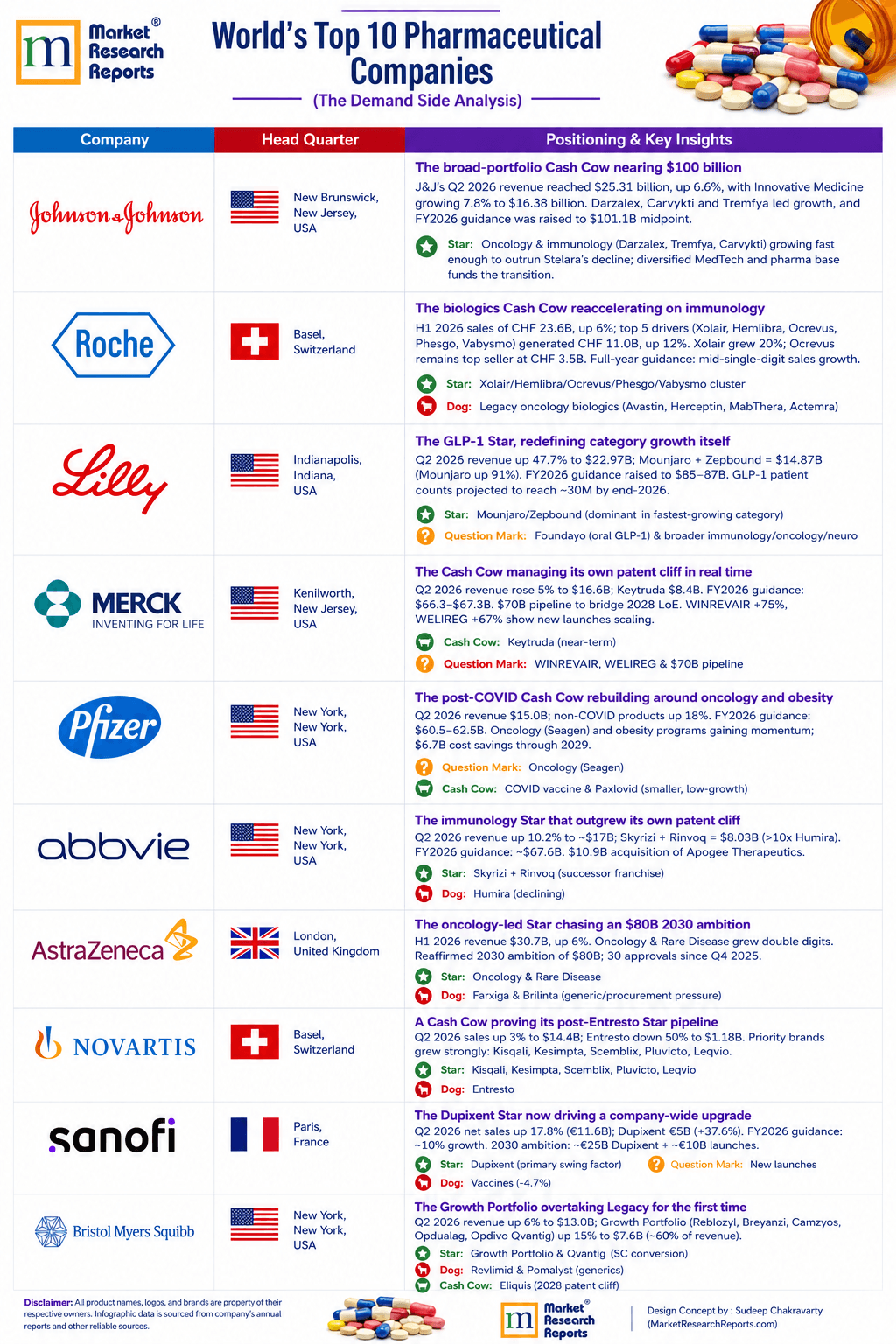
Company-by-Company Positioning
Johnson & Johnson - the broad-portfolio Cash Cow nearing $100 billion
J&J's Q2 2026 revenue reached $25.31 billion, up 6.6%, with the Innovative Medicine segment — the company's pharma arm — growing 7.8% to $16.38 billion behind Darzalex, Carvykti, and immunology drug Tremfya, which posted its first $2 billion quarter (+72.5%). Management raised full-year 2026 guidance to a $101.1 billion midpoint, which CEO Joaquin Duato called the company's first time crossing $100 billion in its 140-year history, even as Stelara's biosimilar-driven decline subtracted roughly 460–1,040 basis points from segment growth in various quarters.
J&J's oncology and immunology franchise (Darzalex, Tremfya, Carvykti) is a Star gaining share fast enough to outrun Stelara's decline; the diversified MedTech and broader pharma base functions as a Cash Cow funding that transition.
Roche - the biologics Cash Cow reaccelerating on immunology
Roche's Pharmaceuticals Division delivered H1 2026 sales of CHF 23.6 billion, up 6% at constant exchange rates, with its top five growth drivers — Xolair, Hemlibra, Ocrevus, Phesgo, and Vabysmo — together generating CHF 11.0 billion, up 12%. Xolair alone grew 20%, aided by expansion into food-allergy indications, and Ocrevus remains the division's single highest-selling medicine at CHF 3.5 billion for the half. Management confirmed full-year guidance for mid-single-digit sales growth and high-single-digit core EPS growth.
The Xolair/Hemlibra/Ocrevus/Phesgo/Vabysmo cluster functions as a Star growing meaningfully faster than the group average, while legacy oncology biologics facing biosimilar competition (Avastin, Herceptin, MabThera/Rituxan, Actemra) sit as a shrinking Dog segment that the growth drivers are now comfortably outpacing.
Eli Lilly - the GLP-1 Star, redefining category growth itself
Lilly's Q2 2026 revenue surged 47.7% to $22.97 billion, with Mounjaro and Zepbound together contributing $14.87 billion — Mounjaro alone up 91% to $9.94 billion. The company raised full-year 2026 guidance to $85–87 billion, up from $82–85 billion, and CEO Dave Ricks projected global GLP-1 patient counts rising from roughly 20 million at the end of 2025 to about 30 million by the end of 2026. Immunology, oncology, and neuroscience products collectively grew 121% in the quarter, indicating the growth engine is broadening beyond incretins alone.
Mounjaro/Zepbound is the industry's clearest Star — dominant share in the fastest-growing category in pharma — while the newly launched oral GLP-1 Foundayo and the broader immunology/oncology/neuroscience portfolio represent Question Marks with credible paths to Star status as they scale.
Merck & Co. (MSD) - the Cash Cow managing its own patent cliff in real time
Merck's Q2 2026 revenue rose 5% to $16.6 billion, with the Keytruda franchise (including the newer subcutaneous Keytruda QLEX) contributing $8.4 billion. Management raised full-year guidance to $66.3–$67.3 billion and reaffirmed a $70 billion "commercial opportunity" from more than 20 pipeline products intended to bridge Keytruda's 2028 loss of exclusivity — what CEO Robert Davis called "more of a hill than a cliff." WINREVAIR (+75% to $588 million) and WELIREG (+67% to $271 million) are the clearest early evidence that newer launches are scaling.
Keytruda itself is the textbook Cash Cow approaching its terminal phase — still generating enormous cash flow but with a known 2028 horizon — while WINREVAIR, WELIREG, and the broader $70 billion pipeline opportunity are Question Marks Merck is deliberately funding with Keytruda's cash generation.
Pfizer - the post-COVID Cash Cow rebuilding around oncology and obesity
Pfizer's Q2 2026 revenue reached $15.0 billion, with non-COVID products up 18% operationally even as COVID-related revenue guidance was trimmed to roughly $4 billion for the year. Management raised full-year 2026 revenue guidance to $60.5–$62.5 billion and highlighted "meaningful momentum" in its obesity program alongside continued oncology strength from the Seagen-derived portfolio, while expanding productivity programs to a targeted $6.7 billion in net cost savings through 2029.
Pfizer's oncology franchise (built substantially through the Seagen acquisition) is a Question Mark maturing into a Star, while the legacy COVID vaccine and Paxlovid business has settled into a smaller, low-growth Cash Cow role funding the obesity pipeline's Question Mark investment.
AbbVie - the immunology Star that outgrew its own patent cliff
AbbVie's Q2 2026 net revenue rose 10.2% to nearly $17 billion, led by Skyrizi ($5.5 billion, +24%) and Rinvoq ($2.5 billion, +23.7%), which together generated $8.03 billion — more than 10 times Humira's now-diminished $756 million (down 36.1%). Management raised full-year guidance to approximately $67.6 billion and announced the planned $10.9 billion acquisition of Apogee Therapeutics to extend the immunology portfolio into dermatology and respiratory disease.
Skyrizi and Rinvoq together are the sector's cleanest Star case study — a successor franchise that not only replaced a $20 billion blockbuster's peak revenue but is still compounding at 24% annually years after Humira's biosimilar exposure began; Humira itself has completed its transition to a shrinking Dog.
AstraZeneca - the oncology-led Star chasing an $80 billion 2030 ambition
AstraZeneca's H1 2026 total revenue reached $30.7 billion, up 6% at constant exchange rates, with Oncology and Rare Disease posting double-digit growth that offset Farxiga's U.S. loss of exclusivity and China procurement headwinds — revenue excluding those two legacy products grew 11%. Management reaffirmed both full-year guidance and its long-standing ambition to reach $80 billion in total revenue by 2030, supported by 30 regulatory approvals since Q4 2025 and more than 20 high-value pipeline readouts expected over the next 18 months.
Oncology (up 18% to $14.1 billion in H1) and Rare Disease (up 13% to $4.9 billion) are clear Stars; Farxiga and Brilinta, now facing generic and procurement pressure, are transitioning from Cash Cow to Dog, a shift AstraZeneca's growth engines are outrunning by a wide margin.
Novartis - a Cash Cow proving its post-Entresto Star pipeline
Novartis returned to growth in Q2 2026 with net sales up 3% to $14.4 billion, even as Entresto — its former largest product — saw sales collapse 50% to $1.18 billion following U.S. generic entry. The offset came from priority brands: Kisqali (+43% to $1.7 billion, on track for a $10 billion peak-sales target), Kesimpta (+32%), Scemblix (+89%), Pluvicto (+43%), and Leqvio (+59%). Management reaffirmed full-year guidance for low single-digit net sales growth.
Kisqali, Kesimpta, Scemblix, Pluvicto, and Leqvio collectively form a Star cluster large and fast-growing enough to fully offset Entresto's collapse into Dog status — a real-time demonstration of pipeline-funded succession that most peers are still working toward.
Sanofi - the Dupixent Star now driving a company-wide upgrade
Sanofi's Q2 2026 net sales rose 17.8% at constant exchange rates to €11.6 billion, with Dupixent alone crossing €5 billion in quarterly sales for the first time (+37.6%) and newer pharma launches (Altuviiio, Ayvakit, Sarclisa) up 48.3%. New CEO Belén Garijo upgraded full-year 2026 guidance to roughly 10% sales growth and set a 2030 ambition of ~€25 billion in Dupixent sales plus ~€10 billion from pharma launches.
Dupixent is unambiguously Sanofi's Star, now large enough on its own to be the primary swing factor in company-wide guidance; the newer launch portfolio is a Question Mark the company is explicitly betting will become a second Star by 2030, while the declining Vaccines segment (-4.7% in Q2) functions as a stable but low-growth Cash Cow.
Bristol Myers Squibb — the Growth Portfolio overtaking Legacy for the first time
BMS's Q2 2026 revenue rose 6% to $13.0 billion, with its self-defined "Growth Portfolio" (Reblozyl +29%, Breyanzi +41%, Camzyos +59%, Opdualag, and the subcutaneous Opdivo Qvantig) up 15% to $7.6 billion — now nearly 60% of total company revenue — while the Legacy Portfolio declined 4% as Revlimid (-49%) and Pomalyst (-71%) faced generic competition, partially offset by Eliquis (+22%). Management raised full-year 2026 revenue guidance to $49.0–$50.0 billion, a sharp increase from the initially guided $46.0–$47.5 billion.
The Growth Portfolio, and specifically Qvantig's active conversion of Opdivo's IV patient base to a subcutaneous formulation, is BMS's clearest Star transition; Revlimid and Pomalyst have completed their fall into Dog status, while Eliquis — still growing at 20%+ but facing a 2028 U.S. patent cliff — occupies a Cash Cow nearing its own horizon, echoing Merck's Keytruda situation.
Consolidated Growth-Share Matrix — Top 10 Pharma, 2026
| High Relative Share | Low Relative Share | |
|---|---|---|
| High Market Growth | STARS — Lilly Mounjaro/Zepbound; AbbVie Skyrizi/Rinvoq; Sanofi Dupixent; Novartis Kisqali/Kesimpta/Pluvicto/Leqvio; AstraZeneca Oncology/Rare Disease; Roche Xolair/Ocrevus/Hemlibra/Vabysmo cluster; BMS Growth Portfolio (Opdivo Qvantig, Reblozyl, Breyanzi, Camzyos) | QUESTION MARKS — Merck's post-Keytruda pipeline ($70B opportunity, WINREVAIR, WELIREG); Pfizer oncology/obesity pipeline; Sanofi new pharma launches (Altuviiio, Ayvakit, Sarclisa); Lilly Foundayo (oral GLP-1) |
| Low Market Growth | CASH COWS — J&J's broad Innovative Medicine/MedTech base; Merck Keytruda (pre-2028 LOE); BMS Eliquis (pre-2028 LOE); Roche legacy biologics base; Pfizer COVID/Paxlovid franchise | DOGS — AbbVie Humira; Novartis Entresto/Promacta/Tasigna; BMS Revlimid/Pomalyst; AstraZeneca Farxiga/Brilinta; Roche Avastin/Herceptin/MabThera/Actemra |
Pharma's growth-share matrix has a genuine, well-populated Dogs quadrant — a direct reflection of the industry's patent-cliff dynamics, where yesterday's blockbuster becomes tomorrow's declining legacy asset on a predictable, disclosed timeline rather than a market-driven one.
Strategic Imperatives for 2026–2031
- Fund Question Marks with Cash Cow cash flow before the cliff arrives, not after. Merck's $70 billion post-Keytruda pipeline commitment and BMS's Growth Portfolio buildout are both explicit, multi-year exercises in using a still-strong Cash Cow's cash generation to seed the next generation of Stars — the playbook every company facing a dated loss-of-exclusivity event is now running in public.
- GLP-1/cardiometabolic access is reshaping category economics industry-wide. Lilly's trajectory — and the market's projected $280 billion of incremental GLP-1-driven consumption value by 2031 — means every company with cardiometabolic assets in development (Roche's petrelintide and enicepatide, Pfizer's obesity pipeline) is racing to establish a credible position before the category's growth curve matures.
- Immunology succession has become a repeatable playbook. AbbVie's Skyrizi/Rinvoq replacement of Humira and Sanofi's Dupixent scale-up are the two clearest proof points that a well-executed successor-biologic strategy can not only replace a lost blockbuster's revenue but exceed it — a template Novartis (Kisqali/Kesimpta post-Entresto) and Roche (Xolair/Ocrevus post-Avastin/Herceptin) are each executing in parallel.
- Patent-cliff transparency is now a disclosed, dated variable rather than a surprise. Merck (Keytruda, 2028), BMS (Eliquis, 2028), and AbbVie (Humira, already largely absorbed) all now guide investors through specific loss-of-exclusivity timelines years in advance — turning what was once treated as tail risk into a scheduled, plannable transition.
Outlook
With the market's underlying forecast pointing toward $2.45 trillion by 2031, and every one of the top 10 companies now navigating some combination of Star-cluster buildout and Dog-quadrant patent-cliff management, the defining question for 2026–2031 is which companies convert their current Question Marks into durable Stars before their existing Cash Cows fully mature into Dogs. On the disclosed evidence, AbbVie, Sanofi, and Novartis have already demonstrated this transition can be executed successfully at scale; Merck, Pfizer, and Bristol Myers Squibb are the clearest cases still mid-transition, with outcomes that will likely define the industry's competitive ordering by the end of the decade.
This analysis draws on company-reported earnings releases, investor presentations, and public regulatory filings (SEC/6-K) from Johnson & Johnson, Roche, Eli Lilly, Merck & Co., Pfizer, AbbVie, AstraZeneca, Novartis, Sanofi, and Bristol Myers Squibb, current through August 2026, together with the market-sizing framework of the Global Pharmaceuticals Industry Strategic Research Report.