


Strategic Autonomy: Analyzing the Top 10 Global Defense Tech Leaders

Driven by escalating geopolitical instability across Eastern Europe, the Middle East, and the Indo-Pacific, global military expenditures have surged to approximately USD 2.2 trillion. Within this broader base, the market is undergoing a rapid paradigm shift away from legacy, platform-centric hardware toward highly integrated, software-defined, and autonomous multi-domain networks. By isolating high-value software, advanced electronics, and systems integration layers from traditional hardware manufacturing—such as basic ship hulls, armored vehicle shells, and conventional airframes—this segment represents the highest-margin, fastest-growing core of modern defense. Underscoring this momentum, a recent report by NAVADHI Market Research projects that the Global Defense Technology & Autonomous Systems Market will reach USD 339.2 billion by 2031.
Strategic Profiling of the Top 10 Industry Leaders
1. Lockheed Martin Corporation
Lockheed Martin continues to anchor the global defense landscape through its massive multi-domain platform footprint. The company is actively driving a software-hardware integration model, embedding software-defined autonomy, AI, and digital twin technology directly into its high-volume hardware production lines. By focusing on cross-domain connectivity, stealth upgrades, and layered missile defense networks, the company remains a primary beneficiary of surging defense budgets globally.
- Latest Developments (2024–2026):
- Successfully tested autonomous missile evasion algorithms in-flight aboard the X-62A VISTA in early 2026 to advance human-machine teaming capabilities.
- Completed the delivery and integration of the MATRIX flight autonomy suite onto the U.S. Army's experimental UH-60MX Black Hawk helicopter.
- Unveiled the "Lamprey" Multi Mission Autonomous Undersea Vehicle (MMAUV) in Q1 2026, offering persistent, low-cost undersea presence and seabed control.
- Groundbroke on a new Munitions Production Center in Alabama in May 2026 following landmark seven-year agreements to triple PAC-3 MSE and quadruple THAAD and PrSM missile production.
- Successfully completed seeker characterization tests for the QuadStar missile as part of the Next-Generation Short-Range Interceptor (NGSRI) competition.
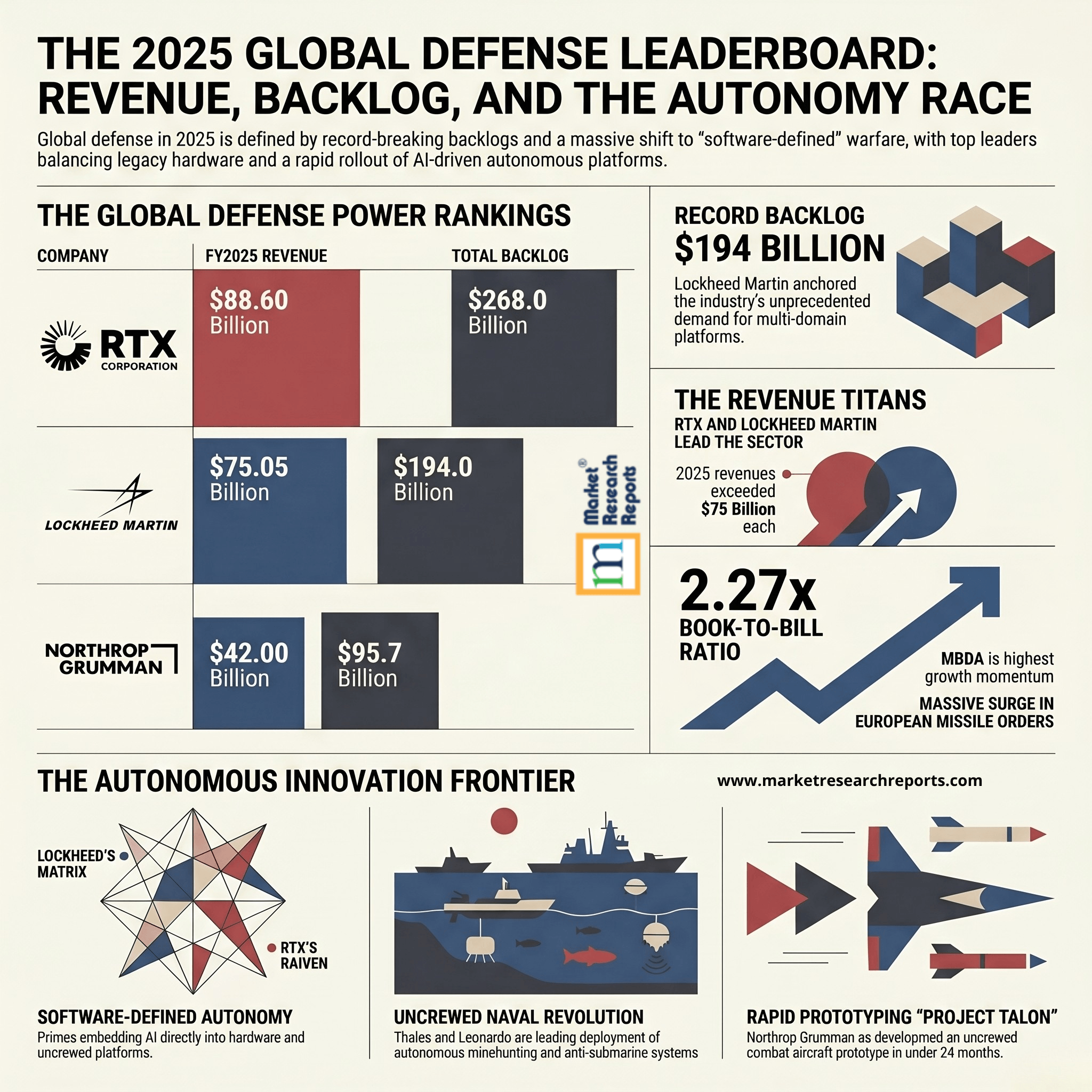
- Delivered total fiscal year 2025 revenues of $75.05 billion, backed by a record-high company backlog of $194 billion.
2. RTX Corporation
RTX Corporation has leveraged its highly diversified aerospace and defense portfolio to capture massive demand across missile systems, advanced sensors, and commercial propulsion. Backed by an immense multi-year backlog, the company is systematically deploying artificial intelligence and digital engineering tools to optimize factory operations and enhance combat systems performance in contested environments.
- Latest Developments (2024–2026):
- Successfully integrated Collins Aerospace's Collaborative Mission Autonomy software onto General Atomics' YFQ-42A Collaborative Combat Aircraft (CCA) for its first semi-autonomous test flight in February 2026.
- Raytheon secured a $1.5 billion U.S. Army contract to deliver nine Lower Tier Air and Missile Defense Sensor (LTAMDS) radars to the U.S. and Poland.
- Pratt & Whitney received $5.3 billion in F135 engine orders, which power all three variants of the F-35 Lightning II.
- Deployed its counter-UAS detection and RF analytics suites at multiple U.S. military bases to improve perimeter monitoring against small drone threats.
- Achieved year-on-year revenue growth of 9.7% and net income growth of 41.0% in fiscal year 2025, generating $7.94 billion in free cash flow.
3. Northrop Grumman Corporation
Northrop Grumman continues to play a central role in national security as a prime contractor for next-generation nuclear modernization and high-altitude autonomous systems. The company is actively bridging the gap between high-end, "exquisite" strategic platforms and low-cost, attritable systems designed for rapid, mass-scale deployment on the modern battlefield.
- Latest Developments (2024–2026):
- Partnered with Kratos Defense in January 2026 to rapidly develop the Marine Corps CCA, combining Northrop's "Prism" open-architecture autonomy software with the Valkyrie UAS.
- Developed "Project Talon," an affordable, uncrewed Collaborative Combat Aircraft (CCA) Increment I prototype, in under 24 months using the "Talon IQ" (formerly Beacon) autonomous testbed.
- Awarded the Low Rate Initial Production (LRIP) Lot 3 contract and advanced procurement funding for Lot 5 for the B-21 Raider stealth bomber program.
- Successfully doubled its solid rocket motor manufacturing capacity at its West Virginia facility, with plans to triple it by early 2027.
- Grew its total order backlog to a record $95.7 billion by the end of fiscal year 2025.
4. BAE Systems plc
BAE Systems represents the backbone of European and British defense electronics and aerospace manufacturing, while maintaining a significant footprint in the U.S. through its highly integrated subsidiaries. The company is actively investing in uncrewed combat platforms, stratospheric endurance flight systems, and digital intelligence tools designed to improve real-time situational awareness across NATO allies.
- Latest Developments (2024–2026):
- Established a landmark strategic partnership between BAE's FalconWorks and Lockheed Martin's Skunk Works in September 2025 to develop uncrewed, rapidly deployable autonomous air systems.
- Royal Marines successfully deployed the BAE-backed T-150 uncrewed air system in the Arctic for cargo resupply and medical trials in April 2026.
- Signed a Memorandum of Understanding (MoU) with Turkish Aerospace in November 2025 to collaborate on uncrewed air systems.
- Developing AI-enabled enhancements for the INTeACT Combat Management System to automate Royal Navy sensor data integration against drone threats.
- Grew its order backlog to £83.6 billion in fiscal year 2025, driven by £36.8 billion in new order intake.
5. L3Harris Technologies, Inc.
Positioning itself as the industry's "Trusted Disruptor," L3Harris Technologies has transitioned from a subsystem component provider to a primary prime systems integrator. The company holds dominant positions in secure software-defined tactical communications, electronic warfare, and proliferated low-Earth orbit (pLEO) space constellations, bridging the gap between legacy primes and agile software-driven startups.
- Latest Developments (2024–2026):
- Announced a major organizational restructure for 2026, consolidating from four segments into three: Space & Mission Systems, Communication & Spectrum Dominance, and Missile Solutions.
- Logged record Q4 orders of $27.5 billion with a 1.3x book-to-bill ratio, led by surging defense bookings.
- Saw its Aerojet Rocketdyne propulsion segment grow by 10% in the fourth quarter of 2025, driven by rocket motor demand.
- Initiated the divestiture of a majority stake in its Space Technology disposal group, scheduled to close in late 2026.
- Advanced its cognitive electronic warfare trials, demonstrating a 40% reduction in data fusion processing times and a 60% increase in jamming resilience.
6. Thales Group
Thales Group serves as the digital shield of Europe, deeply fusing hardware, underwater systems, cybersecurity, and advanced sensors into a highly defensible defense-tech moat. The company remains at the forefront of the naval sector's uncrewed minehunting revolution, deploying highly secure, AI-powered system-of-systems that keep sailors out of harm's way.
- Latest Developments (2024–2026):
- Launched "Expeditionary PathMaster," an AI-boosted uncrewed mine countermeasure (MCM) system featuring the SAMDIS synthetic aperture sonar and cortAIx AI accelerator.
- Selected by the Republic of Singapore Navy in May 2025 to provide a cyber-secured, AI-powered autonomous minehunting system.
- Delivered the world's first operational uncrewed mine countermeasures systems to both the French Navy and the UK Royal Navy.
- Awarded a $13.39 million contract in December 2025 by the UK Royal Navy for portable autonomous command centers for minehunting.
- Reported record fiscal year 2025 sales of $25.6 billion, with the defense segment serving as the primary growth driver.
7. Leonardo S.p.A.
Italy's flagship defense champion, Leonardo, is undergoing a rapid transition to embed itself directly into the software and cyber-security layers of European security. By digitizing its core helicopter, aircraft, and defense electronics lines, the company is successfully capturing high-margin, dual-use markets across southern Europe.
- Latest Developments (2024–2026):
- The Yeovil-developed "Proteus" uncrewed rotary-wing technology demonstrator completed its maiden flight in January 2026 under the Royal Navy's Anti-Submarine Warfare Spearhead Programme.
- Established a strategic joint venture with Turkish uncrewed systems leader Baykar in 2025 to expand its uncrewed systems portfolio.
- Unveiled the "Michelangelo Dome" in November 2025, an advanced integrated air-defense system orchestrating multi-domain sensors and AI command.
- Acquired Iveco Defence in 2025 to expand land domain interoperability and modern combat vehicles capability.
- Achieved full-year 2025 revenues of €19.5 billion, representing a 9.8% year-on-year increase.
8. MBDA
As Europe’s leading designer of complex guided weapons systems, MBDA is investing heavily in manufacturing capacity and next-generation effectors to meet a surge in allied procurement.42 The consortium is driving innovations across hypersonic defense, directed energy laser weapons, and cost-effective uncrewed aerial systems.
- Latest Developments (2024–2026):
- Signed a historic contract with the French DGA in January 2026 for the development and production of the "ONE WAY EFFECTOR" (OWE) single-use saturating strike drone, developed in under 10 months.
- Became a shareholder in UK-based Hybrid Drones Ltd in 2025, culminating in the successful first flight of the HYDRA-400 hybrid jet-electric VTOL drone in March 2026.
- Bagged its first two export contracts for the "Sky Warden" modular counter-UAS system.
- Invested €5 billion in European manufacturing infrastructure over the 2026–2030 period, aiming for a further 40% production rise in 2026.
- Advanced the development of the Future Cruise / Anti-Ship Weapon (FC/ASW) next-generation deep strike missile family.
9. Elbit Systems Ltd.
Israel's Elbit Systems continues to capture strong global demand for its battle-proven unmanned systems, precision-guided munitions, and electronic warfare suites. The company behaves as an agile, internationally focused integrator, actively translating its high-growth backlog into multi-domain modernization solutions.
- Latest Developments (2024–2026):
- Secured an approximately $1.4 billion modernization contract in May 2026 from an unnamed European country, featuring autonomous uncrewed vehicles, electronic warfare, and precision artillery.
- GAAP Net income surged by 66% year-on-year to $534.3 million in fiscal year 2025, on revenues of $7.94 billion.
- Grew its total order backlog to $28.1 billion by the end of 2025, which subsequently surpassed $30 billion in early 2026.
- Generated record free cash flow exceeding $550 million in fiscal year 2025, achieving 100% cash conversion.
- Committed over $500 million to internal R&D and strategic capital expenditure to expand production lines.
10. Hanwha Aerospace Co., Ltd.
South Korea's flagship defense champion, Hanwha Aerospace, is driving a massive global expansion by offering highly competitive land, sea, air, and space solutions. Backed by robust domestic military contracts and rapid-delivery export frameworks, the company has emerged as a key supplier of armored systems and rocket engines to NATO and Indo-Pacific partners.
- Latest Developments (2024–2026):
- Staged the first European live demo of its Arion-SMET multi-purpose UGV in Romania and partnered with Milrem Robotics to establish local uncrewed vehicle production.
- Developing Korea's first built-in starter-generator aircraft engine, designed to supply 100kW of power directly from the rotation shaft to optimize high-power drones.
- Unveiled the "Loitering Precision-Guided Munition (L-PGW)" for the first time during the World Defense Show (WDS 2026) in Riyadh.
- Surpassed ₩26 trillion in consolidated sales and ₩3 trillion in operating profit in fiscal year 2025, driven by land defense revenues doubling in two years.
- Announced plans to acquire ₩500 billion in Korea Aerospace Industries (KAI) shares by the end of 2026, raising its stake to approximately 8%.
Comparative Defense Autonomy Profiles
Table 1: Financial & Backlog Metrics of the top 10 Industry Leaders
Company | FY2024 Revenue | FY2025 Revenue | Total Backlog | Book-to-Bill Ratio |
Lockheed Martin | $71.0 Billion | $75.05 Billion | $194.0 Billion | 1.03x |
RTX Corporation | $80.74 Billion | $88.60 Billion | $268.0 Billion | 1.21x |
Northrop Grumman | $41.03 Billion | $42.00 Billion | $95.7 Billion | 1.10x |
BAE Systems | £28.3 Billion | £30.66 Billion | £83.6 Billion | 1.20x |
L3Harris | $21.3 Billion | $21.87 Billion | $33.0 Billion | 1.30x |
Thales Group | €20.58 Billion | $25.60 Billion | $61.8 Billion | 1.24x |
Leonardo S.p.A. | €17.8 Billion | €19.50 Billion | €46.0 Billion | 1.20x |
MBDA | €4.9 Billion | €5.80 Billion | €44.4 Billion | 2.27x |
Elbit Systems | $6.83 Billion | $7.94 Billion | $28.1 Billion | 1.30x |
Hanwha Aerospace | ₩12.39 Trillion | ₩26.61 Trillion | ₩37.20 Trillion | 1.40x |
Table 2: Primary Autonomous Offerings and Tech Innovations
Company | Flagship Autonomous/Uncrewed Platforms | Domain Focus | Key Technological Feature |
Lockheed Martin | MATRIX flight autonomy, S-70 UAS U-HAWK, Indago 4, Stalker VXE30 | Air & Multidomain | Optionally-piloted helicopter conversion, GPS-denied navigation, on-edge AI |
RTX Corporation | Collins Collaborative Mission Autonomy software, Raytheon RAIVEN EO/IR | Air & Multidomain | Manned-unmanned teaming, local AI-driven real-time threat detection and targeting |
Northrop Grumman | MQ-4C Triton HALE, Project Talon CCA, Talon IQ (Beacon) ecosystem | Air | High-altitude persistent maritime intelligence, rapid prototype digital testing |
BAE Systems | FalconWorks Autonomous Collaborative Platforms, PHASA-35 solar UAS, STRIX | Air & Multidomain | Goal-based autonomous wingman systems, stratospheric ultra-long endurance, VTOL |
L3Harris | Secure software-defined tactical radios, space warning sensors, JADC2 | Multidomain | Miniaturized SmallSat space payloads, jam-resistant cognitive electronic warfare |
Thales Group | PathMaster USV, Expeditionary PathMaster, Toutatis loitering munition | Maritime & Land | cortAIx AI sonar processing engine, autonomous mine countermeasures, seabed mapping |
Leonardo S.p.A. | Proteus uncrewed rotorcraft, AWHero tactical UAS, Falco EVO, Falco Xplorer | Maritime & Air | Anti-submarine warfare uncrewed integration, dual-use border surveillance |
MBDA | ONE WAY EFFECTOR, Sky Warden C-UAS, HYDRA-400 hybrid jet-electric VTOL | Air & Land | Attritable swarm strike, Threat Evaluation & Weapons Assignment (TEWA) AI, heavy-lift |
Elbit Systems | Hermes 900/450, Skylark tactical UAS, Iron Fist active protection system | Air & Land | Battle-proven multi-sensor payloads, autonomous threat defeat, software-defined C4I |
Hanwha Aerospace | Arion-SMET UGV, Small Munition Dronebot, Loitering Precision Munition | Land & Air | Multi-purpose infantry support UGV, secure swarm datalinks, high-power drone engines |
Market Dynamics & Operational Risks
The global defense technology sector is experiencing significant operational adjustments driven by long-term geopolitical demand:
- Mass vs. Complexity: Prime contractors are facing a critical bottleneck: expanding manufacturing capacities for missiles and rocket motors to resolve conventional backlog shortages, while simultaneously building modular assembly lines to mass-produce cheap, attritable uncrewed systems.
- Open Software-Defined Architectures: Militaries are prioritizing the decoupling of uncrewed hardware and software. Open autonomy architectures permit rapid, field-deployable updates and prevent vendor lock-in.
- Supply Chain Vulnerabilities: Scaling uncrewed aircraft has exposed massive dependencies on critical raw materials, such as Chinese-sourced rare-earth magnets for drone motors and Germanium for advanced optical payloads, forcing primes to pursue vertical integration and strategic acquisitions .
Consolidation and Alliances: Primes are acquiring specialized mid-tier developers (e.g., L3Harris acquiring Aerojet Rocketdyne, Lockheed Martin purchasing Terran Orbital) and establishing international joint ventures to secure export channels and accelerate validation.