


Market Research as a Service (RaaS): What It Is and Why It Matters
Market Research as a Service (RaaS): What It Is and Why It Matters
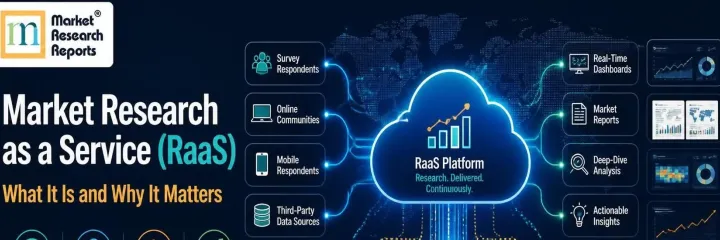
Traditional market research has three structural problems: it is too slow, too expensive, and too inflexible for the pace at which modern organisations need to make strategic decisions. Research as a Service - RaaS - is the model that addresses all three.
What is Research as a Service (RaaS)?
Research as a Service (RaaS) is an on-demand model for accessing professional market intelligence - combining a library of syndicated research with the capability to commission custom intelligence - through a platform that delivers both at the speed and format that modern decision-making requires. Rather than commissioning a bespoke research project through a traditional consulting process, or purchasing static reports through a catalogue-style transaction, RaaS buyers access research intelligence as they need it, in the format they need it, at a consistent quality standard.
MarketResearchReports.com was built from the ground up as a RaaS platform. The architecture - a large library of analyst-validated syndicated reports, a custom research capability with 24–48 hour delivery, multilingual output across 10+ languages, and multiple format options - is designed to match the way strategy teams actually work rather than the way research firms have historically organised their services.
The three problems with traditional market research
Speed. A traditional custom market research engagement from a consulting firm or specialist research house takes 4–12 weeks from brief submission to deliverable. A strategy team preparing a board presentation in three weeks, evaluating an acquisition target under an NDA timeline, or responding to a competitive development cannot wait three months. The research arrives after the decision has been made without it.
Cost. Traditional custom research engagements are priced to recover the full cost of a bespoke project - analyst time, primary research, methodology design, and the overhead of a large professional services firm. For a single focused question, these costs are often disproportionate to the decision being supported. Syndicated reports from legacy providers are cheaper but often available only as large, expensive enterprise subscriptions bundled with coverage that most buyers do not need.
Inflexibility. Traditional research deliverables arrive in a single format, in a single language, at the end of a long process. Organisations that need the same intelligence in a PDF for the analyst team, a PowerPoint for the board, an Excel model for the finance function, and translated into German for the regional management team have historically needed to commission that reformatting separately - or do it themselves.
How RaaS solves each problem
The speed problem is solved by an AI-assisted data processing pipeline that compresses the mechanical components of research production - data extraction, source triangulation, mathematical validation - from weeks to hours, redirecting analyst time to the interpretive and validation work that requires human expertise. The 24–48 hour delivery SLA is the operational result of this architecture, not a marketing claim.
The cost problem is solved by two mechanisms. Syndicated research on the RaaS model amortises production costs across many buyers, as it always has - but the RaaS delivery model eliminates the subscription bundling that inflated costs for buyers who needed specific reports rather than blanket coverage. Custom research on the RaaS model benefits from the same AI-assisted efficiency gains as syndicated research, reducing the analyst time required for a given engagement and passing that efficiency to the buyer in the form of lower costs and faster delivery.
The inflexibility problem is solved by designing the research production pipeline to produce multiple output formats from a single analytical foundation - PDF, Excel data model, PowerPoint deck, Word document - and by building multilingual delivery into the process from the start rather than as an afterthought. Translation at MarketResearchReports.com is handled by professional human translators with domain expertise, not machine translation, across 10+ languages.
RaaS vs. DIY research tools vs. consulting firms
These three approaches serve different purposes and are not strict substitutes.
DIY research tools - survey platforms, data analytics tools, social listening dashboards - give organisations the capability to collect and analyse data themselves. They are valuable for ongoing operational intelligence (brand tracking, customer satisfaction, competitive pricing monitoring) but require internal analytical capability and significant time investment. They do not produce the validated market sizing, competitive landscape, and forecast intelligence that strategic decisions typically require.
Traditional consulting firms provide deep strategic advisory on top of research - they do not just deliver data, they interpret it and recommend action. This added value is reflected in the cost. For organisations that need strategic advisory as well as market intelligence, a consulting engagement may be appropriate. For organisations that need the intelligence to inform their own strategic thinking, a RaaS platform provides the same analytical foundation at a fraction of the cost.
RaaS platforms sit between these two. They provide professional, analyst-validated market intelligence at the speed and cost efficiency of a technology platform, without the strategic advisory layer. The intelligence informs the client's own decision-making rather than replacing it.
What to look for in a RaaS platform
Five qualities distinguish credible RaaS platforms from research catalogues that have adopted the RaaS label without the operational substance.
Published methodology. A RaaS platform whose research process is transparent enough to describe in detail - specific quality checkpoints, named analyst sign-off, documented source triangulation requirements - is operating a defined process. Vague descriptions of "rigorous research" are not a methodology.
Human analyst validation. AI-assisted data processing without human analyst review at the quality assurance stage produces faster but less reliable outputs. The value of the hybrid model - AI for mechanical processing, human analysts for interpretive validation - is the ability to be both fast and rigorous.
Delivery speed that is operationally real. A 24–48 hour delivery claim supported by an AI-assisted pipeline and a defined quality process is credible. The same claim from a platform without these capabilities is a marketing aspiration.
Format and language range. A platform that delivers only PDF reports in English covers only a portion of the format and language requirements of multinational strategy teams. Multiple output formats and professional multilingual delivery are operationally significant capabilities, not differentiators.
Transparent pricing. Research intelligence should be priced without hidden fees, scope ambiguity surcharges, or post-delivery cost adjustments. Transparent pricing at the point of enquiry - not after a scoping call - is the mark of a provider who knows what their research costs and is confident in its value.
The future of RaaS
The next evolution of RaaS is deeper integration between the AI-assisted research pipeline and the formats in which intelligence is consumed - directly integrated into the tools where strategic decisions are made (presentations, financial models, board packs) rather than delivered as separate documents. Multilingual delivery is becoming a standard expectation rather than a premium service as global organisations require consistent intelligence across geographies. And the boundary between syndicated and custom research will continue to blur as on-demand generation capabilities make highly specific research accessible at syndicated timelines and cost structures.
MarketResearchReports.com is the world's premier RaaS platform, combining access to a large library of analyst-validated syndicated reports with a custom research capability delivering intelligence in 24–48 hours across 25 industries, in 10+ languages, in any professional format. Browse our report library, explore our custom research service, or see how our research is built.