Global Food Safety Testing Market Strategic Research Report
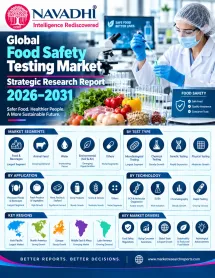
By Type: Pathogen (E.Coli, Salmonella, Listeria, Other), Genetically Modified Organism, Allergen, Mycotoxin, Chemical and Pesticides, Other
By Application: Meat Poultry & Seafood, Dairy Products, Processed Foods, Fruits & Vegetables, Other
Regional Forecast: Asia Pacific, Latin America, MEA, Europe, North America
Key Players: Eurofins Scientific SE, SGS S.A., Intertek Group plc, Mérieux NutriSciences, Bureau Veritas, ALS Limited, TÜV SÜD, NSF International, Romer Labs, Microbac Laboratories
Overzicht
The global food safety testing market is valued at approximately USD 26.08 billion in 2025 and is projected to grow at an 8.25% CAGR to approximately USD 41.96 billion by 2031. This is a mature, well-established sub-sector of the broader testing, inspection, and certification (TIC) industry, anchored by a small number of large, diversified, publicly-listed global players alongside a long tail of specialized food-safety-focused laboratories.
Real, Current, Critical Competitive Intelligence
Bureau Veritas entered a real, confirmed agreement to sell its Food testing business to Mérieux NutriSciences, announced October 2024 -- the single most structurally important development in this market. Bureau Veritas remains one of the world's largest TIC companies overall (real FY2025 revenue EUR 6.4664 billion) but is no longer a current competitor in food safety testing specifically. Real FY2025 results were also independently verified for Eurofins Scientific (revenue EUR 7.296 billion, +3.7% organic, confirmed double-digit Food & Feed testing growth in Asia-Pacific), SGS (revenue CHF 6.945 billion, +5.6% organic), and Intertek (revenue GBP 3.432 billion, +4.3% constant currency).
Scope of the Global Food Safety Testing Market Strategic Research Report
This report provides market sizing (value) across test type and food category segments, and regional/country splits, through 2031, grounded in real, current competitive intelligence including the structurally important Bureau Veritas/Mérieux NutriSciences transaction.
Segment by Test Type
- Pathogen (E.Coli, Salmonella, Listeria, Other)
- Genetically Modified Organism (GMO)
- Allergen
- Mycotoxin
- Chemical & Pesticides
- Other
Segment by Food Tested
- Meat, Poultry & Seafood
- Dairy Products
- Processed Foods
- Fruits & Vegetables
- Other
Who Can Use This Report?
This research report is ideal for people who need a granular, evidence-based view of the global food safety testing market grounded in real, current competitive developments. Some of the intended users are:
- Food and beverage manufacturers evaluating testing partner selection amid real, current competitive restructuring
- Investment analysts assessing TIC sector consolidation and portfolio-focus strategies
- Regulatory and compliance teams tracking the real, ongoing shift toward rapid and molecular testing technologies
- M&A advisors evaluating further consolidation opportunities in a market where a major divestiture has just reshaped the competitive landscape
Market snapshot
Global Food Safety Testing Market Strategic Research Report snapshot, 2026–2031
 © MarketResearchReports.comDisclaimer: The actual data may vary in the final report which undergoes verification check post order confirmation.
Segments covered in this report
Table of contents
01Executive Summary
- 1.1 Market Synopsis
- 1.2 Key Market Findings
- 1.3 Report Scope and Methodology
- 1.4 Strategic Implications for Market Participants
- 1.5 Report Navigation Guide
02Industry Overview & Forecast
- 2.1 Market Definition & Scope
- 2.2 Market Value Forecast, 2026–2031
- 2.3 Historical Market Review, 2022–2025
- 2.4 Regional Market Contribution
- 2.5 Segment Contribution at the Base Year
- 2.6 Scenario Analysis: Base, Bull, and Bear Cases
03Market Segmentation by Type
- 3.1 Market by Test Type Overview
- 3.2 Pathogen Testing
- 3.2.1 E. coli Testing
- 3.2.2 Salmonella Testing
- 3.2.3 Listeria Testing
- 3.2.4 Other Pathogen Testing
- 3.3 Genetically Modified Organism (GMO) Testing
- 3.4 Allergen Testing
- 3.5 Mycotoxin Testing
- 3.6 Chemical and Pesticide Testing
- 3.7 Other Test Types
- 3.8 Comparative Segment Trajectory and Forecast Summary
04Market Segmentation by Application
- 4.1 Overview of Application-Based Segmentation
- 4.2 Meat, Poultry & Seafood
- 4.2.1 Segment Position and Market Size
- 4.2.2 Pathogen Risk as the Core Testing Driver
- 4.2.3 Seafood: A Growing Sub-Dimension
- 4.2.4 Competitive Service Delivery in This Segment
- 4.3 Dairy Products
- 4.3.1 Segment Position and Market Size
- 4.3.2 Regulatory Architecture and Testing Mandate Density
- 4.3.3 Adulteration and Authenticity Testing: A Structural Growth Driver
- 4.3.4 Allergen Testing as an Expanding Sub-Category
- 4.4 Processed Foods
- 4.4.1 Segment Position and Market Size
- 4.4.2 Allergen and GMO Testing Intensity
- 4.4.3 Chemical Contaminants and Additive Compliance
- 4.4.4 E-Commerce and Private Label Dynamics
- 4.5 Fruits & Vegetables
- 4.5.1 Segment Position and Market Size
- 4.5.2 Pesticide Residue Testing as the Dominant Driver
- 4.5.3 Mycotoxin Testing in Fruits and Vegetables
- 4.5.4 Fresh Produce Supply Chain Globalisation
- 4.6 Other Food Categories
- 4.6.1 Segment Composition and Market Size
- 4.7 Cross-Segment Analytical Themes
- 4.7.1 Regulatory Convergence and Testing Frequency Escalation
- 4.7.2 Technology Adoption Differentiation by Segment
- 4.7.3 Supply Chain Integration and On-Site Testing Penetration
- 4.7.4 Emerging Segment: Alternative Proteins and Novel Foods
- 4.8 Application Segment Outlook: 2026–2031
05Regional Market Forecast
- 5.1 North America
- 5.1.1 Regional Overview
- 5.1.2 Key Growth Drivers
- 5.1.3 Regulatory & Infrastructure Landscape
- 5.1.4 Country-Level Analysis
- 5.1.4.1 United States
- 5.1.4.2 Canada
- 5.1.4.3 Rest of North America
- 5.1.5 Market Forecast 2025–2031
- 5.2 Europe
- 5.2.1 Regional Overview
- 5.2.2 Key Growth Drivers
- 5.2.3 Regulatory & Infrastructure Landscape
- 5.2.4 Country-Level Analysis
- 5.2.5 Market Forecast 2025–2031
- 5.3 Asia Pacific
- 5.3.1 Regional Overview
- 5.3.2 Key Growth Drivers
- 5.3.3 Regulatory & Infrastructure Landscape
- 5.3.4 Country-Level Analysis
- 5.3.5 Market Forecast 2025–2031
- 5.4 Latin America
- 5.4.1 Regional Overview
- 5.4.2 Key Growth Drivers
- 5.4.3 Regulatory & Infrastructure Landscape
- 5.4.4 Country-Level Analysis
- 5.4.4.1 Brazil
- 5.4.4.2 Argentina
- 5.4.4.3 Rest of Latin America
- 5.4.5 Market Forecast 2025–2031
- 5.5 Middle East & Africa
- 5.5.1 Regional Overview
- 5.5.2 Key Growth Drivers
- 5.5.3 Regulatory & Infrastructure Landscape
- 5.5.4 Country-Level Analysis
- 5.5.5 Market Forecast 2025–2031
06Country-Level Market Forecast
- 6.1 North America
- 6.1.1 United States
- 6.1.2 Canada
- 6.1.3 Rest of North America
- 6.2 Europe
- 6.2.1 United Kingdom
- 6.2.2 Germany
- 6.2.3 France
- 6.2.4 Spain
- 6.2.5 Italy
- 6.2.6 Rest of Europe
- 6.3 Asia Pacific
- 6.3.1 China
- 6.3.2 India
- 6.3.3 Japan
- 6.3.4 Singapore
- 6.3.5 Australia
- 6.3.6 Rest of Asia Pacific
- 6.4 Latin America
- 6.4.1 Brazil
- 6.4.2 Argentina
- 6.4.3 Rest of Latin America
- 6.5 Middle East & Africa
- 6.5.1 South Africa
- 6.5.2 United Arab Emirates
- 6.5.3 Rest of Middle East & Africa
07Growth Drivers & Inhibitors
- 7.1 Regulatory Stringency and Mandatory Testing Expansion
- 7.2 Technology Transition
- 7.3 Market Restraints
- 7.3.1 Capital and Accreditation Barriers to Advanced Testing
- 7.3.2 Market Concentration Risk from Structural Consolidation
- 7.3.3 Price Competition in the Traditional Testing Tier
- 7.4 Opportunities and White-Space Analysis
- 7.4.1 Emerging Contaminant Categories: PFAS and Beyond
- 7.4.2 Asia-Pacific Expansion Opportunities
- 7.4.3 Post-Consolidation M&A and Portfolio Reconfiguration Opportuni…
- 7.5 Aggregate Driver-Inhibitor Assessment
08Key Company Profiles
- 8.1 Eurofins Scientific SE
- 8.1.1 Company Overview
- 8.1.2 Key Products & Segments
- 8.1.3 Financial Performance (2023–2025)
- 8.1.4 Business Strategy
- 8.1.5 SWOT Analysis
- 8.1.6 Strategic Implications (2025–2031)
- 8.2 SGS S.A.
- 8.2.1 Company Overview
- 8.2.2 Key Products & Segments
- 8.2.3 Financial Performance (2023–2025)
- 8.2.4 Business Strategy
- 8.2.5 SWOT Analysis
- 8.2.6 Strategic Implications (2025–2031)
- 8.3 Intertek Group plc
- 8.3.1 Company Overview
- 8.3.2 Key Products & Segments
- 8.3.3 Financial Performance (2023–2025)
- 8.3.4 Business Strategy
- 8.3.5 SWOT Analysis
- 8.3.6 Strategic Implications (2025–2031)
- 8.4 ALS Limited
- 8.4.1 Company Overview
- 8.4.2 Key Products & Segments
- 8.4.3 Financial Performance (2023–2025)
- 8.4.4 Business Strategy
- 8.4.5 SWOT Analysis
- 8.4.6 Strategic Implications (2025–2031)
- 8.5 TÜV SÜD
- 8.5.1 Company Overview
- 8.5.2 Key Products & Segments
- 8.5.3 Financial Performance (2023–2025)
- 8.5.4 Business Strategy
- 8.5.5 SWOT Analysis
- 8.5.6 Strategic Implications (2025–2031)
- 8.6 NSF International
- 8.6.1 Company Overview
- 8.6.2 Key Products & Segments
- 8.6.3 Financial Performance (2023–2025)
- 8.6.4 Business Strategy
- 8.6.5 SWOT Analysis
- 8.6.6 Strategic Implications (2025–2031)
- 8.7 Romer Labs
- 8.7.1 Company Overview
- 8.7.2 Key Products & Segments
- 8.7.3 Financial Performance (2023–2025)
- 8.7.4 Business Strategy
- 8.7.5 SWOT Analysis
- 8.7.6 Strategic Implications (2025–2031)
- 8.8 Microbac Laboratories
- 8.8.1 Company Overview
- 8.8.2 Key Products & Segments
- 8.8.3 Financial Performance (2023–2025)
- 8.8.4 Business Strategy
- 8.8.5 SWOT Analysis
- 8.8.6 Strategic Implications (2025–2031)
- 8.9 Mérieux NutriSciences
- 8.9.1 Company Overview
- 8.9.2 Key Products & Segments
- 8.9.3 Financial Performance (2023–2025)
- 8.9.4 Business Strategy
- 8.9.5 SWOT Analysis
- 8.9.6 Strategic Implications (2025–2031)
- 8.10 Bureau Veritas
- 8.10.1 Company Overview
- 8.10.2 Key Products & Segments
- 8.10.3 Financial Performance (2023–2025)
- 8.10.4 Business Strategy
- 8.10.5 SWOT Analysis
- 8.10.6 Strategic Implications (2025–2031)
09Competitive Landscape
- 9.1 Competitive Landscape Overview
- 9.1.1 Market Concentration and the Post-Divestiture Landscape
- 9.1.2 Estimated Top-Five Market Share Distribution
- 9.1.3 Herfindahl-Hirschman Index and Competitive Intensity
- 9.2 Competitive Intensity Assessment
- 9.2.1 Tier Structure and Revenue Ranges
- 9.2.2 Capacity vs. Demand Dynamics
- 9.2.3 Pricing Environment
- 9.2.4 Barriers to Entry and Exit
- 9.3 Key Player Strategies & Positioning
- 9.4 Competitive Dynamics & Strategic Outlook
- 9.4.1 Emerging Competitive Threats and New Entrant Dynamics
- 9.4.2 Consolidation vs Fragmentation Outlook
- 9.4.3 Competitive Response Matrix
- 9.4.4 Strategic Recommendations for 2025–2031
10Porter's Five Forces Analysis
- 10.1 Threat of New Entrants
- 10.2 Bargaining Power of Buyers
- 10.3 Bargaining Power of Suppliers
- 10.4 Threat of Substitutes
- 10.5 Competitive Rivalry
11PESTLE Analysis
- 11.1 Political Factors
- 11.1.1 Government Prioritisation of Food Safety as a Public Health Im…
- 11.1.2 Trade Policy and Import/Export Testing Requirements
- 11.1.3 Political Instability and Supply Chain Fragmentation
- 11.1.4 National Food Safety Agency Capacity and Enforcement
- 11.2 Economic Factors
- 11.2.1 Market Sizing and Structural Growth Drivers
- 11.2.2 Inflationary Pressures and Cost-Pass-Through Dynamics
- 11.2.3 Emerging Market Expansion and Investable Capacity Growth
- 11.2.4 Currency and FX Exposure
- 11.2.5 M&A Economics and Market Consolidation
- 11.3 Social and Demographic Factors
- 11.3.1 Rising Consumer Awareness and Demand Transparency
- 11.3.2 Urbanisation and the Growth of Processed and Packaged Foods
- 11.3.3 Dietary Diversification, Allergen Sensitivity, and Specialty T…
- 11.3.4 Global Population Growth and Food Security Pressures
- 11.3.5 Labour Market Dynamics in Laboratory Services
- 11.4 Technological Factors (Rapid and Molecular Testing Technology…
- 11.4.1 The Structural Shift Away from Traditional Culture-Based Methods
- 11.4.2 Rapid Testing Methods: PCR, LFIA, and ELISA
- 11.4.3 Molecular Testing Methods
- 11.4.4 Combined Rapid and Molecular Share Exceeds Traditional Methods
- 11.4.5 Automation, Robotics, and Laboratory Informatics
- 11.4.6 AI and Predictive Analytics in Testing Workflows
- 11.5 Legal and Regulatory Factors
- 11.5.1 The Foundational Role of Regulation in Market Demand Creation
- 11.5.2 Major Regulatory Frameworks Driving Global Testing Volumes
- 11.5.3 Food Fraud Regulation and Authenticity Testing
- 11.5.4 Accreditation Requirements and ISO Standards
- 11.5.5 Evolving Contaminant Regulations and New Parameter Emergence
- 11.6 Environmental Factors
- 11.6.1 Climate Change and Shifting Contamination Risk Profiles
- 11.6.2 Extreme Weather Events and Supply Chain Disruption
- 11.6.3 Sustainability Pressures and ESG-Driven Testing Demand
- 11.6.4 Agrochemical Usage and Pesticide Residue Monitoring
- 11.6.5 Laboratory Environmental Footprint and Sustainability
- 11.7 PESTLE Summary: Integrated Strategic Implications
12SWOT Analysis
- 12.1 Introduction
- 12.2 Market-Level Strengths
- 12.2.1 Structural Demand Inelasticity Anchored in Regulatory Mandate
- 12.2.2 Established and Diversified Test Type Infrastructure
- 12.2.3 Rapid and Molecular Technology Maturity Delivering Competitive…
- 12.2.4 Global Scale of Established TIC Group Infrastructure
- 12.2.5 Supply Chain Globalisation as a Persistent Demand Driver
- 12.3 Market-Level Weaknesses
- 12.3.1 Significant Fragmentation Below the Tier-1 Layer
- 12.3.2 High Capital and Operational Cost of Maintaining Accreditation…
- 12.3.3 Shortage of Qualified Scientific and Technical Personnel
- 12.3.4 Price Sensitivity and Commoditisation Risk in Routine Testing
- 12.3.5 Uneven Quality and Infrastructure in High-Growth Developing Ma…
- 12.4 Strategic Opportunities
- 12.4.1 Accelerating Asia-Pacific Regulatory Tightening and Enforcemen…
- 12.4.2 Consolidation Opportunity Created by the Bureau Veritas Divest…
- 12.4.3 Rapid and Molecular Technology Adoption as a Value-Creation Ve…
- 12.4.4 AI-Assisted Pathogen Detection and Predictive Analytics Integr…
- 12.4.5 Blockchain-Based Traceability Integration as a Premium Service…
- 12.4.6 Emerging Contaminant Categories Expanding the Testing Universe
- 12.5 External Threats
- 12.5.1 Geopolitical Trade Fragmentation and Supply Chain Reshoring
- 12.5.2 Acceleration of In-House Testing Technology Among Large Food P…
- 12.5.3 Regulatory Uncertainty and Divergence Across Jurisdictions
- 12.5.4 Cybersecurity Risk and Data Integrity Vulnerability
- 12.5.5 Macroeconomic Pressure on Food Industry Capital Expenditure
- 12.5.6 Reputation Risk from High-Profile Food Safety Failures and Att…
- 12.6 SWOT Summary
13Future Trends & Outlook
- 13.1 Technology Convergence and the Acceleration of AI-Assisted Pat…
- 13.2 Blockchain-Based Food Traceability Integration
- 13.3 Continued Rapid and Molecular Technology Adoption
- 13.4 Long-Term Market Outlook, 2032–2035
- 13.5 Investment and M&A Activity Outlook Post-Bureau Veritas Divest…
Tables and figures
- 2.1 Exhibit 2.1: Forecast of Global (in USD Bn)
- 2.2 Exhibit 2.2: Forecast of Global Market YoY Growth Rate & CAGR Summary (in %)
- 2.3 Exhibit 2.3: Forecast of North America (in USD Bn)
- 2.4 Exhibit 2.4: Forecast of Europe (in USD Bn)
- 2.5 Exhibit 2.5: Forecast of Asia Pacific (in USD Bn)
- 2.6 Exhibit 2.6: Forecast of Latin America (in USD Bn)
- 2.7 Exhibit 2.7: Forecast of Middle East & Africa (in USD Bn)
- 3.8 Exhibit 3.8: Forecast of Pathogen -- E.Coli (in USD Bn)
- 3.9 Exhibit 3.9: Forecast of Pathogen -- Salmonella (in USD Bn)
- 3.10 Exhibit 3.10: Forecast of Pathogen -- Listeria (in USD Bn)
- 3.11 Exhibit 3.11: Forecast of Pathogen -- Other (in USD Bn)
- 3.12 Exhibit 3.12: Forecast of Genetically Modified Organism (GMO) (in USD Bn)
- 3.13 Exhibit 3.13: Forecast of Allergen (in USD Bn)
- 3.14 Exhibit 3.14: Forecast of Mycotoxin (in USD Bn)
- 3.15 Exhibit 3.15: Forecast of Chemical & Pesticides (in USD Bn)
- 3.16 Exhibit 3.16: Forecast of Other Test Types (in USD Bn)
- 4.17 Exhibit 4.17: Forecast of Meat, Poultry & Seafood (in USD Bn)
- 4.18 Exhibit 4.18: Forecast of Dairy Products (in USD Bn)
- 4.19 Exhibit 4.19: Forecast of Processed Foods (in USD Bn)
- 4.20 Exhibit 4.20: Forecast of Fruits & Vegetables (in USD Bn)
- 4.21 Exhibit 4.21: Forecast of Other Food Categories (in USD Bn)
- 6.22 Exhibit 6.22: Forecast of North America (in USD Bn)
- 6.23 Exhibit 6.23: Forecast of United States (in USD Bn)
- 6.24 Exhibit 6.24: Forecast of Canada (in USD Bn)
- 6.25 Exhibit 6.25: Forecast of Rest of North America (in USD Bn)
- 6.26 Exhibit 6.26: Forecast of Europe (in USD Bn)
- 6.27 Exhibit 6.27: Forecast of United Kingdom (in USD Bn)
- 6.28 Exhibit 6.28: Forecast of Germany (in USD Bn)
- 6.29 Exhibit 6.29: Forecast of France (in USD Bn)
- 6.30 Exhibit 6.30: Forecast of Spain (in USD Bn)
- 6.31 Exhibit 6.31: Forecast of Italy (in USD Bn)
- 6.32 Exhibit 6.32: Forecast of Rest of Europe (in USD Bn)
- 6.33 Exhibit 6.33: Forecast of Asia Pacific (in USD Bn)
- 6.34 Exhibit 6.34: Forecast of China (in USD Bn)
- 6.35 Exhibit 6.35: Forecast of India (in USD Bn)
- 6.36 Exhibit 6.36: Forecast of Japan (in USD Bn)
- 6.37 Exhibit 6.37: Forecast of Singapore (in USD Bn)
- 6.38 Exhibit 6.38: Forecast of Australia (in USD Bn)
- 6.39 Exhibit 6.39: Forecast of Rest of Asia Pacific (in USD Bn)
- 6.40 Exhibit 6.40: Forecast of Latin America (in USD Bn)
- 6.41 Exhibit 6.41: Forecast of Brazil (in USD Bn)
- 6.42 Exhibit 6.42: Forecast of Argentina (in USD Bn)
- 6.43 Exhibit 6.43: Forecast of Rest of Latin America (in USD Bn)
- 6.44 Exhibit 6.44: Forecast of Middle East & Africa (in USD Bn)
- 6.45 Exhibit 6.45: Forecast of South Africa (in USD Bn)
- 6.46 Exhibit 6.46: Forecast of United Arab Emirates (in USD Bn)
- 6.47 Exhibit 6.47: Forecast of Rest of Middle East & Africa (in USD Bn)
Frequently asked questions
What is the size of the global food safety testing market?
Is Bureau Veritas still a major food safety testing competitor?
Who is the largest pure-play food testing specialist?
How many companies and countries does this report cover?
Who are the key companies profiled?
Research Methodology
All MarketResearchReports.com strategic research reports follow a rigorous, multi-stage methodology combining AI-assisted data synthesis with expert analyst validation.
Systematic collection from 500+ verified sources including SEC filings, industry databases (Bloomberg, Statista, OECD), regulatory filings, trade publications, patent databases, and company annual reports. AI-assisted extraction identifies relevant data points across 10,000+ documents per report.
Dual-validation approach: bottom-up sizing aggregates segment-level production, consumption, and trade data; top-down sizing cross-validates against macroeconomic indicators and total addressable market estimates. Discrepancies >5% trigger analyst review.
Company profiles built from public financial disclosures, product launches, M&A activity, job postings (as capability proxies), and supply chain mapping. Market share estimates triangulated across revenue, capacity, and shipment data.
CAGR projections use time-series regression on 5-10 years of historical data, adjusted for identified demand drivers (technology adoption curves, regulatory catalysts, demographic shifts) and demand inhibitors (cost barriers, substitution risk). Scenario modeling covers base, optimistic, and conservative cases.
All quantitative outputs reviewed by a domain-specialist analyst before publication. Data triangulation requires minimum 3 independent sources for every key figure. Reports undergo a structured peer review against our 47-point quality checklist covering methodology, data citations, logical consistency, and formatting standards.
On-demand reports are generated at time of purchase, incorporating the most recent available data. Static reports are republished when underlying market conditions shift by >10% from baseline assumptions. Purchasers receive update notifications for 12 months.
Related reports
 Navadhi Market Research · Food & Beverages
Global Infant Formula Human Milk Oligosaccharides Market Strategic Research Report
The global infant formula human milk oligosaccharides (HMO) market has emerged as one of the most scientifically significant and commercially consequential segments …
Navadhi Market Research · Food & BeveragesGlobal Automated Commercial Kitchen Robotics Market Strategic Research Report
The global automated commercial kitchen robotics market is undergoing a decisive structural shift as food service operators confront a persistent labor shortage, mou…
Navadhi Market Research · Food & BeveragesGlobal Direct To Consumer Coffee Subscription Market Strategic Research Report
The global direct-to-consumer (DTC) coffee subscription market has emerged as one of the most commercially compelling intersections of specialty food culture, recurr…
Need a customized version?
Get country-, segment- or company-specific intelligence tailored to your exact requirements.
Request custom research →Request a free sample
Receive a sample of Global Food Safety Testing Market Strategic Research Report before you buy.
Customize This Report
Describe your specific requirements and our analysts will scope and deliver a tailored version.
Request Invoice
We will email a proforma invoice within 24 hours. Report access is granted upon payment confirmation.
Leading Brands in This Industry