

Global Maritime Insurance Market Strategic Research Report

Regional Forecast: Asia Pacific, Latin America, MEA, Europe, North America
Key Players: Lloyd's of London, Allianz Commercial, Gard P&, I Club, NorthStandard P&, I Club, AXA XL, Tokio Marine Group, Swiss Re, Beazley PLC, PICC Property and Casualty Company Limited, Markel Corporation, Chubb Limited, Skuld (Assuranceforeningen Skuld)
Visão geral
The global maritime insurance market is projected to grow from USD 39.92 billion in 2024 to USD 70.0 billion by 2031, at a blended CAGR of approximately 4.70% under the Base Case scenario - representing the net outcome of structural long-term premium growth, an unprecedented war risk premium surge driven by the Iran-Hormuz War of February 2026, and a gradual post-crisis normalisation through 2027–2028. This growth is neither uniform across product segments nor insulated from material near-term volatility. The 2026 forecast year is the most structurally disrupted in modern maritime insurance history, with total premiums estimated at USD 55.8 billion - a step-change driven by war risk Additional Premiums surging from 0.025% to 5–10%+ of hull value for Hormuz transit coverage within 14 days of the US-Israeli strikes on Iran on February 28, 2026.
The defining characteristic of the 2026–2031 maritime insurance cycle is its bifurcation. Commodity cargo and standard hull markets - accounting for 57% and 24% of global premiums respectively - will experience continued competitive pressure as market capacity remains abundant and pricing discipline is tested by broker-led competition in benign risk environments. Meanwhile, specialty lines - war risk, marine cyber, offshore energy, and P&I liability - operate as constrained-capacity oligopolies where the combination of regulatory approval barriers, actuarial data moats, and reinsurance treaty access creates structural pricing authority unavailable in commodity lines. The Hormuz crisis has crystallised this bifurcation in real time: commodity marine insurers face claims exposure on Gulf-transiting portfolios, while war risk specialists are generating the highest per-policy premium revenues in the industry's modern history.
Marine cyber insurance stands apart as the singular high-conviction growth theme across all scenarios - projected at 52% CAGR from its 2024 base, driven by the Iranian Revolutionary Guard Corps' GPS spoofing operations in the Gulf of Oman during the Hormuz crisis, the IMO's mandatory cyber risk management framework, and the accelerating digitisation of vessel navigation and port management systems. This growth trajectory is not dependent on geopolitical outcomes - it is structurally mandated by regulatory requirements and commercially accelerated by demonstrated threat events.
| Key Metric | Value / Detail |
| 2024 Market Size (Confirmed) | USD 39.92 billion - all-time high; +1.5% on 2023 |
| 2026F Market Size (Base Case) | USD 55.8 billion - war risk premium surge drives step-change |
| 2031F Market Size (Base Case) | USD 70.0 billion - structural growth normalises post-crisis |
| CAGR 2026–2031 (Base Case) | 4.70% - structural premium growth across all lines |
| CAGR 2026–2031 (Bear Case - Extended Conflict) | 3.40% - prolonged disruption suppresses trade volumes |
| CAGR 2026–2031 (Bull Case - Rapid Resolution) | 7.90% - pent-up demand surge post-normalisation |
| Largest Segment 2024 | Marine Cargo - USD 22.64 billion (57.23% share) |
| Fastest Growing Segment | Marine Cyber Insurance - 52.0% CAGR 2026–2031F |
| War Risk AP Range (March 2026) | 2.5–10%+ of hull value (vs 0.025–0.125% pre-crisis) |
| Hormuz Transit Collapse (1 Mar 2026) | 81% decline - from ~77 transits/day to ~4 supertanker transits |
| Largest Geographic Market 2024 | Europe - ~48.7% of global marine premium |
| Fastest Growing Region | Asia-Pacific - 8.2% CAGR 2026–2031F (China = 17.6% of cargo) |
| IG P&I Clubs Collective Free Reserves | USD 5.7 billion - all-time high (2024) |
| Defining Near-Term Risk | Iran-Hormuz War (Feb 2026) - actuarial blockade mechanism |
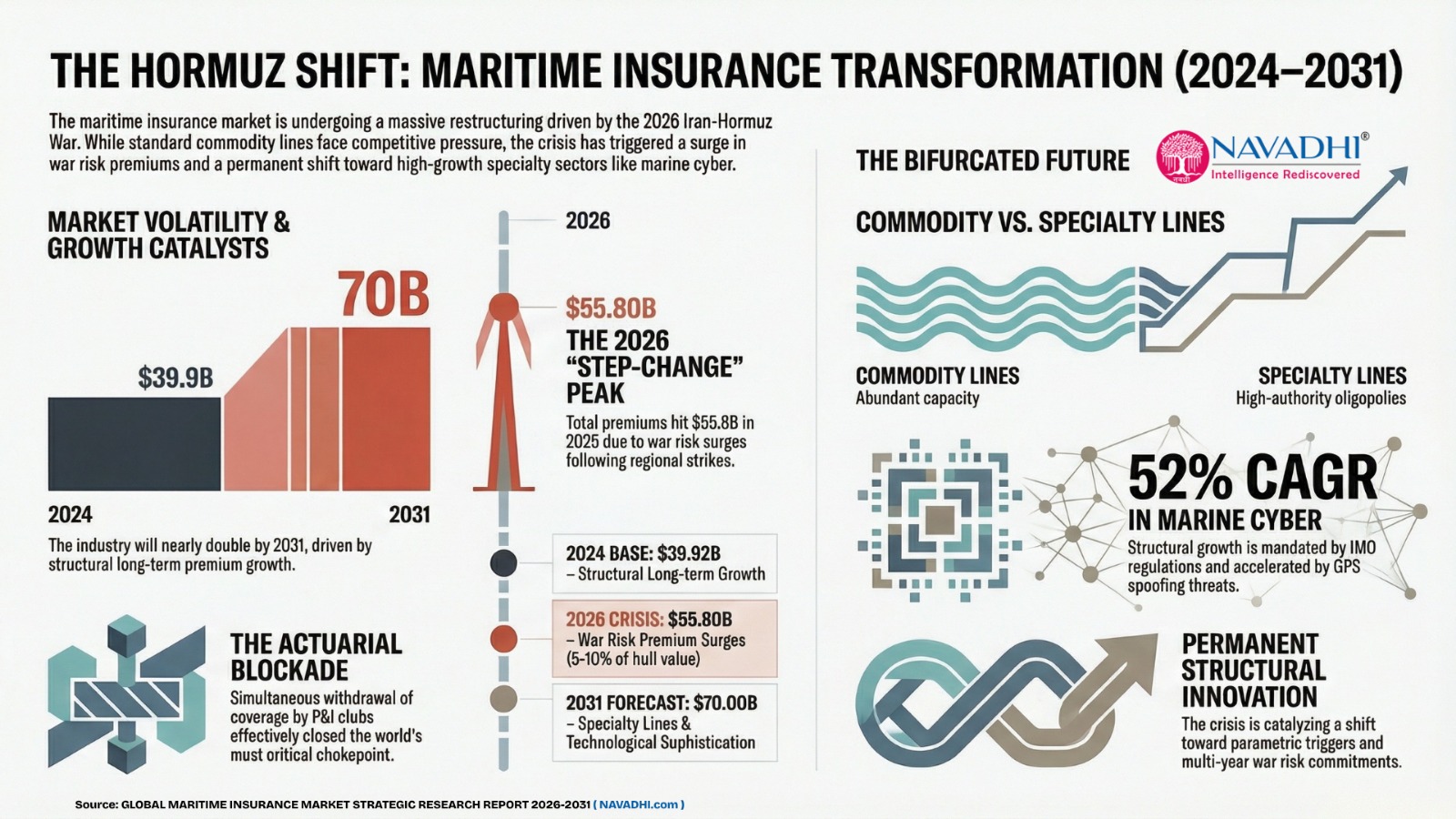
The Iran-Hormuz War of 2026 is not merely a short-term premium inflator - it is a market-restructuring event. The 'actuarial blockade' mechanism it demonstrated - whereby seven P&I clubs simultaneously withdrawing war risk coverage effectively closed the world's most critical maritime chokepoint without a single mine or blockade - will permanently alter how shipowners, cargo owners, and regulators structure their insurance arrangements. Multi-year war risk coverage commitments, parametric trigger products, and government-backed war risk facilities are all structural market innovations that the crisis will catalyse through 2027–2028. The maritime insurance market that emerges from the Hormuz crisis will be structurally larger, more premium-intensive, and more technologically sophisticated than the one that entered it.
Scope of Global Maritime Insurance Market Strategic Research Report 2026-2031
- This report provides forecast data till 2031 for the overall global maritime insurance market and its segments by type (Marine Cargo Insurance, Ocean Hull & Machinery (H&M), Offshore Energy Insurance, War Risk (standalone commercial), Marine Liability (excl. P&I), P&I Club Premiums (IG clubs est.) and Marine Cyber Insurance), thus covering all aspects of the industry.
- This report identifies key growth drivers and inhibitors (pain points) affecting the global maritime insurance market.
- This report provides SWOT (Strengths, Weaknesses, Opportunities and Threats) analysis and competitive landscape for 12 key companies (Sinopec (Lloyd's of London, Allianz Commercial, Gard P&I Club, NorthStandard P&I Club, AXA XL, Tokio Marine Group, Swiss Re, Beazley PLC, PICC Property and Casualty Company Limited, Markel Corporation, Chubb Limited and Skuld (Assuranceforeningen Skuld)) in the global maritime insurance market.
- This report provides Porter’s Five Forces analysis for global maritime insurance market.
- This report provides PESTLE (political, economic, social, technological, legal and environmental) analysis for global maritime insurance market.
- This report provides SWOT (Strengths, Weaknesses, Opportunities and Threats) analysis for global maritime insurance market.
- This report identifies key future trends in the global maritime insurance market.
Segment by Type in Global Maritime Insurance Market
- Marine Cargo Insurance
- Ocean Hull & Machinery (H&M)
- Offshore Energy Insurance
- War Risk (standalone commercial)
- Marine Liability (excl. P&I)
- P&I Club Premiums (IG clubs est.)
- Marine Cyber Insurance
Who can use the Global Maritime Insurance Market Research Report?
This research report is ideal for people who wish to gain a thorough understanding of the maritime insurance market. Some of intended user for this report are:
- C-level executives
- Company Directors
- Industry consultants
- Marketing professionals
- Business development professionals
- Management consultants
- Investment managers
- Financial professionals
- Venture Capitalists
- Bank Managers
- M&A Managers
- Auditors
- Anyone operating in maritime insurance industry value chain.
Market snapshot
Global Maritime Insurance Market Strategic Research Report snapshot, 2025–2031
 © MarketResearchReports.comDisclaimer: The actual data may vary in the final report which undergoes verification check post order confirmation.
Table of contents
01Executive Summary
- Research Methodology
02Scope of Maritime Insurance Market Strategic Research Report 2026-2031
- 2.1 Forecast Period and Base Year
- 2.2 Products and Segments Covered
- 2.3 Geographic Scope
- 2.4 Competitive Landscape Scope
- 2.5 Analytical Framework
03Forecast for Global Maritime Insurance Market 2026-2031
- 3.1 Overall Global Maritime Insurance Market Growth Forecast 2026–2031 (USD Billion)
- 3.2 Scenario Analysis - Three Forecast Trajectories
- 3.3 Segment-Level Forecast - Key Growth Dynamics
- 3.3.1 War Risk Premium Surge and Structural Repricing
- 3.3.2 Global Trade Growth and Cargo Premium Expansion
- 3.3.3 Marine Cyber Insurance Demand Acceleration
- 3.3.4 Offshore Energy Recovery - Wind and Deepwater
- 3.3.5 P&I Fleet Growth and Renewal Rate Momentum
- 3.3.6 Asia-Pacific Market Share Expansion
- 3.4 Global Maritime Insurance Market - Segment Share
- 3.4 .1 Global Maritime Insurance Market - Segment CAGR Growth
- 3.4 .2 Growth Forecast of Global Marine Cargo Insurance Market 2026–2031 (USD Billion)
- 3.4 .3 Growth Forecast of Global Ocean Hull & Machinery Insurance Market 2026–2031 (USD Billion)
- 3.4 .4 Growth Forecast of Global Offshore Energy Insurance Market 2026–2031 (USD Billion)
- 3.4 .5 Growth Forecast of Global War Risk Insurance Market 2026–2031 (USD Billion)
- 3.4 .6 Growth Forecast of Global Marine Liability Insurance Market (excl. P&I) 2026–2031 (USD Billion)
- 3.4 .7 Growth Forecast of Global P&I Club Premium Income 2026–2031 (USD Billion)
- 3.4 .8 Growth Forecast of Global Marine Cyber Insurance Market 2026–2031 (USD Billion)
04Key Growth Drivers for Global Maritime Insurance Market
- 4.1 Iran-Hormuz War: Geopolitical Risk Premium Re-rating
- 4.2 Global Trade Expansion & Seaborne Cargo Growth
- 4.3 Marine Cyber Insurance Demand Acceleration
- 4.4 P&I Club Fleet Growth & Renewal Rate Momentum
- 4.5 Offshore Wind & Deepwater Energy Expansion
- 4.6 Asia-Pacific Market Penetration & China Premium Growth
- 4.7 IMO Regulatory Mandates Creating Non-Discretionary Demand
- 4.8 Parametric & Technology-Enabled Insurance Products
- 4.9 Green Shipping Transition & Alternative Fuel Vessel Insurance
05Key Pain Areas / Growth Inhibitors for the Global Maritime Insurance Market
- 5.1 Hormuz Crisis War Risk Claims Accumulation & Combined Ratio Deterioration
- 5.2 Reinsurance Treaty Capacity Withdrawal & Cost Escalation
- 5.3 P&I Combined Ratio Deterioration - MV Dali Pool Claims & Hormuz FD&D Surge
- 5.4 Geopolitical Fragmentation of Marine Insurance Markets
- 5.5 Market Softening in Commodity Cargo & Hull Lines
- 5.6 Dark Fleet Uninsured Risk & IG Pool Exposure
- 5.7 Marine Cyber Coverage Disputes & War/Cyber Boundary Ambiguity
- 5.8 IMO Green Transition Creating Novel Uninsured Risk Categories
- 5.9 Autonomous Vessel Insurance Vacuum & Regulatory Gap
06Porter’s Five Forces Analysis of Global Maritime Insurance Market
- 6.1 Threat of New Entrants: Low
- 6.2 Bargaining Power of Suppliers: High (Structurally Tiered)
- 6.3 Bargaining Power of Buyers: Moderate (Cyclically Variable, Crisis-Reversed)
- 6.4 Threat of Substitution: Very Low
- 6.5 Intensity of Competitive Rivalry: Moderate (Bifurcated by Segment)
07Key Players in Global Maritime Insurance Market – Competitive Landscape and SWOT Analysis
- 7.1 Lloyd's of London (Lloyd's Market)
- 7.1.1 SWOT Analysis of Lloyd's of London (Lloyd's Market)
- 7.2 Allianz Commercial (AGCS - Allianz Global Corporate & Specialty)
- 7.2.1 SWOT Analysis of Allianz Commercial (AGCS - Allianz Global Corporate & Specialty)
- 7.3 Gard P&I Club
- 7.3.1 SWOT Analysis of Gard P&I Club
- 7.4 NorthStandard P&I Club
- 7.4.1 SWOT Analysis of NorthStandard P&I Club
- 7.5 AXA XL (AXA SA)
- 7.5.1 SWOT Analysis of AXA XL (AXA SA)
- 7.6 Tokio Marine Group (incl. Tokio Marine HCC)
- 7.6.1 SWOT Analysis of Tokio Marine Group (incl. Tokio Marine HCC)
- 7.7 Swiss Re (Marine Reinsurance)
- 7.7.1 SWOT Analysis of Swiss Re (Marine Reinsurance)
- 7.8 Beazley PLC
- 7.8.1 SWOT Analysis of Beazley PLC
- 7.9 PICC Property and Casualty Company Limited (PICC Group)
- 7.9.1 SWOT Analysis of PICC Property and Casualty Company Limited (PICC Group)
- 7.10 Markel Corporation (Marine & Specialty)
- 7.10.1 SWOT Analysis of Markel Corporation (Marine & Specialty)
- 7.11 Chubb Limited
- 7.11.1 SWOT Analysis of Chubb Limited
- 7.12 Skuld (Assuranceforeningen Skuld)
- 7.12.1 SWOT Analysis of Skuld (Assuranceforeningen Skuld)
- 7.13 Competitive Landscape of Key Players in the Global Maritime Insurance Market
- 7.13.1 Capability Matrix
- 7.13.2 Hormuz Crisis Competitive Re-ordering
08PESTLE Analysis of Global Maritime Insurance Market
- 8.1 Political
- 8.2 Economic
- 8.3 Social
- 8.4 Technological
- 8.5 Legal
- 8.6 Environmental
09SWOT Analysis of Global Maritime Insurance Market
10Future Trends in Global Maritime Insurance Market
- 10.1 Permanent War Risk Zone Re-pricing - The New Normal
- 10.2 Parametric Marine Insurance - From Concept to Commercial Mainstream
- 10.3 Marine Cyber Insurance - Fastest-Growing Premium Line
- 10.4 AI-Powered Real-Time Underwriting - Market Transformation
- 10.5 Green Shipping Transition - A New and Poorly-Priced Risk Category
- 10.6 Autonomous Vessel Insurance - The Regulatory Vacuum
- 10.7 China's Insurance Market Dominance - The Long-Term Structural Shift
11Regional Analysis of Global Maritime Insurance Market
- 11.1 Europe - The Lloyd's/London Market Anchor (48.7% of Global Marine Premium 2024)
- 11.2 Asia-Pacific - Centre of Gravity Shift (38.2% Market Share, Fastest Growing Region)
- 11.3 Middle East - The Epicentre (Structural Premium Destruction in Near-Term; Reconstruction Opportunity Medium-Term)
- 11.4 North America - Shale-Driven Growth With Hormuz Upside
- List of Exhibits
- Notes
- Company Information
Tables and figures
List of Exhibits
- Exhibit 1.1 Global Maritime Insurance Market - Key Metrics at a Glance
- Exhibit 1.2 Global Maritime Insurance Market 2026-2031 Infographic
- Exhibit 2.1 Market Scope - Product Segments Covered
- Exhibit 3.1 Global Maritime Insurance Market - Overall Forecast 2026–2031 (USD Billion)
- Exhibit 3.2 Scenario Analysis - Global Maritime Insurance Market 2026–2031
- Exhibit 3.3 Key Forecast Dynamics - Global Maritime Insurance Market 2026–2031
- Exhibit 3.4 Global Maritime Insurance Market - Segment Share in 2026F (USD Billion) 2031
- Exhibit 3.5 Global Maritime Insurance Market - Segment Share in % 2031
- Exhibit 3.6 Global Maritime Insurance Market - CAGR Growth Forecast - By Segment 2026–2031 (%)
- Exhibit 3.7 Growth Forecast of Global Marine Cargo Insurance Market 2026–2031 (USD Billion)
- Exhibit 3.8 Growth Forecast of Global Ocean Hull & Machinery Insurance Market 2026–2031 (USD Billion)
- Exhibit 3.9 Growth Forecast of Global Offshore Energy Insurance Market 2026–2031 (USD Billion)
- Exhibit 3.10 Growth Forecast of Global War Risk Insurance Market 2026–2031 (USD Billion)
- Exhibit 3.11 Growth Forecast of Global Marine Liability Insurance Market (excl. P&I) 2026–2031 (USD Billion)
- Exhibit 3.12 Growth Forecast of Global P&I Club Premium Income 2026–2031 (USD Billion)
- Exhibit 3.13 Growth Forecast of Global Marine Cyber Insurance Market 2026–2031 (USD Billion)
- Exhibit 4.1 Key Growth Drivers for the Global Maritime Insurance Market
- Exhibit 5.1 Key Pain Areas / Growth Inhibitors for the Global Maritime Insurance Market
- Exhibit 6.1 Porter's Five Forces Summary - Global Maritime Insurance Market
- Exhibit 7.1 SWOT Analysis of Lloyd's of London (Lloyd's Market)
- Exhibit 7.2 SWOT Analysis of Allianz Commercial (AGCS - Allianz Global Corporate & Specialty)
- Exhibit 7.3 SWOT Analysis of Gard P&I Club
- Exhibit 7.4 SWOT Analysis of NorthStandard P&I Club
- Exhibit 7.5 SWOT Analysis of AXA XL (AXA SA)
- Exhibit 7.6 SWOT Analysis of Tokio Marine Group (incl. Tokio Marine HCC)
- Exhibit 7.7 SWOT Analysis of Swiss Re (Marine Reinsurance)
- Exhibit 7.8 SWOT Analysis of Beazley plc
- Exhibit 7.9 SWOT Analysis of PICC Property and Casualty Company Limited (PICC Group)
- Exhibit 7.10 SWOT Analysis of Markel Corporation (Marine & Specialty)
- Exhibit 7.11 SWOT Analysis of Chubb Limited
- Exhibit 7.12 SWOT Analysis of Skuld (Assuranceforeningen Skuld)
- Exhibit 7.13 Competitive Landscape of Key Players in the Global Maritime Insurance Market
- Exhibit 8.1 PESTLE Analysis of Global Maritime Insurance Market
- Exhibit 9.1 SWOT Analysis of Global Maritime Insurance Market
Research Methodology
All MarketResearchReports.com strategic research reports follow a rigorous, multi-stage methodology combining AI-assisted data synthesis with expert analyst validation.
Systematic collection from 500+ verified sources including SEC filings, industry databases (Bloomberg, Statista, OECD), regulatory filings, trade publications, patent databases, and company annual reports. AI-assisted extraction identifies relevant data points across 10,000+ documents per report.
Dual-validation approach: bottom-up sizing aggregates segment-level production, consumption, and trade data; top-down sizing cross-validates against macroeconomic indicators and total addressable market estimates. Discrepancies >5% trigger analyst review.
Company profiles built from public financial disclosures, product launches, M&A activity, job postings (as capability proxies), and supply chain mapping. Market share estimates triangulated across revenue, capacity, and shipment data.
CAGR projections use time-series regression on 5-10 years of historical data, adjusted for identified demand drivers (technology adoption curves, regulatory catalysts, demographic shifts) and demand inhibitors (cost barriers, substitution risk). Scenario modeling covers base, optimistic, and conservative cases.
All quantitative outputs reviewed by a domain-specialist analyst before publication. Data triangulation requires minimum 3 independent sources for every key figure. Reports undergo a structured peer review against our 47-point quality checklist covering methodology, data citations, logical consistency, and formatting standards.
On-demand reports are generated at time of purchase, incorporating the most recent available data. Static reports are republished when underlying market conditions shift by >10% from baseline assumptions. Purchasers receive update notifications for 12 months.
Related reports
 Navadhi Market Research · Banking, Finance & Insurance
The Sovereign Frontier: Global Asset Tokenization, Fractional Real Estate, and the Digital Gold Market
By early 2026, the global financial infrastructure has officially entered the era of the "programmable balance sheet," transitioning asset tokenization from a niche …
Navadhi Market Research · Banking, Finance & InsuranceGlobal Explainable AI Retail Fraud Detection Market Strategic Research Report
The global explainable AI (XAI) retail fraud detection market represents one of the most consequential intersections of advanced machine learning and commercial risk…
Navadhi Market Research · Banking, Finance & InsuranceGlobal Real World Asset Tokenization Market Strategic Research Report
The global Real World Asset (RWA) tokenization market sits at the intersection of distributed ledger technology and traditional capital markets, representing one of …
Need a customized version?
Get country-, segment- or company-specific intelligence tailored to your exact requirements.
Request custom research →Request a free sample
Receive a sample of Global Maritime Insurance Market Strategic Research Report before you buy.
Customize This Report
Describe your specific requirements and our analysts will scope and deliver a tailored version.
Request Invoice
We will email a proforma invoice within 24 hours. Report access is granted upon payment confirmation.
Leading Brands in This Industry



