


The Insulation Trap: Why Europe's Heat Crisis is the HVAC Industry's Defining Growth Moment
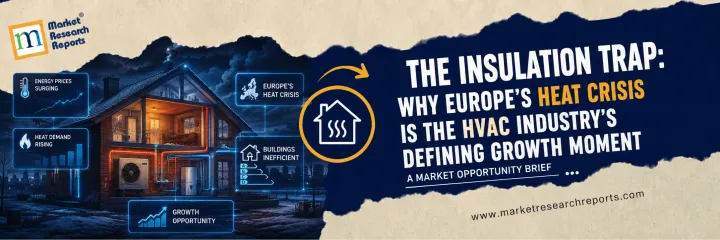
MRR® Business Opportunity Analysis Europe Heat Crisis · Omega Block · HVAC Demand
Europe built its housing stock for a threat that has now reversed. For seventy years, insulation was designed to keep heat in. In the summer of 2026, the same walls, the same triple-glazed windows, the same airtight roofs are keeping heat in for the wrong season — turning millions of homes into thermal batteries that charge all day and refuse to discharge at night. The "Omega Block" heat domes of May, June, and now July 2026 have exposed a structural mismatch between Europe's built environment and its climate reality, and the World Health Organization has already called it what it is: an adaptation failure, not just a weather event.
For HVAC and cooling companies, this is not a one-season demand spike. It is a decade-long infrastructure re-platforming event, arriving at the exact moment electricity tariffs are rising, and EU regulation is forcing the industry toward electrified, low-carbon systems anyway. The companies that frame this correctly — as a clean-cooling opportunity rather than a cooling opportunity — will capture a disproportionate share of a market moving from roughly $26–31 billion today toward $46–53 billion by the early 2030s. Those who sell brute-force air conditioning into a high-tariff, guilt-laden market will find themselves boxed into a shrinking, commoditized, low-margin segment.
The Crisis, Quantified
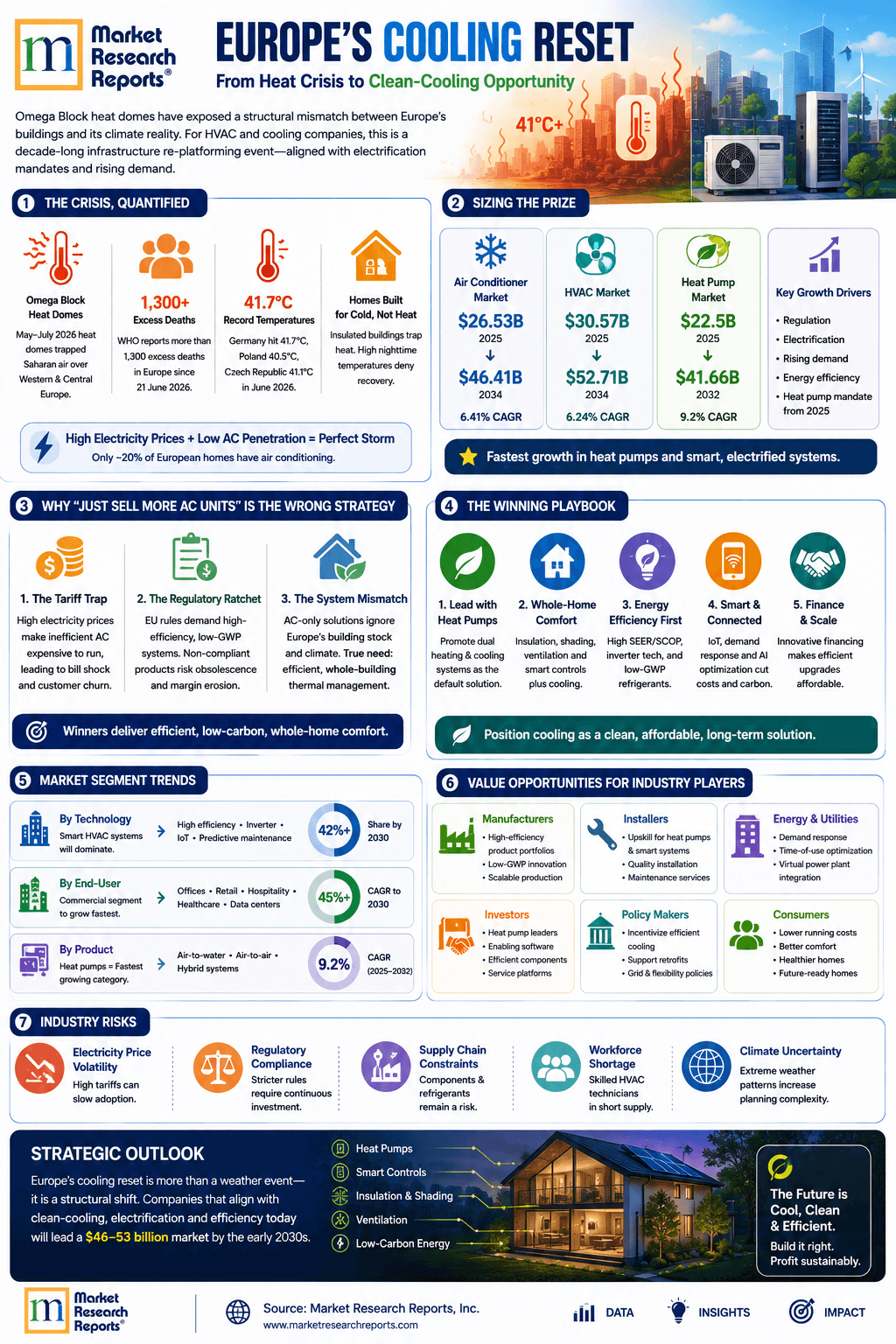
The trigger event is well documented. A stationary high-pressure "Omega Block" — so named because the jet stream bends into the shape of the Greek letter Ω — parked over Western and Central Europe through late May and June 2026, dragging Saharan air north and trapping it beneath an atmospheric lid. Major European cities, including Paris, London, Hanover, Frankfurt, and Brussels, sat at the core of the resulting heat, following a record dry spring that had already stripped topsoil of moisture and removed the land's natural cooling capacity. By late June, Germany had breached 41.7°C, Poland hit an all-time national high of 40.5°C, and the Czech Republic recorded 41.1°C, with the WHO director-general putting the European death toll at more than 1,300 excess deaths since 21 June alone, and warning explicitly that homes, workplaces and schools were not built for these temperatures. A second, potentially longer-stalling Omega Block is already forecast for early-to-mid July.
The mechanism behind why this is uniquely dangerous in Europe — as opposed to, say, the American South — is architectural. Much of Europe's housing, transport and public infrastructure was built for historically temperate or cold conditions, and dense construction absorbs heat during the day and releases it at night, which is compounded by night-time temperatures that have stayed unusually high, denying buildings and bodies the recovery window they need. This is the "insulated home as thermal trap" problem in a single sentence: a building envelope engineered to resist heat loss has no mechanism to resist heat gain, and once solar and ambient heat penetrate, the same airtightness that made it efficient in winter now prevents it from venting in summer.
Structurally, this collides with two economic pressures at once: European electricity prices remain elevated versus pre-2022 levels, and demand for cooling is rising from a very low base — only about 20% of European homes currently have any air conditioning at all, meaning the region is not retrofitting a mature market; it is bootstrapping one under crisis conditions.
 Navadhi Market Research · Industrial Machinery & Robotics
On demand
Global Smart Residential IoT HVAC Control Market Strategic Research Report
The global smart residential IoT HVAC control market occupies an increasingly central position within the broader smart home ecosystem, valued at approximately USD 9…
▲ 12.5%CAGR2025–2032
$3,500.00 from
Forecast $21.4B by 2032
Navadhi Market Research · Energy & UtilitiesOn demand
Global Zero-Emission Heat Pump HVAC Market Strategic Research Report
The global zero-emission heat pump HVAC market occupies an increasingly critical position at the intersection of building decarbonization policy, energy security imp…
▲ 10.2%CAGR2025–2032
$3,500.00 from
Forecast $135B by 2032
Sizing the Prize
This is where the opportunity gets concrete for operators and investors:
- Air conditioning: The European air conditioner market is projected to grow from $27 billion in 2025 to $47 billion by 2034 - and that trajectory predates the 2026 heat events, so current forecasts likely understate near-term acceleration.
- HVAC overall: The broader European HVAC market, valued at $31 billion in 2025, is expected to reach $32 billion in 2026 and $53 billion by 2034, at a 6.20% CAGR.
- Heat pumps specifically: The European heat pump market, valued at $22 billion in 2025, is projected to reach $25 billion in 2026 and $42 billion by 2032, the fastest-growing segment in the space, driven structurally by the fact that EU member states are required from 2025 to discontinue financial incentives for fossil-fuel-based heating systems, cementing heat pumps as the compliant, scalable default.
- Segment shift within cooling: Within heating equipment, heat pumps are expected to be the fastest-growing category, while unitary air conditioners still dominate cooling equipment share — but smart HVAC systems are set to dominate by technology, and the commercial segment is projected to grow fastest by end-user.
The strategic read: growth is not evenly distributed across "cooling." It is concentrating on systems that are simultaneously efficient, electrified, and dual-purpose (heat and cool). That is a heat-pump-shaped hole, not an air-conditioner-shaped one.
Why "Just Sell More AC Units" Is the Wrong Strategy
A naive read of this crisis says: heatwaves rising, AC penetration low, sell units. That strategy has three structural flaws that a BCG-style scan surfaces immediately:
First, the tariff trap. Installing high-draw, low-efficiency cooling into a market with elevated and rising electricity prices creates a product that solves a health crisis by creating an affordability crisis. Given Europe's relatively high electricity prices, many consumers remain cautious about operating costs, forcing manufacturers into a genuine balancing act between cooling effectiveness and monthly utility exposure. A company that wins the sale but loses the customer to bill shock inherits a reputational and regulatory liability, not a loyal install base.
Second, the regulatory ratchet. The EU's Ecodesign Directive and Energy Labelling Regulation already mandate high-efficiency systems, and this is tightening, not loosening. Any product roadmap built around conventional split ACs rather than inverter, heat-pump-based architectures is building toward regulatory obsolescence, not just competitive disadvantage.
Third, the insulation paradox demands a systems answer, not an appliance answer. Dropping a cooling unit into an airtight, heat-trapping envelope without addressing shading, ventilation, and thermal mass is treating a symptom. The winning players will be those who sell building performance, not boxes.
The Strategic Opportunity: Four Plays for HVAC/AC Players
Play 1 - Lead with the dual-purpose heat pump, not the AC. Modern air-to-air heat pumps extract most of the energy needed for cooling or heating from ambient air as a renewable source, achieving efficiency ratings up to A+++ and operating reliably down to -20°C outdoor temperatures — up to five times more efficient than a traditional gas boiler. This is the product story that resolves the tariff objection: the same unit that cools the "gas chamber" in July also displaces gas heating in January, converting one purchase into a twelve-month value case rather than a three-month one. This year-round versatility is precisely why heat pumps are becoming the central growth driver in European climate control, aligning tightly with the region's sustainability targets.
Play 2 - Bundle cooling with the building envelope, not just the equipment. Because the core failure mode is architectural (heat trapped by design), the highest-margin, most defensible position is not appliance sales but "cooling-as-a-retrofit-package": external shading, reflective roofing, night-purge ventilation, and smart controls sold alongside the heat pump. This converts a commoditized appliance sale into a higher-ticket, harder-to-replicate systems integration project — and directly answers the WHO's framing of this as a building-adaptation failure, not a weather event.
Play 3 - Solve the tariff problem with on-site and grid-smart generation. Pair electrified cooling with rooftop solar and battery storage, and with demand-response software that shifts compressor load to off-peak or self-generated hours. This is the only credible answer to rising power tariffs, and it converts HVAC companies from equipment vendors into energy-management platforms — a materially higher-margin, higher-retention business model. Investment in eco-friendly, renewable-energy-based cooling technology is already flagged as a major structural driver of the market, and first movers on the solar-plus-heat-pump bundle will own the "clean cooling" narrative before it becomes table stakes.
Play 4 - Own the financing and installed-base gap. Installation cost remains one of the biggest barriers to adoption across the market, and average equipment prices are still expected to rise from roughly $1,400 to $1,620 per unit by 2033 as high-efficiency heat pumps and smart systems replace cheaper legacy equipment. Companies that pair equipment with financing, subsidy navigation (schemes like France's MaPrimeRénov'), and outcome-based pricing (pay-per-degree-of-comfort, or shared-savings models) will convert price-sensitive households — the bulk of the underpenetrated 80% — into addressable demand years ahead of competitors relying on cash purchase alone.
Where the Puck is Going: A Segmentation View
| Segment | Growth Signal | Strategic Priority |
|---|---|---|
| Residential retrofit (older, poorly ventilated stock) | Highest health-risk exposure, lowest current AC penetration | Bundled envelope + heat pump + financing |
| New-build/commercial | Fastest-growing implementation category, ~6.5–7% CAGR | Design-in VRF and smart controls at the spec stage |
| Southern Europe (Spain, Italy, Greece) | Most acute heat exposure, highest urgency | Solar-integrated cooling, hospitality/tourism vertical |
| Northern/Central Europe (Germany, Benelux, UK) | Fastest-rising demand from a near-zero base | Heat-pump-led, "you already need this for winter" positioning |
| Commercial/institutional | Expected to be the fastest-growing end-user segment | Smart HVAC, indoor air quality, ESG-linked procurement |
The Risk Case
No opportunity brief is complete without the counter-scenario. Three risks temper the enthusiasm:
- Grid strain. Mass electrification of cooling during heat events could stress grids already under peak load — the industry needs to sell demand flexibility alongside capacity, or risk being blamed for the next blackout.
- Affordability backlash. If clean-cooling retrofits remain accessible only to higher-income households, the industry risks a two-tier adaptation crisis, inviting regulatory intervention on pricing and financing.
- Refrigerant and supply chain exposure. The shift to low-GWP refrigerants and the geographic concentration of component manufacturing (Italy, Germany, and Poland account for a large share of European production) create exposure to trade and regulatory shocks that could slow the ramp.
Bottom Line
Europe's insulated homes were built to solve a problem that no longer exists in isolation. The Omega Block heatwaves of 2026 have made the mismatch lethal and visible, and regulators, insurers, and voters now expect an infrastructure response, not just a product one. The HVAC and AC industry's winning position is not "more air conditioners" - it is "electrified, dual-season, tariff-resilient comfort systems," sold as a bundled retrofit rather than a standalone appliance. The market math already supports this pivot; the heat domes have simply made the timeline urgent.
This analysis draws on 2026 European heatwave reporting and current HVAC, air conditioning, and heat pump market research repositories. Figures are drawn from previous and current market forecasts and are subject to revision as 2026 data finalizes.