


The Water Hiding in Plain Sight: Why India's Air Conditioners Could Become Its Next Water Utility

MRR® New Business Idea Analysis Market Research · HVAC
A market and policy brief on AC condensate harvesting for water-stressed Indian cities.
The Setup: Two Curves Crossing
India is running two national trend lines in opposite directions, and almost nobody is looking at where they intersect.
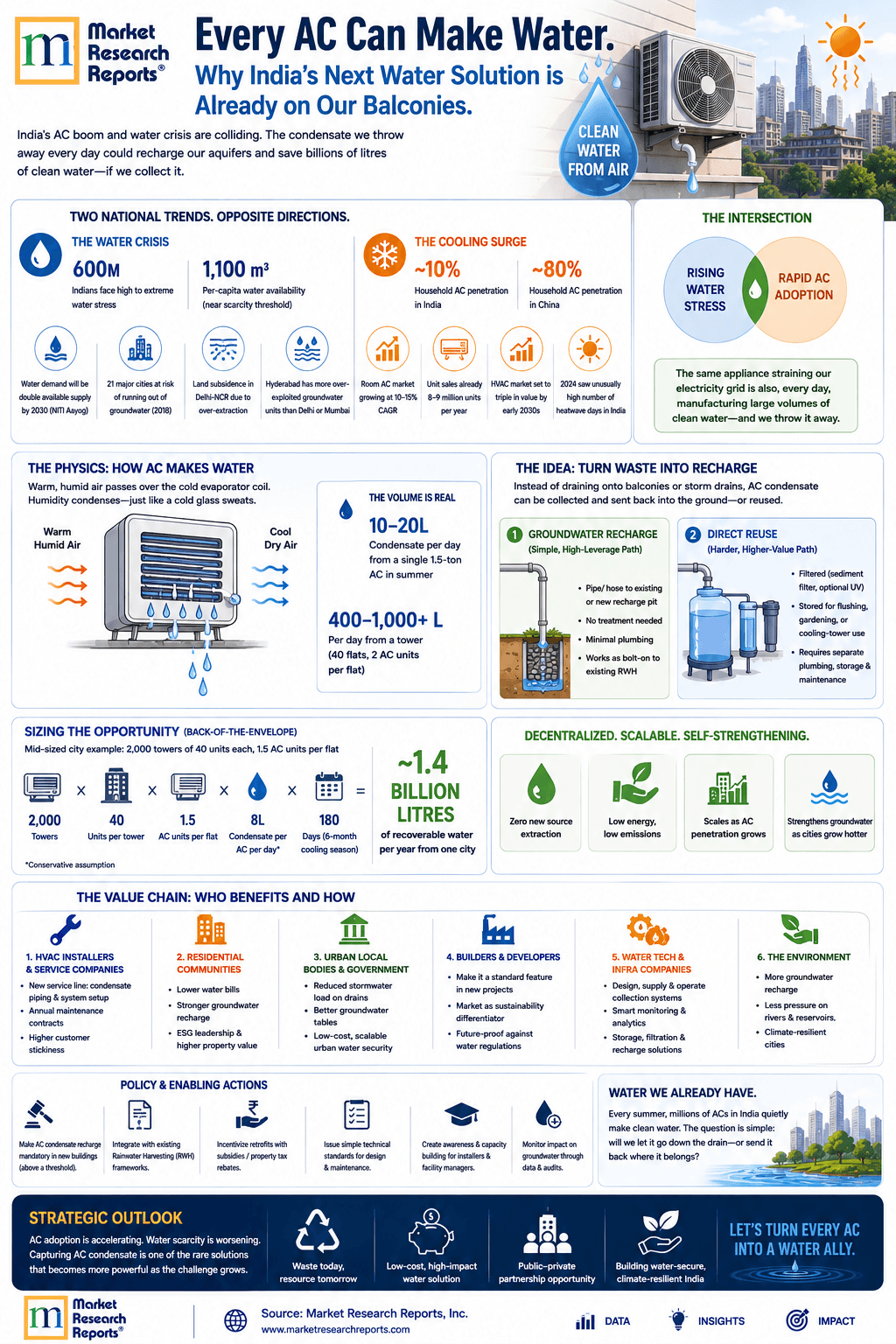
The first curve is water. Roughly 600 million Indians already live with high to extreme water stress, and per-capita water availability has fallen to around 1,100 cubic metres a year - close to the internationally recognized scarcity threshold. NITI Aayog has flagged that national water demand will be roughly double the available supply by 2030, and a widely cited 2018 assessment named 21 major cities, including Delhi, Bengaluru, Chennai, and Hyderabad, at serious risk of exhausting accessible groundwater. Delhi-NCR is showing measurable land subsidence in over-extracted pockets. Hyderabad now has more "over-exploited" groundwater units than either Delhi or Mumbai. This is not a rural problem anymore — it is a dense, urban, apartment-block problem.
The second curve is cooling. India's air conditioner penetration is still only around 10% of households, compared to roughly 80% in China — which sounds like a small base, until you see the growth rate. The room AC market is expanding at a compound rate of roughly 10-15% a year, unit sales are already in the range of 8-9 million a year, and the broader HVAC market is on track to more than triple in value by the early 2030s. Heatwave frequency is doing the rest of the marketing: 2024 alone saw an unusually high number of heatwave days recorded by the India Meteorological Department, and each hot summer converts more households from "AC is a luxury" to "AC is survival infrastructure."
Put those two curves together, and you get an uncomfortable but interesting fact: the same appliance that is straining India's electricity grid is also, every single day, manufacturing large volumes of clean water — and almost all of it is currently thrown away.
The Physics, Stated Plainly
A split or window AC cools air by passing it over a cold evaporator coil. Humidity in that air condenses on the coil, the same way a cold glass of water sweats on a hot day. That condensate drips out through a drain pipe, usually straight onto a balcony, into a storm drain, or onto the ground below the outdoor unit. It is, chemically, close to distilled water — the coil doesn't add minerals, salts, or organic load; the main contaminants are whatever dust, biofilm, or trace metal the pan and pipe pick up on the way out.
The volume is not trivial. A single 1.5-ton residential split AC running eight hours a day in a hot, humid Indian summer can shed somewhere in the range of 10-20 litres of condensate daily. Scale that to a mid-size apartment tower — say 40 flats, two AC units each — and you are looking at 400-1,000+ litres a day evaporating off balconies and into storm drains, from one tower, during precisely the months when municipal water stress peaks. Across a large residential complex with multiple towers, that adds up to a meaningful daily volume, essentially for free, requiring no new source, no tanker, no borewell.
The Idea, Restated as an Infrastructure Concept
The proposal at the heart of this piece is straightforward and, notably, not radical — it borrows almost exactly the same logic India already uses for rainwater harvesting (RWH), which many municipalities have made mandatory for buildings above a certain plot size.
Instead of individual AC units draining onto balconies or the ground, each tower in a residential complex would have its outdoor units plumbed into a common vertical riser — the same engineering pattern used for rainwater downpipes. That riser feeds into a tower-level or complex-level recharge pit, similar in design to existing RWH percolation structures, sending the water back into the ground rather than into a storm drain. Where individual retrofit isn't feasible, a simpler version uses flexible hoses from each unit's drain into a shared collection point at ground level.
Two deployment paths follow from this, and they should not be conflated, because they carry very different costs and complexities:
Groundwater recharge (the simple, high-leverage path): Condensate is piped or hosed into an existing or new percolation pit. No treatment needed, minimal plumbing, works as a bolt-on to RWH infrastructure many buildings already have. This is the version that scales fast and cheaply.
Direct reuse (the harder, higher-value path): Condensate is filtered (basic sediment filter, optionally UV) and stored for flushing, gardening, or cooling-tower makeup water. This requires separate plumbing, storage tanks, and ongoing maintenance — real value, but real capex too.
For a first wave of adoption, recharge is the low-friction entry point. Reuse is the upgrade path once the collection infrastructure already exists.
Sizing the Opportunity: A Back-of-Envelope View
Consider a mid-sized Indian city with, say, 2,000 residential towers of 40 units each, averaging 1.5 AC units per flat — a conservative assumption given rising penetration. At even a modest 8 litres of condensate per AC per day across a 6-month cooling season, that single city is looking at roughly 1.4 billion litres of recoverable water a year — for one city, using only towers built at that scale, without counting standalone houses, offices, malls, or hotels running much larger commercial AC and chiller loads (which produce proportionally far more condensate per unit of cooling capacity).
This is not a substitute for reservoirs or river-linking projects. But framed correctly, it is a decentralized, zero-marginal-source recharge network that grows automatically as AC penetration grows — the more India cools itself, the more water the system returns to the ground, with no new extraction required. That's a rare thing in Indian water policy: an intervention that gets structurally stronger as the underlying problem (heat, AC adoption) gets worse, rather than being overwhelmed by it.
The Value Chain: Who Gets Paid, and For What
1. HVAC installers and service companies : They already touch every outdoor unit at installation and during annual maintenance — the single lowest-cost point to add a condensate-collection connection. The natural product is a retrofit-and-AMC bundle: install the riser/drain connection once, then bill an annual maintenance fee to keep the line clear of biofilm and blockage, much like RO-service companies already do for filtration units. This is a services and recurring-revenue play, not a one-time hardware sale.
2. Real estate developers and contractors : For new construction, this is close to a rounding error in project cost — PVC piping and a recharge pit are cheap relative to a tower's overall build cost — but it is a visible, marketable differentiator. It plugs directly into green-building certification frameworks (GRIHA, IGBC) that developers already pursue for marketing value and, in some cities, for regulatory incentives tied to floor space index. "Water-positive tower" is a stronger sales line than most current green-building claims, and it's backed by something a buyer can actually see: a working recharge pit.
3. RWA (resident welfare association) retrofit specialists : This is the most underexploited niche in the whole chain. Existing buildings, where AC units are scattered across facades with no shared plumbing, are the harder but larger market - most of urban India's AC stock is already installed. A company that designs modular, low-disruption retrofit kits (clip-on riser sections, shared collection manifolds, simple flow sensors to prove volume recharged) sold directly to RWAs is a genuine white-space business, closer to a niche infrastructure contractor than a consumer product company.
4. Component and metering manufacturers : Downstream of the retrofit kit business sits a smaller opportunity in the hardware itself: condensate-grade piping, basic sediment filters, and — importantly — simple metering or sensor devices that let a building certify to a municipal authority how much water it has recharged. That certification layer matters more than it sounds, because it's what turns a good idea into a compliance-linked one (see below).
5. Government and municipal bodies : Government's highest-leverage role here isn't funding — it's extending an existing mandate. Most large Indian cities already require rainwater harvesting structures above a defined plot size. Amending those bylaws to require AC condensate lines to feed into the same recharge pit is a small regulatory change with an outsized effect: it converts a nice-to-have into a compliance requirement, which is exactly the trigger that creates a durable market for installers and product companies rather than a fragmented, opt-in one. Municipal bodies could also use metering data (see above) to award water-tax rebates or green-building fee waivers tied to verified recharge volumes — the same incentive structure already used for solar rooftop and RWH compliance in several states.
Where the Idea Gets Genuinely Hard
A serious market brief has to name the friction, not just the upside.
- Retrofit plumbing in existing buildings is the real bottleneck. New construction can build this in at near-zero marginal cost. Existing towers, where outdoor units are scattered with no shared vertical alignment, need real design work per building — this is a services business with a long sales cycle, not a plug-and-play product.
- Condensate isn't sterile. It picks up dust and biofilm from the coil and drain pan. For recharge into the ground, that's a non-issue. For direct reuse (flushing, gardening), it needs at minimum a sediment filter, and ideally periodic testing — a maintenance obligation that has to be priced into any AMC model, or the pitch collapses on year-two upkeep.
- Per-household volume is small; the aggregation is what has value. No individual flat is going to pay a premium for its own condensate recovery. The economics only work at tower or complex scale, sold to a developer, RWA, or mandated by a municipal body — not marketed to individual AC buyers.
- Verification is unsolved. Without metering, there's no way for a municipality to confirm recharge volumes for rebate or compliance purposes, and without that verification layer, the policy lever (bylaw + incentive) doesn't have teeth. This is arguably the single most valuable unbuilt product in the whole value chain.
The Bottom Line
This isn't a breakthrough technology — it's a plumbing and policy idea, and that's exactly why it's investable. The engineering is well understood (it's rainwater harvesting with a different water source), the target cities are already identified by the same NITI Aayog groundwater data everyone in Indian urban policy already cites, and the growth driver — AC adoption — is one of the most reliably rising curves in the Indian consumer economy. The opportunity doesn't require betting on new demand; it requires redirecting a waste stream that's growing anyway, in the exact cities where it's needed most.
The businesses that will make money here are the ones that treat this as an infrastructure retrofit and compliance play — not a single-appliance gadget. And the single move most likely to unlock the market fastest isn't a subsidy or a startup: it's a municipal bylaw amendment tying AC condensate lines to the rainwater harvesting mandates that already exist in cities like Delhi, Bengaluru, and Chennai. Everything else in the value chain — installers, developers, RWA retrofit specialists, metering hardware — follows from that one regulatory decision.
Sources
- NITI Aayog Composite Water Management Index (2018); water stress and groundwater depletion figures via Vajiram & Ravi, PMF IAS, and International Centre for Sustainability summaries
- Groundwater subsidence data (Delhi-NCR): NCBI/PMC, "Tracking hidden crisis in India's capital from space"
- Hyderabad groundwater over-exploitation: Drishti IAS, "Addressing India's Water Crisis"
- India AC/HVAC market sizing and penetration: MRR Report Repositories
- Heatwave data: India Meteorological Department
 Navadhi Market Research · Environmental Services & Sustainability
On demand
Global Agentic AI-Driven Smart Water Network Optimization Market Strategic Research Report
The global agentic AI-driven smart water network optimization market occupies a critical intersection of digital infrastructure and essential utility management, add…
▲ 15.4%CAGR2025–2032
$3,500.00 from
Forecast $18.5B by 2032
Navadhi Market Research · Energy & UtilitiesOn demand
Global Solar-Powered Commercial HVAC Market Strategic Research Report
The global solar-powered commercial HVAC market sits at the intersection of two of the most capital-intensive sectors in the built environment: commercial real estat…
▲ 12.9%CAGR2025–2032
$3,500.00 from
Forecast $19.6B by 2032