


From Copilot to Autonomous: Why Enterprise Agentic AI Is Growing at 32.6% and Where the Revenue Actually Sits
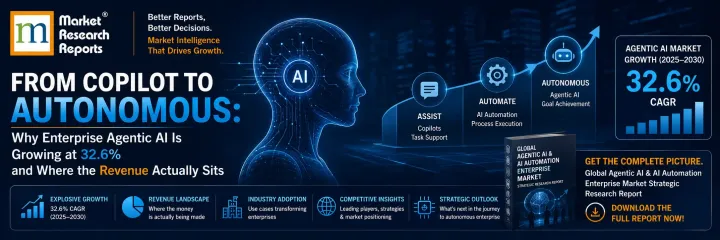
MRR® Industry Intelligence Briefing Artificial Intelligence · Enterprise Software · Automation
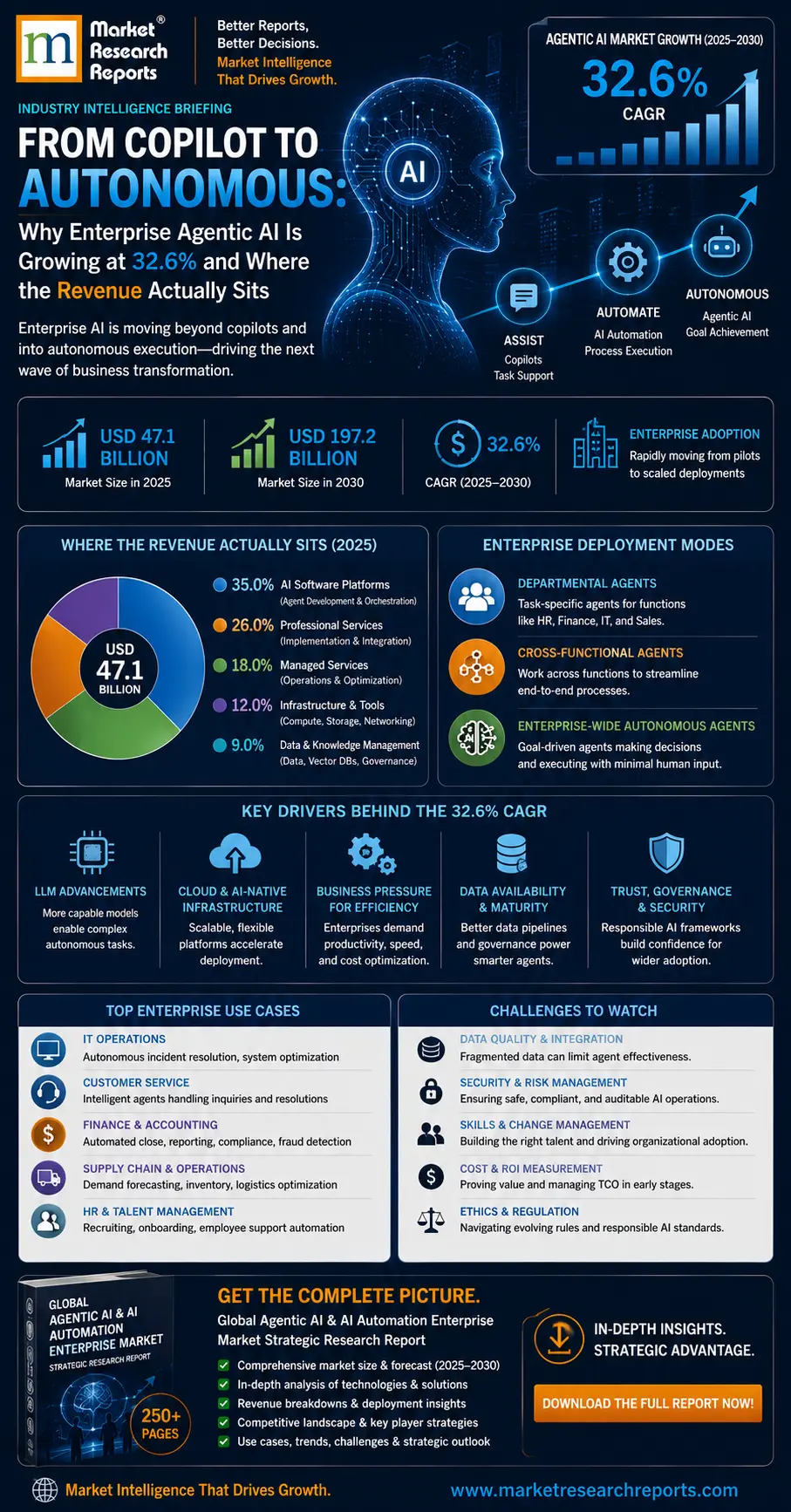
The global enterprise agentic AI and AI automation market stood at USD 42 billion in 2025 - the fastest-growing major enterprise software category, with a projected CAGR of 32.6% through 2031. That headline is accurate but insufficient. The more analytically useful observation is that approximately 48–52% of the market's platform reach is controlled by five incumbents whose AI competitive positions compound through distribution advantages that pure-play entrants cannot replicate organically. This briefing covers how a market sized at USD 42 billion in 2025 reaches USD 227.8 billion by 2031, where the revenue is actually concentrated today, and why the architectural shift from rule-based automation to autonomous goal-pursuing agents is the most consequential discontinuity in enterprise software since the original RPA wave.
Executive Summary
The global enterprise agentic AI and AI automation market is estimated at USD 42.0 billion in 2025, expanding to USD 227.8 billion by 2031 at a CAGR of 32.6% - representing a 5.4-fold absolute expansion and a cumulative growth rate of 441% against the 2025 base, according to Navadhi Market Research's Global Agentic AI & AI Automation Enterprise Market Strategic Research Report 2026–2031. This growth rate is the highest of any enterprise software category, outpacing cloud infrastructure migration (18–20% CAGR), enterprise cybersecurity (14–16% CAGR), and all other enterprise application software segments. The market encompasses seven discrete technology segments - from agentic AI platforms and enterprise copilots to AI-enhanced robotic process automation and AI infrastructure - and nine application verticals spanning IT operations, customer service, finance, healthcare, and supply chain. Three structural forces are simultaneously shaping this trajectory: the architectural displacement of rule-based RPA by autonomous agentic AI systems capable of multi-step reasoning and goal pursuit; the mass-deployment of enterprise copilots through incumbent platform distribution channels that compress the go-to-market timeline and eliminate customer acquisition costs; and macroeconomic productivity imperatives that are converting AI automation from experimental to budgeted spend across enterprise cohorts globally. The market is not a homogeneous growth story. Revenue is heavily concentrated among five incumbents whose structural distribution moats compound faster than new entrants' technology advantages, and the fastest-growing segment - agentic AI platforms - is simultaneously the one with the most nascent enterprise trust deficit, the least mature governance framework, and the most acute implementation talent shortage.
The Research Problem: What 32.6% CAGR Actually Means for Enterprise Buyers and Investors
The risk of a 32.6% CAGR headline is that it aggregates structurally different revenue streams that behave very differently under the same "AI automation" label. Navadhi Market Research's base-year estimate of USD 42.0 billion is anchored to publicly disclosed revenues from the ten primary enterprise AI platform companies profiled in the research. Four anchor disclosures are of particular structural significance: Salesforce's FY2025 annual revenue of USD 37.9 billion, of which AI-attributed automation revenue is estimated at approximately USD 0.6 billion as Agentforce launched in Q4 FY2025; Microsoft's Azure AI growing at approximately 60% year-over-year as of FY2024, driving an estimated USD 4.5 billion in attributed AI automation revenue (approximately 10.7% market share); IBM's disclosure of over USD 1 billion in watsonx platform bookings and over USD 3 billion in AI-related consulting bookings; and Palantir's US commercial segment growing more than 70% year-over-year, representing the clearest pure-play commercial AI validation in the quoted company universe. The market at USD 42.0 billion in 2025 is therefore not speculative - it is anchored to verifiable financial commitments from the world's largest enterprise technology companies. The 2031 target of USD 227.8 billion is grounded in those existing revenue bases extrapolated through a technology adoption curve analysis rather than projected from a greenfield potential estimate.
The Foundational Shift: Why This Is Not the Next RPA Wave
The distinction between traditional robotic process automation and agentic AI is not incremental. It is a qualitative discontinuity that changes the economic case for automation at the enterprise level.
Traditional RPA operates on scripted workflow execution: a human defines every step, every decision branch, and every exception path in advance, and the software bot executes that script against fixed UI surfaces. Industry analyst estimates consistently indicate that 30–50% of RPA bot maintenance effort is consumed by script repair following system or UI changes - a material total cost of ownership burden that erodes the productivity gains that justified the original deployment. Scale in traditional RPA means deploying more bots for more processes, each requiring maintenance proportional to its scope. The ceiling on RPA ROI is determined by the human capacity to specify and maintain every process in advance.
Agentic AI replaces this with a fundamentally different architecture: the enterprise provides a high-level goal - "resolve this customer dispute, check the order history, apply the appropriate discount policy, and update the CRM" - and the AI agent autonomously decomposes the goal into sub-tasks, selects the appropriate tools, executes across multiple enterprise systems, handles unexpected exceptions through reasoning, and reports outcomes. The maintenance burden collapses. The scope of automatable processes expands from well-structured, stable workflows to include the unstructured, judgment-intensive processes that RPA explicitly excluded. This is the architectural shift that drives the Agentic AI Platforms segment's projected growth from 12% to 24% of total market share between 2025 and 2031 - not incremental improvement on the prior paradigm but a structural displacement of it.
What the Research Revealed: Three Market Dynamics That Explain the Revenue Concentration
Dynamic 1 - Incumbent Distribution Is the Moat, Not the Model
Microsoft's theoretical revenue ceiling from M365 Copilot alone is instructive: 345 million commercial M365 seats at USD 30 per user per month represents USD 124 billion in peak annual potential from a single product, across a pre-existing customer base, requiring no new enterprise sales cycles in the conventional sense. That potential will not be captured in the forecast period, but even capturing 15–20% of it within five years would add USD 18–25 billion to Microsoft's AI revenue without a single new logo acquisition. Salesforce's Agentforce is embedded within existing Sales Cloud, Service Cloud, and Marketing Cloud subscriptions, allowing upsell without displacing incumbent technology. SAP Joule, Oracle AI Agents, and ServiceNow Now Assist operate on the same logic. These incumbents are not winning AI automation on the strength of model quality - they are winning it because they already hold the enterprise data, the workflow context, and the login credentials. Any analyst evaluating the competitive landscape of this market without accounting for incumbent distribution leverage is measuring the wrong variable.
Dynamic 2 - Healthcare and Life Sciences Is the Highest-Value Emerging Application
The fastest-growing application segment within the broader market is Healthcare & Life Sciences AI Automation. The structural drivers are distinct from the general enterprise automation case: clinical documentation generates exceptional volumes of unstructured data well-suited to LLM processing; regulatory and compliance workloads are expanding faster than human capacity to address them; prior-authorization workflows are structurally automatable at large cost saving; and the combination of workforce shortage and cost pressure in healthcare creates a cost-of-inaction argument for automation that is more acute than in other enterprise verticals. The segment's growth is further amplified by the FDA's expanding engagement with AI-assisted clinical workflows, which is progressively creating regulatory certainty rather than regulatory ambiguity for healthcare AI deployment.
Dynamic 3 - The Fastest-Growing Technology Segment Also Has the Largest Adoption Barriers
Agentic AI Platforms & Autonomous Agents, the highest-growth sub-segment within the market, simultaneously carries the most significant inhibitors. The four most constraining: first, data quality and governance - agentic systems that execute multi-step tasks across enterprise systems amplify data quality problems rather than abstracting around them, making enterprise data infrastructure a prerequisite for successful deployment; second, AI governance and regulatory compliance risk, particularly in the EU AI Act environment where high-risk AI system classifications impose audit, transparency, and human-oversight requirements on exactly the autonomous workflows that represent the highest ROI use cases; third, organisational change management - the displacement of scripted RPA processes involves the same workforce concerns as original RPA adoption, compounded by the more open-ended autonomy of agentic systems; and fourth, integration complexity with legacy enterprise systems, which often lack the API surfaces that agentic frameworks require for system-to-system task delegation. These inhibitors do not invalidate the 32.6% CAGR trajectory - they explain why adoption is concentrated in early-mover enterprise cohorts with mature data infrastructure, modern cloud architectures, and experienced AI governance functions rather than diffused uniformly across the enterprise universe.
Competitive Landscape: The Three-Tier Market Structure
| Tier | Leading Companies | Estimated AI Revenue 2025 | Market Share | Structural Advantage |
|---|---|---|---|---|
| Tier 1 - Platform Incumbents with Captive Distribution | Microsoft, Salesforce, SAP, Oracle, ServiceNow | ~USD 8–10B combined AI-attributed | ~20–24% | 345M M365 seats; 430K SAP customers; 60%+ ITSM share; no new logo required |
| Tier 2 - Specialist AI Platform Leaders | IBM (watsonx), UiPath, Palantir, Automation Anywhere, Workday | ~USD 6–8B combined AI-attributed | ~14–19% | Domain leadership in AI governance, AI-enhanced RPA, defence/intelligence AI, HCM |
| Tier 3 - Emerging and Niche Players | OpenAI enterprise API, Anthropic Claude for Enterprise, Cohere, Writer, NICE, Genesys, 350+ others | ~USD 25–28B combined across long tail | ~60–66% | Rapid growth, high innovation, single-domain specialisation; vulnerable to Tier 1 distribution |
| Overall Market (2025) | ~USD 42.0B | 100% | HHI ~900–1,050 (moderately concentrated, rising since 2022) |
Source: Navadhi Market Research, Global Agentic AI & AI Automation Enterprise Market Strategic Research Report 2026–2031.
The market's HHI of 900–1,050 places it in the "moderately concentrated" classification - well below the 2,500 threshold for high concentration but rising since 2022 as Salesforce Agentforce, Microsoft Copilot, and ServiceNow AI Agents scale enterprise seat penetration. The direction of travel in market concentration is toward higher concentration at the top tier, as incumbent distribution advantages compound at a rate that pure-play entrants' technology advantages cannot offset.
Technology Segment Composition: The Structural Shift From RPA to Agentic
| Segment | 2025 Market Share | 2031 Projected Share | Growth Direction | Key Dynamic |
|---|---|---|---|---|
| Agentic AI Platforms & Autonomous Agents | 12% | 24% | Fastest-growing | Displacing RPA in unstructured workflow categories |
| Enterprise Copilots & Generative AI Applications | Largest absolute | Large but declining share | High absolute growth | Microsoft, Salesforce incumbency advantage |
| AI-Enhanced Robotic Process Automation | Significant | Declining share | Growth decelerating | Migration platform for RPA-to-agentic transition |
| AI-Powered Business Process Automation | Stable | Stable | Steady-state growth | Finance, HR, procurement automation |
| AI Infrastructure & MLOps Platforms | Foundational | Under margin compression | Commoditising rapidly | Hyperscaler pricing pressure on MLOps tooling |
| Conversational AI & AI Contact Centre | Maturing | Commoditising | Growth moderating | Moving into standard feature layer of CX platforms |
| AI Consulting & Implementation Services | Declining share | Structural decline | Share declining | Being displaced by self-service agentic tooling |
Source: Navadhi Market Research, Global Agentic AI & AI Automation Enterprise Market Strategic Research Report 2026–2031.
Analyst Insight
The single most useful framing for the enterprise agentic AI market in 2026 is that the revenue being recognised today is almost entirely from the infrastructure and platform layer - Microsoft Azure AI, Salesforce platform subscriptions, ServiceNow's AI-embedded workflow licenses - rather than from measurable enterprise productivity outcomes. The deployment pipeline is large, the commitment spend is real, and the disclosed financial anchors are verifiable. But the market is at the stage where enterprise buyers are purchasing the capability before the ROI model is fully established at their scale. Navadhi's forecast that the market reaches USD 227.8 billion by 2031 - a 5.4-fold expansion from 2025 - is credible precisely because it is grounded in existing enterprise software revenue bases with embedded AI features, not projected from hypothetical productivity outcomes that have not yet been measured at scale. The risk to the upside of the forecast is faster-than-expected enterprise adoption of fully autonomous agents in healthcare and financial services. The risk to the downside is regulatory intervention in the EU AI Act's high-risk classification process moving faster and more restrictively than current implementation timelines suggest.
Strategic Lessons for Market Participants
| Observation | Strategic Implication |
|---|---|
| Incumbent distribution is compounding faster than technology differentiation | Technology-differentiated pure-play vendors must identify a narrow domain where incumbent platforms have not yet established embedded AI - typically a regulated, data-sensitive vertical - and build defensible depth before the incumbents' horizontal platform sweep reaches that segment |
| Healthcare & Life Sciences is the premium value emerging vertical | Enterprise AI vendors without a healthcare-specific data governance and regulatory framework are structurally disadvantaged in the fastest-growing application segment; the FDA and EU MDR create barriers to entry that simultaneously protect positioned vendors from commoditisation pressure |
| The RPA migration wave is both a competitive threat and a revenue opportunity | Legacy RPA platforms (UiPath, Automation Anywhere) face displacement from agentic architectures, but also sit closest to the enterprise process knowledge required to design effective agentic systems; the vendors best positioned in 2031 are those that convert the RPA replacement cycle into an agentic platform upgrade rather than treating them as separate markets |
| The 30–50% RPA maintenance burden is the most actionable buyer ROI signal | Enterprise buyers who can quantify their current RPA maintenance cost as a percentage of total automation spend have the clearest business case for agentic migration; vendors who lead with this calculation rather than generic productivity claims close procurement cycles faster |
Frequently Asked Questions
Is the 32.6% CAGR sustainable through 2031, or does it reflect early-adopter concentration?
The CAGR is anchored to existing committed revenue from the world's largest enterprise technology vendors, not projected from greenfield potential. The year-on-year growth rate sustains above 35% through 2029 before moderating to 30.5% in 2030 and 22.8% in 2031 - a deceleration profile consistent with large-platform enterprise software markets entering mid-cycle consolidation as penetration rates mature in North American and Western European enterprise accounts.
What is Microsoft's actual AI automation revenue versus the headline figures?
Navadhi estimates Microsoft's attributed AI automation revenue at approximately USD 4.5 billion in 2025 - approximately 10.7% market share - sourced from Azure OpenAI API usage, M365 Copilot seat fees across the approximately 400,000 organisations that had adopted the product by early 2025, and GitHub Copilot's more than 1.8 million paid subscribers. This is attributed AI-specific revenue, not total Azure or M365 revenue.
Why is AI consulting and implementation a declining-share segment?
AI consulting traditionally provided the integration and implementation expertise that bridged enterprise intent and deployed capability. As agentic tooling matures and platforms embed implementation-layer functionality, the addressable scope of high-margin consulting work narrows. The segment continues to generate absolute revenue growth - more AI spending overall means more implementation work - but its share of the total market declines as the ratio of platform license revenue to services revenue normalises toward the enterprise software industry average.
What does "data quality as the foundational constraint" mean in practice?
Agentic AI systems that autonomously execute multi-step enterprise tasks do not abstract around poor data - they amplify its consequences. An agent tasked with resolving a customer dispute based on order history will apply discount policies or escalation rules inconsistently if the CRM data is incomplete, duplicate, or stale. The enterprises most successfully deploying agentic systems in 2025–2026 are those that invested in data governance, master data management, and API-standardised system connectivity in the 2020–2024 period. This creates a two-speed adoption market: enterprises with mature data infrastructure moving fast, and the broader enterprise universe waiting for either data infrastructure investment or for agentic frameworks robust enough to tolerate data quality problems, which remains an open research problem.
How does the EU AI Act affect this market's growth trajectory?
The EU AI Act's risk classification framework imposes audit, transparency, and human-oversight requirements on AI systems deployed in high-risk applications including HR and employment decisions, credit scoring, and certain medical device contexts. These requirements apply to exactly the highest-ROI enterprise automation use cases. The practical effect for vendors is a compliance overhead on EU-market deployments and a two-tier product architecture requirement for global vendors - a core system that meets Act requirements plus additional features for non-EU deployment contexts. For buyers in regulated industries, the Act increases upfront compliance cost and procurement timeline without eliminating the ROI case; for buyers in less-regulated industries, EU Act compliance requirements do not apply and represent no material growth constraint.
For full market sizing, technology segment forecasts, and company profiles across the enterprise agentic AI landscape, see our Global Agentic AI & AI Automation Enterprise Market Strategic Research Report 2026–2031. For the infrastructure layer enabling these AI workloads, read our companion briefing on AI data centre power and cooling. For a vendor-specific analysis of your organisation's AI automation options, commission custom research.