


Continuous Market Monitoring vs. One-Time Research: Building an Intelligence Function That Scales
MRR® Market Intelligence Market Research Methods · Competitive Intelligence
The instructive number in this comparison is not Gartner's 78% subscription mix - it is that Forrester's subscription mix actually increased, from 73% to 75%, in the same year its absolute revenue fell 8%. A rising subscription percentage inside a shrinking total revenue base is not evidence the continuous model is winning; it is evidence the other segments (Consulting, down 9%; Events, down 29%) collapsed faster than the subscription core did. Any organization benchmarking its own intelligence function against "industry leaders" should look at absolute revenue and client-count trends, not segment-mix percentages in isolation - Forrester's client count fell 7% to 1,797 in the same period, which is the number that should worry a continuous-monitoring vendor far more than a two-point shift in segment mix.
Executive Summary
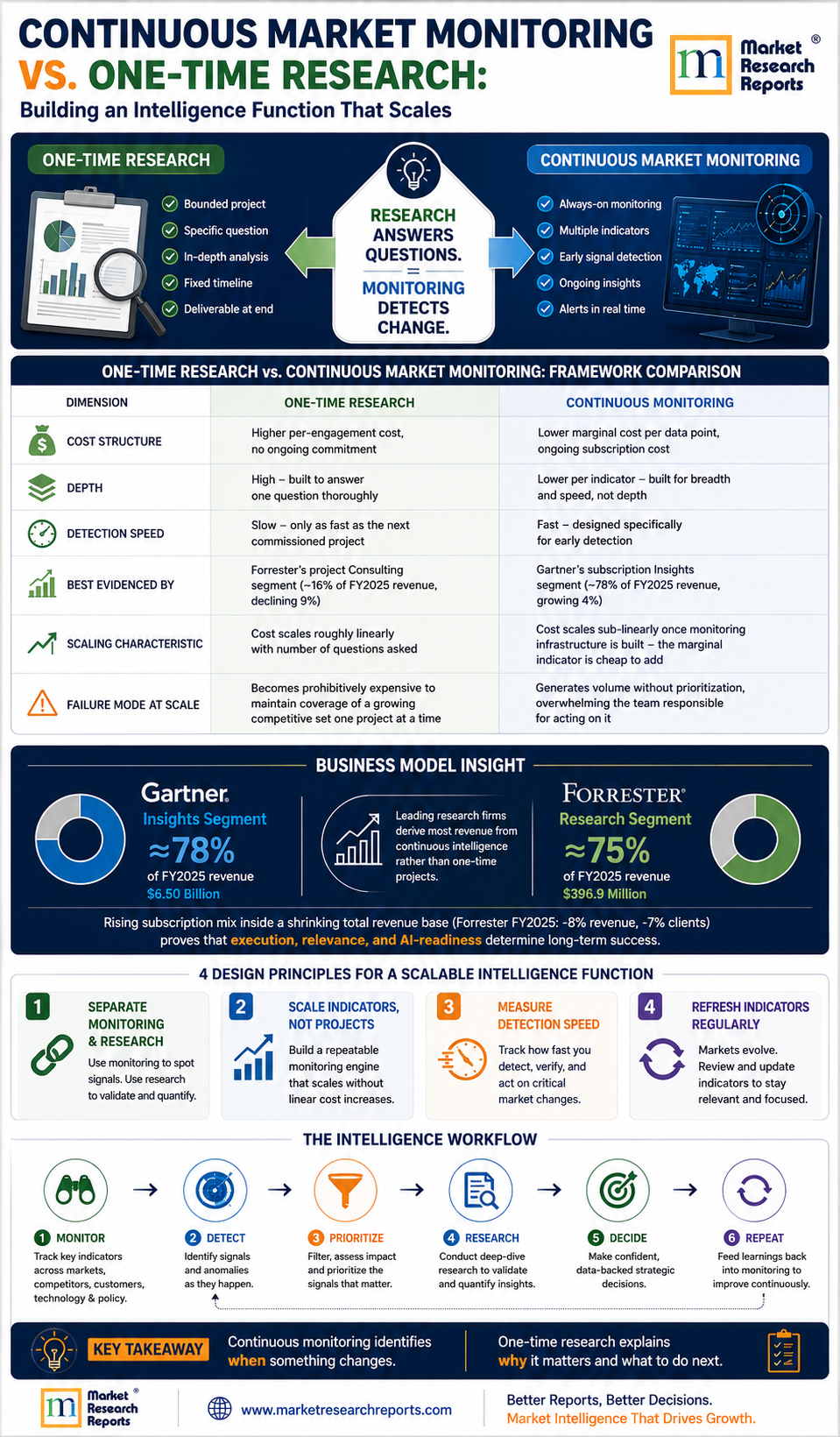
Two of the largest publicly traded research and advisory firms in the world generate the overwhelming majority of their revenue from continuous, subscription-based intelligence rather than one-time project research - Gartner's Insights segment delivered approximately 78% of the company's $6.50 billion in FY2025 revenue, while Forrester's Research segment delivered approximately 75% of its (declining) $396.9 million. This is not a coincidence of business-model preference; it reflects what buyers are actually willing to pay for at scale. Yet most internal corporate intelligence functions - see our companion article on build vs. buy for market research teams - are still built around the opposite default - a series of disconnected one-time studies commissioned reactively, with no continuous layer underneath them to catch a signal between projects. This article sets out how to build an intelligence function that scales past that default, using the operating patterns of organizations that monetize continuous monitoring as their core product.
What Is Continuous Market Monitoring?
Continuous market monitoring is an always-on capability that tracks a defined set of competitor, customer, technology, and regulatory indicators on a rolling basis, generating alerts when a tracked indicator crosses a predefined threshold. It has no project end date and is evaluated on detection speed and signal-to-noise ratio, not on the depth of any single deliverable.
What Is One-Time Research, in Contrast?
One-time research is a bounded project commissioned to answer a specific question with a fixed start date, end date, and deliverable - a market entry study, a pricing analysis, a customer segmentation. It is evaluated on the rigor and accuracy of that single answer, not on ongoing coverage.
Advantages and Trade-offs: A Framework Comparison
| Dimension | One-Time Research | Continuous Monitoring |
|---|---|---|
| Cost structure | Higher per-engagement cost, no ongoing commitment | Lower marginal cost per data point, ongoing subscription cost |
| Depth | High - built to answer one question thoroughly | Lower per indicator - built for breadth and speed, not depth |
| Speed to detect new signals | Slow - only as fast as the next commissioned project | Fast - designed specifically for early detection |
| Best evidenced by | Forrester's project Consulting segment (~16% of FY2025 revenue, declining 9%) | Gartner's subscription Insights segment (~78% of FY2025 revenue, growing 4%) |
| Scaling characteristic | Cost scales roughly linearly with number of questions asked | Cost scales sub-linearly once monitoring infrastructure is built - the marginal indicator is cheap to add |
| Failure mode at scale | Becomes prohibitively expensive to maintain coverage of a growing competitive set one project at a time | Generates volume without prioritization, overwhelming the team responsible for acting on it |
Why the Continuous Model Scales Better - and Where It Breaks
The economics in the table above explain why Gartner's subscription Insights model has outgrown its project-based Consulting segment over time, and why the comparison firm running the same subscription logic - Forrester - still posted an 8% revenue decline in FY2025 with a $110.7 million goodwill impairment specifically tied to its Research segment. The continuous model scales well on cost structure; it does not automatically scale well on relevance, and Forrester's results show that a subscription intelligence product loses its scaling advantage the moment buyers conclude an AI-assisted internal team or a newer entrant can deliver comparable monitoring more cheaply. Forrester's response - explicitly building a self-service "AI Access" product alongside its traditional analyst-delivered Research - is itself evidence that the scaling advantage of continuous monitoring is now contested at the delivery-mechanism level, not just the content level.
The Commercial Model for Continuous Monitoring at Scale
Outside the research-and-advisory sector itself, the clearest commercial embodiment of continuous monitoring is the syndicated consumer-data industry - firms such as NielsenIQ and Circana, which sell continuously updated point-of-sale and consumer-panel data to consumer packaged goods manufacturers on a subscription basis, structurally identical to Gartner's Insights model but applied to retail transaction data rather than technology and business advisory content. NielsenIQ's Homescan panel alone tracks purchase behavior across more than 250,000 households in 25 countries on a continuous basis - a scale of ongoing data collection that would be commercially impossible to replicate through one-time research commissioned project by project. Circana, formed from the 2023 merger of IRI and the NPD Group, competes directly in the same continuous-monitoring model, and the existence of two large, well-capitalized competitors selling essentially the same continuous-data product is itself market evidence that the subscription monitoring model, properly executed, supports durable competitive businesses rather than commoditizing immediately.
Building an Intelligence Function That Scales: Four Design Principles
- Separate the always-on monitoring layer from the deep-dive research layer organizationally, not just conceptually. Gartner's three-segment structure - Insights, Consulting, Conferences - is reported and managed as genuinely distinct businesses with different economics, not as one team doing both jobs informally. A function that conflates the two ends up running every question as a slow, expensive project, the exact failure mode that limits one-time research from scaling.
- Build the monitoring layer's cost structure around marginal indicators, not marginal projects. Once the infrastructure to track one competitor's pricing exists, tracking a second competitor's pricing should cost a small fraction of the first - if it doesn't, the function has built a research project, not a monitoring system, regardless of what it is called internally.
- Instrument detection speed and signal-to-noise ratio as the primary success metrics for the monitoring layer, and reserve depth and accuracy as the primary success metrics for the project-research layer. Measuring both layers against the same criteria is a common design error that causes monitoring teams to over-invest in depth they don't need and under-invest in coverage breadth.
- Revisit the indicator set on a fixed cadence, not only when something breaks. Forrester's pivot toward AI-delivered research is a direct response to its monitored indicator set - client retention, contract value, competitive entry from AI-native players - having moved enough to force a structural product change; the warning was visible in the firm's own metrics before the FY2025 results made it unavoidable.
Integrating Monitoring and Research
The two methods are not competing approaches to the same problem - they are sequential stages of the same intelligence function. Continuous monitoring's job is to flag that something has changed and assign it a rough materiality score; one-time research's job is to take a flagged signal that clears a pre-agreed threshold and produce a rigorous, decision-grade answer about what it means and what to do about it. An organization that runs only continuous monitoring accumulates dashboards full of unresolved signals with no validated implication attached. An organization that runs only one-time research answers each question thoroughly but misses everything that happens in the white space between commissioned projects - precisely the gap that allowed Kodak's slow-moving, fully observable market-share erosion to continue for years without triggering a board-level review.
Market Research Use Cases for the Project Layer
- Deep validation of a monitoring-flagged signal - commissioning rigorous primary research only once continuous monitoring has surfaced a signal clearing a materiality threshold
- Periodic recalibration studies - refreshing the assumptions underlying a monitoring system's thresholds, since indicators that mattered two years ago may no longer be the right ones to track
- One-time market entry or M&A diligence - questions that are genuinely bounded and do not benefit from an ongoing monitoring layer
- Custom segmentation rebuilds - periodic, not continuous, since customer segment structures shift slowly relative to competitor pricing or product signals
Frequently Asked Questions
Should a mid-size company build its own continuous monitoring function or buy a subscription from a vendor like Gartner or NielsenIQ?
The build-versus-buy decision typically follows category specificity: broad, cross-industry indicators (technology trends, general business advisory) are usually cheaper to buy from an established subscription vendor, while highly specific competitive indicators unique to a narrow category often justify building an internal monitoring layer.
How many indicators should a continuous monitoring function track at launch?
Fewer than most teams default to. A monitoring function tracking twenty well-chosen, high-signal indicators with clear thresholds outperforms one tracking two hundred indicators with no prioritization, because the latter reliably overwhelms whoever is responsible for acting on alerts.
Why did Forrester's revenue decline if continuous subscription models are supposed to scale well?
Subscription economics provide a favorable cost structure, but they do not guarantee demand - Forrester's contract value fell 6% and client count fell 7% in FY2025, indicating buyers were leaving the subscription product itself, not that the subscription model failed structurally.
Is continuous monitoring always cheaper than one-time research in the long run?
Only once the indicator set is mature and stable. Early in a monitoring function's life, the upfront cost of building tracking infrastructure can exceed the cost of simply commissioning a one-time study, which is why many functions start with research and add monitoring incrementally rather than the reverse.
What is the single biggest organizational risk in scaling a continuous monitoring function?
Conflating monitoring success metrics with research success metrics, per Design Principle 3 above - a monitoring team measured on depth rather than detection speed will under-deliver on the one thing continuous monitoring is supposed to provide.
MarketResearchReports.com supports both layers of this model: browse our syndicated report library for continuously updated category coverage, or commission custom research for the validation layer once a monitored signal clears your materiality threshold.