


Economic Impact of COVID-19 on Australia and its Policy Response

The COVID-19 pandemic has negatively impacted Global economic activity. No country whether advanced, emerging or developing has remained untouched from slowing economic growth, rising job losses and increasing human cost. In this series we will be exploring what has been economic impact of COVID-19 on a country’s economy and what policy measures being taken by governments during this period of crisis.
Today we will be focusing on economic impact of COVID-19 pandemic on Australia. We will also be taking a look at the social, fiscal, monetary and employment related policy measured taken by Australian government under following sections –
-
Impact of COVID-19 on Australian Economy in 2020
-
Coronavirus (COVID-19) Containment Measures of Australia
-
Coronavirus (COVID-19) Related Fiscal Policy Measures by Australia
-
Coronavirus (COVID-19) Related Monetary Policy Measures by Australia
-
Coronavirus (COVID-19) Related Employment Policy Measures by Australia
-
Coronavirus (COVID-19) Related Social Policy Measures by Australia
We have covered various macroeconomic factors and PESTLE (political, economic, social, technological, legal, and environmental), SWOT (Strengths, Weaknesses, Opportunities and Threats) and risk analysis for Australia in separate market research reports.
1. Impact of COVID-19 on Australian Economy in 2020
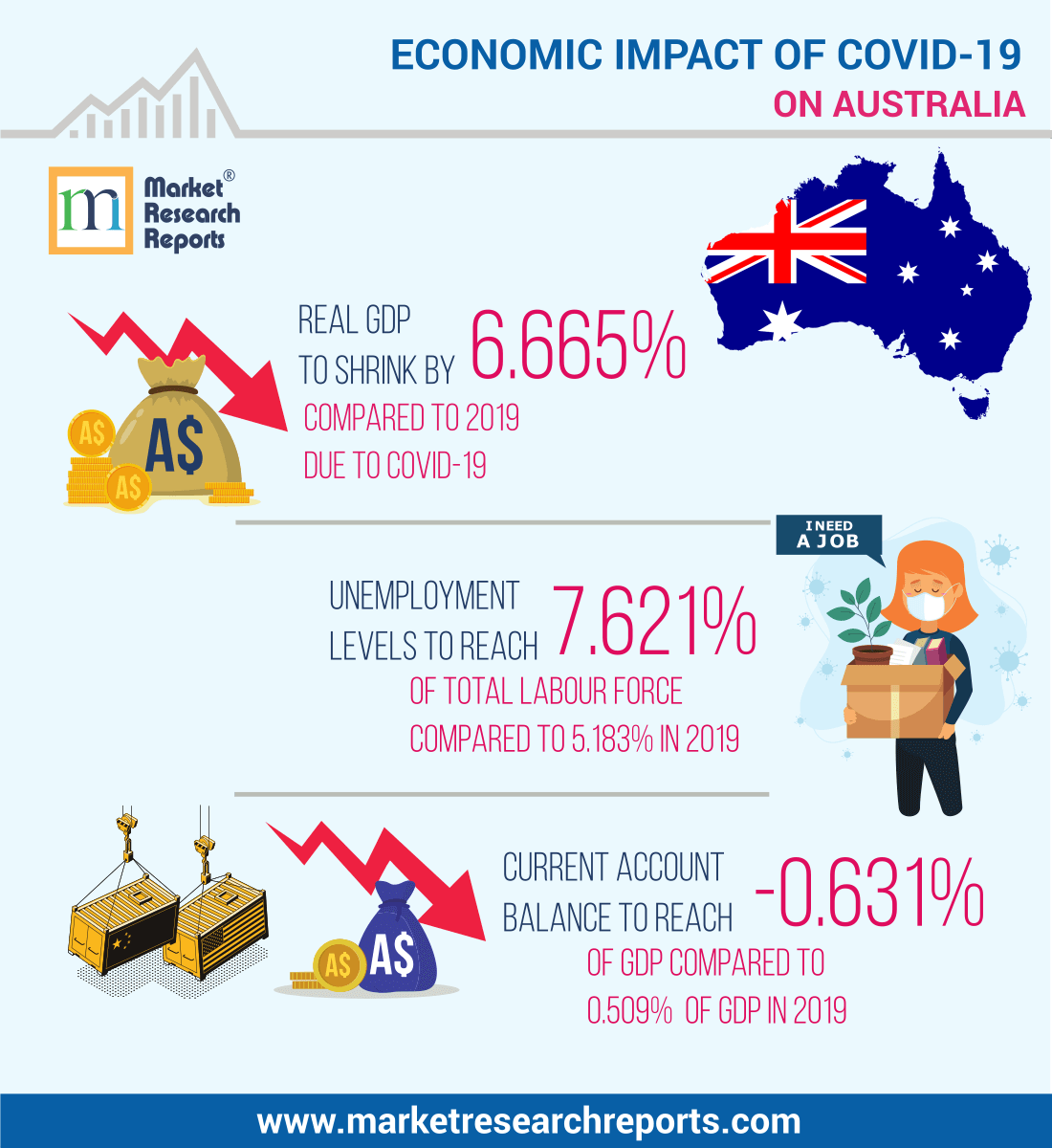
Australia’s real gross domestic product (GDP) was AUD 1871.51 billion in 2019 and due to COVID-19 outbreak it is estimated to shrink by 6.665% to be around AUD 1746.77 billion in 2020.
Australia’s unemployment rate was 5.183% of total labor force in 2019. Due to slowdown in global economic activity due to COVID-19 pandemic the unemployment is expected to increase by 31.99% and reach 7.621% in 2020. Unemployment is further estimated to increase in 2021 by 14.60% and reach 8.924% of total labor force in Australia.
Australia’s current account deficit which was turned positive in 2019 is expected to slip to -0.631% of GDP in 2020 meaning Australia will remain net borrower from the world. Output gap for Australia in 2020 is estimated to be in negative at 0.492% of the potential GDP which indicates that Australian economy will be underperforming by managing actual output.
As of 26th May 2020, the Australian government has taken following fiscal, monetary, employment and social policy measures to contain coronavirus (COVID-19) pandemic.
2. Coronavirus (COVID-19) Containment Measures of Australia
Quarantine/Confinement
From 9pm AEDT 20 March 2020, only Australian citizens, residents and immediate family members can travel to Australia. All travellers to Australia are required to self-isolate for 14 days. Since 28 March, all travellers arriving in Australia are required to undertake their mandatory 14 day self-isolation at designated facilities. Interstate travel is possible, but some individual states have introduced a requirement to self-isolate for 14 days after arrival and restrictions on non-essential travel. On 8 May, Australia's Commonwealth Government outlined a general plan for the relaxation of COVID-19 containment measures. The intention is for the country to have moved to the third stage of the plan (see below) by July 2020. Individual states and territories have moved into stage 1 of relaxing restrictions. This stage includes an increase in the allowed size of outdoor gatherings (now 10 people across most states), some reopening of cafés and restaurants (albeit with restrictions on the number of diners) an increase in the size of indoor gatherings at home (usually up to five visitors allowed) and the number of guests permitted at weddings and funerals.
Travel bans/restrictions
Only Australian citizens, residents and immediate family members can travel to Australia. From 9pm AEDT 20 March 2020, only Australian citizens, residents and immediate family members can travel to Australia. All travellers to Australia are required to self-isolate for 14 days. From 28 March, all travellers arriving in Australia will be required to undertake their mandatory 14 day self-isolation at designated facilities. On 24 March, it was announced that Australians are not allowed to take a return trip overseas, unless in exceptional circumstances. Cruise ships from foreign ports have been banned. From 18 May, Western Australia relaxed some restrictions on movements within the state.
Closure of schools/universities
Schools in most states are now open or students are being gradually reintroduced through the second half of May.
Cancellation of public events / Closure of public places
Individual states and territories have moved into stage 1 of relaxing restrictions. This stage includes an increase in the allowed size of outdoor gatherings (now 10 people across most states), some reopening of cafés and restaurants (albeit with restrictions on the number of diners) an increase in the size of indoor gatherings at home (usually up to five visitors allowed) and the number of guests permitted at weddings and funerals (the exact number differs by state, but usually from 10-20).
3. Coronavirus (COVID-19) Related Fiscal Policy Measures by Australia
Overall fiscal measures
Total direct spending across Commonwealth Government amounts to AUD 134 billion (6.7% of GDP) and by State Governments of around AUD 30 billion (1.5% of GDP).
Health system measures
On 11 March 2020, the Australian Government committed an additional AUD 2.4 billion to support the health system to manage any further outbreak in Australia. The package provided support across primary care, aged care, hospitals, research and the National Medical Stockpile, along with a national communication campaign. The package also provided funding to ensure Australia had sufficient personal protective equipment and medicines in addition to infection control training and programs for health and aged care workers.
On 15 March 2020, the Prime Minister announced that health services had moved into the 'Targeted Action' stage of the Australian Health Sector Emergency Response Plan for Novel Coronavirus (COVID-19). This included moving resources within hospitals to priority areas, establishing fever clinics which specialise in COVID-19, cancelling non-urgent elective surgeries to free up capacity in public hospitals and adapting hospital resources (i.e. rooms and equipment) for use in priority areas, such as Intensive Care Units.
On 29 March, the Prime Minister announced an additional AUD 1.1 billion in funding for mental health services, domestic violence support, Medicare assistance for people at home (including through telehealth services) and emergency food relief.
On 31 March, the Government announced a partnership with private health providers for their infrastructure, essential equipment, supplies, workforce and additional resources to be made available to the public health system. In return, the government would ensure the viability of these enterprises. In essence, this agreement will integrate the private and public health systems in the event that capacity in the public system is strained.
On 26 April, the government launched the new voluntary app, COVIDSafe. It is intended that the app will help with tracking and tracing COVID-19 infections.
On 27 April, the first phase in reinstating elective surgeries commenced.
Income support measures for individuals and households excluding tax and contribution changes
On 30 March 2020, the Commonwealth Government announced a planned wage subsidy to businesses (AUD 130 billion or 6.50% of GDP) to encourage them to keep workers in jobs. A “JobKeeper Payment” of AUD 1,500 per fortnight per eligible employee will be paid to the business under the condition that every eligible employee receives at least AUD 1,500 per fortnight from the business. The Jobkeeper Payment covers full-time and part-time employees, as well as employees stood down ahead of the commencement of the scheme, casual employees who have been employed for at least 12 months and the self-employed. Eligible businesses are those with a turnover of less than AUD 1 billion that can demonstrate a 30% decline in turnover relative to a comparable month one year ago (firms with turnover of greater than AUD 1 billion must demonstrate at least a 50% reduction in turnover). The programme commenced 30 March, with the first payments being received by eligible businesses in the first week of May as monthly arrears from the Australian Taxation Office.
There has been a temporary expansion of eligibility for income support payments and the establishment of a new, time-limited Coronavirus supplement to be paid at a rate of AUD 550 per fortnight. This will be paid to both existing and new recipients of various government benefits. The supplement will be paid for the next six months.
Social security and veteran and other income support recipients and eligible concession card holders will receive up to two separate cash payments of AUD 750 (those who do not receive the Coronavirus supplement payment will receive the second cash payment of AUD 750).
The government has announced some relaxation of the partner income test for employees applying for unemployment benefits and the Coronavirus Supplement of AUD 550 per fortnight. An individual can now receive these benefits provided that their partner earns less than AUD 79,762 per annum (the threshold was previously less than AUD 48k).
On April 2, a subsidy to childcare providers was announced, conditional on them staying open and not charging families for care. The Commonwealth Government will pay 50 per cent of the sector's fee revenue up to the existing hourly rate cap. The funding will apply from 6 April based on the number of children who were in care during the fortnight leading into 2 March, whether or not they are attending services.
Some labour market regulations have also been temporarily relaxed for the duration of the crisis. Across a large range of work types (103 of the 121 modern awards), employees will receive two weeks of unpaid pandemic leave. The covered employees will also be allowed to take double the duration of annual leave at half pay. There have also been changes to three specific awards that cover about 2 million workers, those related to restaurants, hospitality and the clerks award. These changes will allow an individual worker who was performing one type of duty in one type of classification perform another type of duty in another type of classification.
Tax and contribution policy changes
New Commonwealth Government measures include support for business investment, including by increasing the threshold for assets eligible for instant tax write-off and expanding access to this regime to larger firms (with annual turnover of <500 million AUD up from <50 million AUD), as well as through new accelerated depreciation measures. Measures have also been implemented to support business cash flows (including through payments to SMEs that employ workers to help finance payments of salaries and wages plus wage subsidies to SMEs to support them in retaining apprentices and trainees).
Deferral of taxes and social security contributions and bringing forward expenditures within current fiscal year
On 12 March 2020, the Australian Taxation Office announced a range of measures to allow firms that are affected by the pandemic to defer payment of tax liabilities for up to 4 months without incurring interests or penalties for late payment (incl. for income taxes, goods and services tax (GST), excises and fringe benefits tax). These have been complemented with measures to accelerate tax refunds, notably of excess input-GST credits.
Loan guarantees by the state benefiting private borrowers
Under a new Coronavirus SME Guarantee Scheme, the Government will guarantee 50 per cent of new loans issued by eligible lenders to SMEs. The total lending capacity of the facility will be AUD 40 billion (2% of GDP). Under a plan put forward by the banking industry, businesses with up to AUD 10 million in total loan facilities will be able to defer their loan repayments for six months.
4. Coronavirus (COVID-19) Related Monetary Policy Measures by Australia
Monetary policy
The central bank cash rate was cut by 25 basis points on 3 March. Then, on 19 March, the central bank announced additional measures including 1) A reduction in the cash rate target to 0.25 per cent (from 0.5 per cent); 2) A target for the yield on 3-year Australian Government bonds of around 0.25 per cent; 3) the introduction of a AUD 90 billion (4.50% of GDP) term funding facility for the banking system, with particular support for credit to small and medium-sized businesses; 4) Exchange Settlement Balances at the Reserve Bank will be remunerated at a rate of 10 basis points, rather than zero as would have been the case under previous arrangements.
The government will also allocate AUD 15 billion (0.7% of GDP) to the Australian Office of Financial Management to invest in wholesale funding markets used by smaller lenders.
Prudential regulation
On 19 March 2020, the Australian Prudential Regulation Authority announced that it would tolerate bank capital levels that were below benchmark capital targets as long as institutions demonstrate that they can meet their various minimum capital requirements. On 20 March, the central bank announced that it would establish a temporary reciprocal currency swap arrangement with the US Federal Reserve for the provision of US dollar liquidity.
Support to individuals and households
The government will also allow the unemployed and some workers and sole traders adversely affected by COVID-19 to access up to AUD 10,000 of their superannuation in 2019-20 and a further AUD 10,000 in 2020-21. Minimum superannuation drawdown requirements have also been reduced and social security deeming rates (the rate of income beneficiaries are assumed to be earning from financial investments) have also been reduced.
Support to private companies
On 7 April 2020, the government introduced a mandatory code of conduct in relation to commercial tenancies. The Code imposes a set of good faith leasing principles for application to commercial tenancies (including retail, office and industrial) in circumstances where the tenant has annual turnover up to A$50 million and is eligible for the government's JobKeeper programme. The Code includes rent reductions that are proportional to the tenant's decline in turnover, in order to ensure that the burden is shared between landlords and tenants. On 9 April 2020, Commonwealth and State governments agreed to a nationally consistent approach to hardship support across the essential services for households and small businesses. The principles for dealing with entities in financial stress are:
- offering flexible payment options to all households and small businesses in financial stress;
- Not disconnecting restricting supply/services to those in financial stress;
- Deferring debt recovery proceedings and credit default listing;
- Waiving late fees and interest charges on debt; and
- minimising planned outages for critical works, and provide as much notice as possible to assist households and businesses during any outage.
5. Coronavirus (COVID-19) Related Employment Policy Measures by Australia
Income support to persons losing their jobs or self-employment income
Temporary expansion of eligibility for income support payments and the establishment of a new, time-limited Coronavirus supplement to be paid at a rate of AUD 550 per fortnight. This will be paid to both existing and new recipients of various government benefits. The supplement will be paid for the next six months. Social security and veteran income support recipients and eligible concession card holders who do not receive the Coronavirus supplement payment will receive a AUD 750 one-off payment (in addition to a AUD 750 one-off payment already announced in the government’s first stimulus package). The Government has also taken measures to support retirees.
Helping companies to adjust working time and preserve jobs
Wage subsidy to businesses (AUD 130bn or 6.50% of GDP) to encourage them to keep workers in jobs. A “JobKeeper Payment” of AUD 1,500 per fortnight per eligible employee will be paid to the business under the condition that every eligible employee receives at least AUD 1,500 per fortnight from the business. The Jobkeeper Payment covers full-time and part-time employees, as well as employees stood down ahead of the commencement of the scheme, casual employees who have been employed for at least 12 months and the self-employed. Eligible businesses are those with a turnover of less than AUD 1.00 billion that can demonstrate a 30% decline in turnover relative to a comparable month one year ago (firms with turnover of greater than AUD 1.00 billion must demonstrate at least a 50% reduction in turnover). The Government is supporting small business to retain their apprentices and trainees. Eligible employers can apply for a wage subsidy of 50 per cent of the apprentice’s or trainee’s wage for 9 months from 1 January 2020 to 30 September 2020. Where a small business is not able to retain an apprentice, the subsidy will be available to a new employer that employs that apprentice
Financial support to companies affected by a drop in demand
The Government plan to support businesses in managing short-term cash flow challenge is manifold: - Boosting Cash Flow for Employers: up to AUD 100,000 to eligible small and medium-sized businesses, and not-for-profits (NFPs) that employ people, with a minimum payment of AUD 20,000. - Temporary relief for financially distressed businesses: The Government is temporarily increasing the threshold at which creditors can issue a statutory demand on a company and to initiate bankrupt proceedings against. - Increasing the instant asset write-off from AUD 30,000 to AUD 150,000 and expanding access to include businesses with aggregated annual turnover of less than AUD 500 million (up from AUD 50 million) until 30 June 2020. - Backing business investment: time-limited 15-month investment incentive (through to 30 June 2021) to support business investment and economic growth over the short term, by accelerating depreciation deductions. - Co-ordinated actions have been taken by the Government, the Reserve Bank of Australia and the Australian Prudential Regulatory Authority to ensure the flow of credit in the Australian economy.
6. Coronavirus (COVID-19) Related Social Policy Measures by Australia
Helping dealing with unforeseen care needs
The Early Childhood Education and Care Relief Package is a payment to support childcare services, including Centre Based Day Care, Family Day Care, Outside School Hours Care and In-Home Care, to remain open. To receive these payments child support services must prioritize care to essential workers, vulnerable and disadvantaged children and previously enrolled children, must not charge any fees for sessions of care provided.
Helping economically insecure workers stay in their homes
Temporary suspension of evictions from rental properties (for 6 months) Major banks have agreed to allow households to postpone mortgage repayments temporarily, with interest capitalization.
Source – With inputs from Organisation for Economic Co-operation and Development (OECD), International Monetary Fund, World Bank, International Labour Organization (ILO) and Government of Australia