


Economic Impact of COVID-19 on Guyana and its Policy Response

Guyana’s economy is expected to be not affected by COVID-19 in 2020. This is mainly possible due to a smaller number of COVID-19 infections and deaths in Guyana. As of 03rd June 2020, Guyana had 153 confirmed COVID-19 cases out of which 70 people have recovered from the disease while 12 have lost their lives.
The COVID-19 pandemic has negatively impacted Global economic activity. No country whether advanced, emerging or developing has remained untouched from slowing economic growth, rising job losses and increasing human cost.
Today we will be focusing on economic impact of COVID-19 pandemic on Guyana. We will also be taking a look at the social, fiscal, monetary and employment related policy measures taken by Guyana government under following sections –
-
Impact of COVID-19 on Guyana Economy in 2020
-
Coronavirus (COVID-19) Related Fiscal Policy Measures by Guyana
-
Coronavirus (COVID-19) Related Monetary Policy Measures by Guyana
We have covered various macroeconomic factors and PESTLE (political, economic, social, technological, legal, and environmental), SWOT (Strengths, Weaknesses, Opportunities and Threats) and risk analysis for Guyana in separate market research reports.
1. Impact of COVID-19 on Guyana Economy in 2020
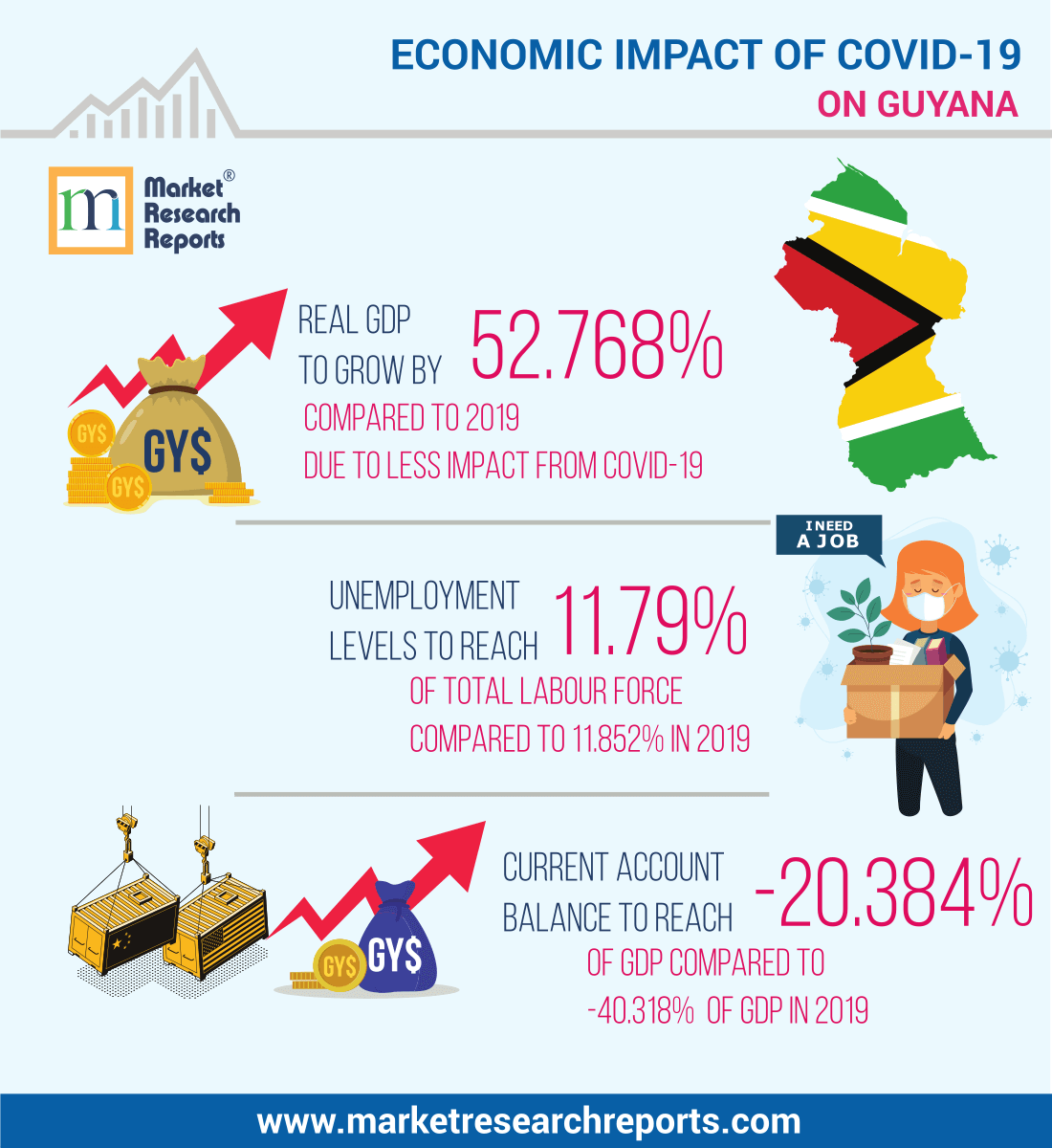
Guyana’s real gross domestic product (GDP) was GYD 443.303 billion in 2019 and it is estimated to increase by 52.77% to be around GYD 677.226 billion in 2020.
Guyana’s unemployment rate was 11.852% of total labor force in 2019. The unemployment levels in Guyana is expected to decrease by 0.53% and reach 11.79% in 2020.
Guyana’s current account balance which has been constantly declining since 2016. It is expected to improve it’s current account balance at -20.384% of GDP in 2020 from -40.318% of GDP in 2019, meaning Guyana will remain net borrower from rest of the world in 2020.
The Guyana government has taken following fiscal and monetary measures to contain coronavirus (COVID-19) pandemic.
2. Coronavirus (COVID-19) Related Fiscal Policy Measures by Guyana
As of 27th April 2020, because of the ongoing pandemic the government of Guyana has approved a number of relief measures. Tax measures include:
- Removal of VAT on Water and Electricity with effect from April 01, 2020 to June 30, 2020
- Removal of VAT on Domestic Air Travel with effect from April 08, 2020 to June 30, 2020
- Waiving of VAT and duties on all medical supplies for the testing, prevention and treatment of COVID- 19 for the period 26th March, 2020 to June 30, 2020.
- The government has also decided to expedite the processing of VAT refunds for businesses and PAYE refunds for employees.
- Tax filing date which was April 30th has been extended to June 30, 2020. However, estimated remaining taxes using “balance of taxes”, for the Year of Income 2019 (Year of Assessment 2020) has to be paid by April 30th, 2020.
- Tax deductions for all donations made by local businesses to staff and health institutions for the treatment of the virus.
- The deferral of the payment of advance corporate and individual advance taxes for the Year of Assessment 2021 (Year of Income 2020) and PAYE for affected businesses until June 30, 2020.
- Affected businesses will pay advance taxes on the current year basis.
- The Guyana Revenue Authority (GRA) has introduced the pre-payment functionality in ASYCUDA World for all Export Declarations.
3. Coronavirus (COVID-19) Related Monetary Policy Measures by Guyana
The Bank of Guyana has implemented the following measures in relation to the financial sector:
- To grant a three-month moratorium to classify affected accounts as non-performing
- To continue with an accommodative monetary stance to promote sustained growth and development of the economy.
The Bank has further encouraged financial institutions to consider the following measures:
- Defer loan payments to assist customers in good standing;
- Defer loan payments by companies to assist with their liquidity requirements;
- Waive or reduce fees/penalties for transactions with ATMs, POS, EFT, debit cards, loan processing, late payments on loans, etc. and;
- Encourage customers to reduce in-person transactions by using e-banking, ATMs, POS, telephone, etc.
Source – With inputs from Organisation for Economic Co-operation and Development (OECD), International Monetary Fund, World Bank, International Labour Organization (ILO) and Government of Guyana