


Economic Impact of COVID-19 on North Macedonia and its Policy Response
After declaring independence from Yugoslavia in 1991, North Macedonia’s economy and GDP have consistently grown till 2019. Per capita GDP has increased, and unemployment levels have come down to historical lows at 17.25% of total labor force in 2019. The economy of North Macedonia is expected to be adversely affected by COVID-19 pandemic in 2020. The real gross domestic product (GDP) of North Macedonia is expected to shrink, unemployment level to increase and current account balance to continue its negative growth due to COVID-19 this year. As of 09th June 2020, North Macedonia had 3152 confirmed COVID-19 cases out of which 1653 people have recovered from the disease while 156 have lost their lives.
In this blog post we will be focusing on economic impact of COVID-19 pandemic on North Macedonia. We will also be taking a look at the containment, fiscal and monetary related policy measures taken by North Macedonia government under following sections –
-
Impact of COVID-19 on North Macedonia Economy in 2020
-
Coronavirus (COVID-19) Containment Measures of North Macedonia
-
Coronavirus (COVID-19) Related Fiscal Policy Measures by North Macedonia
-
Coronavirus (COVID-19) Related Monetary Policy Measures by North Macedonia
We have covered various macroeconomic factors and PESTLE (political, economic, social, technological, legal, and environmental), SWOT (Strengths, Weaknesses, Opportunities and Threats) and risk analysis for North Macedonia in separate market research reports.
1. Impact of COVID-19 on North Macedonia Economy in 2020
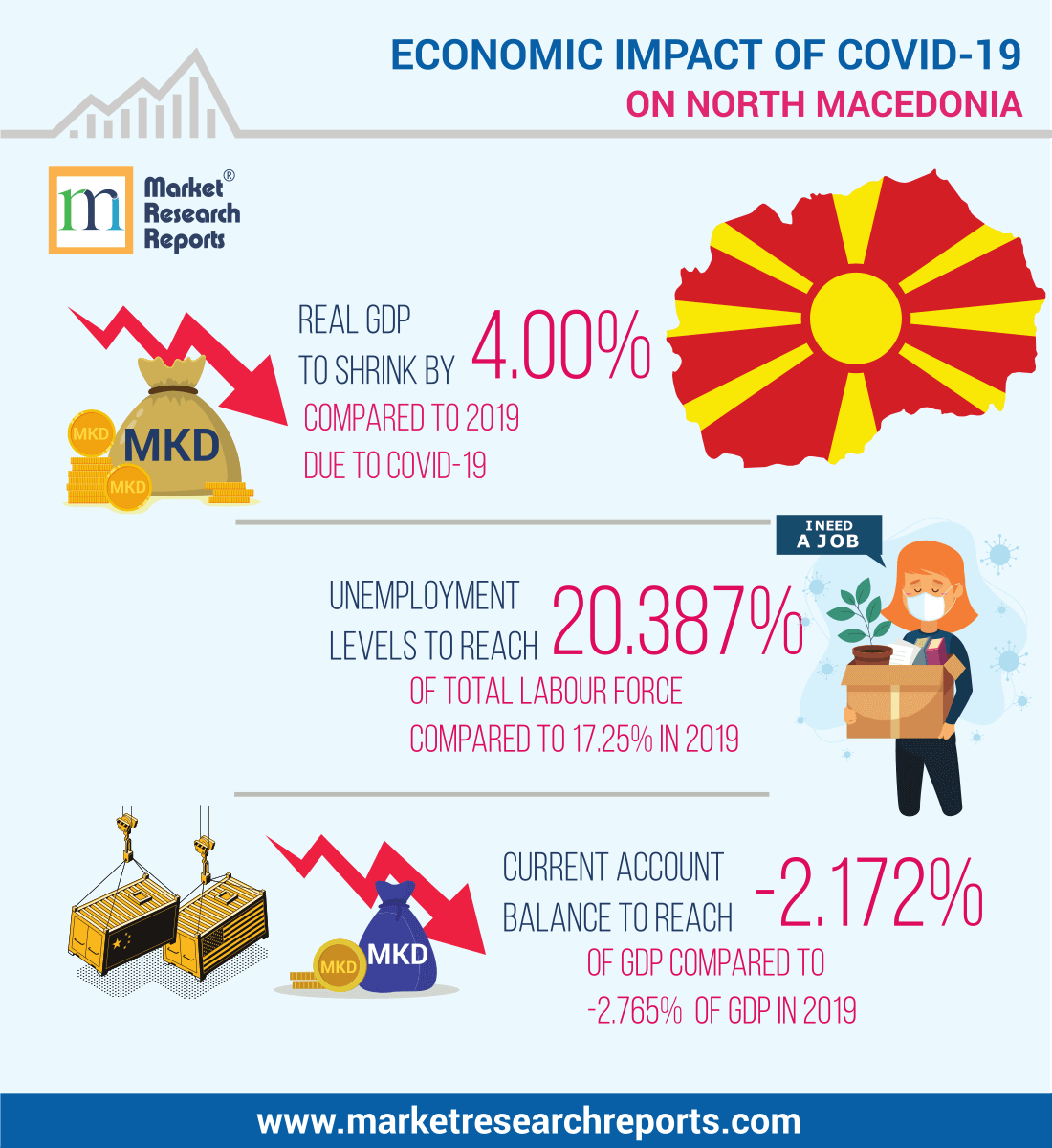
North Macedonia’s real gross domestic product (GDP) was MKD 464.137 billion in 2019 and due to COVID-19 outbreak it is estimated to shrink by 4.00% to be around MKD 445.572 billion in 2020.
North Macedonia’s unemployment rate was 17.25% of total labor force in 2019. Due to slowdown in global economic activity due to COVID-19 pandemic the unemployment is expected to increase by 15.39% and reach 20.387% in 2020.
North Macedonia’s current account balance which has been constantly decreasing since 2017. It is expected to decrease its current account balance at -2.172% of GDP in 2020 from -2.765% of GDP in 2019. This means North Macedonia will remain net borrower from rest of the world in 2020.
As of 20th May 2020, the North Macedonia government has taken following fiscal, employment and social policy measures to contain coronavirus (COVID-19) pandemic.
2. Coronavirus (COVID-19) Containment Measures of North Macedonia
Quarantine/Confinement
- May 20, 2020: A curfew is introduced. It will last from 19h00 to 5h00, starting on Saturday and ending on Tuesday 26 May.
- May 20, 2020: Movements through public transport vehicles is banned ifrom 19h00 until 5h00.
- May 15, 2020: People over 67 or younger than 18 are now allowed to go outside from 5h00 to 19h00 as the others.
- May 15, 2020: The State of emergency has been extended for 14 more days.
- May 8, 2020: Curfew on weekends are relaxed too. Going outside is allowed from 5h00 to 19h00, like in the weekdays. Restrictions for age groups still hold.
- April 22, 2020: Curfew on weekdays are relaxed. Every citizen is required to wear masks or scarfs in public places and gathering places. Going outside is allowed from 5h00 to 19h00. Restrictions for age groups still hold.
- April 16, 2020: A new 30-day "State of emergency" has been announced.
- April 14, 2020: An extended curfew is introduced over the Orthodox Easter holiday and lasts from 16h00 on April 17 through 05h00 on April 21.
- April 13, 2020: the government launches the app "StopKorona!". The app uses short-range Bluetooth communications to establish a voluntary contact-tracing network, and thus keep data on phones that have been in close proximity with each other. Users can, 2020: report to the Ministry of Health if they have been diagnosed with COVID-19; be alerted to whether they were in close contact with an infected person.
- April 3, 2020: the government has launched a new specialised web page (koronavirus.gov.mk), that offers comprehensive guidelines, an overview of the number of infections, and the measures the country is taking to stop the spread of the pandemic.
- March 21, 2020: a curfew was introduced from 21h00 to 6h00, starting on March 22.
- March 18, 2020: A "State of emergency" of 30 days is declared.
- Mid-March, 2020: a curfew is introduced between 16h00 and 05h00 on weekdays; citizens older than 65 may only leave the house between 10h00-12h00 on weekdays; person younger than 18 may only leave the house between 13h00-15h00. Curfew violators could face up to one year in prison.
- March 13, 2020: The municipalities of Debar and Centar Zupa, early hotspots for the pandemic, are under lockdown for 30 days. These restrictions were lifted on April 13.
Travel bans/restrictions
All border crossings in North Macedonia are closed to foreign citizens, with a few exceptions (mainly freight vehicles, diplomatic corps). Skopje International Airport is closed to air traffic (except for state, military, medical and emergency flights), as well as St. Paul the Apostle Airport in Ohrid.
Closure of schools/universities
April 8, 2020: The government in partnership with a local telecom provider, Makedonski Telekom, will donate mobile internet for distance learning purposes to 30 000 primary and secondary school students from families at social risk.
The government has developed an online learning portal where students can access recorded classes, live lessons and play-based learning activities. In partnership with UNICEF, the government has established an online database of free picture books, worksheets and teaching materials in multiple languages available to all parents and teachers. Finally, the government has an online library with materials specifically designed for pre-school and early primary school aged children available in Macedonian, Albanian, Turkish and Bosnian.
Cancellation of public events / Closure of public places
- May 22, 2020: Association in groups of more than five persons in parks and other public places and areas is still banned.
- February 28, 2020: All sports events should take place without any audience until 6 March. This measure was later extended until 13 March.
- February 28, 2020: All mass gatherings are cancelled.
- The General elections planned for April 12, are postponed. No new date has yet been set.
Obligatory shut down of economic activities
- May 13, 2020: the Government decided to allow the opening of closed shopping malls under strict sanitary conditions
- May 8, 2020: some shops were authorized to open business provided they had the infrastructure to maintain sufficient physical distance between customers.
3. Coronavirus (COVID-19) Related Fiscal Policy Measures by North Macedonia
Overall fiscal measures
- May 17, 2020: the government implemented a third package of measures which is based on 3 main pillars: (i) distribution of means of payment to the population in order to encourage the consumption of local goods and services; (ii) a direct support for the economy; (iii) and an aid for the agrarian sector in North Macedonia. The value of the third package is estimated to cost around EUR 355 million and will affect 733.000 users.
- North Macedonia opened a “solid COVID-19 fund” to collect donations from the civil society.
- The government implemented a fiscal package (0.2% of GDP) to help address firms' liquidity problems and protect jobs, targeted to affected sectors such as transport, hotel and restaurants for three months starting in April.
Health system measures
- April 3, 2020: A field hospital is being built by the army adjacent to the Skopje Infectious Diseases Clinic and equipped to receive some 130 patients early next week.
- The government has implemented price controls on medicines, disinfection products, and abolished import duty on medical supplies.
- Ban of export of medical devices and material needed for tackling COVID-19 crisis, unless authorized by Ministry of Health.
- The government has requisitioned all the masks available from private companies to redistribute them to medical personnel.
Income support measures for individuals and households excluding tax and contribution changes
- May 17, 2020: As part of a third package of measures, up to denars 6,000 for tuition fees and a payment card of 3,000 denars and co-financing vouchers up to denar 30,000 for IT and digital skills training will be distributed to North Macedonian students.The measure is estimated to affect 100,000 students and mobilise around EUR 12 million.
- Public officials will receive salaries reduced to the legal minimum of 14 500 denars (EUR 230) for April and May 2020. Presidents and members of the governing and supervisory boards of public institutions will not receive compensation for the duration of the crisis unless it is their only source of revenue.
- Doctors and medical staff of infectious disease clinics and departments, like all members of the emergency medical teams will receive a 20% higher salary for May and June 2020, via a home payment card.
- The payment of rent for social housing and the payment of rent will be postponed for all users.
- April 6, 2020: Unemployed or part of the informal economy will have fast access to the social protection system from April to May, and will receive an average of 7,000 (EUR113) dinars per household (20,000 households are targeted).
- April 6, 2020: Monthly allowance of 50% of the average monthly net salary for the last 24 months distributed to employees who lost their job due to COVID-19.
Public sector subsidies to businesses
- As part of the the third package of measures supporting agriculture in North Macedonia will mobilise up to EUR 76.1 milion.
- May 17, 2020: As part of the third package of measures, the government will indirectly support the domestic tourism sector by distributing vouchers to the local population. Payment cards credited will be distributed with denar 3,000 and denar 6,000 vouchers in order to stimulate domestic tourism by the poorest households.
- The measure will affect about 100,000 citizens from the poorest households, i.e. earning less than denar 15,000 per month (the minimum wage is denar 14,500 per month). The voucher will be used in domestic hotels and other accommodation facilities, while with the payment card will encourage the purchase of domestic tourism products and services.
- North Macedonia government has announced a wage subsidy for the months of April, May and June 2020 for companies in the tourism, transport and hospitality sectors. The subsidy per employee will amount up to 50% of the average salary paid in 2019, provided that, 2020: the company has not reduced the number of employees since February 2020; the company does not pay out dividends during 2020; the company has not paid bonuses to the employees after this measure comes into force. North Macedonia will subsidize salaries for the months of April and May 2020 up to a maximum of 14 500 denars (EUR 235) per month and per employee.
Deferral of taxes and social security contributions and bringing forward expenditures within current fiscal year
- May 14, 2020: North Macedonia Government introduced a tax deferral system for excise duties for selected excise goods (mainly auxiliary medicines and disinfectants).
- April 24, 2020: North Macedonia Government introduced a tax deferral system for VAT returns.
-
The government has announced that companies can be released from the advance payment of corporate income tax for April, May, and June provided that, 2020:
- the company has not reduced the number of employees since February 2020
- the company does not pay out dividends during 2020
- the company has not paid bonuses to the employees after this measure comes into force.
Loan guarantees by the state benefiting private borrowers
- State guarantee for commercial loans dans customs debt for start-ups and small and micro companies: a support for start-ups and small and micro companies through commercial banks with EUR 10 million initial capital for easier access to funds will be granted, mainly by taking part of the credit risk.
Public sector loans or capital injections to businesses
- May 17, 2020: as part of the third package of measures, the Development Bank of Northern Macedonia will deblock interest free loans worth EUR 31 milion. This credit line ill be available to all micro and small companies and it will also offer a 30% grant (non-refundable) for those companies that are run or founded by women or employ young people, are export-oriented or introduce innovation and digitalization in their operations.
- The Development Bank of Northern Macedonia issued a first set of 13.7 million (5.7 million + 8 million) interest-free loans for micro, small and medium enterprises the amount of which depended on the number of employees. The loans were up to 90,000 Euros.
4. Coronavirus (COVID-19) Related Monetary Policy Measures by North Macedonia
Monetary policy
- March 16, 2020: The National Bank Operational Monetary Policy Committee (OMPC) decided to cut the policy rate by 0.25 percentage points to 1.75%.
- March 20, 2020: Additional measures were taken by OMPC, mainly promoting more favorable credit standards for the companies affected of the COVID-19 crisis and easing the standards for household and corporate loans restructuring. Loans are interest-free.
- April 15, 2020: The National Bank reduced by a third the amount of CB bills offered to banks at the auction.
- May 15, 2020: the Government adopted a Decision on new loans from international institutions that will be repaid with a Eurobond sale that will likely take place late in 2020 or early next year.
Prudential regulation
The National Bank has revised its credit risk regulation, to encourage banks to restructure loans temporarily, and has relaxed the loan classification standards for NPLs. It has also reduced the base for the reserve requirement by the amount of new loans to firms in affected sectors and has extended the deadline for banks to submit their first Internal Liquidity Assessment Report in order to allow them to focus on providing credit while maintaining the quality of the loan portfolio.
Source – With inputs from Organisation for Economic Co-operation and Development (OECD), International Monetary Fund, World Bank, International Labour Organization (ILO) and Government of North Macedonia.