


Generative Video AI Market: A 360-Degree Industry Analysis

The Generative AI video market has completed its transition from "tech demo" to genuine commercialization. Market sizing remains fragmented across research houses depending on scope (narrow text-to-video tools vs. the full AI video generation platform category, which includes avatar/enterprise tooling), but the trend line is consistent: an estimate puts the broader AI video generation platform market at roughly $6.2 billion in 2025, growing at a 25%+ CAGR toward the high-$40-billion range by the mid-2030s, while narrower text-to-video-only segments are sized in the low billions. The value-chain squeeze predicted earlier has materialized even faster than expected - and with a twist few anticipated: the original category leader, Sora, has effectively exited the consumer product race.
Pure-play foundation model providers continue to face brutal margin compression from hyper-competition, now a genuinely multipolar field rather than a single "OpenAI effect." Verticalized application-layer players solving enterprise workflows — corporate training, localized advertising, avatar-led communications — have pulled decisively ahead on unit economics and now command billion-dollar-plus valuations with real, audited revenue.
The Sora Story: Cautionary Tale, Not Triumph
OpenAI's original Sora (February 2024) was the inflection point that reset expectations for the category. But the follow-through has been rockier than the original thesis assumed. Sora 2, released September 30, 2025, as a TikTok-style social app with synchronized dialogue and sound effects, achieved the fastest app-store climb in OpenAI's history — the #1 most-downloaded US iOS app within two days, ahead of ChatGPT itself. It expanded to Android, added markets in Japan, Korea, Thailand, Vietnam, and Taiwan, and in December 2025 landed a $1 billion investment and licensing deal with Disney to generate over 200 characters from Marvel, Pixar, and Star Wars.
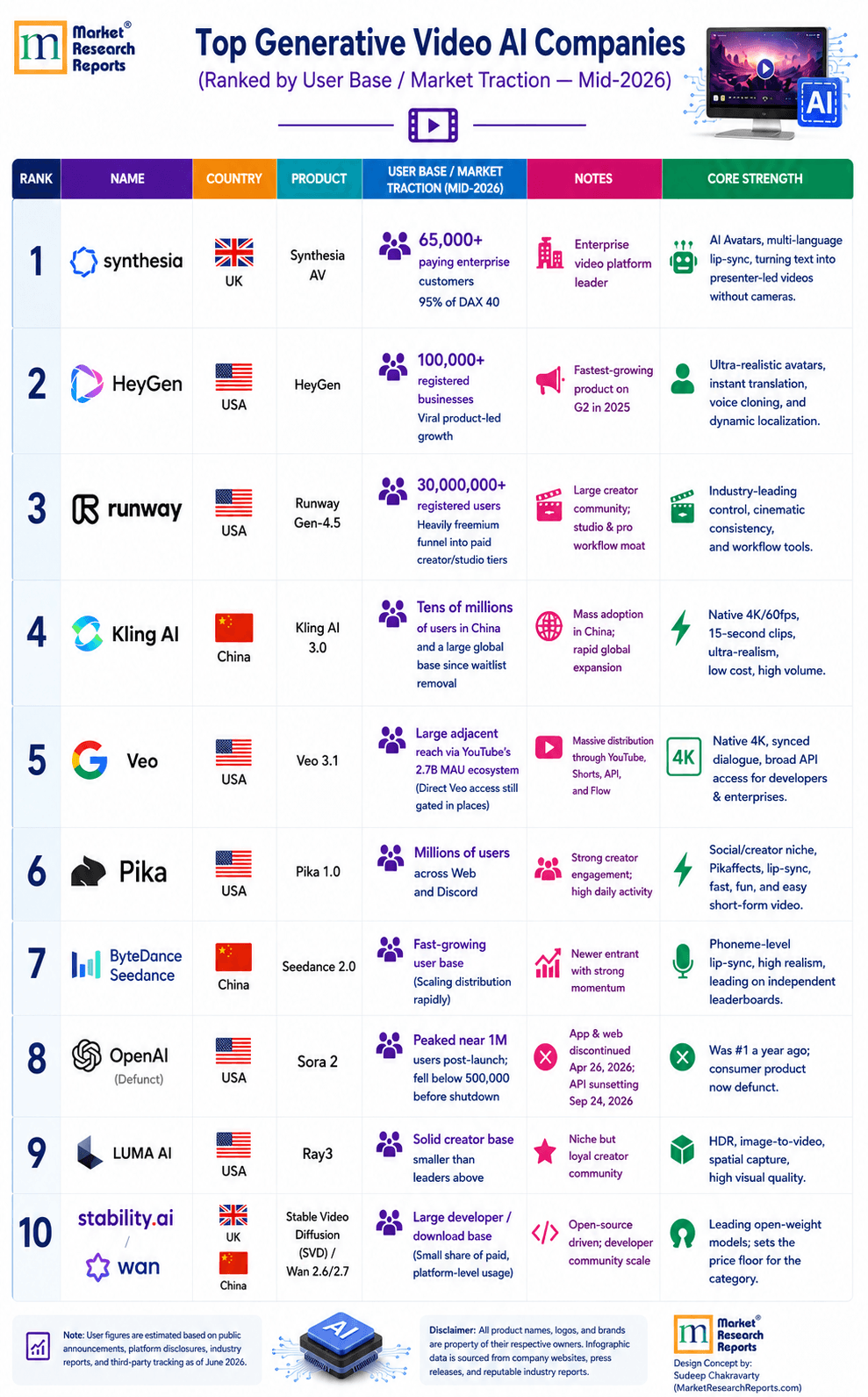
That momentum did not hold. Engagement fell sharply — downloads down 45% month-over-month by January 2026, with daily operating costs estimated near $1 million given the compute intensity of video generation. Free access was cut off in January 2026, requiring a ChatGPT Plus/Pro subscription. On March 24, 2026, OpenAI announced it was discontinuing Sora; the consumer app and web product shut down on April 26, 2026, and the API is scheduled to fully sunset on September 24, 2026. Coverage has framed this as part of a broader OpenAI pattern of killing consumer experiments to refocus compute and capital on core enterprise products amid GPU supply constraints. On independent leaderboards (Artificial Analysis), Sora 2 Pro now ranks below several rivals — Seedance 2.0, Runway 4.5, and Kling 3.0 are all rated higher.
Lesson for the industry players: "video quality" leadership proved even more perishable than projected, and a consumer social-feed wrapper around a foundation model is not, by itself, a durable business — even for the company that defined the category.
The Competitive Landscape, Mid-2026: A Genuinely Multipolar Frontier
The "two trajectories" framework we defined in our earlier market analysis still holds, but Trajectory A (the Cinematic Frontier) is now crowded with credible leaders rather than dominated by one or two names.
Trajectory A: The Cinematic Frontier — now six-way competitive
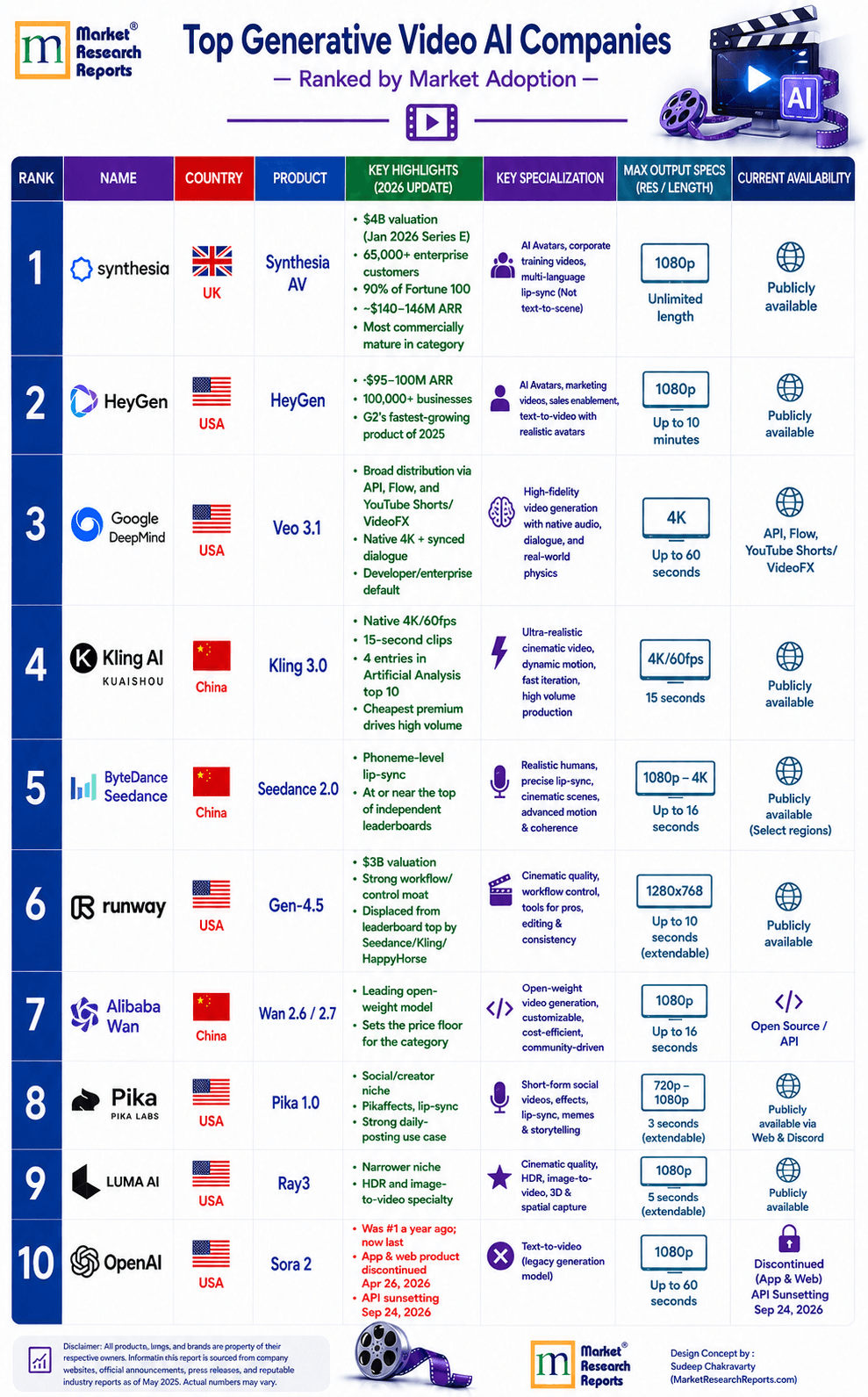
Google (Veo 3.1): The current all-rounder benchmark. Native 48kHz synchronized dialogue (not just sound effects), 4K output in landscape and portrait, strong prompt adherence, and mandatory SynthID watermarking. Pricing is transparent and per-second ($0.15/sec in fast mode, up to ~$0.50/sec), which has made it the developer API favorite. Access has historically been more restricted in some regions, including parts of Europe.
Kuaishou (Kling 3.0, February 2026): Native 4K at 60fps, up to 15-second single-pass clips, multilingual lip-sync, and an "AI Director" multi-shot storyboard mode. Four entries in the Artificial Analysis top 10. The cheapest premium option at roughly $0.10/second, making it the volume-production leader, particularly for SME and social-content use cases.
Runway (Gen-4.5): Briefly the #1 leaderboard model at its late-2025 launch (1,247 Elo) before being displaced by Seedance 2.0 and others by mid-2026. Runway has pivoted to compete on what the original thesis called "workflow lock-in" rather than raw quality: Motion Brush, Act-One performance capture, scene-consistency tooling, and a credit-based subscription model. It also now resells Google's Veo models inside its own platform - an early sign of foundation-model commoditization driving aggregators to multi-source. Runway raised $308 million in April 2025 at a $3 billion valuation (General Atlantic), with total funding exceeding $540 million.
ByteDance (Seedance 2.0, February 2026): A unified audio-video architecture with phoneme-level lip-sync and scene-aware audio (e.g., realistic reverb matched to room size). Currently ranks at or near the top of independent leaderboards.
Alibaba (Wan 2.6/2.7): The leading open-weight option (Apache 2.0 licensing for sub-$10M ARR users), prized for self-hostable, low-cost inference.
OpenAI (Sora 2): Still technically capable - strong on physics simulation and "cinematic feel" — but commercially in wind-down, with the API the only surviving access path through September 2026.
Net effect: The prediction made in our previous research report—that "the visual difference between models will be indistinguishable to 95% of viewers within 12 months"—has essentially come true. Differentiation has shifted almost entirely to audio sync, resolution/length specs, control surfaces, and price — exactly the workflow and unit economics dimensions the original strategic playbook identified as the real moat.
Top Generative Video AI Companies Ranking by Market Adoption
Trajectory B: The Enterprise Utility — now the proven value pool
The avatar/enterprise-communications players are generating real, growing, audited revenue at premium valuations, in sharp contrast to the cinematic-frontier players' continued cash burn and leaderboard churn.
- Synthesia (UK): Scaled from roughly $88 million ARR at the end of 2024 to an estimated $140–146 million ARR by early-to-mid 2026, with a path to $200 million ARR for the full year. In January 2026, Synthesia closed a $200 million Series E led by GV at a $4 billion post-money valuation — nearly double its January 2025 Series D valuation ($2.1 billion). It now serves over 65,000 customers, including 90% of the Fortune 100 and 95% of Germany's DAX 40, derives 70% of revenue from enterprise contracts, and posted net revenue retention above 140%. Adobe reportedly explored a ~$3 billion acquisition of Synthesia in 2025.
- HeyGen (USA): Reached an estimated $95–100 million ARR by late 2025 — up from roughly $1 million in early 2023 — and was recognized as G2's fastest-growing product of 2025. HeyGen pursues a product-led, freemium growth motion (vs. Synthesia's enterprise-sales motion) and has expanded into "Instant Avatar" cloning, real-time interactive avatars, and B-roll generation that embeds Sora, Veo, and Kling directly inside its editor — illustrating how enterprise players are becoming model-agnostic aggregators rather than committing to a single foundation model.
- Tavus and D-ID continue to anchor the "video AI as API/infrastructure" battleground (Tavus near $8M ARR; D-ID with 280,000+ developers), serving the H2 "hyper-personalization at scale" thesis directly.
Avatar/enterprise players are compounding ARR at high margins with sticky, expanding contracts, while cinematic foundation-model leaders are locked in a leaderboard arms race with compressing differentiation and, in Sora's case, an outright product shutdown.
Top Generative Video AI Companies (Ranked by User Base & Market Traction)
Infrastructure and Compute: The Bottleneck Deepened, Not Eased
The CapEx super-cycle is intensified. Hyperscaler AI infrastructure spending has continued to scale well beyond 2024 levels, and OpenAI's compute relationship with Oracle and other partners (including a reported $300+ billion, multi-gigawatt commitment disclosed through 2026) underscores that foundation-model video generation remains one of the most compute-hungry workloads in AI.
Sora's own shutdown was explicitly linked in press coverage to compute costs and a strategic reallocation toward higher-ROI enterprise products — direct evidence that the "barrier to entry is computational, not algorithmic" is reality now, and that even a well-capitalized lab can be forced to retreat from a video product on cost grounds. Pricing per generated second has fallen substantially across the field even as quality has risen — Veo 3.1 fast-mode pricing and Kling's roughly $0.10/second rate show real deflation in unit costs, an 80% cost-per-video decline driving margin pressure on undifferentiated players.
Regulation and IP: From Headwind to Active Constraint
The EU AI Act's transparency and watermarking obligations are now live constraints platforms design around (Veo's mandatory SynthID watermarking is a direct response).
In the US, a federal "Take It Down" law targeting non-consensual synthetic media took effect in 2025, and provenance/watermarking expectations (C2PA-style metadata) are now standard practice across major platforms, including Sora 2, Veo, and others. Sora 2's own launch controversy - an initial opt-out policy for copyrighted characters that drew immediate criticism from the MPA chairman and forced a rapid switch to opt-in - illustrates how quickly copyright missteps can become reputational and regulatory liabilities. OpenAI's subsequent $1 billion Disney licensing deal represents the clearest evidence yet that "commercially safe," rights-cleared content generation (the approach the original report praised in Adobe Firefly) is becoming the enterprise-credible path forward, not an outlier.
Strategic Outlook
The market is currently progressing through a three-horizon framework:
- H1 (Efficiency and Replacement): Now substantially realized through volume production platforms like Synthesia, HeyGen, and Kling-class models.
- H2 (Hyper-Personalization at Scale): Actively underway, driven by Tavus, D-ID, and HeyGen's interactive avatars.
- H3 (Real-Time, Interactive GenAI Video): The current frontier. While generation latencies currently sit at 1–3 minutes, they are expected to fall to 10–30 seconds by late 2026, establishing the essential precondition for live, agentic video interaction.
Strategic imperatives for 2026 and beyond:
- The quality trap has closed. Differentiation by raw visual fidelity is now genuinely commoditized across at least six credible foundation models. Workflow, control surfaces, and audio-native synchronization are the remaining technical moats, and even those are converging fast.
- Become model-agnostic, not model-loyal. The strongest application-layer players (HeyGen, Runway) now embed multiple foundation models inside their own product rather than betting on one — a structural hedge against any single lab's strategic retreat, as Sora's shutdown just demonstrated.
- Enterprise trust and rights-clearance are now monetizable, not just defensive. Disney's $1 billion bet on Sora and Adobe's pursuit of Synthesia both signal that "commercially safe" provenance is worth a premium, not merely a cost of doing business.
- Compute discipline is now a survival question, not a margin question. Sora's shutdown shows that even a top-tier lab will kill a viral, fast-growing consumer product if the unit economics of video inference don't pencil out. Application-layer players with lighter, more efficient inference footprints (avatar generation vs. full scene synthesis) are structurally advantaged here.
- Watch the open-source floor. Apache-licensed models like Wan 2.6/2.7 and HunyuanVideo continue to set a near-zero price floor for base-level generation, reinforcing that horizontal, undifferentiated text-to-video remains a poor place to deploy capital — the original report's central caution, now more true than when it was written.
Conclusion
The market has validated our initial analysis of the central bet faster and more dramatically than expected: application-layer leaders solving real enterprise pain points (Synthesia, HeyGen) have compounded into multi-billion-dollar, high-retention businesses, while the most prominent horizontal foundation-model consumer product — Sora — has been discontinued within eight months of its highest-profile relaunch. For investors and operators, the playbook is sharper than before: deploy capital toward proven application-layer PMF and model-agnostic workflow/control tooling, and treat foundation-model leaderboard position as a fast-depreciating asset rather than a durable moat.
Note: The figures in this analysis are compiled from public disclosures, funding announcements, company statements, and our internal industry research library. Because private companies do not publish real-time dashboards, these metrics should be treated as directionally indicative rather than audited financial data.