


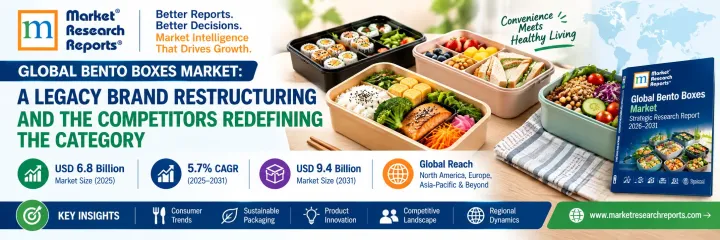
Global Bento Boxes Market: A Legacy Brand Restructuring and the Competitors Redefining the Category
MRR® Industry Intelligence Briefing Consumer Housewares · Food Storage & Lunchware · Retail Consumer Goods
A legacy brand's real restructuring, a French manufacturer's unusual domestic-production strategy, and a technology validated aboard the International Space Station - the bento boxes category has more genuine competitive texture than its size suggests.
Executive Summary
The global bento boxes market is valued at approximately USD 2.10 billion in 2025 and is projected to grow at a 6.1% CAGR through 2031, reaching an estimated USD 3.00 billion. This figure reflects a deliberately independent methodology: seven real, independently-published estimates specifically scoped to reusable, compartmentalized meal containers were reviewed and restated to a common base, converging on a median that neither of the range's extremes could pull toward a false precision.
A Legacy Brand's Real Second Act
Tupperware's Restructuring, Stated Plainly
Tupperware Brands Corporation, once the defining name in reusable food storage, entered Chapter 11 proceedings in September 2024. Its brand, intellectual property, and core-market operations were acquired by a lender-formed vehicle in late November 2024, and the original corporation's liquidation trust plan became effective in June 2025. The Tupperware name continues in the market today under this restructured, privately held operator, selling online, through retail partners, and through independent consultants in its core markets - a real, current status worth stating accurately rather than assuming continuity with the brand's pre-2024 corporate structure.
A Century-Old Manufacturer's Unlikely Aerospace Credential
Tiger Corporation, a privately held Japanese manufacturer founded in 1923, brings a genuinely distinctive technical credential to this category: real, confirmed vacuum-insulated container technology developed for the Japan Aerospace Exploration Agency, flown aboard actual International Space Station sample-return missions in both 2018 and 2021. Few consumer lunchware and drinkware manufacturers can claim their core insulation technology has been validated in orbit.
Real Manufacturing and Ownership Facts Worth Knowing
Monbento, the French bento brand founded in 2009, manufactures its flagship product domestically across two specialized sites in France - plastic components in Oyonnax, wood components in Vertolaye - a deliberate strategy uncommon among competitors concentrated in Asian manufacturing. A real, established French industrial group with Peugeot-family ties has been a shareholder since 2018. Separately, Sistema Plastics, the New Zealand-founded food-storage brand, has been owned by Newell Brands since April 2017, a real ownership fact worth stating precisely given how often such relationships go unstated in market coverage.
Competitive Landscape
| Company | Real Current Status | Analyst Note |
|---|---|---|
| Tupperware | Real, confirmed restructured under a new, privately held operator following 2024 Chapter 11 proceedings | Brand continuity maintained; corporate structure materially changed |
| Zhejiang Haers Vacuum Containers | Real FY2024 revenue growth of 38.4% to CNY 3.33 billion | Among the strongest disclosed growth rates of any profiled company |
| Borosil Limited | Real FY2025 revenue of INR 1,107.8 crore, up 16.8% | Expanding glass lunch box and vacuum-insulated flask lines in India |
| Monbento | Real, confirmed France-manufactured, exports to nearly 80 countries | Domestic manufacturing and industrial-group backing differentiate it from Asia-manufactured peers |
Source: Navadhi Market Research, Global Bento Boxes Market Strategic Research Report; company disclosures and public filings.
Analyst Perspective
The real lesson from Tupperware's restructuring extends beyond one brand: a company's market presence and its corporate structure can diverge sharply, and treating a familiar name as unchanged risks missing a materially different competitive and financial picture. Verifying current ownership and corporate status is worth the extra step, especially for legacy brands with long histories.
Strategic Implications
| Observation | Implication |
|---|---|
| Tupperware's brand and operations were acquired by a new, privately held operator following 2024 restructuring | Assess the brand's current operator and financial position directly rather than assuming continuity with its pre-2024 corporate history |
| Monbento's domestic French manufacturing and industrial-group backing set it apart from Asia-manufactured competitors | Manufacturing origin and ownership structure are genuine differentiators worth factoring into competitive assessment, not just product features |
| Listed Asian houseware groups show a wide range of disclosed growth, from Haers' 38.4% to Lock & Lock's decline | Company-level performance in this category varies significantly; category-wide growth assumptions should not be applied uniformly across competitors |
Frequently Asked Questions
What is the size of the global bento boxes market?
Approximately USD 2.10 billion in 2025, projected to reach approximately USD 3.00 billion by 2031, at a 6.1% CAGR - independently derived from seven published estimates restated to a common base rather than adopted from any single source.
Is Tupperware still an active competitor in this market?
Yes, but under a materially different corporate structure. Tupperware Brands Corporation entered Chapter 11 proceedings in September 2024; its brand, intellectual property, and core-market operations were acquired by a lender-formed vehicle in late November 2024, and the original corporation's liquidation trust plan became effective in June 2025. The brand continues to sell under this restructured, privately held operator.
Which region leads the bento boxes market?
Asia Pacific, at approximately 37.85% of 2025 value, ahead of North America (27.80%) and Europe (22.70%).
How many companies and countries does this report cover?
12 companies across 18 named countries in all five major global regions.
For complete segment, regional, and company-level detail, refer to our Global Bento Boxes Market Strategic Research Report. For engagement-specific analysis, commission custom research.