


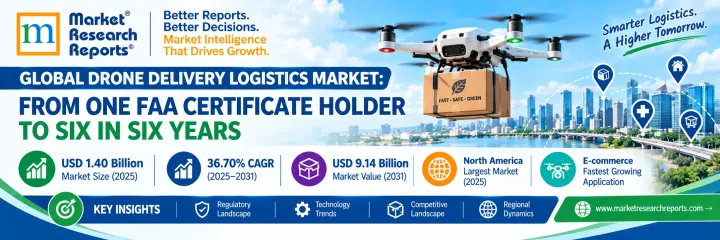
Global Drone Delivery Logistics Market: From One FAA Certificate Holder to Six in Six Years
MRR® Industry Intelligence Briefing Drone Delivery · Unmanned Logistics · Last-Mile & Middle-Mile Cargo
Six companies now hold FAA Part 135 air carrier certificates in the United States, up from a single holder in 2019 - and two of the newest entrants arrived not through drone engineering, but through direct investment by Uber and DoorDash.
Executive Summary
The global drone delivery logistics market is valued at approximately USD 1.40 billion in 2025 and is projected to grow at a 36.7% CAGR through 2031, reaching an estimated USD 9.14 billion. This is a genuinely nascent, high-growth category, and the figure reflects a deliberately independent methodology: nine real, independently-published estimates were reviewed and restated to a common base, converging on a median that avoids anchoring to any single publisher's number in a category where scope definitions still vary widely.
Regulatory Maturation Is Unlocking Commercial Scale
From One Certificate Holder to Six in Six Years
UPS Flight Forward became the first company to receive FAA Part 135 Standard certification to operate a drone airline business in September 2019. As of 2026, six companies hold that certification: Wing, UPS Flight Forward, Amazon Prime Air, Zipline, Causey Aviation Unmanned (which operates Flytrex's aircraft), and DroneUp. Amazon Prime Air received FAA authorization to fly beyond visual line of sight without ground observers in May 2024 and announced plans in August 2026 to expand to nearly 500 US cities and towns by year-end - roughly a sixfold increase from its 11 sites at the time.
Consumer Platforms Are Entering Directly, Not Just Partnering
Uber Technologies made its first investment in drone delivery technology in September 2025, backing Flytrex to support Uber Eats pilot markets. DoorDash, after years of testing third-party drone hardware from partners including Wing and Flytrex, developed its own first-party drone program and earned FAA Part 135 certification in July 2026 - becoming the eighth company to hold that authorization in the US. Both moves suggest established delivery platforms increasingly see drone capability as core infrastructure worth owning, not just testing.
A Correction Worth Making Plainly
DHL, commonly cited among this category's key players, discontinued its own Parcelcopter drone development program in August 2021 after eight years of investment, with a company spokesperson confirming at the time that DHL was "not continuing the Parcelcopter project." DHL has since worked with third-party operators, including Dronamics for middle-mile cargo, as a logistics customer rather than as a drone operator in its own right. Getting this distinction right matters: treating DHL as an active operator would materially misstate the current competitive landscape.
Competitive Landscape
| Company | Real Current Development | Analyst Note |
|---|---|---|
| Zipline International | Real USD 7.6 billion valuation, funding round completed Jan-Mar 2026 | Surpassed 2 million commercial deliveries as of January 2026, operating in seven countries |
| Matternet, Inc. | Real, confirmed went public via reverse merger, May 2026 | Only holder of an FAA Type Certificate for a purpose-built delivery drone |
| Elroy Air, Inc. | Real order book exceeding USD 2 billion | Chaparral cargo aircraft manufactured exclusively by Kratos Defense & Security Solutions |
| DoorDash Air | Real FAA Part 135 certification, July 2026 | First-party drone hardware following years of third-party partnerships |
Source: Navadhi Market Research, Global Drone Delivery Logistics Market Strategic Research Report; company disclosures and regulatory filings.
Analyst Perspective
The real signal in this category isn't any single milestone - it's the pattern across all of them. Regulatory certification is compounding faster than most observers expected, and the entrants arriving now are not drone startups but the consumer platforms that already own the demand. That combination is what turns a nascent category into an investable one.
Strategic Implications
| Observation | Implication |
|---|---|
| Six companies now hold FAA Part 135 certification, up from one in 2019 | Regulatory pathways once seen as the category's main bottleneck are compounding faster than expected |
| Uber and DoorDash have both made direct moves into drone delivery infrastructure | Established consumer platforms increasingly view drone capability as infrastructure worth owning, not a feature to test |
| DHL's real 2021 exit from in-house drone development is often still cited as if current | Verify current operator status directly before treating any company's category involvement as unchanged |
Frequently Asked Questions
What is the size of the global drone delivery logistics market?
Approximately USD 1.40 billion in 2025, projected to reach approximately USD 9.14 billion by 2031, at a 36.7% CAGR - independently derived from nine published estimates restated to a common base rather than adopted from any single source.
Is DHL a current player in drone delivery?
No. DHL discontinued its own Parcelcopter drone development program in August 2021 after eight years of investment and has not operated an in-house drone delivery fleet since. It has continued working with third-party operators, including Dronamics, as a logistics customer rather than as a drone operator itself.
Which region leads the drone delivery logistics market?
North America, at approximately 35.50% of 2025 value, reflecting the concentration of leading operators and the advanced FAA Part 135/BVLOS regulatory framework. Asia Pacific is the fastest-growing region, led by China's low-altitude economy policy push.
How many companies and countries does this report cover?
10 companies across 13 named countries in all five major global regions.
For complete segment, regional, and company-level detail, refer to our Global Drone Delivery Logistics Market Strategic Research Report. For engagement-specific analysis, commission custom research.