


Defense Image Intensifier Tubes: A 208,000-Tube Order Meets a Capacity-Constrained Supply Base
MRR® Industry Intelligence Briefing Image Intensifier Tubes · Night Vision · Defense Electronics · Optoelectronics
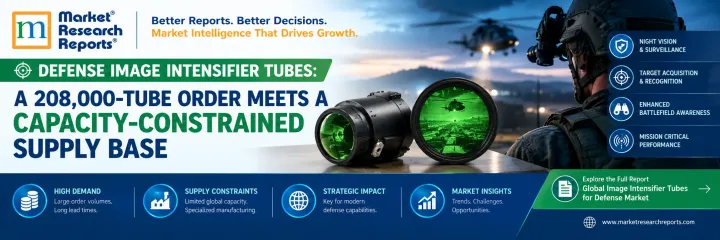
The largest night-vision order reported so far, 200,000 tubes for Germany plus 8,000 for Belgium, is due for delivery from 2027 to 2029 and lands on a supplier base that few firms can serve and that is adding capacity to keep up.
Executive Summary
The global defense image intensifier tubes market is valued at approximately USD 749 million in 2025 and is projected to grow at a 9.0% CAGR through 2031, reaching an estimated USD 1.26 billion. The scope is the tube itself: the photocathode, microchannel plate, phosphor screen and, where sold together, the power supply. Complete night-vision devices, thermal imagers and non-defense intensifiers are excluded. No audited tube-only series exists, so the base year is derived from company disclosures: the largest non-US supplier states that it holds about 42% of the world market and that the United States is about 45% of it. The planning range for 2025 runs from USD 677 million to USD 820 million.
Why the Market Is Moving
Binocular Goggles Roughly Double the Tubes per Unit
The shift from monocular to binocular goggles roughly doubles the tubes needed per device, and NATO members remain below a one-goggle-per-soldier target. The German-led order of December 2025 covers 100,000 binoculars for Germany and 4,000 for Belgium, requiring 200,000 16 mm tubes for Germany plus 8,000, with delivery from 2027 to 2029 at a tube value the supplier states as more than EUR 500 million. In the United States, a USD 74.4 million fourth delivery order for the Marine Corps squad binocular goggle was announced in January 2026 and a USD 212 million Army ENVG-B delivery order in May 2026; both use white-phosphor Gen 3 tubes.
Supply Is the Binding Constraint
Few producers can build military-grade tubes, and output is capacity-constrained rather than demand-constrained. The largest non-US supplier has announced a EUR 37 million plan to add about 40% capacity by 2027, including a first US tube site in Sturbridge, Massachusetts. Gallium-arsenide photocathodes used in Gen 3 tubes add a structural risk: China supplies about 98% of raw gallium and has required export licences since 1 August 2023.
Where the Value Sits: Gen 2 Plus Leads, Gen 3 Is Half the Market
Gen 2 and Gen 2 Plus tubes, which include tubes marketed as 4G and 5G under the US classification convention, are the largest generation at about 44% of 2025 value. Gen 3 tubes together are about 50%, split between filmless (27%) and filmed (23%), with legacy Gen 0 and Gen 1 tubes at 6%. By platform, soldier-worn goggles and binoculars account for about 38% and weapon sights and clip-ons about 28%. The report also sizes green versus white phosphor and four resolution tiers; because no manufacturer or agency publishes those splits, they are analyst estimates, with white phosphor at about 42% of 2025 value and the 64 to 71 lp/mm tier the largest at about 49.5%.
North America holds the largest share of 2025 value at about 48% (USD 359.5 million), followed by Europe at 27%, Asia Pacific at 16%, Middle East & Africa at 7% and Latin America at 2%. Domestic production in China, Russia and India for domestic forces is not published and is not part of the commercially traded market measured here.
Competitive Landscape
| Company | Current Development | Analyst Note |
|---|---|---|
| Exosens SA (Photonis) | FY2025 revenue of EUR 468.2 million, up 22.1%; its Amplification division, which holds the tube business, grew 18.4% to EUR 319.2 million | States a world share of about 42%; launched a next-generation 5G tube in September 2025 with a stated minimum figure of merit of 2,500 |
| L3Harris Technologies, Inc. | Tube maker in Tempe, Arizona; awarded a Gen III tube contract by the US Defense Logistics Agency in June 2022 (USD 11.1 million) | One of two US captive suppliers serving US forces |
| Elbit Systems of America | Tube operations in Roanoke, Virginia; awarded a Gen III tube contract by the same agency in June 2022 (USD 9.7 million) | The second US captive supplier |
| Theon International plc | Largest tube customer of Exosens; supply agreement extended potentially to the end of 2030 for up to more than 400,000 tubes over five years | Acquired 60% of HARDER digital in 2024 for EUR 34 million |
| HARDER digital GmbH | Germany-based tube producer | One of the smaller European producers alongside the two large supply groups |
| BEL Optronic Devices Limited | India-based producer, part of Bharat Electronics | Has supplied over 150,000 tubes; a domestic-supply anchor |
Source: Navadhi Market Research, Global Image Intensifier Tubes for Defense Market Strategic Research Report; company disclosures, press releases and procurement announcements. Tube-only revenue is not published by any profiled company.
Analyst Perspective
This is a capacity story as much as a demand story. Binocular conversion, large multi-year orders and Gen 3 and next-generation Gen 2 Plus upgrades are lifting demand, while a handful of qualified producers decide how fast it can be served. Export-control regimes and the choice between US-made and ITAR-free supply are becoming purchasing criteria, and sovereign supply programs in Europe, India and the Gulf are a response to that concentration. Buyers should compare tubes on tested resolution, signal-to-noise ratio and figure of merit as well as on generation labels, which are contested.
Strategic Implications
| Observation | Implication |
|---|---|
| Large multi-year orders are scheduled for 2027 to 2029 | Tube capacity, not demand, sets the pace; suppliers with committed capacity additions are best placed |
| Gen 3 tubes are about half of value and depend on gallium-arsenide photocathodes | Raw-material and export-licence exposure is concentrated in the highest-value segments |
| Phosphor color and resolution tier are analyst estimates, not published splits | Buyers needing those cuts should validate them with supplier data in a custom engagement |
Frequently Asked Questions
What is the size of the global defense image intensifier tubes market?
Approximately USD 749 million in 2025, projected to reach approximately USD 1.26 billion by 2031, at a 9.0% CAGR.
What does the report count as an image intensifier tube?
The tube itself (photocathode, microchannel plate, phosphor screen and the power supply when sold with it) sold for defense use. Complete night-vision devices, thermal imagers, digital sensors and non-defense intensifiers are excluded.
How is the market segmented?
By tube generation (Gen 2 and Gen 2 Plus, Gen 3 filmed, Gen 3 filmless, legacy), by phosphor type (green P43 and white P45), by performance specification (four limiting-resolution tiers) and by host platform (goggles and binoculars, weapon sights, handheld devices, vehicles, aviation and other).
How are the phosphor and resolution splits derived?
No manufacturer or agency publishes them. They are analyst estimates derived from the largest non-US supplier’s stated 45% US share of the world market and from stated assumptions, shown with a sensitivity range in the report.
How many companies and countries does this report cover?
10 companies and the named countries across five global regions, with value forecasts for every segment, region and country.
For complete segment, regional, and company-level detail, refer to our Global Image Intensifier Tubes for Defense Market Strategic Research Report. For engagement-specific analysis, commission custom research.