


Spinal Endoscopy Systems and Disposables: Why the Tower Is the Entry Ticket and Disposables Are the Business
MRR® Industry Intelligence Briefing Spinal Endoscopy · Minimally Invasive Spine Surgery · Medical Devices · Single-Use Disposables
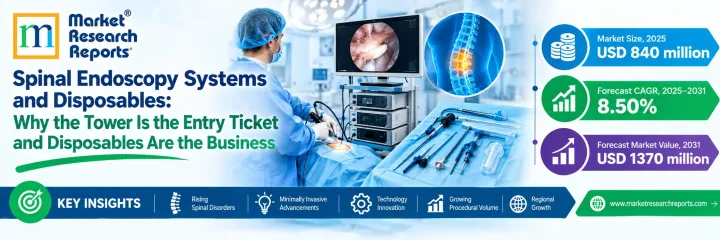
In spinal endoscopy the tower is the entry ticket and the disposables are the business: single-use disposables and procedure packs are already the largest product category at 20% of a USD 840 million market, and recurring-revenue categories are set to gain share through 2031.
Executive Summary
The global spinal endoscopy systems and disposables market is valued at approximately USD 840 million in 2025 and is projected to grow at an 8.5% CAGR through 2031, reaching an estimated USD 1.37 billion. The scope covers the whole procedure ecosystem: rigid and flexible or single-use spinal endoscopes, visualization systems, fluid management pumps, powered and radiofrequency systems, reusable instruments and access kits, and disposables; implants and navigation platforms are excluded to avoid double counting. Published estimates range from roughly USD 72 million, which reflects the endoscope instrument alone, to about USD 770 million or more for full systems, a spread that comes from differing scope rather than disagreement about market health. The base year is therefore the report’s own synthesis, built from the narrow endoscope estimate and layered up category by category.
Why the Market Is Moving
Endoscopy Is Moving from Specialist Niche to Mainstream Option
Endoscopic discectomy, foraminoplasty and decompression are moving from a specialist-led practice toward a mainstream option for lumbar disc herniation and stenosis, and indications now extend to cervical and thoracic pathology. Unilateral biportal endoscopy (UBE) has become an important adoption bridge because it uses familiar arthroscopy-style instruments and has a gentler learning curve than uniportal approaches. South Korea in particular helped establish biportal endoscopy as a mainstream alternative to microscopic and tubular decompression.
Ambulatory Surgery Centers Favor Compact Systems and Procedure Packs
Eligible cases are moving into ambulatory surgery centers, which favors compact, cost-efficient systems and procedure-pack disposables that simplify setup and turnover. Capital cost, a steep surgeon learning curve and variable reimbursement and coding clarity remain the main brakes, particularly in emerging markets and smaller community hospitals.
Where the Value Sits: Disposables Lead, Recurring Revenue Gains Share
No single category exceeds one fifth of value. Single-use disposables and procedure packs lead at 20% (USD 168 million), followed by reusable endoscopic instruments and access kits at 18%, rigid working-channel endoscopes and visualization systems at 17% each, powered and radiofrequency systems at 13%, flexible, steerable and single-use endoscopes at 9% and fluid management at 6%. Capital equipment accounts for about 30% of value and reusable devices about 35%; the recurring-revenue categories, flexible and single-use endoscopes plus disposables, account for about 29%. Between 2025 and 2031 disposables rise from USD 168 million to about USD 289 million, and flexible and single-use endoscopes from USD 76 million to about USD 131 million, the fastest-growing product type.
North America and Asia Pacific each hold about 33% of 2025 value, at roughly USD 277 million apiece, with Europe at 27% (USD 227 million). Asia Pacific is the fastest-growing region, at a 9.5% CAGR to about USD 477 million by 2031, against 7.9% for North America, and is positioned to move ahead of North America during the forecast period. Segment, region and country shares are analyst estimates and are the first items to refine against buyer-supplied procedure data.
Competitive Landscape
| Company | Current Development | Analyst Note |
|---|---|---|
| joimax GmbH | Privately held, headquartered in Karlsruhe, Germany; described as one of the specialist pioneers in full-endoscopic spine surgery | Combines capital placements with recurring disposables and surgeon training; standalone revenue is not published |
| Richard Wolf GmbH | Privately held, headquartered in Knittlingen, Germany; about 1,500 employees as of January 2022 | Engineering-led endoscopy specialist with a strong European footprint and a reputation for optical quality |
| KARL STORZ SE & Co. KG | Family-owned group headquartered in Tuttlingen, Germany; EUR 2.18 billion revenue in 2023 and about 9,800 employees in 2025, per a secondary source | No spine-specific revenue or launch date was located, so none is asserted |
| DePuy Synthes | Orthopaedics franchise of Johnson & Johnson MedTech | Profiled as an adjacent competitor: no full-endoscopic spine system was identified in the sources reviewed |
| Globus Medical, Inc. | Audubon, United States; broadened its footprint through its combination with NuVasive | Relevance is indirect, through access instrumentation, navigation and robotic guidance that endoscopic workflows increasingly depend on |
| Maxer Endoscopy GmbH | Germany-based; acquisition by a German surgical-technology group announced on 6 April 2021 | Specialist European supplier of visualization and working-channel instruments for spine procedures |
Source: Navadhi Market Research, Global Spinal Endoscopy Systems and Disposables Market Strategic Research Report; company websites and disclosures. Most profiled specialists are privately held and standalone revenue is not published.
Analyst Perspective
The commercial logic of this market is a razor-and-blade model: a capital placement establishes an installed base, which then generates reusable instrument replenishment and, increasingly, single-use consumables on every case. Specialists with high utilization of their installed towers secure annuity-like revenue, while vendors reliant on one-time capital sales face more volatile results. The platform groups bundling endoscopy with implants, navigation and robotics compete on breadth; the specialists compete on technique-specific training and a gentler path to adoption.
Strategic Implications
| Observation | Implication |
|---|---|
| Disposables are already the largest category and gain share through 2031 | Utilization of the installed base, not tower placements alone, increasingly determines vendor economics |
| Asia Pacific is level with North America and growing faster | UBE-led adoption and local manufacturing make the region the main source of incremental volume |
| Published estimates range from about USD 72 million to USD 770 million or more | Scope definition matters more than the headline number; compare market sizes only on a like-for-like product scope |
Frequently Asked Questions
What is the size of the global spinal endoscopy systems and disposables market?
Approximately USD 840 million in 2025, projected to reach approximately USD 1.37 billion by 2031, at an 8.5% CAGR.
What does the report include in scope?
Rigid and flexible or single-use spinal endoscopes, visualization and imaging systems, fluid management and irrigation pumps, powered and radiofrequency systems, reusable instruments and access kits, and single-use disposables and procedure packs. Implants and navigation platforms are excluded.
Why do published market sizes differ so widely?
Published figures range from roughly USD 72 million for the endoscope instrument alone to about USD 770 million or more for full systems. The difference is product scope, and the report reconciles its base year to the narrower estimates.
Which region leads and which grows fastest?
North America and Asia Pacific are level at about 33% of 2025 value each. Asia Pacific is the fastest-growing region, at a 9.5% CAGR.
How many companies and countries does this report cover?
12 companies and 22 named countries across five global regions, with value forecasts for every product type, application, region and country.
For complete segment, regional, and company-level detail, refer to our Global Spinal Endoscopy Systems and Disposables Market Strategic Research Report. For engagement-specific analysis, commission custom research.