


The GLP-1 Pill Problem: Why the Real Competitive Race Isn't Lilly vs. Novo Nordisk
MRR® Industry Intelligence Briefing GLP-1 · Pharmaceutical Pipeline · Market Analysis
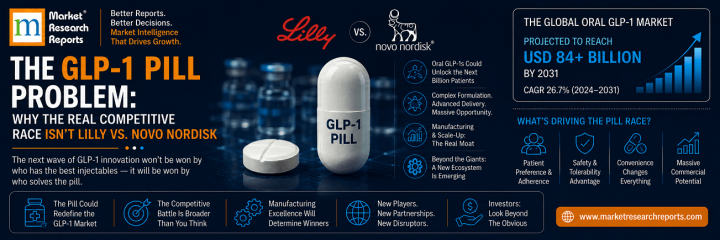
The GLP-1 story most people know is Ozempic versus Mounjaro, Novo Nordisk versus Eli Lilly, injection versus injection. The story that actually determines who wins the next five years is quieter: a pill, not a pen, and a wave of biosimilar and dual-agonist molecules that most patients have never heard of, working their way through Phase II and Phase III trials right now.
Executive Summary
The global GLP-1 drug market is estimated at $70.58 billion in 2025, projected to reach $145.39 billion by 2031 - a 12.8% compound annual growth rate, according to Navadhi Market Research's Global GLP-1 Drug Market Strategic Research Report. That forecast is a deliberate moderation from an earlier 15.9% CAGR assumption, recalibrated against real FY2025 company-reported actuals rather than an earlier draft model. Eight companies are profiled in depth, and the competitive dynamic worth watching isn't the current Lilly/Novo Nordisk duopoly - it's the five-molecule pipeline crowding in behind it, led by an oral reformulation race and a biosimilar wave that could compress category economics faster than either incumbent's own guidance currently assumes.
The Research Problem: Why "Injectable Market Share" Undercounts the Real Competitive Field
Almost every GLP-1 market narrative is built around injectable market share - Ozempic and Wegovy versus Mounjaro and Zepbound - because that's where the disclosed revenue currently sits. But a market sizing exercise anchored purely on today's injectable revenue split systematically undercounts where the category is actually headed, because it treats oral reformulation and biosimilar entry as a future footnote rather than a present, quantifiable segment.
Oral semaglutide, marketed as Rybelsus, is already commercially established - not a hypothetical next-generation product. It represents a structurally different distribution and adherence profile than injectable therapy, with materially lower administration burden for patients who are needle-averse or managing chronic multi-drug regimens. A market model that treats oral GLP-1 as a rounding error inside the broader semaglutide franchise, rather than tracking it as its own segment with its own growth trajectory, will miss the single fastest-forming access expansion in the category.
The second undercounted segment is biosimilar and emerging pipeline entry. Hanmi Pharmaceutical and Biocon Biologics both represent real, disclosed biosimilar and pipeline activity in markets outside the two incumbents' core commercial footprint - activity that matters disproportionately in price-sensitive and emerging markets where reimbursement economics look nothing like the US commercial model driving Lilly and Novo Nordisk's current headline numbers. A report that profiles only the two injectable incumbents in depth, and treats everyone else as a competitive footnote, will misprice the category's medium-term margin trajectory.
Three Forces Behind the Market's 12.8% Growth Rate
Force 1 - Oral Formulation Development Is Structurally Expanding the Addressable Patient Population
Injectable delivery has been a meaningful adoption barrier since the category's earliest commercial years - not for efficacy reasons, but for the simple, persistent reason that a meaningful share of eligible patients are needle-averse or reluctant to commit to lifelong self-injection. Oral GLP-1 formulations remove that barrier directly, and the pipeline behind Rybelsus (a next generation of oral candidates, including oral tirzepatide programmes and additional novel small-molecule GLP-1 receptor agonists) represents the single clearest access-expansion lever available to the category over the forecast period, independent of any pricing or reimbursement change.
Force 2 - Manufacturing Capacity Expansion Is Resolving the Constraint That Defined 2022–2024
A meaningful share of the category's 2022–2024 growth ceiling was set by supply, not demand - a documented, persistent gap between prescription demand and available manufacturing capacity that constrained real patient access for the first several years of commercial launch. That constraint is easing as originator and CDMO capacity investment matures, converting pent-up, previously unfulfillable demand into recognized revenue for the first time - a real driver, not merely faster-than-expected uptake of an already-available product.
Force 3 - Indication Expansion Is Broadening the Category Beyond Weight Management and Diabetes
Cardiovascular risk reduction and chronic kidney disease indications are converting GLP-1 therapy from a diabetes-and-obesity category into a broader cardiometabolic platform, each new approved indication adding a distinct patient population and, in many health systems, a distinct reimbursement pathway. This indication-expansion dynamic compounds with the oral-formulation and manufacturing-capacity forces above rather than operating independently of them - a patient newly eligible under a cardiovascular indication is more likely to be retained on therapy if an oral option removes their administration barrier.
The Competitive Landscape: Incumbents and the Pipeline Crowding In Behind Them
| Company | Position | What to Watch |
|---|---|---|
| Eli Lilly | Incumbent - Tirzepatide (Mounjaro/Zepbound) | Dual GLP-1/GIP mechanism differentiation; oral tirzepatide programme progression |
| Novo Nordisk | Incumbent - Semaglutide (Ozempic/Wegovy/Rybelsus) | Only incumbent with a commercially established oral GLP-1 product today |
| Viking Therapeutics | Late-stage pipeline challenger | Injectable and oral dual-agonist programme progression through registration |
| Zealand Pharma | Pipeline / licensing partner | Amylin-analogue and GLP-1 agonist programmes, including partnered assets |
| Roche / Genentech | Pipeline entrant | Dual-agonist programme with a later projected approval window |
| Hanmi Pharmaceutical | Regional biosimilar / pipeline | Ex-US commercial footprint and biosimilar-adjacent development |
| Biocon Biologics | Biosimilar entrant | Emerging-market biosimilar semaglutide launch activity |
Source: Navadhi Market Research, Global GLP-1 Drug Market Strategic Research Report; company disclosures.
Analyst Insight
The most easily missed dynamic in this market is that the incumbents' own oral-formulation roadmaps are, in effect, competing against their own injectable franchises' current economics. An oral GLP-1 product that removes the adoption barrier for millions of needle-averse eligible patients also, mechanically, cannibalizes some share of the injectable base it's expanding around - the same dynamic that shaped the early years of insulin's oral-versus-injectable history, playing out on a compressed timeline in a much larger addressable market. The companies that manage that cannibalization deliberately, rather than treating oral formulation purely as incremental access expansion, are the ones likely to hold category leadership furthest into the 2031 forecast horizon.
Strategic Lessons for Market Participants
| Observation | Strategic Implication |
|---|---|
| Oral semaglutide is already commercial, not a future catalyst | Access-expansion forecasting should treat oral GLP-1 as a present, trackable segment, not a speculative future scenario |
| 2022–2024 growth was partly capacity-constrained, not demand-constrained | Near-term forecast acceleration reflects genuine pent-up demand conversion, not solely new patient starts |
| Biosimilar and regional pipeline activity concentrates outside the US commercial market | Margin and pricing forecasts built purely on US commercial dynamics will misstate category-wide economics |
| Five distinct companies are advancing dual-agonist or oral pipeline programmes behind the two incumbents | Competitive concentration risk should be evaluated on a 2028–2031 horizon, not solely against today's duopoly |
Frequently Asked Questions
What is the size of the global GLP-1 drug market?
The market is estimated at $70.58 billion in 2025, projected to reach $145.39 billion by 2031, a compound annual growth rate of approximately 12.8%.
Is oral GLP-1 therapy already available, or is it a future development?
Oral semaglutide (Rybelsus) is already commercially established. A next generation of oral candidates, including oral tirzepatide programmes and additional novel small-molecule GLP-1 receptor agonists, is progressing through the pipeline behind it.
Which companies are profiled in this report?
Eight companies: Eli Lilly, Novo Nordisk, Biocon Biologics, Amgen, Viking Therapeutics, Zealand Pharma, Hanmi Pharmaceutical, and Roche/Genentech.
How does this report relate to the companion Manufacturing report?
This report covers GLP-1 drug CONSUMPTION - demand-side, end-market revenue. A separate companion report covers GLP-1 MANUFACTURING - the production and supply-side capacity required to meet that demand.
For full market sizing, segment and regional detail, and all eight company profiles, see our Global GLP-1 Drug Market Strategic Research Report. For the supply-side view of this same market, see our companion Global GLP-1 Drug Manufacturing & Supply Chain Market Strategic Research Report. For bespoke GLP-1 market analysis, commission custom research.