


The Manufacturing Stage Nobody Talks About Is the Biggest One
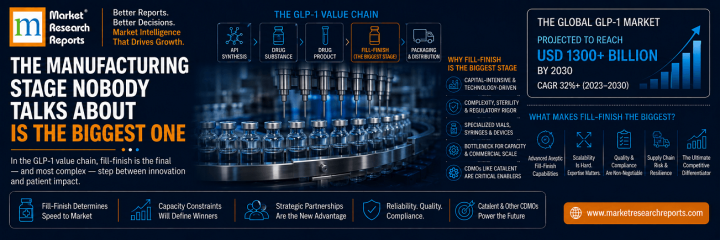
MRR® Industry Intelligence Briefing GLP-1 · Pharmaceutical Manufacturing · Market Analysis
Everyone racing to expand GLP-1 manufacturing capacity talks about the same bottleneck: not enough peptide synthesis, not enough bioreactor time. That's true, but it's not the biggest single line item in the value chain. The single largest stage isn't making the drug substance at all - it's the unglamorous, capital-intensive work of turning bulk peptide into the injector pen sitting in a patient's refrigerator.
Executive Summary
The global GLP-1 drug manufacturing and supply chain market is estimated at $45.0 billion in 2025, projected to reach $180.0 billion by 2031 - a fourfold increase at approximately 26.0% CAGR, according to Navadhi Market Research's Global GLP-1 Drug Manufacturing & Supply Chain Market Strategic Research Report. Seven companies are profiled across the value chain, spanning originator-anchored manufacturing and the CDMO and packaging partners now central to closing the capacity gap. The detail most demand-side coverage misses: Drug Product Formulation and Fill-Finish, not API peptide synthesis, is the single largest stage of that value chain - and it's also the stage where a single acquisition just changed the competitive map for every sponsor that isn't Novo Nordisk.
The Research Problem: Peptide Synthesis Gets the Headlines, Fill-Finish Gets the Dollars
Most manufacturing-capacity coverage of the GLP-1 boom focuses on API peptide synthesis capacity - the bioreactor and synthesis-line investment required to produce the drug substance itself, because that's the stage most directly tied to the "can they make enough of the active ingredient" question that dominates the demand-side narrative. That focus is understandable, but it undercounts where the real capital and competitive dynamics actually concentrate.
Drug Product Formulation and Fill-Finish - the process of converting bulk drug substance into the sterile, prefilled injector pens patients actually use - is a structurally distinct manufacturing step with its own capital intensity, quality-system requirements, and capacity constraints, separate from peptide synthesis capacity entirely. A sponsor can have abundant API supply and still face a bottleneck getting finished product to market if fill-finish capacity isn't secured in parallel. Treating the two stages as a single undifferentiated "manufacturing capacity" line item, rather than tracking them as the genuinely distinct segments they are, produces a materially incomplete picture of where the real supply constraint sits at any given point in the buildout.
This is precisely the stage where Novo Holdings' acquisition of Catalent becomes strategically significant beyond its headline price tag. Catalent provides dedicated GLP-1 fill-finish and drug-device combination manufacturing capacity - the exact bottleneck stage described above - now under the same corporate umbrella as Novo Nordisk's own commercial programme. That's a vertically integrating move with direct capacity-allocation implications for every other sponsor, including Eli Lilly, that relies on third-party fill-finish capacity to bring product to market.
Three Forces Behind the Market's 26.0% Growth Rate
Force 1 - Fill-Finish and Delivery Device Manufacturing Are the True Capacity Chokepoints
Across the six-stage value chain this report tracks, Drug Product Formulation and Fill-Finish and Delivery Device Manufacturing together represent the largest combined share of 2025 market value - ahead of API peptide synthesis itself. Capacity investment in these two stages specifically, not peptide synthesis alone, is what ultimately determines how quickly finished product reaches pharmacy shelves.
Force 2 - CDMO Capacity Investment Is Structurally Under-Modeled by Sponsor-Only Analysis
A manufacturing forecast built only from disclosed originator capex commitments will understate real capacity growth, because a substantial and growing share of GLP-1 manufacturing capacity is being built by specialized CDMO and packaging partners rather than the branded pharmaceutical companies themselves. Capturing CDMO-side capacity investment as its own tracked category, not a footnote to originator disclosures, is necessary to size the buildout accurately.
Force 3 - Vertical Integration Is Reshaping Capacity Access, Not Just Capacity Volume
Novo Holdings' acquisition of Catalent doesn't just add manufacturing capacity to the market - it changes who has preferential access to a specific, bottlenecked stage of the value chain. That's a structurally different dynamic than pure capacity expansion, with direct implications for competing sponsors' own fill-finish sourcing strategy over the forecast period.
The Manufacturing Landscape: Six Stages, Seven Companies
| Company | Value-Chain Role | What to Watch |
|---|---|---|
| Eli Lilly | Integrated originator | Disclosed multi-billion-dollar capex programme across API and fill-finish |
| Novo Nordisk | Integrated originator | Now vertically integrated into fill-finish via Novo Holdings/Catalent |
| Novo Holdings (via Catalent) | Fill-finish / drug-device combination CDMO | Strategic-alignment question for sponsors competing with Novo Nordisk |
| Samsung Biologics | Biologics CDMO | Large-scale biologics manufacturing capacity additions |
| Lonza | CDMO | Biosimilar-scale bioreactor capacity booked years in advance |
| WuXi Biologics | CDMO | Geopolitical/export-control exposure affecting sponsor sourcing decisions |
| Biocon Biologics | Biosimilar manufacturer | Emerging-market biosimilar semaglutide manufacturing capacity |
Source: Navadhi Market Research, Global GLP-1 Drug Manufacturing & Supply Chain Market Strategic Research Report; company disclosures.
Analyst Insight
The Catalent acquisition is worth reading as a preview of where the rest of the value chain is likely headed, not an isolated transaction. Once one originator demonstrates that owning a bottlenecked manufacturing stage outright is more strategically valuable than contracting for it, competing sponsors face real pressure to evaluate the same move - either through acquisition, long-term capacity reservation, or deeper strategic partnership with a CDMO that could otherwise be acquired by a competitor. The stages most exposed to this dynamic going forward are the ones with the least spare capacity relative to demand: fill-finish and delivery device manufacturing specifically, not API synthesis, where the six-stage segmentation in this report shows more distributed capacity across a larger number of qualified suppliers.
Strategic Lessons for Market Participants
| Observation | Strategic Implication |
|---|---|
| Fill-finish, not API synthesis, is the single largest value-chain stage | Capacity risk assessment should weight fill-finish and delivery-device bottlenecks at least as heavily as peptide synthesis capacity |
| Novo Holdings' Catalent acquisition vertically integrates a previously third-party bottleneck stage | Competing sponsors should evaluate their own fill-finish sourcing concentration risk, not treat CDMO capacity as interchangeable |
| CDMO-side capacity investment is a distinct, growing category alongside originator capex | Manufacturing forecasts built solely on disclosed originator capex will understate real market-wide capacity growth |
| Seven companies span both integrated originators and specialized CDMOs | Competitive and capacity analysis should track both cohorts explicitly, not treat CDMOs as undifferentiated suppliers |
Frequently Asked Questions
What is the size of the global GLP-1 drug manufacturing market?
The market is estimated at $45.0 billion in 2025, projected to reach $180.0 billion by 2031, a compound annual growth rate of approximately 26.0%.
Which manufacturing stage represents the largest share of the market?
Drug Product Formulation and Fill-Finish is the single largest stage of the six-stage value chain this report tracks, ahead of API peptide synthesis.
Why does Novo Holdings' ownership of Catalent matter to competing sponsors?
Catalent provides dedicated GLP-1 fill-finish and drug-device combination manufacturing capacity - a bottlenecked stage of the value chain now under the same corporate umbrella as Novo Nordisk's commercial programme, with direct capacity-allocation implications for sponsors like Eli Lilly that rely on third-party fill-finish capacity.
Which companies are profiled in this report?
Seven companies: Eli Lilly, Novo Nordisk, Novo Holdings (via Catalent), Samsung Biologics, Lonza, WuXi Biologics, and Biocon Biologics.
How does this report relate to the companion Drug Market report?
This report covers GLP-1 MANUFACTURING - production and supply-side capacity. A separate companion report covers GLP-1 drug CONSUMPTION - demand-side, end-market revenue, including the demand this manufacturing buildout is racing to keep pace with.
For full value-chain segmentation, country-level manufacturing capacity detail, and all seven company profiles, see our Global GLP-1 Drug Manufacturing & Supply Chain Market Strategic Research Report. For the demand-side view of this same market, see our companion Global GLP-1 Drug Market Strategic Research Report. For bespoke GLP-1 manufacturing and supply chain analysis, commission custom research.